 Beyond Nuclear International
Politicians and executives snared for their roles in bribery and racketeering schemes
By Linda Pentz Gunter
Breaking: On June 29, former Ohio Speaker of the House, Republican, Larry Householder, was handed down the maximum sentence of 20 years in prison for his role in the high crimes described below. His co-conspirator, Matt Borges, the former Ohio GOP Chairman, was sentenced on June 30 to five years in federal prison.
This is part one of a two-part story on bribery and corruption in the nuclear power realm and the questionable ethics of legal lobbying. The original article was published in its entirety in Capitol Hill Citizen, a print-only newspaper published by Ralph Nader. These articles are reproduced with kind permission of the editor. Part two will be published in the next few weeks. Capitol Hill Citizen comes out in print only. To subscribe or purchase single copies, click here.
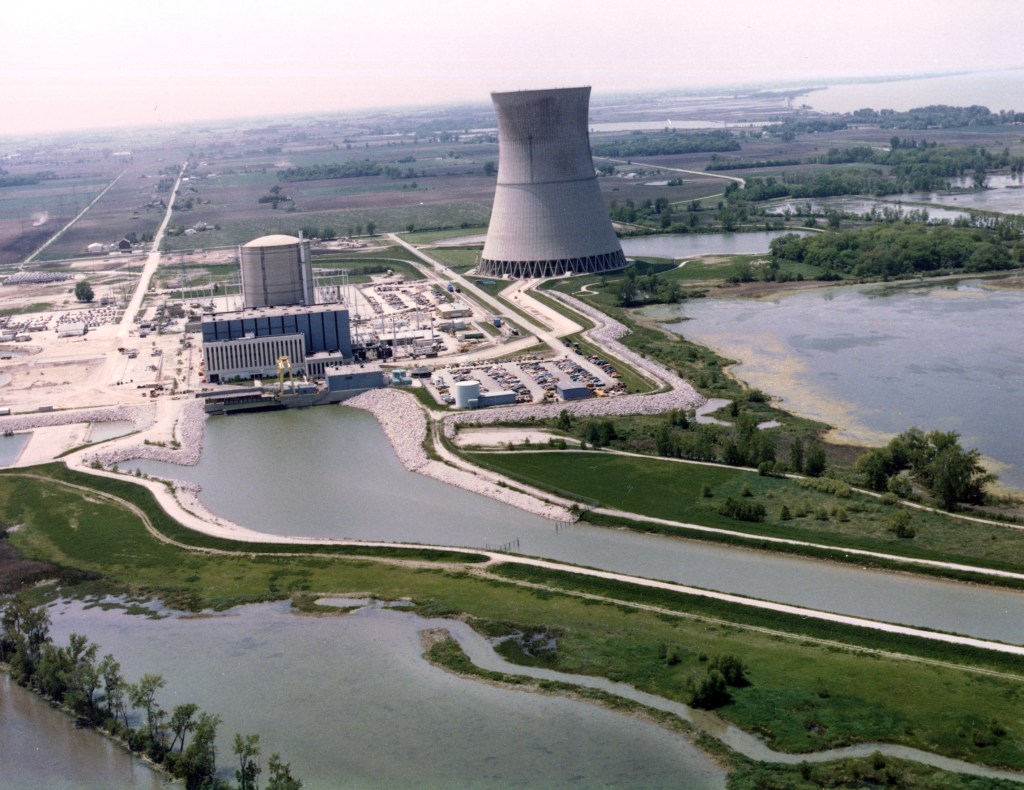
It all began when Ohio nuclear power plant owner, FirstEnergy, began “bleeding cash” in a desperate effort to keep its aging and uneconomical Davis-Besse and Perry nuclear power plants solvent.
The effort bankrupted FirstEnergy subsidiary, FirstEnergy Solutions, then owner of the two nuclear plants. The shareholders wanted out. FirstEnergy threatened to close the plants. But Ohio House Republican, Larry Householder, had other plans.
Householder concocted a nefarious scheme to extract $61 million from the failing company to ensure his re-election and that of enough political allies to guarantee his return to the House Speakership.
This, in turn, would secure enough votes to ensure passage of a $1.3 billion bailout bill, known as HB6, that would rescue the two nuclear plants along with struggling coal plants.
And it worked. For a while.
Householder, who had previously held the Ohio House Speakership from 2001-2004, was duly re-elected to that position in January 2019. Millions of dollars also poured into the campaign war chests of 21 political candidates in order to stack the House with votes in favor of the bailout bill. It duly passed the House on May 29, 2019 and the Senate on July 17, 2019. But the July 23, 2019 Ohio House concurrence vote passed the bill by only one vote. And then it all unraveled.
On July 21, 2020, Householder and four others were arrested for what investigating US Attorney for the Southern District of Ohio, David DeVillers, described as “the biggest criminal racketeering conspiracy in Ohio history.”
Householder, who was re-elected to the Ohio House shortly afterwards and refused to resign, was unanimously voted out as Speaker on July 30, 2020. Eleven months later the House voted 75-21 to expel Householder.
After a seven week trial, Householder and fellow conspirator, former GOP Chairman Matt Borges, were found guilty of racketeering conspiracy on March 9, 2023. The jury took just nine hours to reach their verdict. Householder was sentenced on June 29 to 20 years in prison — the maximum penalty. Borges was sentenced on June 30 to five years in federal prison. Both men said they would appeal.
The U.S. District judge in the case, Timothy Black, scolded Householder at sentencing, saying: “Beyond financial greed, I think you just liked power. You weren’t serving the people. You were serving yourself.”
Assistant U.S. Attorney Emily Glatfelter described Householder as “the quintessential mob boss, directing the criminal enterprise from the shadows and using his casket carriers to execute the scheme”, in a sentencing memorandum to the judge.
FirstEnergy Corp. was also charged with conspiring to commit honest services wire fraud, but the company signed a deferred prosecution agreement that could see the charges dismissed. FirstEnergy also agreed to pay a $230 million monetary penalty.
But an ongoing civil lawsuit against FirstEnergy alleging insider trading and other offenses has brought documents to light released by Ohio Consumers’ Council that reveal the true depth and scope of involvement of its executives in the scheme to ensure passage of HB6.
Householder defense attorney, Steve Bradley, argued during the trial that Householder was just “being a good politician” and is simply “good at fundraising”
Nevertheless, Householder defense attorney, Steve Bradley, argued during the trial that Householder was just “being a good politician” and is simply “good at fundraising”. Never mind that Householder hid the source of the $61 million by funneling it through a murky 501(c)(4) called Generation Now, then redirected around $500,000 of it to pay off his personal credit card debt, settle a lawsuit, and repair a Florida home.
The flow of dark money to Generation Now, which FirstEnergy has now admitted supplying, also paid for a disinformation campaign to suppress a public petition drive to repeal HB6, launched by a coalition called Ohioans Against Corporate Bailouts.
Through ad buys with another Republican-controlled entity, Strategic Media Placement, Generation Now alleged that petitioners were in the payroll of Chinese government operatives who were “quietly invading our electric grid”.
The HB6 opponents ultimately ran out of time and were forced to withdraw their petition in October 2019, when HB6 effectively became law. (The Ohio legislature has since repealed parts of HB6 including the more than $1 billion nuclear subsidy for FirstEnergy, but fossil fuel subsidies for two other utilities remain.)
Generation Now has also since pled guilty to federal racketeering.
Although a year-long investigation and an 81-page indictment may have undone Householder and his co-conspirators, it is a warning for just how easily the political system can be corrupted and manipulated by the combination of a financially desperate corporation and greed-driven politicians. And Ohio was not the only state where a failing energy corporation and its pocketed politicians drifted into criminal activity.
In South Carolina, two new Westinghouse AP1000 reactors under construction at the V.C. Summer site were scheduled to be brought online in 2016 and 2019, but were falling behind schedule as costs soared. Executives of then plant owner, SCANA, lied to shareholders about the delays and financial losses, claiming the two reactors would be finished on time, which would allow the company to qualify for $1.4 billion in future federal tax credits.
These deceits effectively defrauded the South Carolina Public Service Commission and its customers of at least $2 billion, a conspiracy that FBI Special Agent in Charge, Jody Norris, described as “breathtaking in scope and audacity”.
The debacle ended in the July 2017 abandonment of the project before completion and bankrupted SCANA, which was taken over by Dominion Energy.
SCANA CEO, Kevin Marsh, pled guilty to conspiracy to commit mail and wire fraud and is due to complete his two-year prison sentence in August this year. SCANA COO, Stephen Byrne, also pled guilty but received a slightly more lenient 15-month sentence on March 8, 2023, after cooperating with investigators. He was also ordered to pay back the $1 million he accrued in lucrative personal bonuses while defrauding South Carolina electricity customers.

Two Westinghouse executives were also charged. Senior Vice President, Jeffrey A. Benjamin, faces 16 felony counts including conspiracy, wire fraud, securities fraud, and causing a publicly-traded company to keep a false record. Carl Churchman, the Westinghouse project’s director, has pled guilty to lying to federal authorities.
Meanwhile, in March 2022, a federal grand jury in Chicago, Illinois indicted Democratic leader and former Illinois House Speaker, Mike Madigan and his long-time ally, former legislator and lobbyist, Michael McClain, on 22 counts in an alleged $3 million criminal enterprise that included racketeering conspiracy, attempted extortion, bribery and other charges.
Madigan is accused of leading efforts to persuade utility Commonwealth Edison, a subsidiary of the country’s biggest nuclear power plant owner, Exelon, to provide hundreds of thousands of dollars to himself and associates, as well as jobs to Madigan allies for work that was often never performed. In return, ComEd was assured of favorable legislation. Madigan faces trial on April 1, 2024.
McClain was tried separately along with three other alleged co-conspirators — former ComEd CEO Anne Pramaggiore, former ComEd lobbyist, John Hooker, and former head of the City Club of Chicago, Jay Doherty. On May 2, all four were found guilty on nine different counts of conspiracy, bribery and falsification of records in May.
In what could be read as an admission of wrongdoing, ComEd had in July 2020 cooperated with authorities and paid a $200 million fine, in a deferred prosecution deal.
It remains to be seen whether the fate of those politicians and corporate executives who fell prey to greed and deception and to whom punishment will now be meted out, will serve as an adequate deterrent against further such conduct.
Linda Pentz Gunter is the international specialist at Beyond Nuclear and writes for and curates Beyond Nuclear International.
Headline photo by Alan Cleaver/Creative Commons.
 Beyond Nuclear International
Pingback: Zelensky – Embroiled in war and embattled at home « nuclear-news
Pingback: Embroiled in war and embattled at home | Beyond Nuclear International
Pingback: Nuclear “lobbying” blurs into bribery « Antinuclear
Pingback: Nuclear “lobbying” blurs into bribery « nuclear-news
Pingback: Undue influence | Beyond Nuclear International
Pingback: A watershed week in nuclear news « nuclear-news
Pingback: A watershed week in nuclear news « Antinuclear
Pingback: High nuclear crimes don’t pay « nuclear-news