 Beyond Nuclear International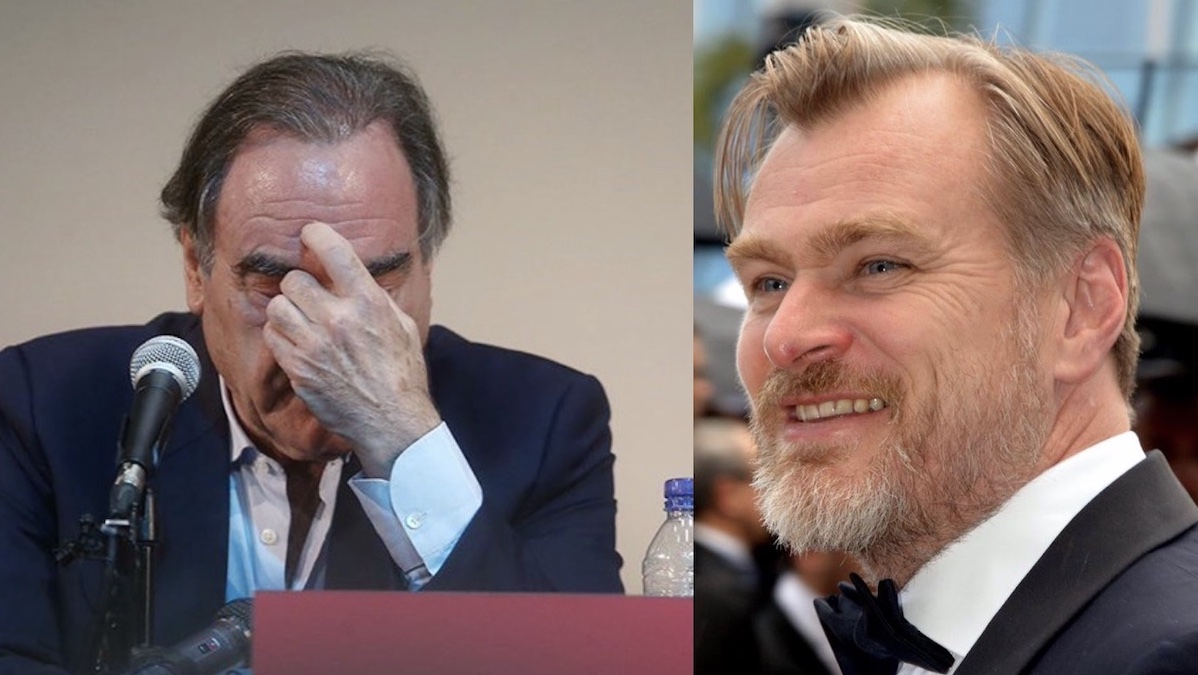
Nolan’s film soars but Stone’s is for the chop
By Linda Pentz Gunter
It’s A Tale of Two Directors. For one, it is certainly the best of times, for the other, probably the worst.
Each took a single book as their inspiration and adapted it into a film.
One film is about the bomb. The other is a bomb.
The first is a blockbuster drama that garnered unprecedented advance hype thanks to a weeks-long saturation publicity campaign. Now packing cinemas everywhere, it grossed $80.5 million in the US and Canada alone during its first weekend.
The other made a documentary that grossed, well, $9,814 in the US and Canada over its first weekend. The average audience size for that film is apparently between 6 to 8 people.
Both directors have bodies of work behind them that put them in the panoply of the greats. And both chose nuclear as their subject matter.
Unless you are living in a remote cave somewhere, you know by now that the first film is Oppenheimer, directed by Christopher Nolan. It’s essentially a dramatization of the life and career of J. Robert Oppenheimer, often referred to as the father of the atomic bomb.
Nolan’s film is based on the book American Prometheus: The Triumph and Tragedy of J. Robert Oppenheimer, a 2005 biography by Kai Bird and the late Martin J. Sherwin.
If you haven’t heard of the other film, you can be forgiven, as it’s clearly dying quietly in a corner. It’s a documentary called Nuclear Now, directed by Oliver Stone, and based on the book A Bright Future; How Some Countries Have Solved Climate Change and the Rest Can Follow, by Joshua S. Goldstein. (The fact that Goldstein suggests any country has “solved” climate change is your first clue as to its veracity.)
While the former film is a triumph of cinematic story telling and fine performances, the latter is by all accounts a dreary trudge along a well worn and totally discredited pro-nuclear power propaganda path.
I say “by all accounts” because I haven’t seen it yet. I decided not to hand over my hard-earned dollars to Stone and will wait for him to hand his film to me on streaming.
But many of my colleagues have seen it in cinemas. So ironically, it’s likely that about half of those 6-8 people per showing are probably anti-nuclear activists curious to see just how turgid and off base Stone’s film actually is.
For fans of Stone, it was sad to see the old lion stumble so badly. Worse, that he’s making the talk show rounds as a self-appointed nuclear power expert, spouting all manner of patently absurd and just plain wrong drivel.
But in a way, he handed us an opportunity. If Nuclear Now is the pinnacle of the pro-nuclear lobby’s achievement, they gave us an easy target full of holes to knock off the pedestal, allowing us to further educate people about the true detriments of nuclear power.
Nolan’s though, is the greater gift, given the audiences who are seeing it. Yes, Oppenheimer doesn’t tell the whole story from every perspective, especially the millions of victims of Oppenheimer’s invention, whether Indigenous peoples mining uranium, those in the path of the 2,000 or so atomic tests and especially those beneath the bombs dropped on Hiroshima and Nagasaki.
But that’s not Nolan’s job. It’s ours.
Millions of people are now thinking about something they had chosen to ignore, or forget: nuclear weapons. They will be asking themselves why we still have them, let alone invented them, and how we can get rid of them.
Nolan has planted the horrors of nuclear weapons in the public conscience in a way that no amount of advocacy by the anti-nuclear movement ever could.
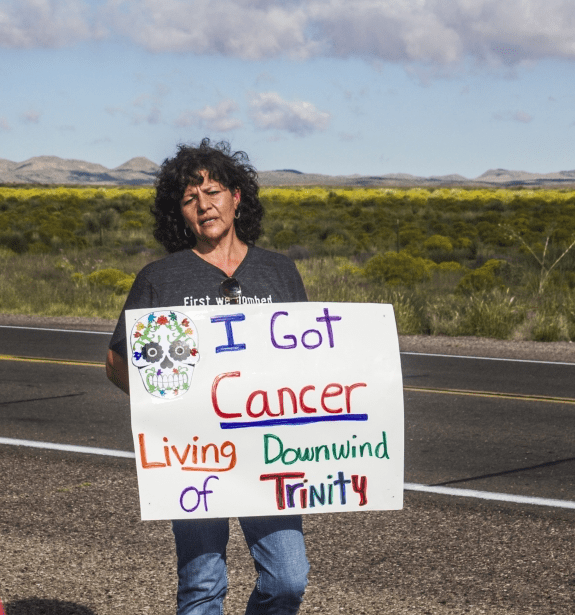
He has given new life to the importance of the UN Treaty on the Prohibition of Nuclear Weapons. And he has opened the way for us to tell all those other stories — as Trinity downwinder, Tina Cordova, Hibakusha, Setsuko Thurlow and physicist, Zia Mian just did on National Public Radio’s Science Friday.
So thank you Christopher Nolan. And thank you Oliver Stone as well. Opportunity has knocked. Now it’s our responsibility to continue using it.
Linda Pentz Gunter is the international specialist at Beyond Nuclear and writes for and curates Beyond Nuclear International.
Headline photos: Oliver Stone (left) by Foad Ashtari/Wikimedia Commons and Christopher Nolan (right) by Georges Biard/Wikimedia Commons.
 Beyond Nuclear International