 Beyond Nuclear International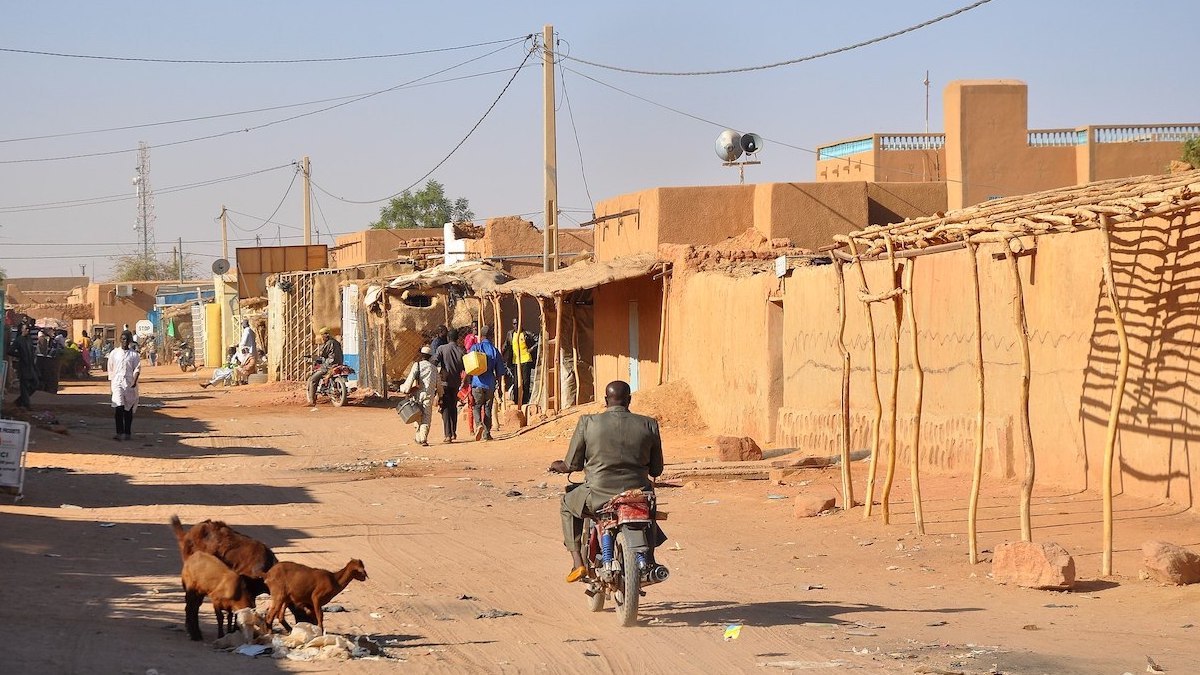
Uranium tailings in Niger are blowing in the wind and poisoning the water
By Linda Pentz Gunter
Note: In late July, a military coup ousted Niger’s president, Mohamed Bazoum. Since then, those who have declared themselves in charge have announced a halt to uranium exports to France. France relies on Niger for around 17% of the uranium that fuels its troubled commercial reactor fleet (with Kazakhstan and Uzbekistan the main suppliers). Since Russia’s invasion of Ukraine, European countries have been wrestling with their uncomfortable dependence on Russian-sourced uranium supplies. The Russian mercenary group, Wagner, already has a strong presence in Africa, and one that is now growing.
The grey mountain looms, mirage-like, on the horizon of the uranium mining town of Arlit in Niger.
Except, this is the Sahel, and it’s not a real mountain. It’s a pile of radioactive uranium mine tailings, blowing around in the desert winds and dispersing into the air, soil, waterways and people’s bodies.
The “mountain” is part of a legacy of an estimated 20 million tonnes of radioactive waste left behind by the French mine owner, Areva, now known as Orano, which closed its Arlit uranium mines in March 2021.
A report on Radio France International described the situation this way: “Niger’s northern town of Arlit has been left wallowing in 20 million tonnes of radioactive waste after a uranium mine run by French company Orano (formerly Areva) closed down. People living in the area are exposed to levels of radiation above the limits recommended by health experts.”
This lethal legacy has been confirmed by the independent French radiological research laboratory — Commission de Recherche et d’Information Indépendantes sur la Radioactivité — known in international circles simply as CRIIRAD. The lab, and its director, Bruno Chareyron, have been studying the situation around uranium mines in Niger for years. In 2009 his lab measured the radioactive levels of the wastes at 450,000 Becquerels per kilogram.
In a recent video, CRIIRAD describes the waste pile— mostly radioactive sludges — as “a sword of Damocles hanging over the drinking water supply for more than 100,000 people.” (You can watch the video below, in French with English subtitles. If you understand French, you can also listen to the CRIIRAD podcast episodes on this topic on Spotify.)
Under its subsidiary, Cominak, Orano exploited mines near Arlit for 40 years. Much of the uranium extracted was used as fuel for reactors in France and other countries in the European Union.
As part of the extraction process, radon gas was released into the air along with fine radioactive dusts, inhaled by the uranium mine workers and local residents. Radioactively contaminated materials ended up in workers’ homes, used to fashion furniture and utensils and even as construction materials for the homes themselves. And yet, no effort was made by Orano to contain this waste. Instead, as the Radio France International report says, “it was simply dumped on the ground.”
Some workers who were treated in the local Areva-run hospital were told their illnesses had nothing whatever to do with the uranium mines.
Diners along the Seine, sitting under their Parisian fairy lights, rarely if ever thought about the workers in Arlit who helped turn those lights on, and who suffered all the negative health consequences while enjoying none of the financial gain. Niger remains one of the world’s poorest countries.
Niger is yet another example of colonialism, its people burdened effectively with a radioactive smallpox blanket. It’s a story and a pattern that repeats itself across the world where people of color toil in uranium mines or other foreign-imposed government or corporate methods of exploitation, working to benefit white western customers thousands of miles away.
And it’s an exploitation that could now be prolonged at Orano’s only remaining uranium mine in Niger — Somair. Earlier this year, Orano and the then Niger government signed an agreement to extend operations at Somair until 2040, 11 years longer than its originally projected closure date. That agreement may now be in doubt under the current political uncertainty brought about by the July coup.
Imouraren in northern Niger, with potentially 200,000 tonnes of uranium deposits, is still also potentially within Orano’s sights, although what would become the world’s biggest uranium mine has been on hold for some time, even before the current coup.

Meanwhile, in Arlit, many live without electricity at all. Or even running water. That water, according to Chareyron, has already been contaminated by the 40 years of waste discharges from the mines —chemicals and heavy metals along with radioactive uranium and its daughter products such as radium and polonium— which have migrated into groundwater. Absent other alternatives, local populations are obligated to keep drinking it.
According to the Radio France International report, “Orano’s Niger subsidiary, Cominak, said that it will cover the radioactive mud with a two-metre layer of clay and rocks to contain the radiation.” But, even though it is a necessary first step to prevent further dispersal into the air, the measure will scarcely be an enduring barrier, given the wastes will be dangerous to human health for hundreds of thousands of years.
But while it is dangerous for Arlit locals to wash their hands in their radioactively contaminated water supply, has Cominak washed its hands of them? In the two years since the mines closed, nothing has happened to safeguard the waste piles.
Almoustapha Alhacen, a former mine worker who heads the local NGO, Aghir’n Man and collaborates with CRIIRAD, told Chareyron that the reason given for inaction is lack of financing.
In reality, the problem is an even bigger one than miserly corporate inaction. Worldwide, points out Chareyron, authorities have yet to figure out how to confine lethal radioactive waste safely over the longterm. The simple answer is that, when it comes to radioactive waste, no one really knows what to do.
Linda Pentz Gunter is the international specialist at Beyond Nuclear and writes for and curates Beyond Nuclear International.
Headline photo of Arlit, Niger street scene by TZai/Wikimedia Commons.
 Beyond Nuclear International
Pingback: The Choice to Bomb Hiroshima and Nagasaki: Dehumanizing the Victims – Front Maltin Inqumu
Pingback: Protests at Great Reset/MacKinsey racist takeover of African Climate Summit – ‘Kick the Bastards OUT’ – The Free
Pingback: Racism and the choice to bomb Hiroshima and Nagasaki « Antinuclear
Pingback: 1 A Racism and the choice to bomb Hiroshima and Nagasaki « nuclear-news
Pingback: The choice to bomb Hiroshima and Nagasaki | Beyond Nuclear International
Pingback: Big ‘M62’ Niger protests were violently repressed with French help, before the popular Coup. – The Free
Pingback: 20 million tonnes of radioactive waste — Der Friedensstifter
Pingback: 20 million tonnes of radioactive waste – The Free