 Beyond Nuclear International
Nuclear plant builder seeks to avoid installing fish deterrent
From Stop Hinkley and Together Against Sizewell C with additional contributions from the Beyond Nuclear International editor
As Hinkley Point C (HPC) power plant is being built in South West England by Électricité de France (EDF), hundreds of thousands of fish living in the Severn estuary, including protected Atlantic salmon, are under threat from the plant’s cooling turbines. The UK Environment Agency (EA) has decided that this wholesale slaughter is perfectly okay.
On August 1, the EA announced that it had removed the requirement to install an acoustic fish deterrent (AFD) at the head of its seawater intake in the Bristol Channel.
“In doing so, the EA has condemned millions of fish and other marine creatures to their fate of impingement, injury and death adding to the many millions of fish fry, fish eggs, small fish and other marine biota that will be killed when entrained in the cooling system of the plant,” said Together Against Sizewell C (TASC) in a press statement. An identical two-reactor EPR project is targeted for the Sizewell nuclear site in Suffolk.
The HPC Pressurized water reactors will need vast amounts of cooling water for their steam power generation. The intake indiscriminately sucks in huge amounts of living creatures, ranging from marine mammals, crustaceans, fish, eggs and their larvae, most of which won’t survive the journey through 3km of pipe work at high pressure to the condenser and the discharge back to the Estuary.
Consequently, EDF was required in its 2013 Development Consent Order to meet a number of conditions, including the installation of an Acoustic Fish Deterrent (AFD) that generates sound waves to deter sound-sensitive fish away from the water intakes. Although EDF originally proposed the installation of the AFD as part of their environmental protection package, they then proposed to avoid it, despite the fact that the Severn Estuary supports up to 110 fish species, with fish nurseries serving the whole of the Bristol Channel and Celtic Sea and an average of 74,000 wintering birds each year.

EDF claimed the AFD would be too costly and impractical. But rather than evaluating other methods to cool the power plant, EDF instead reduced its original estimates of fish losses to suggest the AFD speakers wouldn’t make much difference after all, so that construction should be allowed to continue without them. It claimed the speakers would add a “minimal benefit” to wildlife and its construction would prove a “safety risk to workers”. Bear in mind that the amount of fished killed by Hinkley B station was 2.05 tonnes per day. Hinkley C is likely to kill far more. Apparently, the EA agreed.
Removing this piece of environmental protection will threaten the biodiverse ecosystem of the UK’s largest estuary and designated Special Area of Conservation. It could also set a precedent for future projects like Sizewell nuclear power stations in Suffolk.
“The impact of the power station is tiny in comparison to the impact of commercial fishing,” a spokesperson for EDF said. “All power station cooling systems using river or sea water have an impact on fish. Even with measures to protect fish, not all will survive the passage through the cooling tunnels. The fish return system is effective for more robust species.”
But TASC vehemently disagrees. In the press statement they said:
“‘Our spineless environmental regulator has simply rolled over to do the nuclear industry’s dirty work, directly contradicting its promise to protect and improve the environment and making itself complicit with the ceaseless attack on this country’s biodiversity.
“It is shocking that our young people have to witness such shameless sacrifice of millions of creatures on the altar of wildly misplaced government policy which is recognised by its own Science and Technology Committee as fantasy.
“When will we have a regulatory system in the UK which is capable of demonstrating enough spine to put the environment above corporate greed and the arm lock of government policy? The Environment Agency should be ashamed of itself.”
According to Stop Hinkley, EDF’s claims that the AFD would add no significant protection for fish does not take account of the fact that technology has moved on considerably in the last few years, and systems have now been designed to operate in the conditions of the Severn Estuary. Also, climate change and other external factors will alter the characteristics of fish stocks over the 60 year operating life of the station.
Construction of two tunnels in the seabed adjacent to Hinkley Point C has already begun, each large enough to drive a double-decker bus through. The tunnels will suck in the equivalent weight in seawater of a dozen buses every second as well as all the sea life within it.
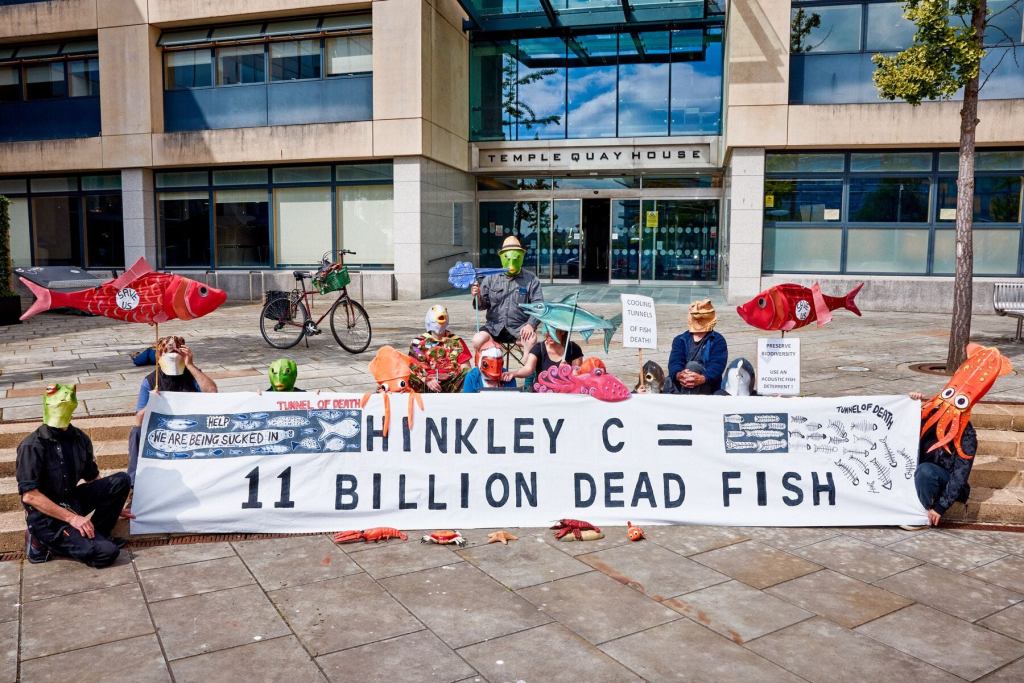
Even with EDF’s fish return system, fish with swim bladders sucked into the system and dragged along the tunnels will be damaged by the changing water pressure and die, others will suffer direct impact to their delicate fins as well as the damage as they hit the final mesh at force before being scooped with a rotating bucket system across to an outflow, fish recovery system. EDF admit that over 90% of some species will not survive. Most of the eggs and larvae will pass through the mesh filter system and be destroyed by the high temperatures and chemicals in the condenser, thus also killing future generations.
Over one hundred consultation responses were received from individuals and conservation bodies by the Environment Agency regarding the application to remove the requirement for an AFD. Stop Hinkley is not aware of a single response that agreed with the removal.
Secretary of state for Business, Energy and Industrial Strategy, Alok Sharma, responsible for the decision, evidently chose to ignore this overwhelming opposition.
Do we really want to sacrifice the unique life of our Severn Estuary to allow HPC to leave us a legacy of nuclear waste in exchange?
- Stop Hinkley’s Katherine Attwater says: “EDF are up to their usual tricks of appearing to comply with Environmental Laws to get planning permission. They then renege on their commitments when the project is so far down the line they feel they can twist the arm of Government. This doesn’t bode well for proposed plans at Sizewell and Bradwell or for the UK fishing industry”.
- Dr Andy Turnpenny, Fisheries Scientist, said: “The Severn Estuary is a Special Area of Conservation, important for its role as a fish nursery and migratory corridor. There is uncertainty over the exact impact Hinkley Point C will have on the fish assemblage that supports the complexity of bird species and commercial fish stocks. The Hinkley Point C cooling system will be 3 to 4 kilometres offshore and the number of fish it will draw in will take away the ability of the stocks to withstand normal environmental pressures and natural setbacks. With climate change, we will see significant changes to fish stocks over the 60-year life span of the station and the assessments made by Centre for Environment, Fisheries and Aquaculture Science*, therefore, carry a high degree of uncertainty. The acoustic fish deterrent is a keystone in the design to minimise harm to fish”
* The government’s marine and freshwater science experts.
- Natasha Bradshaw, an independent researcher in coastal governance with extensive knowledge of the Severn Estuary, says: “I have lost sleep over the danger to the fish and the risk of devastating the ecosystem of the Severn Estuary. There is little proof that fish will survive the journey through 3km of tunnels or what impact returning them (dead or alive) into the estuary will have on the ecosystem. The decision made about the fish deterrent for the cooling water system for Hinkley Point C will last decades and set a precedent for other new nuclear and industrial projects across the UK.”
A version of this article first appeared on the Stop Hinkley website prior to the August 1 decision of the Environment Agency.
Headline photo of Portishead, Severn Estuary, by Stuart Allen/Creative Commons.
The opinions expressed in articles by outside contributors and published on the Beyond Nuclear International website, are their own, and do not necessarily reflect the views or positions of Beyond Nuclear. However, we try to offer a broad variety of viewpoints and perspectives as part of our mission “to educate and activate the public about the connections between nuclear power and nuclear weapons and the need to abandon both to safeguard our future”.
 Beyond Nuclear International