 Beyond Nuclear International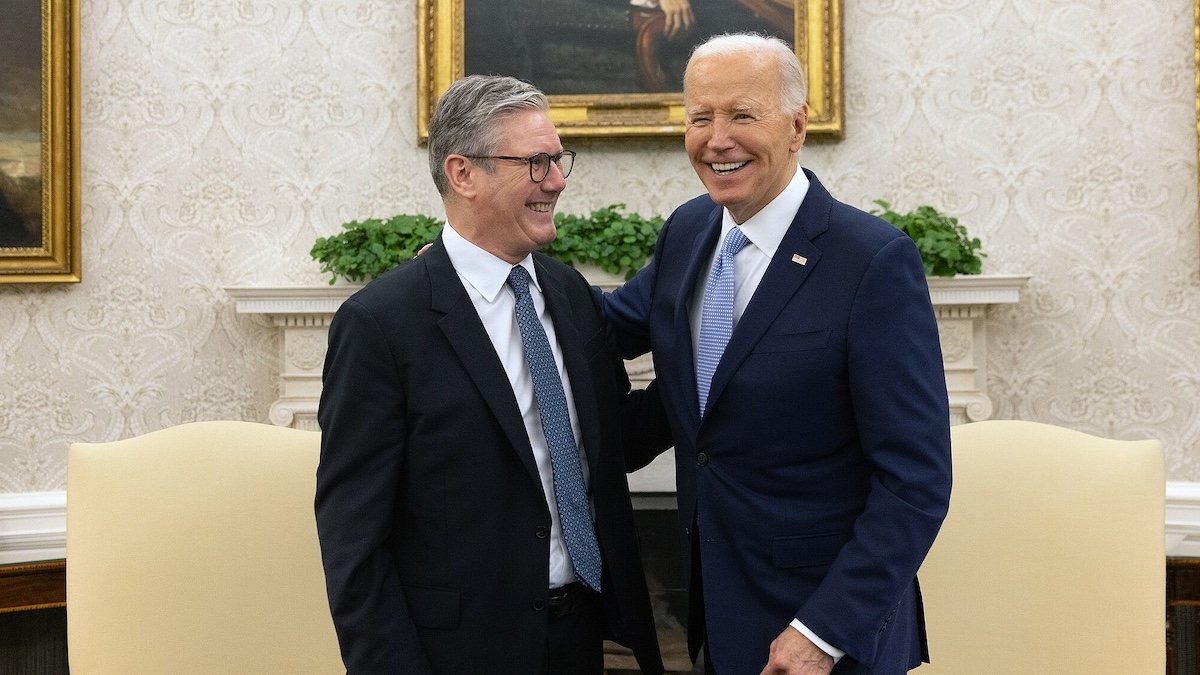
The Mutual Defence Agreement now permanently ties British nuclear weapon dependency to the United States, writes Linda Pentz Gunter
Remember the pet poodle that used to belong to US President George W. Bush? “I must correct you,” I hear you say. It was Scottish terriers that W had, not poodles.
Yes, but I refer here not to Barney and Beazley but to Bush’s third dutiful dog, Blair, as in Tony Blair, the contemporaneous British prime minister, who was routinely featured in cartoons as the compliant canine — specifically a poodle — glued to W’s side.
“I will be with you, whatever,” Blair had written to Bush in a confidential note eight months before the ill-fated invasion of Iraq, launched on the basis of exaggerated and downright false information.That declaration and other professions of poodlish loyalty, were revealed in the 2016 report issued by the Chilcot Commission examining events around the ensuing Iraq war.

“I express more sorrow, regret, and apology than you can ever believe,” was Blair’s response to the report’s findings. Based on his activities since then —which include serving as a well-paid advisor to corporate financial institutions, charging speaking fees as high as $300,000 a pop, and amassing a net worth of at least $60 million — no, we won’t ever believe it.
Perhaps Sir Keir Starmer, whose popularity continues to plummet, is also eagerly awaiting such post-prime ministerial plentitude. At least then, he will be able to pay for his own suitable suits.
But after winning the UK general election in July and duly ascending to US poodlehood, Starmer knew he needed to quickly mark some territory before the departure of the gray-muzzled mutt then occupying both the dog house and the White House.
In order to ensure that the so-called special relationship — the canine cordiale — between the UK and the US remained intact, Starmer orchestrated a fundamental change to a key joint defense policy, cunningly by-passing parliamentary oversight.
The Mutual Defence Agreement (MDA) of 1958 effectively ensures that the UK remains a nuclear weapon power by allowing the US to provide it with nuclear materials, including uranium and plutonium, nuclear weapons components, and submarine reactors. It also permits the sharing of staff and know-how between the two countries.
Thus far, a section of the MDA has required renewal by the UK parliament every ten years. Those key clauses were due to expire this December.
Britain is in possession of four Vanguard class attack submarines armed with American-made Trident II D-5 ballistic missiles carrying UK-made warheads. As long time British national security correspondent, Richard Norton-Tayor, explained in Declassified: “The MDA enables the US to provide Britain with nuclear weapons materials and know-how without which Trident would not be able to function.” It also makes the program affordable for UK coffers.
In a briefing put out by the British nuclear watchdog group, Nuclear Information Service, the MDA is described as “the treaty that governs the relationship between the nuclear weapons programmes of the United Kingdom (UK) and the United States (US), which is unique amongst nuclear armed states for the level of dependency and technical integration involved.”
Now the MDA will endure in perpetuity. That’s because the Starmer government skillfully avoided a vote on the lifting of the sunset clause by first introducing its amendment during parliamentary recess, thus guaranteeing six weeks of inaction, then setting the expiry deadline for October 23 during which politicians from both parties were consumed with party conferences and budget issues.
Consequently, the key amendments to the MDA slipped through without debate.
As NIS’s David Cullen summed it up, “The idea is to put this beyond democratic accountability in perpetuity.”
Specifically, the amended treaty contains three important clauses that leash the nuclear poodle tightly to its American owner. As reported in a debate in the British House of Lords, which did discuss the MDA renewal, can choose to oppose any changes, but has no actual jurisdiction over it, these are:
- Article 4 which makes the provisions on naval nuclear propulsion cooperation reciprocal and allows the UK to transfer technology to, and share information with, the US.
- Article 5 which removes the expiry provisions that relate to article III bis and allows for the MDA, as a whole, to remain in force on an “enduring basis”. As such, the agreement will not require renewal every ten years.
- Article 13 adds new final provisions to the agreement that will ensure that information, material or equipment shared or transferred under the MDA will continue to be protected should the agreement be terminated by either party in the future.
What this means in real terms, explained NIS’s Cullen at a recent conference held in London by the Campaign for Nuclear Disarmament, is that Rolls Royce parts “can be used in the next generation of US nuclear submarines. There will be no dispute mechanisms allowed. No parliamentary scrutiny. And it will not be subject to approval by the US congress.”
The amendment also increases the already considerable secrecy shrouding the precise language in the MDA. “Efforts to scrutinise this relationship are regularly deflected by the government under the guise of national security,” said outgoing CND general secretary, Kate Hudson, in a statement.
According to the NIS report, “no information abut plutonium transfers after March 1999 or transfers of HEU [highly enriched uranium] and tritium outside the three barter exchanges has been made public, and the MOD [Ministry of Defence] has rejected Freedom of Information Requests for information about more recent transfers.”
Likewise, “there is little information in the public domain about the quantity and nature of transfers of non-nuclear components under the MDA,” says NIS.
“This ‘special relationship’ tethers British military and foreign policy to Washington – and makes redundant the claim that Britain has an independent nuclear weapons system,” Hudson added. “Without US support, Britain would be unable to sustain its nuclear arsenal.”
But why the rush to do away with the renewal clause and preserve key terms of the agreement in aspic? The answer, it appears, was insurance, to make the treaty impervious to the bite of the orange attack dog then potentially poised to return to the White House. This was necessary, the argument went, because Donald Trump had already shown a predilection under his previous presidential term for shredding nuclear treaties.
Trump withdrew the US from the 1987 Intermediate-Range Nuclear Forces (INF) Treaty with Russia, a key instrument of global arms control, leaving Russia free to develop as many intermediate-range nuclear missiles as it wants and potentially triggering a new nuclear arms race.
Trump also tore up the Joint Comprehensive Plan of Action — or Iran nuclear deal — which, while still in place, at least allowed for independent verification and oversight of Iran’s civil uranium enrichment activities in exchange for sanctions relief. Iran has already said it has now enriched uranium above 60%, well within the weapons-usable range if not yet weapons-grade.
In January, Trump will indeed be US president again. Starmer has decided to remain as his nuclear lapdog. The MDA may be impermeable to MAGA meddling. But how else Trump may choose to use his UK nuclear proxy should fill all of us with dread.
Linda Pentz Gunter is the international specialist at Beyond Nuclear and writes for and edits Beyond Nuclear International. Her forthcoming book, Hot Stories. Reflections from a Radioactive World, will be published in the new year.
Headline photo: UK prime minister, Keir Starmer (left) quickly cemented the MDA to protect it against meddling by a future Donald Trump presidency — now a reality. He met with current US president, Joe Biden, in July. (Photo: Number 10/Wikimedia Commons.)
 Beyond Nuclear International
Pingback: Climate, nuclear, news and more -this week « Antinuclear
Pingback: Climate, nuclear, news and more -this week « nuclear-news