 Beyond Nuclear International
Obscene amounts are spent on US nuclear weapons, but hardly anything to help the people they harmed, writes Linda Pentz Gunter
It’s pie season in America with Thanksgiving fast approaching and pumpkins ready to be pureed into pulp and baked into a delicious confection topped with whipped cream.
But there are other kinds of pies, ones we savor far less happily and that leave a bitter taste in taxpayers’ mouths.
Let’s start with the military pie. Each year, the National Priorities Project (NPP) publishes a US discretionary budget pie for us to sample — sourced from the Office of Management and Budget — and it’s not a pretty sight.
Its most recent version — entitled Militarization of the federal budget in FY 2023 — delivers us a pie guaranteed to cause heartburn if not heartache. A hefty 62% of the pie is sliced off before we even begin to digest the rest, all of it going to militarism to the tune of $1.14 trillion.
You might need a magnifying glass to scrutinize the remaining slices, more accurately described as slivers. If your grandma served you up this meager portion at the Thanksgiving table you would have something to say about it. And yet, the majority of Americans swallow this disproportionate deprivation of essential services with nary a murmur.
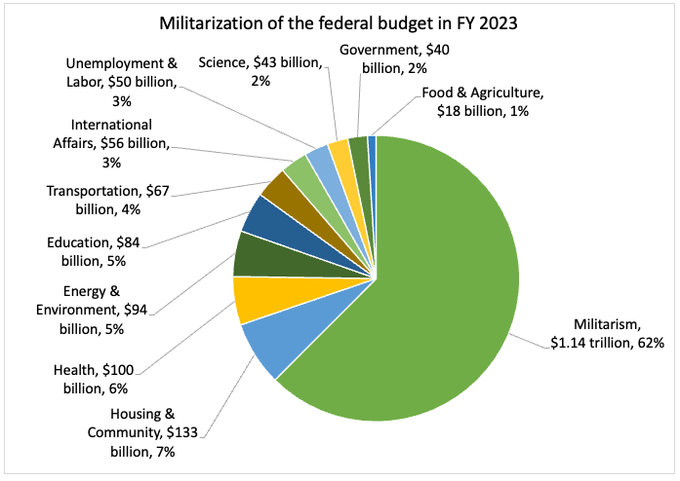
Some of the tiniest wedges are allocated to the services we need the most — food and agriculture, unemployment and labor, and transportation. Education, energy and environment, and health and housing are handled slightly more generously, but it’s all relative. The biggest non-military slice — for housing and community — comprises just 7% of the entire budget and totaling $133 billion, a pittance relative to the funding of weaponry and war.
At the bottom end of the spending spectrum is food and agriculture, with $18 billion allocated in 2023, just 1% of the total budget.
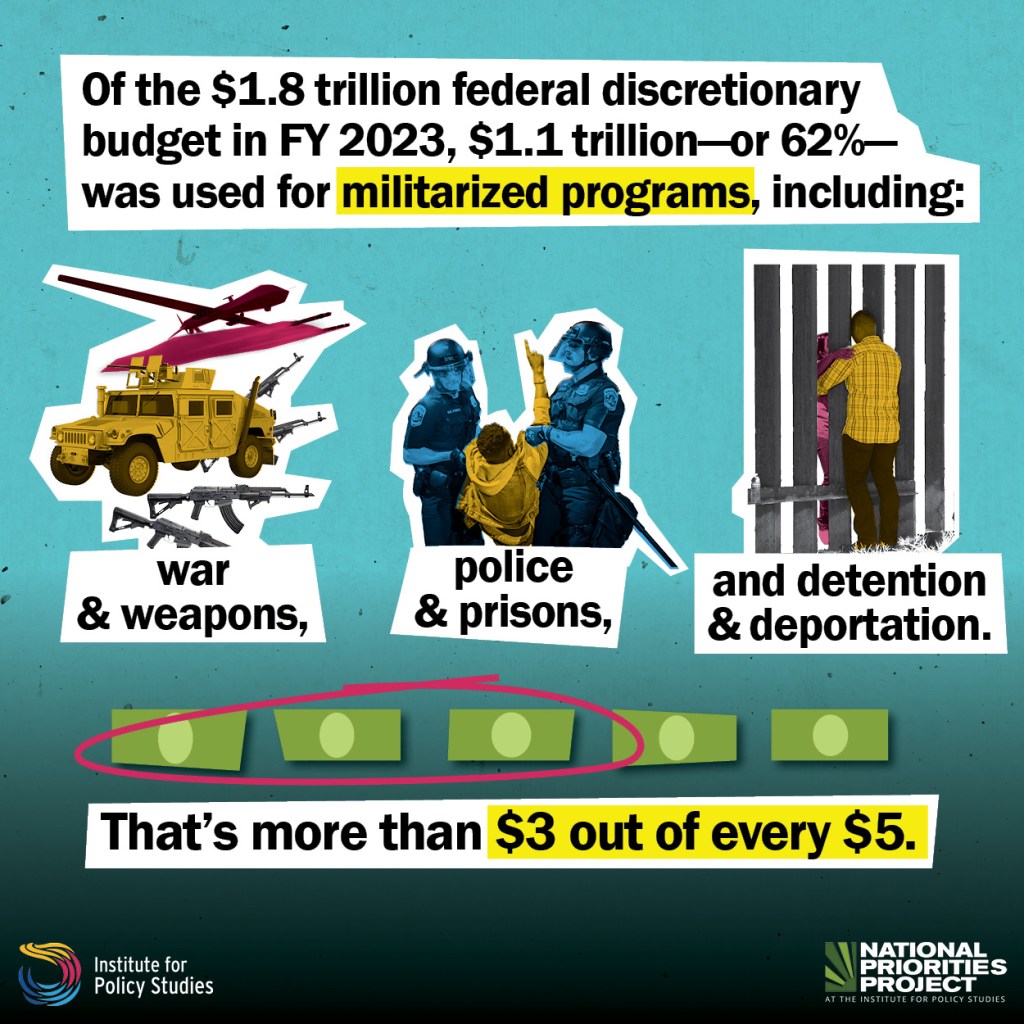
NPP, in partnership with the Institute for Policy Studies, also produces some striking infographics to illustrate this imbalance, including one that shows how that $1.1 trillion was distributed — to war and weapons, police and prisons and detention and deportation. “That’s more than $3 out of every $5,” the graphic tells us.
Of course, a massive chunk of that military money goes to maintaining and now upgrading the US nuclear weapons arsenal. Never mind that this very arsenal was used by the US on its own people over decades of atomic testing and the related industries such as uranium mining that have left a legacy of health deficits enduring to this day.
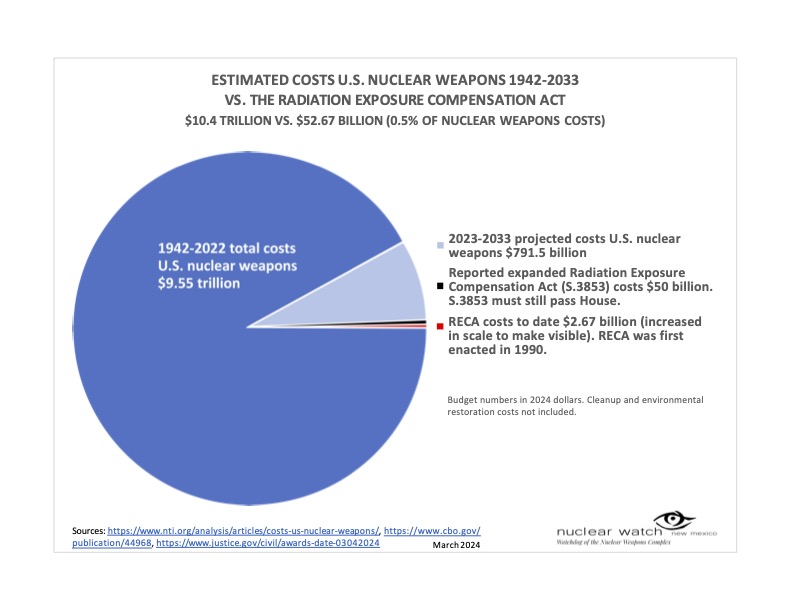
Enter another pie, this time the one that illustrates the greedy consumption of taxpayer dollars to fund nuclear weapons versus the amount allocated to compensate those harmed by them.
The blue pie chart produced in March by Nuclear Watch reveals that while $9.55 trillion was spent on US nuclear weapons between 1942 and 2022, just $2.6 billion has been allocated so far toward the Radiation Exposure Compensation Act that is designed to compensate citizens and workers harmed by the nuclear weapons industry.
The red RECA sliver on the graph is so tiny, Nuclear Watch had to disproportionately enlarge it to make it visible to the naked eye.
Enacted in 1990 there have been frantic efforts to expand RECA to include the most grievously omitted, the downwinders from the first ever US atomic test, Trinity, in New Mexico. Other affected downwinders have also been fighting for compensation, including those harmed by the legacy of Manhattan Project activities in the St. Louis, MO area.
But despite even recruiting an unlikely right wing champion in Republican Missouri senator, Josh Hawley, his fellow Republican, House Speaker Mike Johnson, has refused to bring expansion amendments to the House floor (the bill passed the US Senate.) This resulted in RECA expiring in June.
Expanding RECA would cost an estimated $50 billion, according to the pie chart, a drop in the ocean compared to the planned $791.5 billion in proposed spending on US nuclear weapons in the next decade.
In September, activists from three Native American tribes, Hopi, Laguna Pueblo and Navajo, made yet another arduous trip to Washington, DC, riding for 37 hours in a bus from New Mexico to push for the reintroduction of the RECA extension.
Native activist, Maggie Billman, speaking with KOB News after making the trip to DC, described the frustrations around getting proper health care for those exposed to radioactive and heavy metal toxins from uranium mining and nuclear testing. “They just send us around in circles, they don’t give us a clear diagnosis,” said Billman, whose father, a Navajo code talker, died from lung cancer in 2001.
“RECA has expired because of Speaker Johnson,” said Democratic New Mexico senator, Ben Ray Lujan, a champion of the compensation cause, speaking at a press conference during the visit.
“These people should not have to cross the country for justice,” proclaimed Congresswoman Melanie Stansbury, another New Mexico Democrat.
Mildred Chino from Laguna Pueblo, held up a photo of her late husband, a uranium miner for 11 years who died without ever receiving compensation. His exposure levels, he was told by the US government, were too low to qualify him for assistance.
“I come with a memory of my spouse’s voice,” said Chino at the press conference. “‘Why, Mom, why’?” Chino said she has “a stack of denial letters,” but that his claim “never went through.”
With Johnson intransigent and unmoved, situations like Chino’s are unlikely to change anytime soon. That means that the thin red sliver on the Nuclear Watch piechart, along with any further hope for radiation victims seeking care and compensation under RECA, could disappear altogether.
Linda Pentz Gunter is the international specialist at Beyond Nuclear and writes for and edits Beyond Nuclear International. Her forthcoming book, Hot Stories. Reflections from a Radioactive World, will be published in the new year.
Headline photo of Missouri Congresswoman, Cori Bush, a champion of RECA extension, courtesy of the office of Congresswoman Bush.
 Beyond Nuclear International