 Beyond Nuclear International
It’s time to expose the sham plan for new nuclear power, write Andy Blowers and Stephen Thomas in their new report
The following is the introduction and the conclusion from the report, “It is time to expose the Great British Nuclear Fantasy once and for all”. Read the full report.
In April 2022, the then UK Prime Minister, Boris Johnson, set a target of 24GW (equivalent to eight stations like Hinkley Point C) of new nuclear capacity to be completed in Great Britain by 2050. At the heart of the proposal was the creation of a new government owned entity, Great British Nuclear (GBN), with a mission of ‘helping projects through every stage of the development process and developing a resilient pipeline of new builds’ designed to ensure energy security and to meet the UK’s commitment to achieving net zero.
The new Labour Government, elected in July 2024, has been emphatic about the scaling up of renewables, and has confirmed that nuclear power ‘will play an important role in helping the UK achieve energy security and clean power’. While not explicitly committing to the 24GW target, the new Government expressed its belief that a scale expansion of new nuclear projects was a necessary part of the energy mix for the transition to achieving net zero carbon by 2050.
The Government is expected to continue with GBN but in a clearly subordinate role to its new creation, Great British Energy, its vehicle for driving development and investment into projects that will enable the energy transition to achieve net zero by 2050.
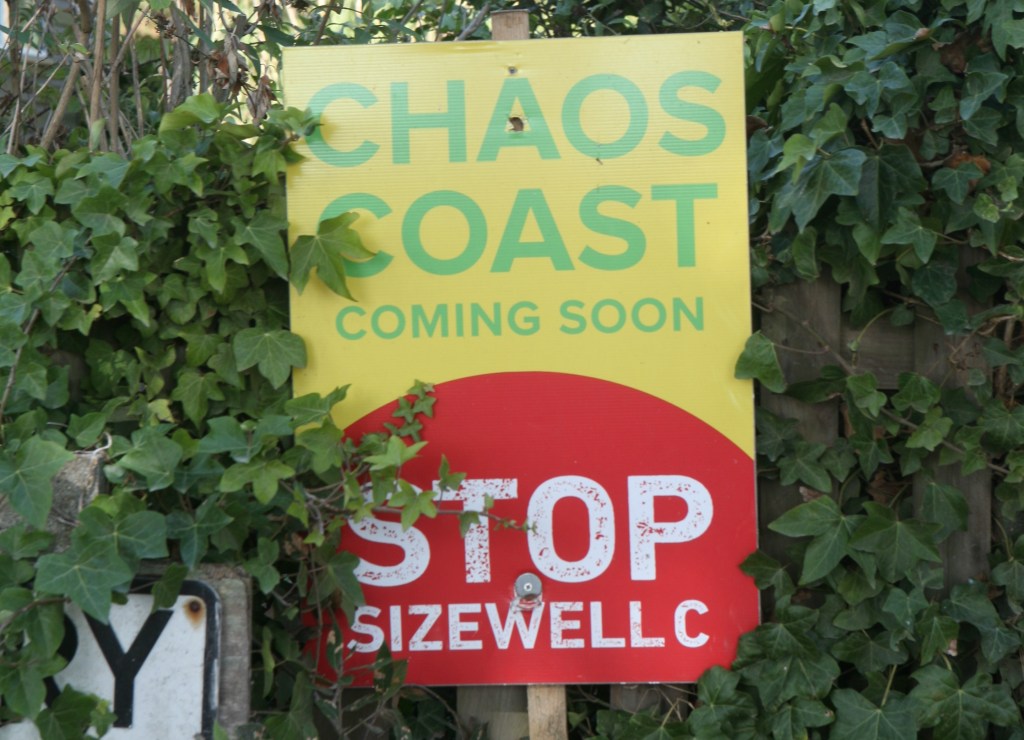
There has, so far, been little government recognition of the sheer difficulty of achieving a vast expansion of nuclear energy. As so often in the past, the nuclear programme has barely got off the ground and the flagship project of the new nuclear programme, Sizewell C, had, by October 2024, yet to receive a Final Investment Decision (FID) apparently because of the lack of interested investors.
In an attempt to keep the project from collapsing while it tries to find investors, Government has chosen to invest £8bn in the project, in addition to Electricité de France’s (EDF’s) contribution of about £700m, just to get it to FID, a process budgeted by EDF in 2016 to cost only £458m. Small Modular Reactors in which much hope is vested barely exist beyond the drawing boards and by the time they could be deployed, if all goes to plan, it will be too late for SMRs and Sizewell C to make any significant contribution to achieving ‘Net Zero’.
The recipe for expanding nuclear and overcoming the problems that have meant previous large nuclear programmes came to little remains the same as that of the previous government: create a flow of large nuclear projects starting with an FID for Sizewell C; bring Small Modular Reactors to commercial availability by 2029 and start ordering them then; and streamline the planning and regulatory processes.
Achieving these objectives in whole or in part will be impossible. In addition, the nuclear programme remains encumbered by its traditional ethical and sustainability problems, if anything, more so. The prevailing fear of nuclear accidents and radiation risks has intensified as nuclear is increasingly exposed to cyber-attack and the palpable threats from terrorism and warfare.
The accidents at Chernobyl and Fukushima, and the threats to Zaporizhzhia in Ukraine and Russia’s Kursk plant at the heart of the Russo-Ukraine war provide chilling evidence of dangers that are likely to materialise sometime somewhere.
With its embedded relationship to the bomb, nuclear energy is implicated in existential catastrophe. The other existential threat comes from accelerating Climate Change which will inundate some coastal sites, create problems of cooling water and, render the legacy of wastes scattered at vulnerable sites an unmanageable problem for generations far into the future.
We may well ask why, in the face of such deficiencies and dangers and with evidence of flagging momentum, this fantastical project is still proceeding? The answer lies in a powerful combination of political ambition, nuclear industry and trade union lobbying purveying the promise of skills, jobs investment, export markets and wealth associated with nuclear development and its supply chain. A mainstream discourse of nuclear as a mainstay of base load supply, energy security and the goal of net zero has been nurtured, to which powerful interests unthinkingly subscribe. Inertia ensures the persistence of the fantasy.
Yet, all the evidence in terms of renewables competition, the opportunity costs and long term economic and security risks of a swerve to new nuclear indicates a vast gulf between rhetoric and reality. In this paper it is our purpose to address the realities and to demonstrate why new nuclear expansion is not only impossible but acts as a barrier to achieve a rapid energy transition powered by renewable technology, storage and energy efficiency.
In the face of the evidence, we consider it reasonable to conclude that any expansion of civil nuclear power in the UK beyond that already committed is unachievable.
The history of nuclear power worldwide is of ambitious programmes falling far short of plans, with huge delays and time overruns. The impact of these failures has been masked by less than expected electricity demand growth and the availability of quicker and cheaper alternatives.
However, there has been a significant opportunity cost to money wasted on these ill-fated policies. For decades UK governments have been seduced by claims from the nuclear industry that, this time, a major nuclear programme will go to plan. More than ever before, the latest programme will be dependent on huge quantities of public money with financial risks falling squarely on the public.
It strains credibility that, with a massive hole in the finances and urgent priorities in health and welfare, the justice system, education and infrastructure, the idea of plugging the nuclear black hole will be met with universal enthusiasm.
The signs are all too clear, the rhetoric has no concrete foundations and the programme will vaporise slowly, perhaps but with inevitable termination. Future demand is again being over-estimated and cheaper, quicker alternatives exist.
The real cost of nuclear power continues to rise and the delays increase, while the cost of alternatives continues to fall. The latest prices for off-shore and onshore wind, and solar photovoltaic are about half the likely price for new nuclear. The IEA reported that over the 10 years from 2013-23, battery costs fell by more than 80%.
Authoritative analysis by an Oxford University team found that UK energy demand could be halved by 2050 with substantial welfare benefits in terms of reducing fuel poverty.
While government documents on nuclear invariably speak of things moving ‘at pace’, the reality is that in the period since the 24GW programme was announced, delays have mounted. In only two years, the completion date for Hinkley Point C went back up to four years and Sizewell C’s FID has been delayed by at least three years.
By October 2024, more than two years after it was announced, GBN barely exists. It has no permanent executive, no premises and no independent budget and its staff are temporary secondees.
GBN’s first substantive task was to complete the SMR competition and award contracts. In October 2023, it expected this to happen in spring 2024. It now seems likely this will not happen until the end of 2024, so a task expected to take about 6 months will, if there are no more delays, take 15 months.
The new Labour administration has yet to say whether GBN will remain as a separate body or whether it will be absorbed into its own new creation, Great British Energy. This uncertainty could delay the decision further.
Despite the sound and fury, the GBN project is bound to fail. Its contribution to achieving net zero by 2050 will be nugatory. No amount of political commitment can overcome the lack of investors, the absence of credible builders and operators or available technologies let alone secure regulatory assessment and approval.
Moreover, in an era of climate change there will be few potentially suitable sites to host new nuclear power stations for indefinite, indeed unknowable, operating, decommissioning and waste management lifetimes.
And there are the anxieties and fears that nuclear foments, the danger of accidents and proliferation and the environmental and public health issues arising from the legacy of radioactive waste scattered on sites around the country.
Abandoning Sizewell C and the SMR competition will lead to howls of anguish from interest groups such as the nuclear industry and trade unions with a strong presence in the sector. It will also require compensation payments to be made to organisations affected. However, the scale of these payments will be tiny in comparison with the cost of not abandoning them.
It is our hope that sanity and rationality may prevail and lead to a future energy policy shorn of the burden of new nuclear and on a pathway to sustainable energy in the pursuit of net zero.
Professor Andy Blowers is a British geographer and environmentalist and Emeritus Professor of the Faculty of Arts & Social Sciences at the Open University. Professor Stephen Thomas is a professor at the University of Greenwich Business School, working in the area of energy policy.
Headline photo of Sizewell nuclear site by Martin Pettitt/Creative Commons.
The opinions expressed in articles by outside contributors and published on the Beyond Nuclear International website, are their own, and do not necessarily reflect the views or positions of Beyond Nuclear. However, we try to offer a broad variety of viewpoints and perspectives as part of our mission “to educate and activate the public about the connections between nuclear power and nuclear weapons and the need to abandon both to safeguard our future”.
 Beyond Nuclear International
Pingback: New Nuclear – TASC – Together Against Sizewell C
Pingback: The Great British Nuke Off « nuclear-news