 Beyond Nuclear International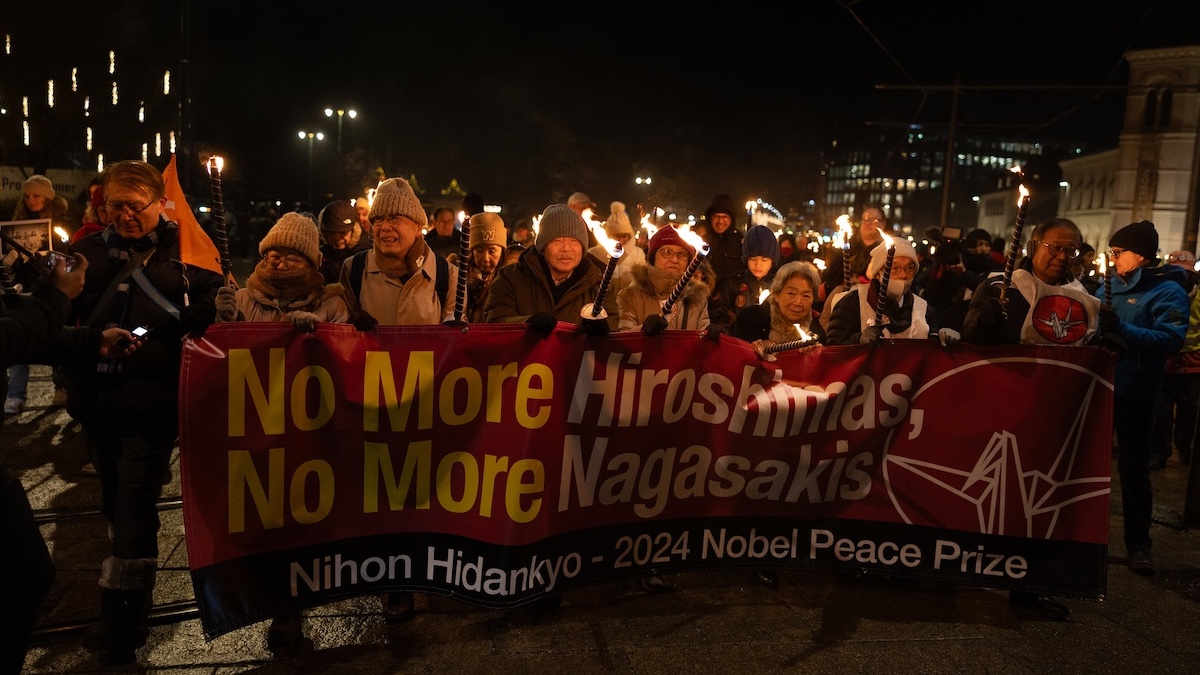
No US president should be allowed to unilaterally authorize a first strike of nuclear weapons, writes Linda Pentz Gunter
President Trump once again has sole authority to make a decision to launch the U.S. nuclear arsenal. He can do so unilaterally, without consulting, getting permission from or even informing his defense secretary or Congress.
We are back on very thin atomic ice.
Not that anyone should ever launch nuclear weapons, whether they are allowed to or not, and no matter who approves it. Under what circumstances would there by any point in doing so? If it’s in retaliation, it’s already too late. If it’s a first strike, our own extinction is 15 minutes away.
But a trigger happy US president, whether literal or metaphorical, does not instill confidence that in a moment of who knows what kind of impulsive petulance, the nuclear button won’t get pushed. Despite Trump’s pronouncements in Davos last month that he wants to work with the leaders of Russia and China to “see if we can denuclearize,” something Trump says he thinks is “very possible,” there is no reason to be confident that a man who lied more than 30,000 times last time he was US president, really means what he says.

Anticipating that chaos is more likely to be Trump’s preferred modus operandi, Senator Ed Markey of Massachusetts and his fellow Democrat in the House, Ted Lieu of California, wrote to then president Joe Biden last December 12, to urge him to make the change himself and mandate that a president must obtain authorization from Congress before initiating a nuclear first strike. No one individual, including the US president, should be able to start a nuclear war without congressional approval they said. They described current U.S. nuclear launch policy as “terrifying, dangerous, and unconstitutional”.
”As Donald Trump prepares to return to the Oval Office, it is more important than ever to take the power to start a nuclear war out of the hands of a single individual and ensure that Congress’s constitutional role is respected and fulfilled,” wrote Markey and Lieu in their letter to Biden. But Biden did not act.
Accordingly, two days after Trump’s inauguration, the pair put out a similar warning. “As Trump returns to the White House, we cannot let the power to start a nuclear war rest in the hands of a single individual,” they wrote, at the same time announcing the reintroduction of their The Restricting First Use of Nuclear Weapons Act.
The bill, if enacted, would restrict the first-use strike of nuclear weapons. The Constitution already gives Congress the sole power to declare war. Why then does the US president have the sole power to start what would be the most deadly and final war of all?
As the Markey-Lieu bill states, “The framers of the Constitution understood that the monumental decision to go to war, which can result in massive death and the destruction of civilized society, must be made by the representatives of the people and not by a single person.”
Given the hateful rhetoric and destructive decision-making already coming out of the Trump White House, passing this legislation has never been more imperative. As the statement from Markey and Lieu reads: “We must put guardrails on presidential authority to start nuclear war. We must never again entrust the fate of the world to just one fallible human.”

Clearly, a first-use nuclear strike carried out by the United States would constitute the ultimate act of war and a first-use nuclear strike conducted absent a declaration of war by Congress would violate the Constitution. And yet, as the law currently stands, a US president can launch a first strike of nuclear weapons in, as it were, a sacred vacuum where only he — and unfortunately it is still a he — is making that choice. (This last comment is not meant as an endorsement of Kamala Harris’s candidacy for US president but rather a mournful observation that it is high time the US felt able to elect a woman to that highest of offices.)
U.S. nuclear launch policy may indeed be “terrifying, dangerous, and unconstitutional”, but ANY nuclear launch policy is “terrifying and dangerous”, even if it is constitutional.
Despite the good intentions of this bill, to make us just a tiny bit safer and reduce the likelihood of a nuclear launch, it keeps us within a mindset that we COULD launch nuclear weapons and that under certain circumstances this might actually be a good idea.
Until we accept that using nuclear weapons under any circumstances would be an act of omnicide, gaining nothing for either side while resulting in a global catastrophe beyond imagining, we will always be one bad decision away from such an outcome, whether caused by a single mad despot or with the approval of a compliant cabinet and Congress.
And lest we doubt that Congress might go along with such a heinous and ultimately suicidal act, we only have to take note of the slavish and sycophantic behavior toward Trump that a majority of the Republicans elected to Congress are demonstrating, to know this could be a real possibility.
This bill, if passed, will throw up at least one important safeguard. But it doesn’t remove the nuclear sword of Damocles still hanging over all of us.
Headline photo of 2024 Nobel Peace Prize-winning Nihon Hidankyo during the Nobel Week torchlight procession by ICAN.
Linda Pentz Gunter is the international specialist at Beyond Nuclear and writes for and edits Beyond Nuclear International. Views are her own. Her forthcoming book, Hot Stories. Reflections from a Radioactive World, will be published later this year.
 Beyond Nuclear International
Pingback: More nuclear news in the time of Trump « Antinuclear
Pingback: More nuclear news in the time of Trump « nuclear-news
Pingback: Sole control -No US president should be allowed to unilaterally authorize a first strike of nuclear weapons « nuclear-news