 Beyond Nuclear International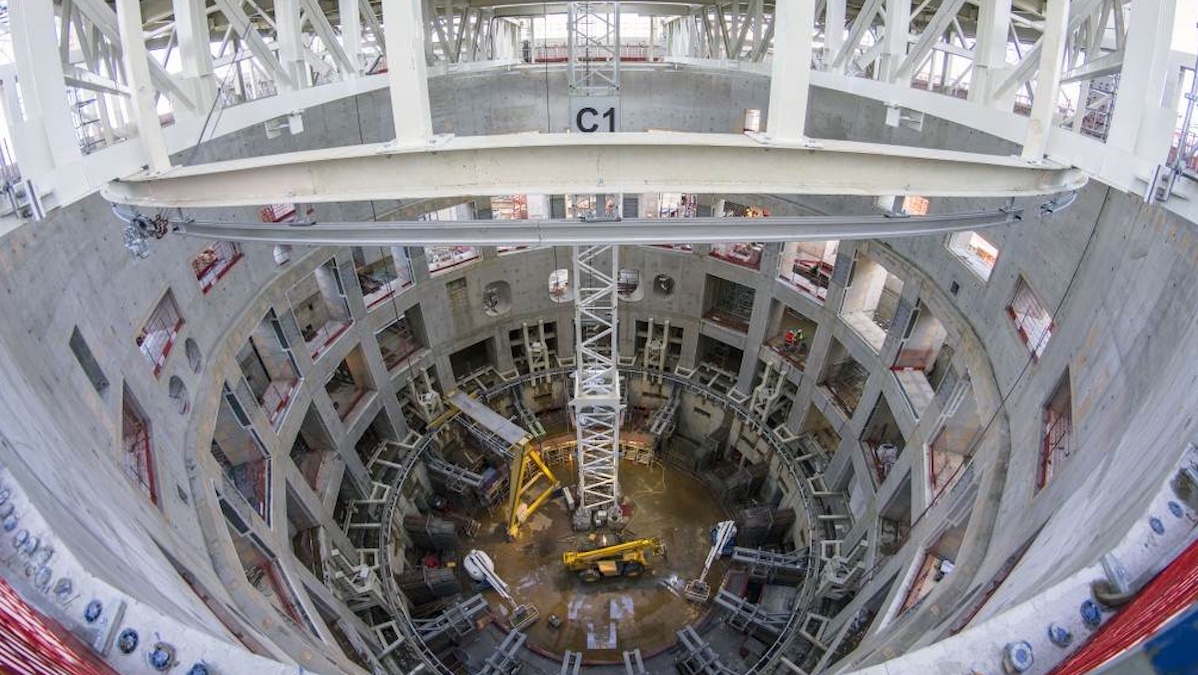
The ITER fusion project is 18 years behind schedule and can do nothing for climate change, writes Antoine Calandra
ITER (International Thermonuclear Experimental Reactor) is an international tokamak nuclear fusion research and engineering project, massively over budget and behind schedule, currently under construction next to the Cadarache nuclear facility in southern France.
India is one of 7 partner countries in the ITER project, along with the European Union, Russia, Japan, the United States, China and South Korea. No matter how much Macron boasts about it, ITER is a total fiasco, a delusional, ruinous and obsolete project.
On November 14, 2024, the annual public meeting was held in Peyrolles, entitled: ITER, 15 years on: what has been achieved?
I was expecting the event to be a great success, and to be able to pick up some recent information on the ITER project… But surprise, nothing of the sort!
An ordinary multi-purpose room, no decor, no documents available, an unpleasant white light, around forty people present, all interns (CEA ITER* employees, CLI members, local elected representatives, a few union members).
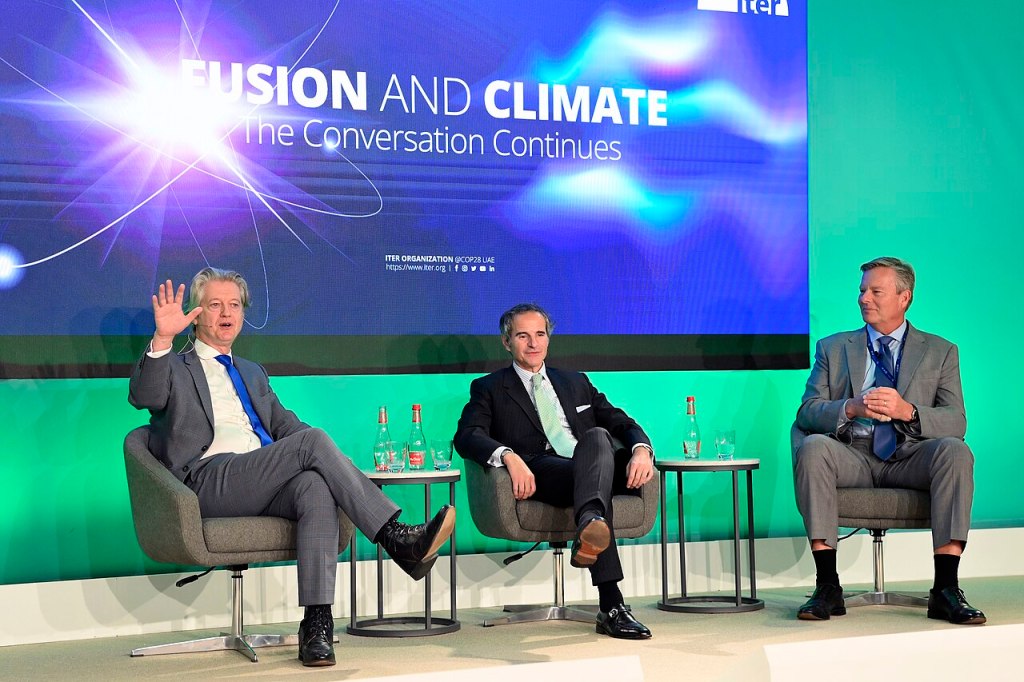
For the event, tables and chairs were arranged differently “for a more convivial, cabaret-like atmosphere”, did I hear them say? Aha!?
Pietro Barabaschi, ITER General Manager, wasn’t there.
As on previous occasions, there was no agenda with the names of the speakers to let us know how the evening would unfold. A meagre presentation of the ITER project (5 or 6 images) and that was it. And “time for questions from the floor”. Aha!
In short, the lamest ITER public meeting I’ve ever attended. A public meeting in the image of the ITER balance sheet.
ITER, what’s the outcome? …. a disaster!
As we wrote in 2005 with the MEDIANE association, “ITER, a dangerous, ruinous nuclear project, lost in advance”.
The last important news about ITER came on July 3, 2024, at a press conference given by Pietro Barabaschi, the current ITER Director-General.
A new timetable: a further 9 years behind schedule!
The first production of a fusion plasma was originally scheduled for 2016, then postponed to 2025. It has now been pushed back to 2034. That’s 18 years behind schedule.
And with the new schedule, an additional cost of €5 billion!
To date, this represents at least 25 billion euros of public money, a cost multiplied by five. And more than 40 billion euros if we include the in-kind contributions of the project’s partner countries.
The ITER Director has acknowledged that “Fusion cannot arrive in time to solve the problems facing our planet today, and investment in other technologies, both known and unknown, is absolutely necessary”.
However, the rhetoric and commitments to get this nuclear fusion project accepted were quite different in 2006, at the time of this masquerade of a public debate.
We could even read that after ITER, DEMO was planned, a pre-industrial demonstrator, to “prove the industrial feasibility of this technology around 2040 and demonstrate that fusion can, by 2050, produce electricity on an industrial scale”.
Once again, the 7 partner countries (European Union, Russia, Japan, United States, China, India and South Korea) have agreed to pay more. But the ITER Director is now looking to private players to help bridge the financial gap.
A number of private companies no longer expect anything from ITER, but are firm believers in nuclear fusion, promising electricity production within a shorter timeframe.
Some even claim that ITER will be obsolete by the time it is commissioned.
Let me add that ITER probably won’t work, and that there will NEVER be any industrial production of electricity thanks to nuclear fusion.
Nuclear fusion is neither “a revolution for mankind”, nor “the energy of the future”.
It is not a clean energy, nor even an abundant one. It is dangerous to human health and produces radioactive waste.
ITER’s main interest is military, in an attempt to save the nuclear industry, which has been in bad shape for several years.
ITER will probably never work, and will end up a total fiasco, worse than SuperPhénix*, which was supposed to be the jewel in the crown of the French nuclear industry.
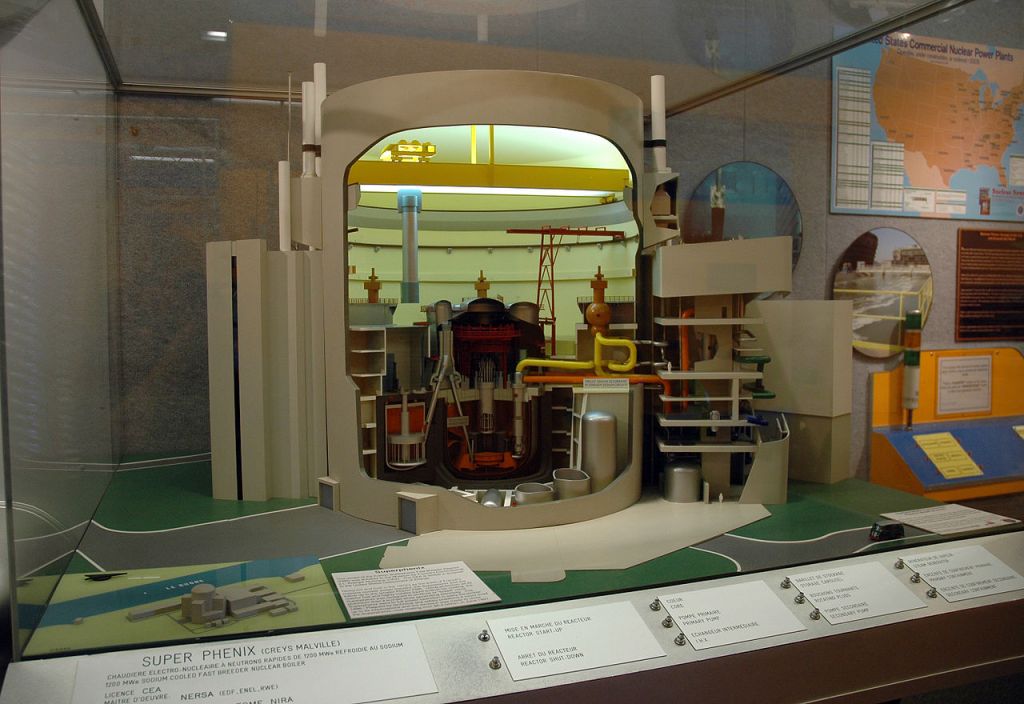
But by squandering all those billions, the ITER monster will have succeeded in blocking any progress towards a different energy model and imposing the continuation of the nuclear industry for years to come.
We need to put out of our minds once and for all this myth of free, inexhaustible energy that allows us to consume and waste indefinitely. It’s also time to put an end to this gigantism and centralization of production in the hands of powerful and interventionist states, at the service of the wealthiest.
The solutions for the future have long been known:
Save energy, put an end to waste, develop and improve renewable energies (solar, wind, hydro), the only truly clean energies of the future.
And don’t develop them in an industrial, centralized way, which is unfortunately what’s happening.
The industrialization of the world must be fought. A new social project is a prerequisite for any energy project.
The future lies in small-scale, local or regional production units, using technology that is accessible to the greatest number of people, requires little energy and avoids the cost of distribution.
Nuclear fusion, like fission, is a dangerous, dirty, and expensive energy source. It’s a complex, centralized technology reserved for wealthy countries, leading to proliferation, dependency, injustice, and war.
* CEA : Commissariat à l’Énergie Atomique
* CLI: Commission locale d’information
* SuperPhénix, ancien réacteur nucléaire, mis en service en 1986, définitivement arrêté en 1997, prototype de réacteur à neutrons rapides à caloporteur sodium. Une machine dangereuse qui a englouti plus de 60 milliards de francs pour ne tourner que trente mois en douze années d’existence.
Antoine Calandra is a former director of the “Sortir du nucléaire” network, and a member of the Médiane association. This article first appeared in French on Mediapart.
Headline photo of the center of the tokamak complex at the ITER site during construction in 2018 Oak Ridge National Laboratory/Wikimedia Commons.
The opinions expressed in articles by outside contributors and published on the Beyond Nuclear International website, are their own, and do not necessarily reflect the views or positions of Beyond Nuclear. However, we try to offer a broad variety of viewpoints and perspectives as part of our mission “to educate and activate the public about the connections between nuclear power and nuclear weapons and the need to abandon both to safeguard our future”.
 Beyond Nuclear International