 Beyond Nuclear International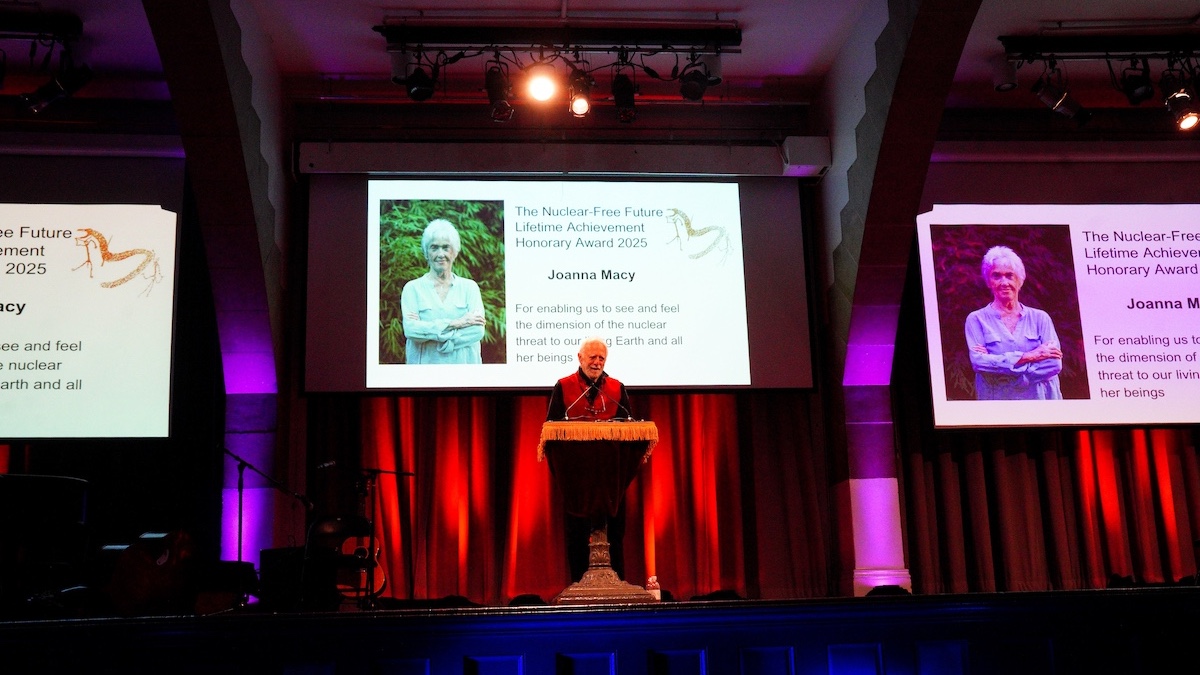
Rainbow serpent magic filled the air at the Great Hall at Cooper Union, writes Linda Pentz Gunter
The Rainbow Serpent has been the symbol of the Nuclear-Free Future Awards (NFFA) since the event first began in 1998. In Indigenous cultures, the serpent offers an ominous warning to be left undisturbed in the ground rather than unleash its vengeful powers. This has been taken to mean, in particular, uranium. But the NFFA’s friendlier serpent also seems to release a certain magic into the air, enveloping those who breathe it in joy and optimism when they attend an NFFA ceremony as it travels to different cities around the world.
In 2025, the Awards were held in the Great Hall at Cooper Union, in New York City, a historic and atmospheric venue where a certain candidate for US president, Abraham Lincoln, made what would remain not only his longest speech but arguably his most important and one that would send him on his way to winning the White House.
Lincoln’s lectern still stands on the Cooper Union stage and at the 2025 Nuclear-Free Future Awards it was graced by a series of remarkable activists. Some were there to receive the Awards, others to present it or honor recipients who could not be with us. Many in the audience had come to participate also in the Third Meeting of States Parties to the Treaty on the Prohibition of Nuclear Weapons at the United Nations.
The Awards were founded by Claus Biegert, a Munich-based journalist who serves both as the event’s visionary and its emcee. And the event is now supported by my organization, Beyond Nuclear, and by International Physicians for the Prevention of Nuclear War, Germany, as effectively “co-owners”, although the hard work on the IPPNW end comes from Chuck Johnson and Jenny Cole at the Geneva Liaison Office.
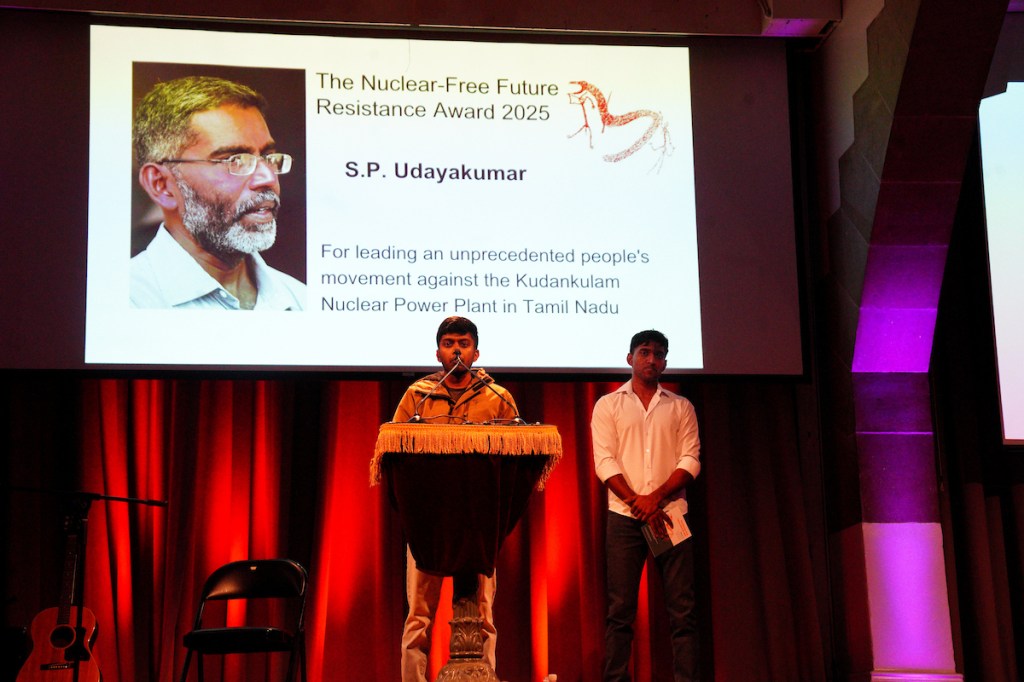
Courage is the first word that comes to mind when describing the 2025 recipient in the category of Resistance. For standing up to the Indian authorities in opposition to the construction of the massive Russian nuclear power plant at Kudankulam in Tamil Nadu, S.P. Udayakumar and thousands of other villagers, farmers and fisherfolk, the majority of them women, have been hounded, persecuted, arrested and prosecuted.
Udayakumar could not travel to the US to receive his award, but his sons Surya and Satya, both of whom live in Maryland, were able to come to New York to honor their father. The video recorded by Uday, as everyone knows him, moved the audience to prolonged applause and even tears, given all he and his family have endured, including two years in hiding when he could not see his sons at all.
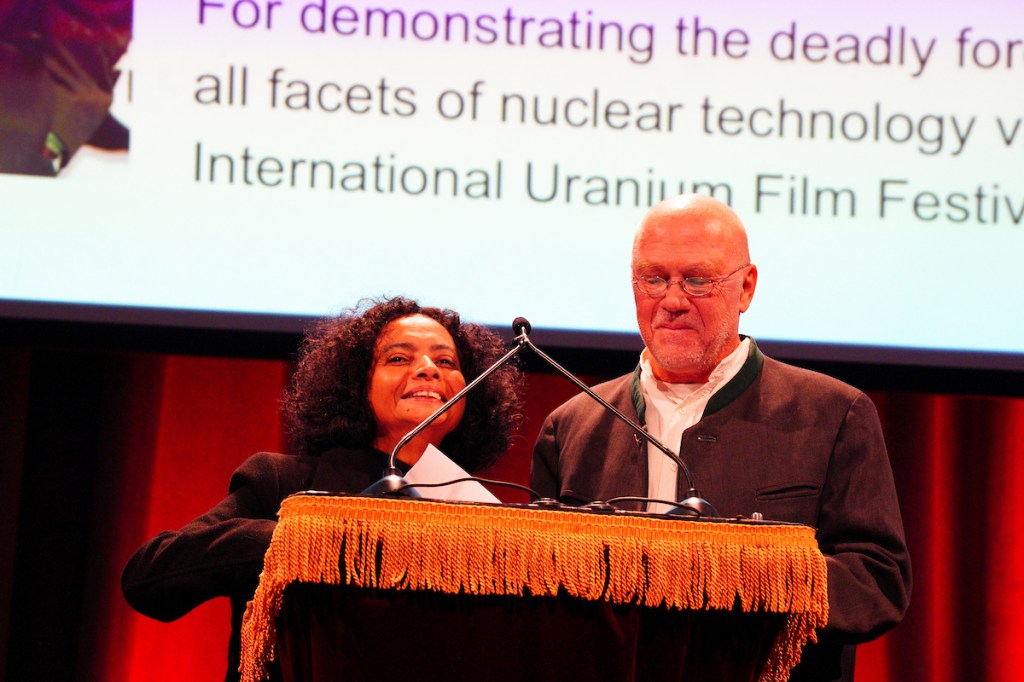
The exuberant promoters of the International Uranium Film Festival, Márcia Gomes and Norbert Suchanek, based in Rio de Janeiro, Brazil, won the Award for Education. Born as a small idea that grew into a remarkable international film festival, the pair realized that dense reports and statistics were not going to galvanize people to oppose all things nuclear in quite in the same way that pictures could, and especially moving pictures, whether documentaries, dramas or animation.
The success of the festival, which began with enormous struggles to find funding and venues, is a testament to perseverance and canny marketing skills that have brought people together to collectively advance the festival around the world.
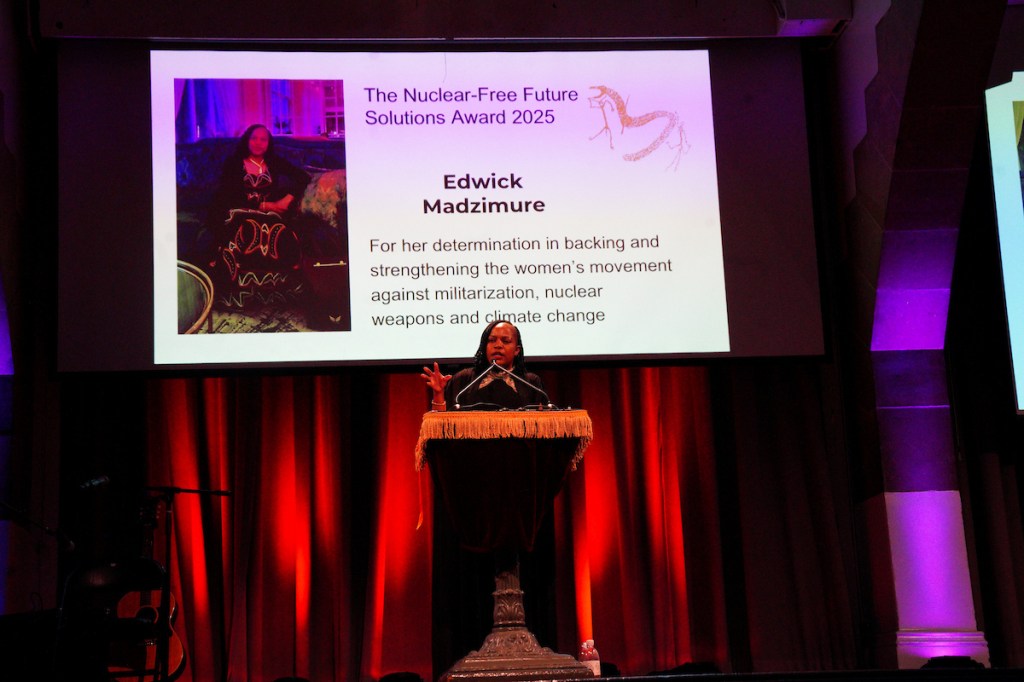
Solutions to the problems of nuclear power and nuclear weapons are not always obvious. Beyond technical fixes like renewable energy and energy efficiency, as well as campaigning for peace and nuclear disarmament, sometimes the answer lies in changing the conversation. To get away from the macho-dynamic of nuclear weapons especially, the voices of women — all too few — were clearly needed. Furthermore, the voices of women from the Global South were even more essential, in the view of Zimbabwean campaigner, Edwick Madzimure.

This “solution” became a key to the success of of the Treaty on the Prohibition of Nuclear Weapons, which tackled the issue from the perspective of human rights impacts, where women are invariably disproportionately impacted in a negative way.
There were two other notable absentees on the night, both of whom received Lifetime Achievement Awards. Berta Benally sang and played for her lost son, Klee Benally, a force of nature and fiery determination, a Diné warrior for peace and justice who died in December of 2023. Klee, like his mother, was a musician, as well as a filmmaker, author and the creator of board games, all designed to tell the story of the colonial invasion of Diné lands and the tragic consequences for his people.
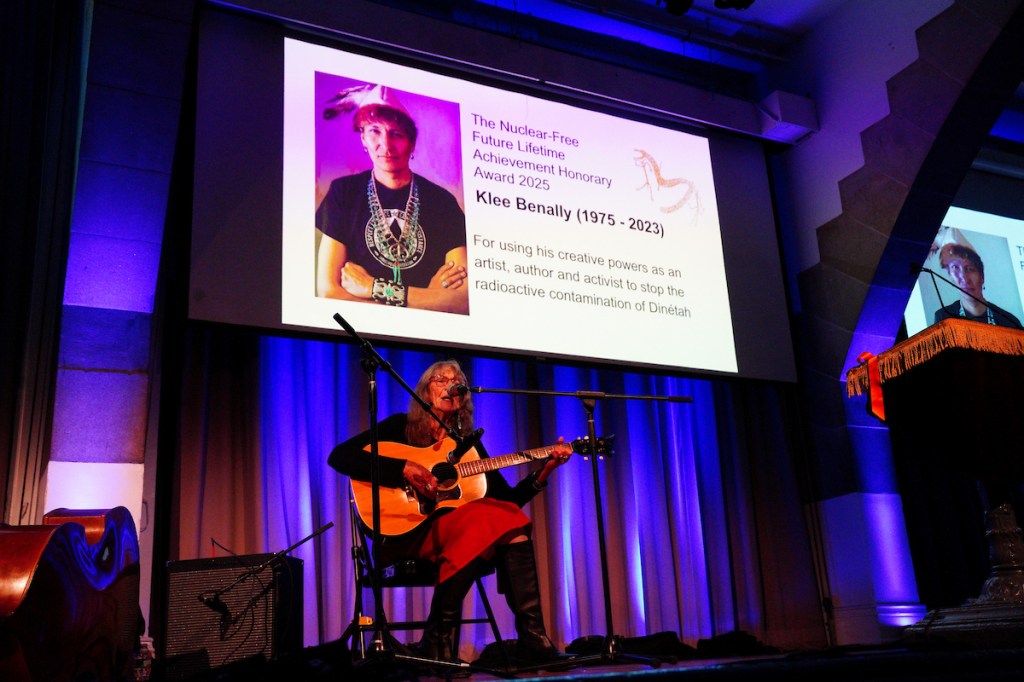
Berta said she was nervous to speak (although not to play) but she recounted her son’s life and spirit without notes, from the heart, and with a passion that brought Klee back into the space in vivid form. Those memories were augmented with love and joy by two of Klee’s Native American colleagues, Petuuche Gilbert of Acoma Pueblo, and fellow Diné Leona Morgan, who memorialized him with a little humor as well.
The evening ended with a tribute to living legend, Joanna Macy, a Buddhist teacher, author and peacemaker and a matriarch of the anti-nuclear cause. Macy, now in her nineties, could not make the trip from California but offered her thanks in a written statement read by her longtime friend, Kathleen Sullivan of the Nuclear Truth Project and Hibakusha Stories.

Macy has been a mentor to many, both within the anti-nuclear movement and well beyond it, and is best known for popularizing the concept, The Great Turning, in which humanity makes an essential shift from an industrial growth society to a life-sustaining civilization, emphasizing a transition to a more sustainable and just world.
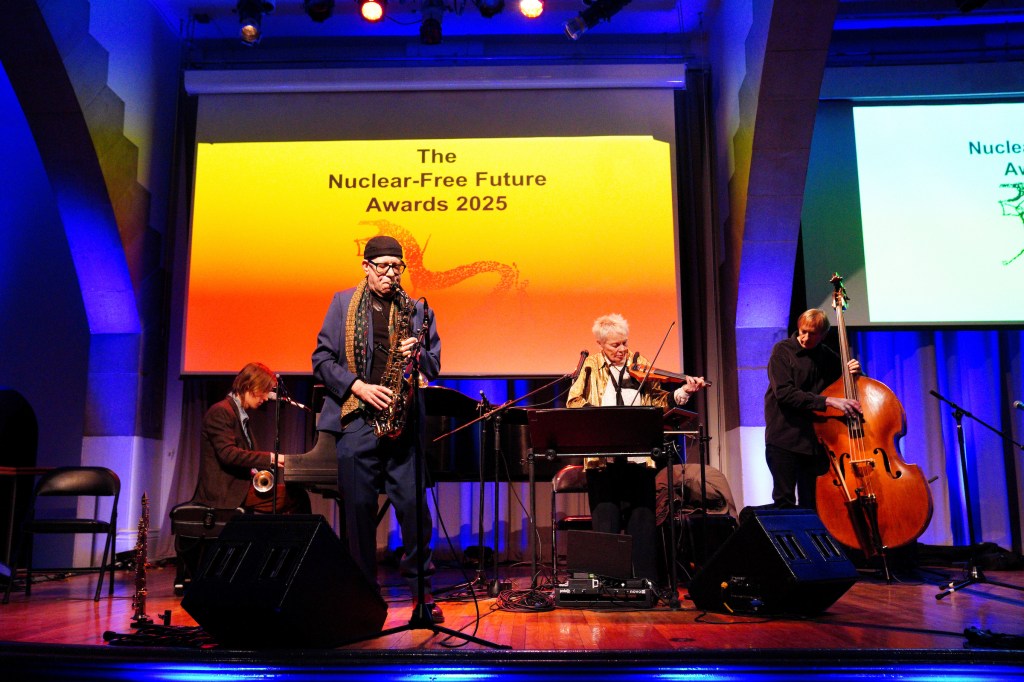
Musical performances were generously provided by the quartet featuring Laurie Anderson, Greg Cohen, Peter Gordon, and Max Gordon.
A video of the Nuclear-Free Future Awards is under preparation and will be available later this year. You can learn more on the Nuclear-Free Future Award website.
Headline photo of Nuclear-Free Future Award founder, Claus Biegert, introducing Joanna Macy’s Lifetime Achievement Award. (Credit: ©Adam Stoltman. Photos not to be republished without attribution.)
Linda Pentz Gunter is the international specialist at Beyond Nuclear and writes for and edits Beyond Nuclear International. Her forthcoming book, Hot Stories. Reflections from a Radioactive World, will be published later this year.
 Beyond Nuclear International
Pingback: Nuclear news – not the industry handouts « nuclear-news
Pingback: Nuclear news – not the industry handouts « Antinuclear
Pingback: The 2025 Nuclear-Free Future Awards « nuclear-news