 Beyond Nuclear International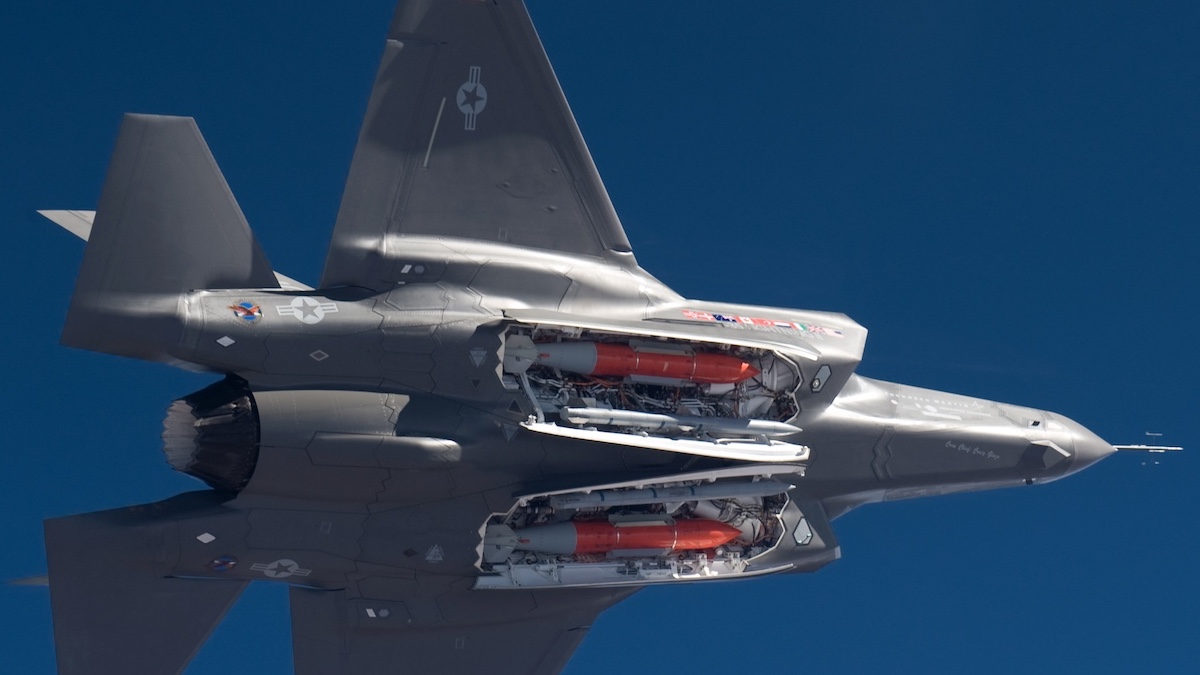
Nukewatch UK reveals how US nuclear gravity bombs were deployed on US soil for the first time in 17 years
By Peter Burt
US nuclear bombs were delivered to Lakenheath air base on Thursday 17 July as part of NATO plans to deploy new battlefield nuclear nuclear weapons intended for war-fighting in Europe. The following is an examination of how we know this, with an update also below.
The flight
The arrival of a special flight transporting the bombs was observed by Nukewatch UK, who judge that the evidence publicly available from our observations and flight-tracking data now supports the conclusion that nuclear weapons are based at the Lakenheath US air base in Suffolk. This article explains how the weapons were brought to Lakenheath by the US Air Force and sets out the evidence which indicates they are now stationed at the British base.
Shortly after 7 am local time on Tuesday 15 July a giant C-17 Globemaster transport aircraft, flight number RCH4574 (‘Reach 4574’), assigned to the US Air Force’s 62nd Airlift Wing left Joint Base Lewis–McChord, its home base in Washington state. The 62nd Airlift Wing is an elite, highly trained transport unit which serves as the US Air Force’s Prime Nuclear Airlift Force: the only Air Force section tasked with the role of supporting the US Department of Defence and Department of Energy with their nuclear airlift operations. The aircraft undertaking the flight was a C-17 with the serial number 08-8200, flying on high priority mission with the air force mission number PAM112271196.
The aircraft flew across the continental United States to Kirtland Air Force Base in Albuquerque, New Mexico – the hub of the US Air Force’s nuclear operations, where the largest nuclear weapons storage facility in the world is located: the Kirtland Underground Munitions Maintenance and Storage Complex(KUMMSC). KUMMSC stores a significant portion of the US nuclear arsenal, including gravity bombs and warheads.
At Kirtland the aircraft almost certainly loaded up with a cargo of anything up to 20 newly manufactured B61-12 nuclear weapons – a new, modernised version of the US Air Force’s principal nuclear gravity bomb with greater accuracy than older variants of the weapon. Manufacturing of the B61-12 variant was completed in December 2024 and the weapon is currently being rolled out on deployment. Whilst at Kirtland the aircraft was parked on Pad 5 – the section of the airbase designated for handling hazardous cargoes. Other aircraft at the airport were given a warning not to overfly the aircraft on Pad 5 for a period of over five hours, which ended only once the C-17 had departed.
Mid evening local time on Wednesday 16 July Reach 4574 took off, with the pilot reminding the ground controller that the aircraft has “haz cargo” on board. The aircraft flew through the night across the Atlantic Ocean, rendezvousing with two KC-46 tanker aircraft from Pease Air National Guard Base and McGuire Air Force Base to refuel over the ocean east of New York.
In a co-ordinated operation, a second C-17 aircraft (aircraft number 09-9211, flight number RCH4205, mission number PAM112472196) also left Lewis-McChord on 15 July and flew to Ramstein Air Force Base in Germany (stopping briefly at Lakenheath) to be on standby in the event of a failure or emergency involving the primary aircraft. This standby aircraft may have been loaded with nuclear emergency response equipment for dealing with an accident involving the primary aircraft.
Reach 4574 approached the UK flying south of Ireland, then flew up the Bristol Channel, cut across north Devon, and flew north west along a corridor taking it close to Oxford and Milton Keynes, but avoiding overflying major centres of population. The plane landed at Lakenheath air base at 12.50 local time.
Unloading the bombs
Nukewatch UK was able to observe the aircraft landing and unloading from outside the Lakenheath base. During the unloading operation base security was at an unusually high level, with USAF security patrols and police cars undertaking patrols inside the base’s security fence and plain-clothed (but badged) personnel from the Air Force Office of Special Investigations patrolling outside the base.
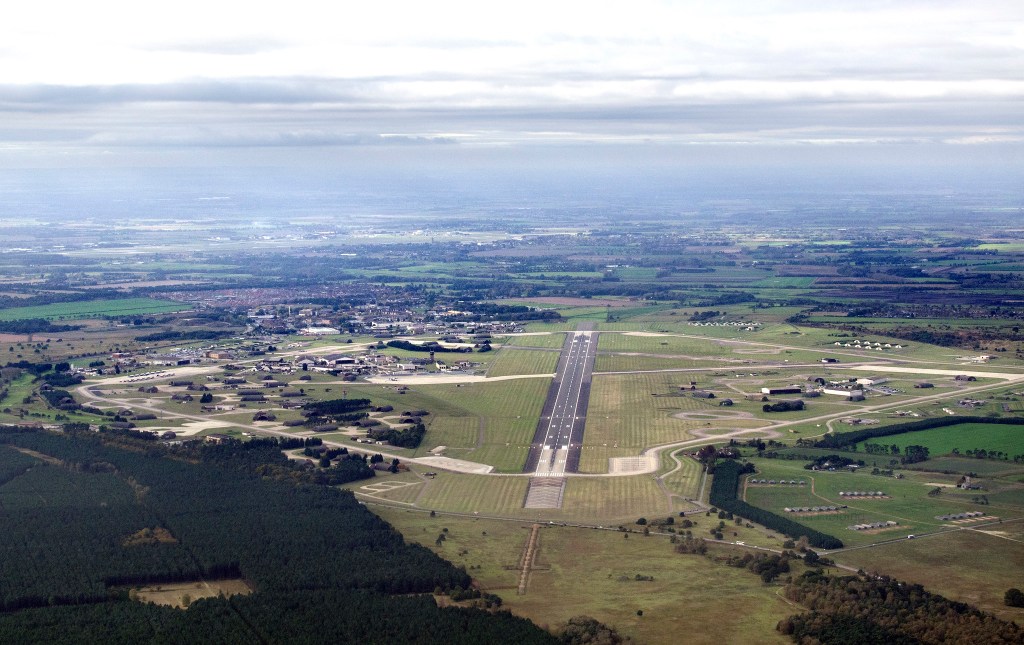
After landing the aircraft taxied to an area of the airbase known as ‘Victor Ramp’ – a location towards the centre of the base which is one of the areas designated for loading and unloading hazardous cargoes. During the entire unloading operation the aircraft was accompanied by a US Air Force fire tender, stationed alongside the right wing of the aircraft, and the tender also did a sweep along the runway before the aircraft landed. Security vehicles surrounded the unloading area and a number of vehicles approached the aircraft for the unloading operation, deploying close to its rear drop-down ramp. Following unloading a convoy of several vehicles moved very slowly with red lights flashing to a protected aircraft shelter near the unloading area and disappeared from sight behind the shelter. Among the vehicles seen unloading the aircraft were MHU83 Aircraft Aerial Munitions Lift Trucks, used by the US Air Force for loading and unloading munitions from aircraft, and certified for use with nuclear weapons.
Whilst Reach 4574 was at Lakenheath no other flights flew from the base and a strict ‘no fly’ restriction was in place for a 2.5 nautical mile radius around the base in the Lakenheath Aerodrome Traffic Zone area. The aircraft departed from Lakenheath at the end of the afternoon on Friday 18 July and flew straight back to Lewis-McChord.
Photos of flight Reach 4574 landing at Lakenheath and unloading its cargo accompany this article (please see below). Nukewatch UK believes that this C-17 aircraft was transporting a batch of B61-12 nuclear weapons to Lakenheath. Our reasons for arriving at this conclusion are given below.
US nuclear weapons in Europe
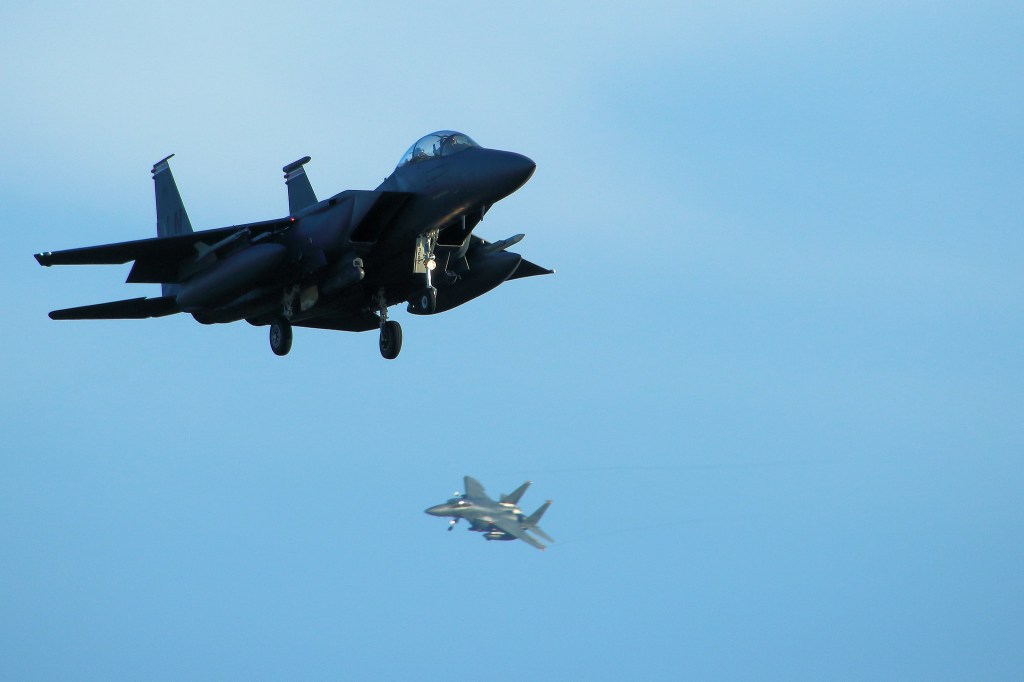
Lakenheath air base is no stranger to nuclear weapons, and hosts F-15E Strike Eagle and F-35A Lightning aircraft, both of which are certified to carry B61-12 nuclear gravity bombs. During much of the Cold War nuclear weapons were stored at Lakenheath but in 2008 they were quietly removed from the base following consolidation of the US nuclear arsenal in Europe. Since 2022 nuclear-related infrastructure at Lakenheath, including hardened aircraft shelters and a ‘surety dormitory’, has been upgraded, giving rise to speculation that nuclear weapons would be returning to Suffolk.
The 62nd Airlift Wing regularly conducts Prime Nuclear Airlift Force missions across the Atlantic to transport materials and equipment to air bases in Europe which support NATO’s nuclear mission in Europe, under which B61 bombs are stored at US bases in Europe and bases of European nations which take part in NATO nuclear-sharing arrangements with the US. Nukewatch has been actively tracking these flights for three years, and has used archived tracking data to analyse flights since the beginning of 2020. Over this period missions have included occasional operations which have been unusually complex, involving up to seven aircraft as stand-bys and for in-flight refuelling. In addition to operations involving nuclear weapons, the unit also conducts missions transporting special nuclear materials which visit several NATO nuclear bases in Europe in sequence, and also conducts missions involving training with ground personnel at several nuclear bases.
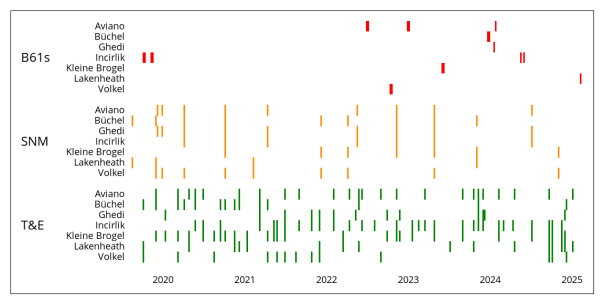
It is possible that the earliest of these missions were training and rehearsal flights for the delivery of new B61-12 nuclear bombs to Europe, with more recent flights actually transporting the nuclear bombs across the Atlantic for deployment at bases in Europe. Nukewatch has observed that Lakenheath has been involved in many of these missions, initially as a location for basing a stand-by aircraft in Europe – possibly for use by a nuclear emergency response team. More recently Lakenheath appears to have been involved in a series of ‘work up’ exercises and security drills involving aircraft from 62 Airlift Wing to prepare the base for the arrival of nuclear weapons, culminating in a large-scale exercise over two days on 10 – 11 June 2025 which may have been a dress rehearsal for the nuclear delivery operation. This chart gives an indication of the frequency of Prime Nuclear Airlift Force missions to Europe since 2020:
The day before flight Reach 4574 landed Lakenheath air base held a ‘quiet hour’ from 09.00 – 10.00 am – a session where all base personnel are briefed by senior officers on important matters. It is likely that the briefing took place to inform staff at the base that Lakenheath had been formally ‘stood up’ for its nuclear role and to explain arrangements for the delivery operation the next day.
It can be expected that Prime Nuclear Airlift Force flights to Lakenheath and other European nuclear weapons bases will continue on a regular basis for the foreseeable future. These flights are necessary to deliver materials required for the B61-12 nuclear programme (for example tritium, a radioactive gas involved in boosting a nuclear explosion which has a relatively short half-life and needs regular replenishment); to transport loads to and from the US for servicing and maintenance; and for emergency, security, and crew training exercises.
It is important to understand that the delivery of B61-12 nuclear weapons to Lakenheath has nothing to do with the recent announcement by the Prime Minister that the UK will purchase a small number of F-35A nuclear-capable aircraft for the Royal Air Force. The UK has not yet purchased these aircraft and a long period of training and certification would be mandated by the US authorities before the RAF was deemed competent to take part in NATO’s tactical nuclear mission. As yet doctrine and operational arrangements for any RAF nuclear role do not appear to have been developed.
What we think
Speaking on the delivery of US B61-12 nuclear weapons to Lakenheath, Juliet McBride of Nukewatch UK said:
“The new nuclear bombs which are now based at Lakenheath are entirely under the control of Donald Trump and could be used without the UK having any say at all in the matter. In fact, we wonder whether the UK government has even been notified by the US Air Force that the weapons are now stationed at Lakenheath.
“The nuclear weapons now stored at Lakenheath have an explosive power of up to 50 kilotons. For comparison, the atom bomb that devastated Hiroshima in 1945 had an explosive yield of 15 kilotons. Far from protecting Europeans during wartime, these nuclear weapons would contribute to turning Europe into a radioactive wasteland.
“Despite the significant issues and risks involved in basing these weapons of mass destruction in Europe, neither the US nor the UK government have bothered to inform citizens or Parliament that they have been deployed here. Nukewatch UK believes that UK citizens have a right to know that these preparations for fighting a nuclear war are under way, and we will continue to report on nuclear movements to Lakenheath and other European nuclear bases”.
Update: Second nuclear flight arrives at Lakenheath
Following a delivery of nuclear weapons to Lakenheath US air base in Suffolk on 17-18 July 2025, a second Prime Nuclear Airlift force flew to Lakenheath on 24-25 July to delivery a high priority hazardous cargo.
The mission in many ways replicated the previous week’s delivery, with the same aircraft used to delivery the cargo to Lakenheath; a similar schedule; and another spare aircraft on standby at Ramstein US base in Germany. During the primary mission a C-17 aircraft from 62nd Airlift Wing flew to Kirtland Air Force Base in New Mexico, where it loaded a cargo on Pad 5 – the section of the airbase designated for handing hazardous cargoes. The aircraft then flew on to Lakenheath to deliver its cargo, remaining there overnight before returning directly to its home base at McChord Air Force Base in Washington state. Please see below for flight details.
Nukewatch was again able to observe the delivery and unloading at Lakenheath on 24 July, although as a result of poor weather and visibility our deductions are qualified. On this occasion, unlike the previous delivery to Lakenheath, armed Ministry of Defence police were on patrol around the outside of the base. The aircraft again unloaded on the Victor Ramp hazardous cargo area. Static security vehicle pickets were located inside the base fence, but in fewer numbers when compared with the previous week, and not in a pronounced semi-circle around the aircraft as before.
The aircraft unloading procedure took around two hours, following a period of around one hour after the aircraft landed while it taxied to the ramp and personnel and vehicles assembled before unloading began in earnest. Unloading operations appeared to follow a different format to the previous week. Loads appeared to have been transferred from the aircraft by four to six small convoys consisting of two or three larger vehicles (different to those observed last week) accompanied by a smaller vehicle. A separate vehicle / vehicles regularly shuttled between the aircraft and unloading vehicles throughout the unloading operation.
On the second day (Friday 25 July) security arrangements at the base and around the aircraft were noticeably more relaxed. Activities continued around the aircraft, including possibly some unloading or loading, and also refuelling before the aircraft departed early in the afternoon.
Nukewatch concludes the following:
- A high security unloading operation for hazardous materials took place at Lakenheath.
- The operation seemed to follow slightly different procedures to the one observed the previous week.
- Nevertheless, the degree of security and general circumstances of the flight seem to indicate that a nuclear-related load was probably delivered in the aircraft. This may have been components and equipment related to nuclear weapons, or possibly weapons themselves.
- Between four to six loads seemed to be transported away from the aircraft in small convoys to a location on the airbase nearby.
- Assuming two or three transporting vehicles in each convoy, and each convoy carried one nuclear bomb, this suggests that between around 8 and 18 ‘units’ of cargo were delivered by this flight.
These articles are republished from the Nukewatch UK website, where you can also find additional photos, videos and updates.
Headline photo: An F-35A Lightning aircraft, loaded with B61-12 nuclear gravity bombs. (Photo: Wikimedia Commons)
The opinions expressed in articles by outside contributors and published on the Beyond Nuclear International website, are their own, and do not necessarily reflect the views or positions of Beyond Nuclear. However, we try to offer a broad variety of viewpoints and perspectives as part of our mission “to educate and activate the public about the connections between nuclear power and nuclear weapons and the need to abandon both to safeguard our future”.
 Beyond Nuclear International
Pingback: Britain’s “borrowed bombs” « nuclear-news
Pingback: Britain’s “borrowed bombs” | Beyond Nuclear International
Pingback: Velká Británie chce prosadit mír s Ruskem pomocí F-35A s atomovkami
Pingback: Non-corporate nuclear news – too long this week-sorry « nuclear-news
Pingback: Non-corporate nuclear news – too long this week-sorry « Antinuclear
Pingback: US flies nuclear bombs to Britain. « nuclear-news