 Beyond Nuclear International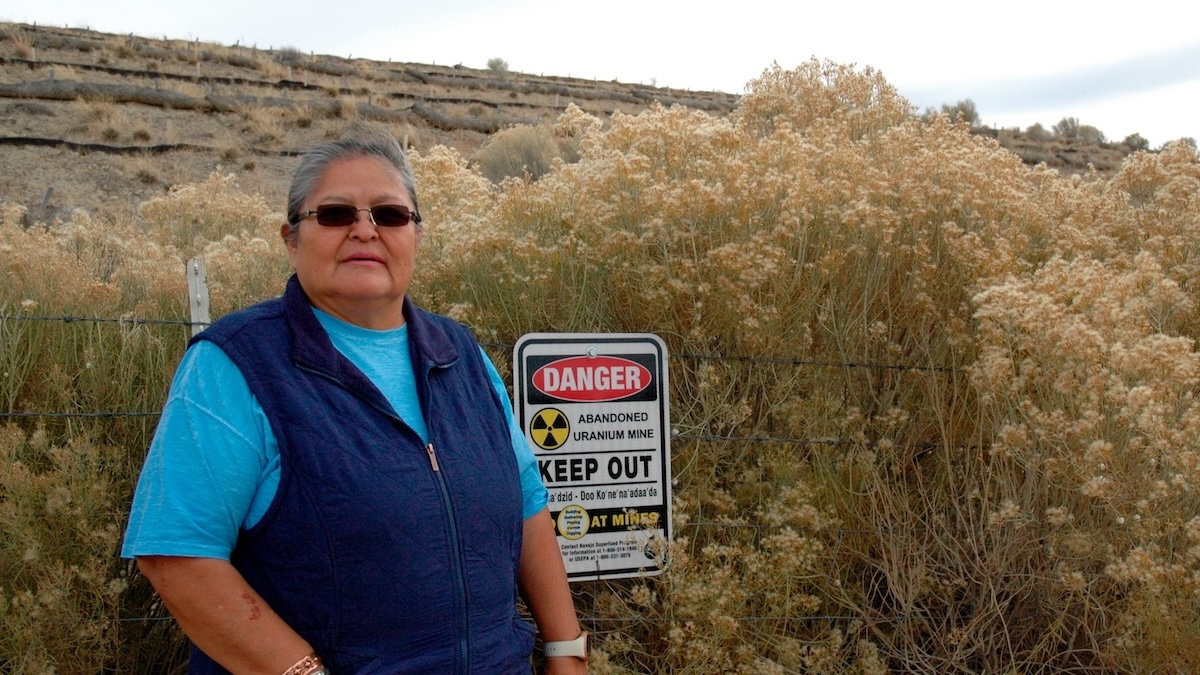
Navajo communities want pros and cons delivered in language all can understand, writes Kathy Helms
Explaining the rationale of burying low-level radioactive waste in a solid waste landfill to Navajo elders, especially if English is not their first language, obviously would be a bit daunting. Regulators relish acronyms like one would a yummy bowl of alphabet soup – RCRA, SMCRA, NORM, TENORM. Elders, not so much.
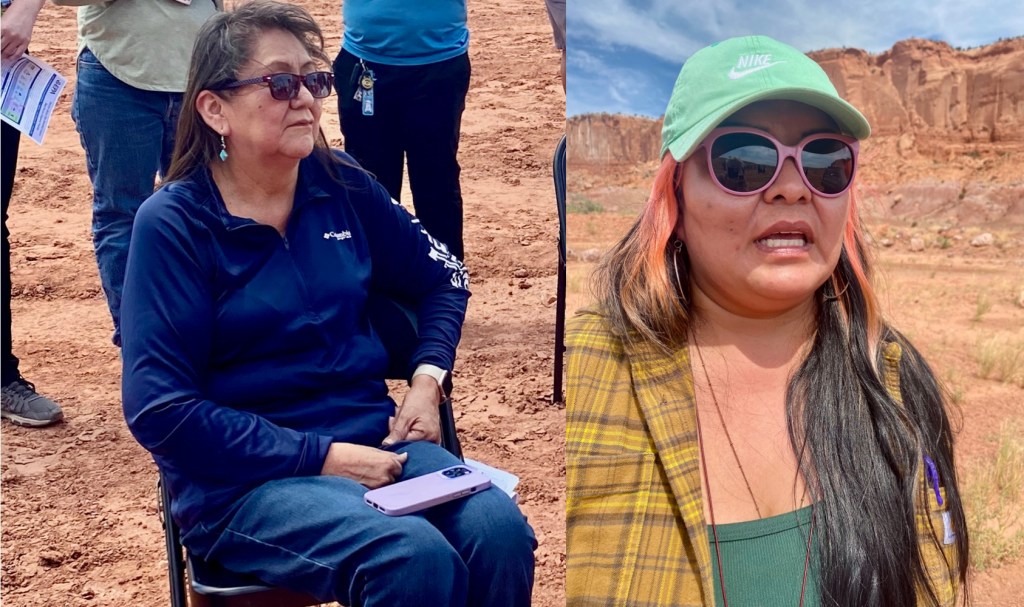
Regulators need to bring the discussion down to the people’s level, Judy Platero, secretary/treasurer of Thoreau Chapter, told federal, state and tribal officials during an August 14 tour of the Red Rock Landfill.
“A lot of our community members are not here because they don’t understand this,” Platero said. “There’s no understanding of this because all of this language, all of this information that’s being disseminated, is all technical. We’ve asked many times, ‘Bring it to us in our own language.’”
Not against cleanup
Platero made it clear that the people of Thoreau are not against cleanup of the former Quivira uranium mine near Church Rock. They understand the need for the removal of 1.1 million cubic yards of radioactive waste rock and sand from within the Red Water Pond Road community. Residents have been saddled with those Cold War remnants for more years than they care to remember.
“What we are trying not to have happen is the transport and the storage here in Thoreau. That’s what we are talking about. “We want everybody, all our people, to be safe,” Platero said.
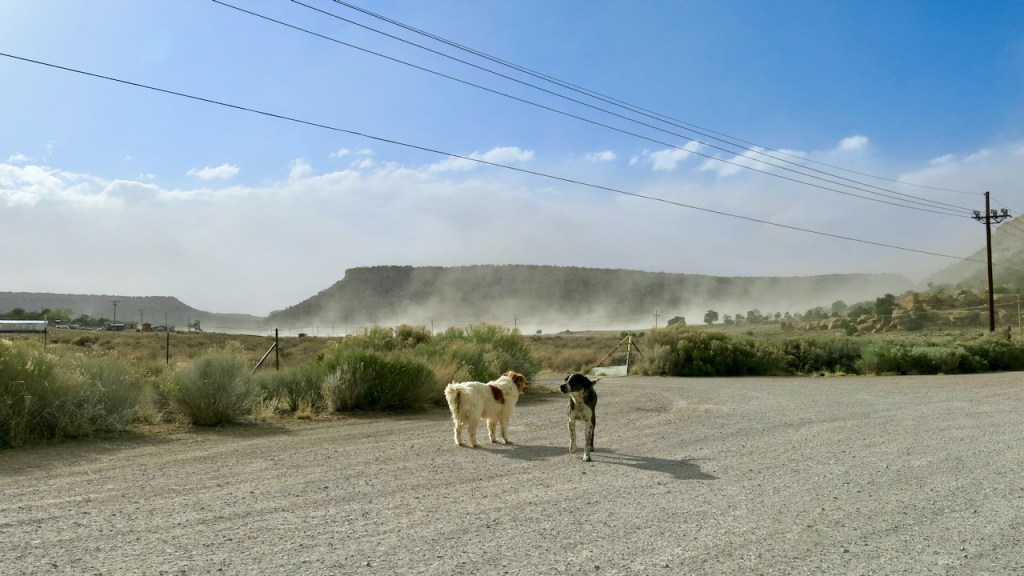
The proposed removal plan means that an estimated 76,710 truckloads – over 60 truckloads a day – will travel a 44-mile haul route along New Mexico Highway 566 to Interstate 40E, across the Continental Divide to and through downtown Thoreau to the Red Rock Landfill. Another 3,300 truckloads of waste from Sections 32 and 33 mines in Casamero Lake are expected to travel a more rural haul route, including a private toll road, according to the U.S. Environmental Protection Agency’s Region 9.
If the landfill “test pilot” for the waste is successful, the state of New Mexico could approve the disposal of more waste in other areas of the landfill on a case-by-basis in the future, tour-goers were told.
Another tour, another time
Platero recalled participating in a smaller tour of the landfill within the last couple years. “We were taken to this place over on the other side and told, ‘This is where the proposed site is.’ But now we’re over here on this side. I see it as there is really nothing definite – and I’m glad there’s nothing definite – except for the cleanup,” she said.
During a June 30, 2023, meeting of the Eastern Navajo Land Commission, Jay R. DeGroat, who worked with the Bureau of Indian Affairs and Eastern Navajo Agency for many years, informed land commissioners that back when the landfill first was being proposed, they were talking to the Elkins family which was acquiring land for the Red Rock facilities.
“They assured us that the area with the Indian mineral rights was a buffer zone to the location and they weren’t ever going to put anything on there,” DeGroat said. But upon hearing EPA’s proposal to haul uranium- and radium-contaminated mine waste to the landfill, DeGroat said he was afraid the agency might have a problem with obstructing the mineral rights of Navajo allottees.
“What you’re putting on there, the way it’s going to be, you can’t ever, ever remove it again,” he said. “My understanding is that part of the landfill area included these lands that still had mineral rights that belonged to the allottees.”
Mine waste ‘reality’
Teracita Keyanna, an advocate for cleanup of the Quivira uranium mine, grew up on Red Water Pond Road. She often tells her family’s story at public meetings and events. When she does, she can’t help but cry the tears of a mother.
“I had to take care of my son who was born with a hole in his heart,” she shared with those assembled at the tour site. “My youngest daughter, she started at 3 years old with her first surgery. She started getting these little nodules close to the lymph node area.”
Now 11, her youngest daughter has gone through four surgeries to remove nodules from five different locations. “Why is it OK for my youngest daughter to have to suffer like this?” she asked.
“Even though the mine is not open any longer, the impact is still real,” Keyanna said. It’s just a stone’s throw away from our house, from our community.”
Keyanna wants a safe place to live. She has been fighting for removal of the waste pretty much all her life. Figuratively speaking, her son basically cut his teeth on Nuclear Regulatory Commission and EPA meetings.
“My kids, unfortunately for them, they have been brought up in the capacity of learning how to be a leader in their community because I had to do that,” she said. “My children have probably gone to more meetings than some of you here because they’re involved.”
Keyanna noted that Platero was correct about the language barrier. “You are completely right. It needs to be explained to you in our Dine´ language,” she said.
In an Executive Order signed March 1, President Donald Trump designated English as the official language of the United States. That order revoked a 2000 executive order designed to improve access to services for persons with limited English proficiency. However, the new order does not require or direct any change in the services provided by any agency.
“Agency heads should make decisions as they deem necessary to fulfill their respective agencies’ mission and efficiently provide Government services to the American people,” Trump’s Executive Order 14224 states.
Too close for comfort?
Stephen Etsitty, executive director of Navajo Nation EPA, said during the 2023 meeting that it had taken a lot of internal meetings within U.S. EPA and the state of New Mexico to reach possible solutions for disposal of the Quivira wastes. “We have been advocating for the initial position that the Nation took, which is off-site reservation disposal,” he said.
The Thoreau community had hoped that “off-site” meant taking the waste to an established repository far away from the reservation, according to Platero “I know it was said, ‘off the Navajo Nation.’ You know what? Navajo Nation is just a skip and a hop away.” She sees it as a continuing pattern of the federal government – regulators “pitting neighbor against neighbor” in the name of money. EPA estimates the pilot project cost at $189 million – about $100 million more than they have currently.
Talia Boyd, a Navajo tribal member, works with communities on environmental issues. She sees regulators’ proposal as an indication of just how much federal agencies, state agencies, and industry don’t listen to the communities.
“From the get-go, our communities have always asked that this waste be removed far from our homelands. Over the years, we haven’t been listened to. They’ve been giving us the bare minimum as far as coming up with solutions on where to take this waste,” she said. “So far, the best thing they’ve come up with is, really, putting it right on the other side of Navajo federal trust land, which is absolutely unacceptable.”
While there is no permanent repository for high-level nuclear waste in the United States, there are four active, licensed low-level waste disposal facilities. Those are located in Barnwell, SC.; Richland, Wash.; Clive, Utah; and Andrews County, Texas.
There are over 520 abandoned uranium mines on the Navajo Nation, Boyd said. “We have a lot of waste that we need to be removed … We understand and hear the communities on both parts – the community of Church Rock and Red Water Pond Road who want their waste removed, and the Thoreau community who don’t want this waste housed in their backyard.
“This is how our communities are being pitted against each other by federal agencies, by the industry, and sometimes even our own tribal governments who don’t step in to help advocate for the people and demand transparency and accountability and justice on behalf of their people,” she said.
Kathy Helms is a retired investigative journalist who has spent her career either editing or covering courts, corruption, energy and environmental issues in Tennessee, Indiana, Arizona and New Mexico.
Headline photo: Annie Benally at the Quivira Mine, which still remains to be adequately cleaned up. (Photo: Kathy Helms.)
The opinions expressed in articles by outside contributors and published on the Beyond Nuclear International website, are their own, and do not necessarily reflect the views or positions of Beyond Nuclear. However, we try to offer a broad variety of viewpoints and perspectives as part of our mission “to educate and activate the public about the connections between nuclear power and nuclear weapons and the need to abandon both to safeguard our future”.
 Beyond Nuclear International
Pingback: A big week in the non-corporate nuclear news « nuclear-news
Pingback: A big week in the non-corporate nuclear news « Antinuclear
Pingback: Nuclear waste in a landfill? « nuclear-news