 Beyond Nuclear International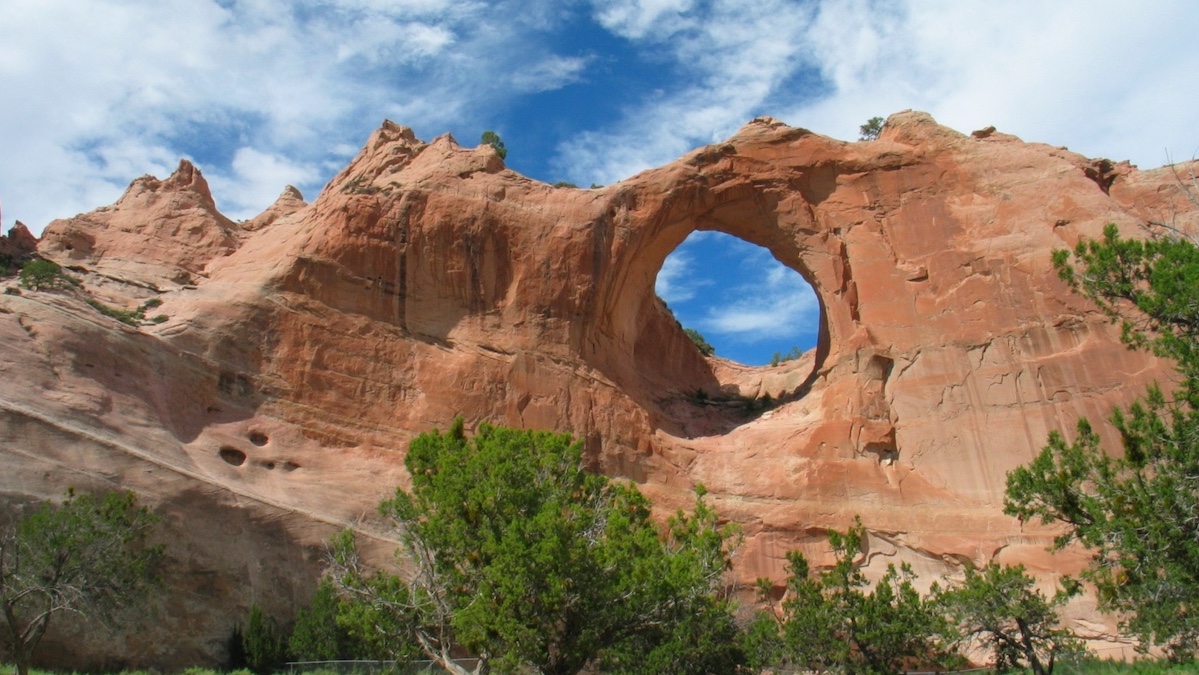
New proposal is extraction not remediation, warns the Navajo group, Dooda Disa
More than 500 abandoned uranium mines (AUMs) contaminate the Navajo Nation, and genuine cleanup is urgently needed. But cleanup must be grounded in strict environmental oversight, transparency, and full community consultation. A proposal now being advanced by Navajo Nation EPA (NNEPA) Executive Director Stephen Etsitty, in partnership with DISA Technologies, is being marketed as AUM remediation when DISA’s High-Pressure Slurry Ablation (HPSA) system does not clean up Navajo land—it extracts uranium for commercial sale while leaving radioactive waste behind.
Etsitty told the Albuquerque Journal he was “really excited” that the process could “accelerate the cleanup” and said “the Navajo Nation is investing roughly $3 million” in a commercial-scale test —all of which is misleading. Even calling HPSA “remediation” is whitewashing, because the technology is strictly a uranium-extraction process.
On January 6, 2025, he introduced Resolution ENAC-12-2025-049 at the Eastern Navajo Agency Council (6) that asks the Navajo Nation to enter into a commercial partnership with DISA in order to apply for DOE critical-minerals grants—an extraction initiative, not a cleanup program. It provides no site information, no environmental safeguards, and no cost details, yet seeks approval for a commercial partnership structured around uranium extraction rather than cleanup.

The Truth About DISA and HPSA
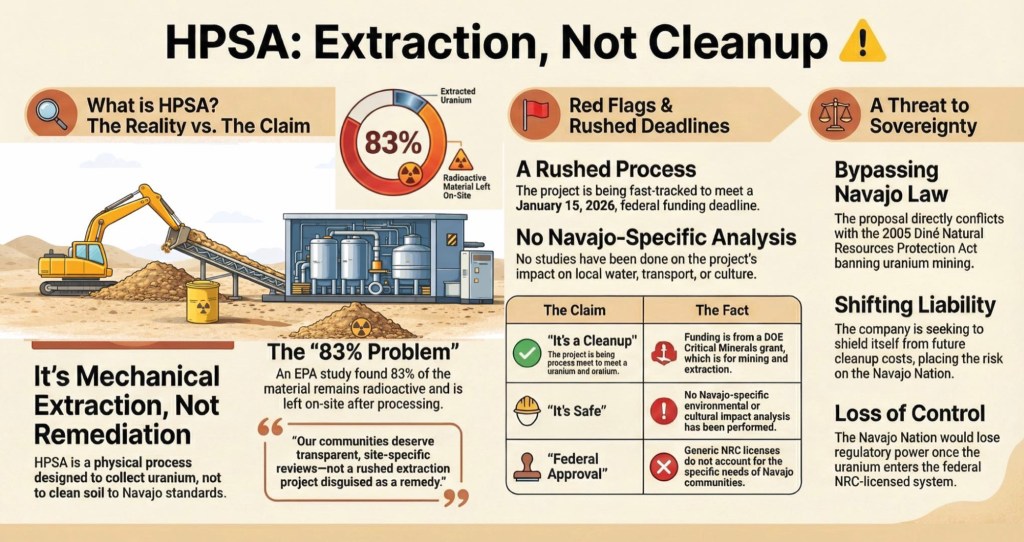
In 2023, the EPA commissioned Tetra Tech to test HPSA on waste from three Navajo AUM sites: Old Church Rock Mine (OCRM), Quivira Church Rock-1, and the Cove Transfer Station (CTS-2). Over two weeks, small batches of contaminated waste were run through a pilot-scale HPSA unit. The system blasts rock with high-pressure water to create slurry, then separates it into a coarse fraction and a fines fraction. The fines—about 17% of the material—contain 80–95% of the uranium and radium that DISA intends to ship to the White Mesa Mill and sell to Energy Fuels. The coarse fraction is waste that remains radioactive and may be left onsite, buried, or sent to a disposal site that does not exist.
The results are unequivocal: HPSA did not meet Navajo Nation residential cleanup standards because the coarse waste rock left behind is still too radioactive. At each site, the process removed 80–95% of the uranium and concentrated it into the fines fraction (1), but the remaining coarse material still fails cleanup standards. At OCRM, rock that began at 940 mg/kg uranium—milligrams of uranium per kilogram of soil—was reduced only to 47 mg/kg, still far above the Navajo residential cleanup standard of 3.2 mg/kg. The report notes that meeting Navajo standards would require 99.7% uranium removal, which HPSA never achieved. The study shows that HPSA concentrates uranium for extraction but does not produce coarse waste rock clean enough to meet Navajo residential standards. It documents uranium extraction, not cleanup.
Environmental Review, Licensing, and the FONSI
After the field tests, DISA quickly sought federal licensing. On March 28, 2025, the company applied to the Nuclear Regulatory Commission (NRC) for a multi-site “service provider” license. NRC issued a Draft Environmental Assessment (EA) and Finding of No Significant Impact (FONSI) on August 5, 2025, opened a brief comment period, and finalized both documents by September 25, 2025.
This speed was possible only because Trump-era changes to the National Environmental Policy Act (NEPA) weakened requirements for thorough environmental review. NRC’s FONSI rests on assumptions—not Navajo-specific data—about water use, dust, trucking, and waste left onsite. HPSA has never been tested at commercial scale. NRC ultimately granted DISA a multi-state, non–site-specific generic license requiring only a pilot program and a Pre-Mobilization Notification (PMN) before work at any site. If the assumptions in the FONSI are not met, the PMN could trigger a full Environmental Impact Statement (EIS), but this is unlikely given the current administration’s broad weakening of environmental oversight.
Water Use, Energy, Waste, and Trucks
The Tetra Tech study relied on municipal water from Gallup because no Navajo source was available. A scaled-up 50-ton-per-hour HPSA system would use about 200,000 gallons of water per month; a 100-ton-per-hour system, roughly 384,000 gallons—requiring two to four water trucks per day. Each operating campaign ends with 32,000–54,000 gallons of contaminated process water that must be disposed of or transported to another AUM site.
For every 100 tons processed, HPSA generates about 17 tons of fines—the uranium-rich concentrate DISA intends to ship to White Mesa—and roughly 83 tons of coarse waste rock, which remains on the land or must be hauled to a disposal site that does not exist.
Energy demand is also heavy. A 100-TPH system requires two 500-kilowatt diesel generators running continuously, ensuring constant deliveries of diesel fuel and the need for onsite fuel storage—none of which were meaningfully evaluated in the EA, FONSI, or license.
In practice, the project would rely on three continuous streams of truck traffic: water trucks, diesel fuel trucks, and haul trucks carrying uranium-laden fines through Navajo lands to the White Mesa Mill in Utah—transport that is prohibited under the Diné Natural Resources Protection Act of 2005.
Who Profits—and Who Bears the Risk
Under federal law, all Navajo trust land is held by the United States, which controls the mineral rights. Once uranium is extracted from AUM waste, it becomes “source material” that DISA—not the Navajo Nation—may own, transport, and sell under its NRC license. Uranium recovered from high-grade AUM sites could be worth hundreds of millions of dollars—benefiting DISA and Energy Fuels, not the families who have lived with contamination for generations.
Whatever commercial partnership Etsitty envisions with DISA is not clear. DISA needs the partnership to obtain Navajo consent to access sites and conduct business, but what does the Navajo Nation receive in return? Why should the Nation take on the risk while giving up control over Navajo land? The reality is that DISA, a startup with limited funding, cannot even afford to conduct the required pilot itself. That is why Etsitty is asking the Navajo Nation to finance the pilot for $3 million—so DISA can prove its own extraction technology while keeping the uranium and the long-term profits.
What Happens Next—and What Navajo Nation Can Still Do
The question is not whether AUMs should be cleaned up—they must be. The real question is whether DISA should be entrusted with that work. Should the Navajo Nation pay to enter into a commercial partnership with a high-risk company using an unproven technology under the false banner of “cleanup”? All available evidence—the Tetra Tech study, DISA’s own descriptions of HPSA, and NRC’s licensing structure—shows the same thing: this is a mining project, not a cleanup program.
The bottom line is that the Diné Natural Resources Protection Act of 2005 bans uranium mining and processing on Navajo land. Extracting uranium from AUM waste for commercial sale is mining, whether the feedstock is called “ore” or “waste,” and is therefore prohibited.
Dooda Disa is a community-based grassroots group dedicated to providing accurate information, raising awareness, and protecting Navajo lands and communities from renewed uranium extraction disguised as cleanup.
Headline photo: The Window Rock on the Navajo Nation, by Ben FrantzDale/Wikimedia Commons.
The opinions expressed in articles by outside contributors and published on the Beyond Nuclear International website, are their own, and do not necessarily reflect the views or positions of Beyond Nuclear. However, we try to offer a broad variety of viewpoints and perspectives as part of our mission “to educate and activate the public about the connections between nuclear power and nuclear weapons and the need to abandon both to safeguard our future.”
 Beyond Nuclear International
Pingback: The non-corporate nuclear news this week « nuclear-news
Pingback: The non-corporate nuclear news this week « Antinuclear
Pingback: Navajo lands at risk « nuclear-news