 Beyond Nuclear International
The NRC commission looks poised to rubber-stamp “Cowboy Chernobyl”, write Paul Gunter and Linda Pentz Gunter
Donald Trump loves a yes-man. What we are now waiting to learn is just how many of those yes-men are sitting on the US Nuclear Regulatory Commission (NRC).
The agency was ordered late last year by the then White House and Elon Musk-created US Department of Government Efficiency, to effectively accelerate and “rubber stamp” reactor license approvals in order to fulfill the White House’s reckless directive, contained in four executive orders issued last May, to license new reactors at lighting speed.
On December 1, the NRC proudly announced that its staff had completed their final safety evaluation for the Bill Gates company TerraPower’s small modular reactor design in record time, in keeping with the make haste mandate from the White House. The NRC staff had concluded that “there are no safety aspects that would preclude issuing the construction permit.”

Jeremy Groom, acting director of the NRC’s Office of Nuclear Reactor Regulation, even bragged how the NRC staff “finished our technical work on the Kemmerer review a month ahead of our already accelerated schedule, as we aim to make licensing decisions for new, advanced reactors in no more than 18 months.”
What we are now waiting to find out, likely sometime this month, is whether the five NRC commissioners will indeed grant a construction license to a patently dangerous reactor design (we are using the term “dangerous” here under their own definition since all of us already know that every nuclear reactor design is inherently dangerous and the so-called new ones haven’t changed that reality.)
Who will be calling those shots, however, has now been significantly reshuffled by the Trump administration.
Sitting NRC commissioner and Republican David Wright had been appointed commission chair immediately after Trump’s January 2025 inauguration, bumping the Biden administration’s appointed chair, Democrat Christopher Hanson, to commissioner.
By June, the White House had unceremoniously fired Hanson from the commission “without cause” in a move widely viewed as illegal based on US Supreme Court precedent case law that went unchallenged. By August, Republican commissioner Annie Caputo had resigned, a surprise move explained by the need to “spend more time with family,” invariable a convenient cover story. This left two vacant seats on the commission.
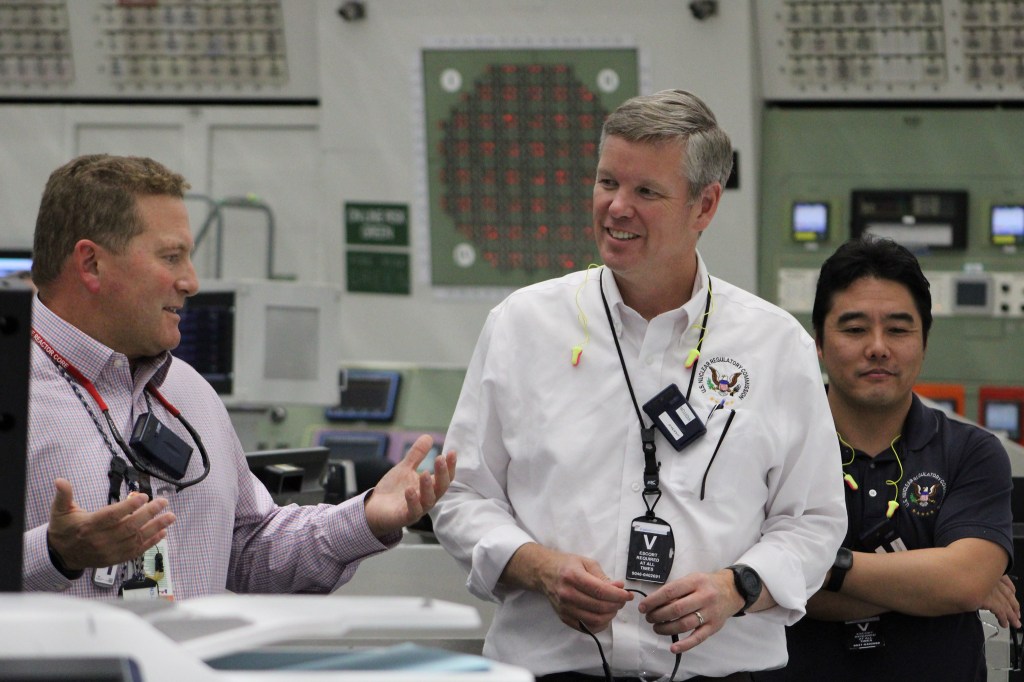
These have now been filled by two Republicans nominated by the White House — Douglas Weaver (straight from industry) and Ho Nieh, who has been spinning through industry-regulator revolving doors for much of his career.
Nieh has been an NRC employee for 23 years, reaching senior management level. He was confirmed to the commission by the US Senate on November 19, 2025 and sworn in on December 4, 2025.
Then, in yet another surprise move, on January 8, 2026, Trump named Ho Nieh the new NRC commission chairman, effective immediately, bumping David Wright back to commissioner. Caputo’s vacant seat was filled by Weaver.
This was a strategic political maneuver to set up a 3-2 Republican majority on the commission, with the Democrats — Bradley Crowell (term expiring June 30, 2027) and Matthew Marzano (term expiring June 30, 2028 — now pushed to the minority.
Prior to becoming NRC chair, Nieh cycled through a series of revolving doors between the federal regulator and the US commercial nuclear power industry, including serving as vice president of regulatory affairs at Southern Nuclear Company. Southern Company now operates eight nuclear reactors in Alabama and Georgia. But in June 2024, Ho Nieh was loaned out as a Southern Nuclear executive to work at the Institute of Nuclear Power Operations (INPO).
INPO is composed of the nation’s senior nuclear utility executives. It was created in 1979 by the US nuclear power industry in direct response to the March 28 Three Mile Island Unit 2 nuclear accident in Pennsylvania.
INPO is effectively “the shadow regulator” to the NRC and remains entirely off the public radar. Its “safety reports” are guarded secrets and withheld from NRC public records as “proprietary”. INPO reports are kept secret to encourage the nuclear industry to “self-regulate” its most controversial, costly and high-risk safety issues.
However, according to the US Government Accountability Office, the NRC has routinely chosen not to issue its own public information notices when INPO had already alerted the industry to potential safety problems. Lacking such needed transparency, there remain no essential checks and balances in place to promptly address the stubborn and increasingly costly issues that compete with the nuclear industry’s bottom line.
The shuffling of commission chair is surprising, mainly because Wright was considered to be one of those compliant yes-men that the Trump administration so esteems. Under questioning in September 2025 from California Democrat Adam Schiff, during a hearing of the Senate Environment and Public Works Committee, Wright had resisted suggestions he might buckle to pressure to rubber-stamp reactor licenses.
“Do you acknowledge that if you find that a reactor design is unsafe and vote that way, that you may be fired by the administration?” Schiff had asked. While the two Democrats on the then three-man commission agreed it was a possibility, Wright was boldly defiant. “It doesn’t matter,” he declared. “I’m going to make the right decision and I’ll stand by that decision.”
The decision soon to be before them is whether or not to grant a construction license for TerraPower’s 345-megawatt sodium-cooled fast Natrium reactor approved by NRC staff (a subsequent operating license will require a separate review).
The reactor is designated for a site in Kemmerer, Wyoming. The construction permit yet to be issued by the commission is for the nuclear component of the plant. TerraPower already broke ground on a 44-acre site in Kemmerer back in June 2024. But, even though the reactor is still on paper, it has already been called out as recklessly dangerous by experts in the field.
Eminent climate scientist, Michael Mann, has called the Natrium “misguided and dangerous.” Mann, professor of atmospheric science at Penn State University, told the German news outlet DW that the reactor was counterproductive to remedying the climate crisis “because it leads us down the wrong path. The obstacles to meaningful climate action aren’t technological at this point. They’re political,” he said.
“I’d say this was a joke but it’s no laughing matter,” wrote Dr. Ed Lyman, of the Natrium approval. Lyman, a physicist with the Union of Concerned Scientists, is deeply familiar with the kinds of technology being promoted by TerraPower and other experimental reactor startups.
“This is a dangerous reactor,” Lyman said. “Its liquid sodium coolant can catch fire, and the reactor has inherent instabilities that could lead to a rapid and uncontrolled increase in power.” Added Lyman: “The only way they could pull this off is by sweeping difficult safety issues under the rug or putting them off until the operating license phase.”
While we wait to see whether the NRC commissioners will duly do the sweeping, members of Congress are unfortunately pushing the same broom. Far from being a partisan issue, Democrats in both the House and Senate cheerlead for nuclear power just as hard from their side of the aisle.
A few Democrats have expressed concerns about safety issues, most recently Frank Pallone of New Jersey during a hearing of the House Committee on Energy and Commerce on January 7 this year. But with a focus entirely on worst case scenarios, valid those these concerns are, they seem to miss the more obvious reality that, dangerous or not, these new reactors, like their predecessors, are too slow and too expensive to serve any useful purpose. They just don’t want a nuclear accident in their constituency back yard.
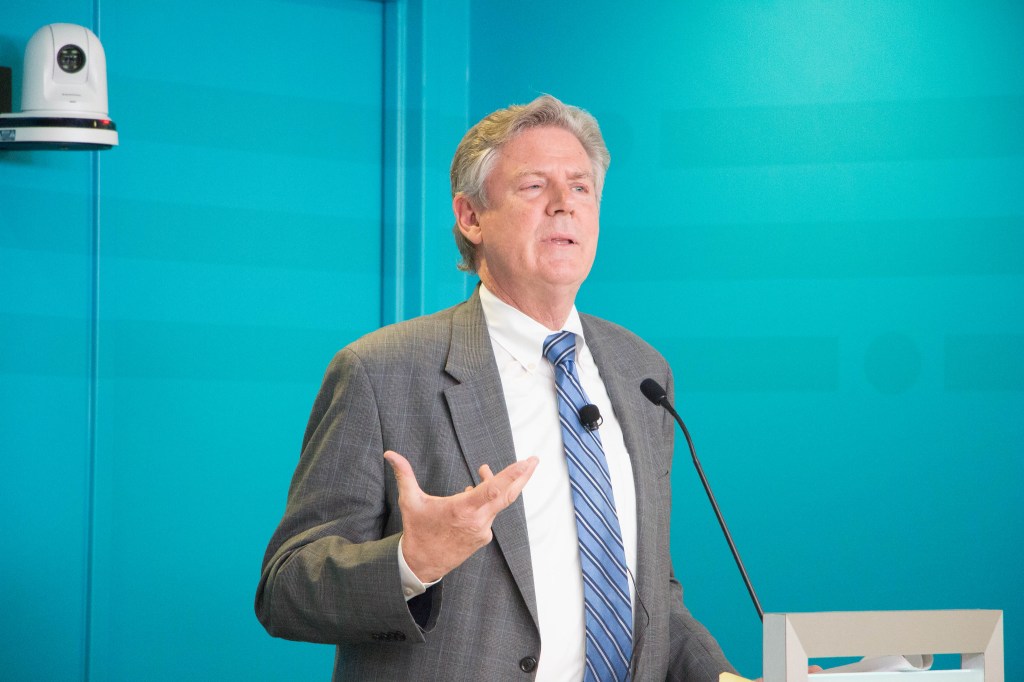
“I’ve been supportive of nuclear,” Pallone said. “If anything happens that gives the impression or actually makes it so that people’s lives are at risk, that’s going to be the end of it.” Of course, as long as nuclear power plants remain operational, people’s lives are at risk, and it’s time Pallone and other members of Congress realized that.
The witnesses for the House hearing — tellingly called “American Energy Dominance: Dawn of the New Nuclear Era” — came exclusively from the industry, with representatives from the Nuclear Energy Institute — the nuclear industry’s paid propaganda arm — and from Southern Company, the Nuclear Innovation Alliance and the Idaho National Laboratory.
Entirely missing were any contrary, independent, objective and scientifically knowledgeable voices. Did they invite Lyman or M.V. Ramana, or Arjun Makhijani, physicists who actually understand how precisely dangerous these new reactor schemes are?
Did they invite Amory Lovins to blow the lid off the extreme costs or Mark Jacobson to educate them on how they could achieve their same goals with renewables instead?
And did they invite anyone from the targeted communities to see if they actually wanted these things in their neighborhoods or had even been consulted?
Even the right wing British daily newspaper, the Daily Mail, ran a headline that screamed “Tiny city of just 2,000 residents are fearful as Bill Gates-backed nuclear plant dubbed ‘Cowboy Chernobyl is built on their doorstep,” borrowing the moniker Lyman had used for the Natrium plan.
“I don’t think there are, at least from our perspective, many communities that are out there raising their hands saying, ‘Yes. We want a nuclear project in our community with an expedited safety and environmental review,’” John Burrows, Wyoming Outdoor Council’s energy and climate policy director told his local NPR station. “It’s just not something that any community wants to see, especially for a pilot or demonstration project.”
At least 60 percent of Americans now say they want more nuclear power according to a recent Pew Research Center poll. Of course they do, because they, like members of Congress, are only listening to the endless propaganda drumbeat from the nuclear industry, blasted non-stop across mainstream media and almost always without challenge.
Lyman’s “Cowboy Chernobyl” quip is actually a deep serious warning. It’s time we drove those nuclear cowboys off into the sunset, not in glory but in disgrace.
Paul Gunter is the Director of the Reactor Oversight Project at Beyond Nuclear. Linda Pentz Gunter is the founder of Beyond Nuclear and serves as its international specialist. Her book, No To Nuclear. Why Nuclear Power Destroys Lives, Derails Climate Progress and Provokes War, can be pre-ordered now from Pluto Press.
Headline photo of Ho Nieh when he was NRC’s director of the Office of Nuclear Reactor Regulation, by NRC.
 Beyond Nuclear International
Pingback: The mostly non-corporate nuclear news -week to 24 January « Antinuclear
Pingback: 3 The mostly non-corporate nuclear news -week to 24 January « nuclear-news
Pingback: All the president’s yes-men? « nuclear-news