 Beyond Nuclear International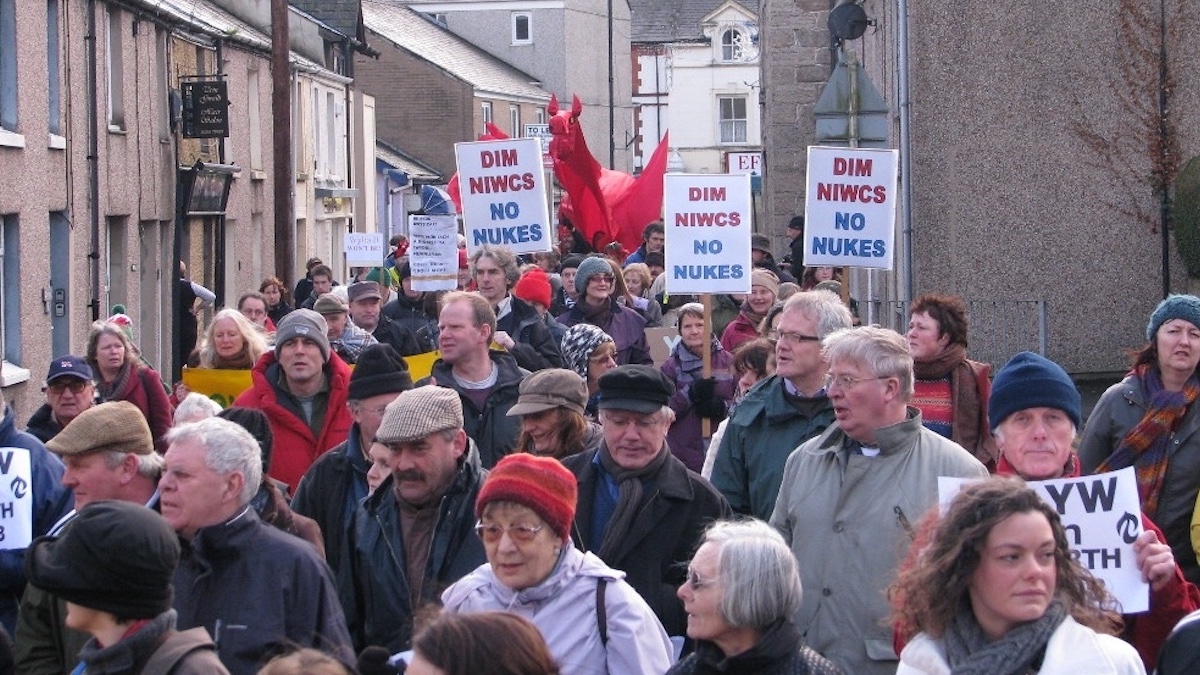
Citizens of Wales are gearing up for another assault on their right to a safe, clean and healthy environment
Anti-nuclear campaigners meeting in Wrexham last October issued a declaration calling on politicians representing Welsh constituencies in parliaments in Cardiff and Westminster to work for a nuclear-free, renewables-powered Wales.
Welsh campaigners are working with US, Canadian and other UK activists to establish a Transatlantic Nuclear-Free Alliance to campaign on issues of common concern. The new initiative came in conjunction with a screening of the award-winning film SOS: The San Onofre Syndrome, which highlights the impact of the decommissioning and the legacy of managing deadly radioactive waste faced by the neighbors of the San Onofre nuclear power plant in California.
The film’s messages resonate with international audiences faced with identical threats and challenges. At the screening, the audience heard from the filmmakers Marybeth Brangan and the now sadly late Jim Heddle as well as from Professor Stephen Thomas, Emeritus Professor in Energy Policy at Greenwich University and Richard Outram, Secretary of the Welsh Nuclear Free Local Authorities.
“The nuclear industry tries to assure us the radioactive waste disposal and reactor decommissioning are established processes with easily affordable costs,” Thomas said. “The truth is that we are three or more decades away from permanent disposal of waste and of carrying out the most challenging stages of decommissioning. The cost will be high, and the failure of previous funding schemes means the burden will fall on future taxpayers, generations ahead”.
Despite this, the UK Government will introduce developer-led siting plans, permitting nuclear operators to apply to locate new plants in sites throughout Wales, and intends to reduce regulation in the nuclear industry.
A recent Memorandum of Understanding was also signed with the United States that could lead to British regulators being obliged to accept US reactor designs not currently approved for deployment in the UK. Great British Energy – Nuclear has also acquired land at Wylfa in Anglesey (Ynys Môn) as a potential site for the deployment of one or more so-called Small Modular Reactors being commissioned from Rolls-Royce and the US company Westinghouse has also expressed interest in constructing a larger nuclear plant there.
The Welsh Government specifically created Cwmni Egino to develop a new nuclear plant on the Trawsfynydd site at the heart of the beautiful Eryri National Park. And in South Wales, US newcomer Last Energy is seeking permission to deploy multiple micro reactors on a former coal power station site at Llynfi outside Bridgend.
Eight leading campaign groups have backed the Wrexham Declaration which denounces the continued political obsession with the pursuit of nuclear power as a ‘fool’s errand’. NFLA Secretary Richard Outram explains why:
“Nuclear is too slow, too costly, too risky, contaminates the natural environment compromising human health, and leaves a legacy of nuclear plant decontamination and radioactive waste management lasting millennia that is ruinously expensive and uncertain. And nuclear plants represent obvious targets to terrorists and, as we have seen in Ukraine, to hostile powers in times of war”.
Campaigners are also convinced that nuclear power will worsen fuel poverty and climate change. As Welsh people face spiraling energy costs, with many in fuel poverty, while a new nuclear levy is to be added to all customers’ energy bills to help pay for the construction of the eye-wateringly expensive Sizewell C nuclear plant in Suffolk. Further, nuclear generation costs much more than generation from renewables, meaning more expensive electricity for consumers.
Significant nuclear generating capacity will also only come on line in at least a decade’s time, perhaps longer, and maybe never, when the most critical phase in which human intervention can arrest inexorably rising temperatures is now. Every pound spent on nuclear in the never-never is a pound denied for investment in the proven renewable technologies that can be built at scale and can deliver far cheaper, sustainable electricity now.
The anti-nuclear groups firmly believe that Wales can provide for its own energy needs solely through renewable energy. This must be combined with the comprehensive rollout of a national program of insulating homes and public buildings. This combination would provide electricity quicker and cheaper for consumers and make homes warmer, reducing fuel bills and fuel poverty, and improving public health, whilst cutting energy consumption and creating jobs, with many of these being directed to residents in poorer communities.
This initiative needs to be a national effort, with government supporting householders and residents to install renewable systems, such as rooftop solar, to make their homes and communities more energy-efficient and energy self-sufficient. A greater effort must also be made to utilize the potential of tidal, micro-hydro and geothermal power to contribute to the nation’s needs.
In making this Declaration, campaigners urged local Councillors, Welsh Government ministers, Senedd members, and MPs representing Welsh constituencies at Westminster to embrace this vision and join with the communities and people of Wales in working “together, earnestly and collaboratively, to provide for our nation a sustainable and affordable energy future that is free of the blight of nuclear power”, the Declaration said.
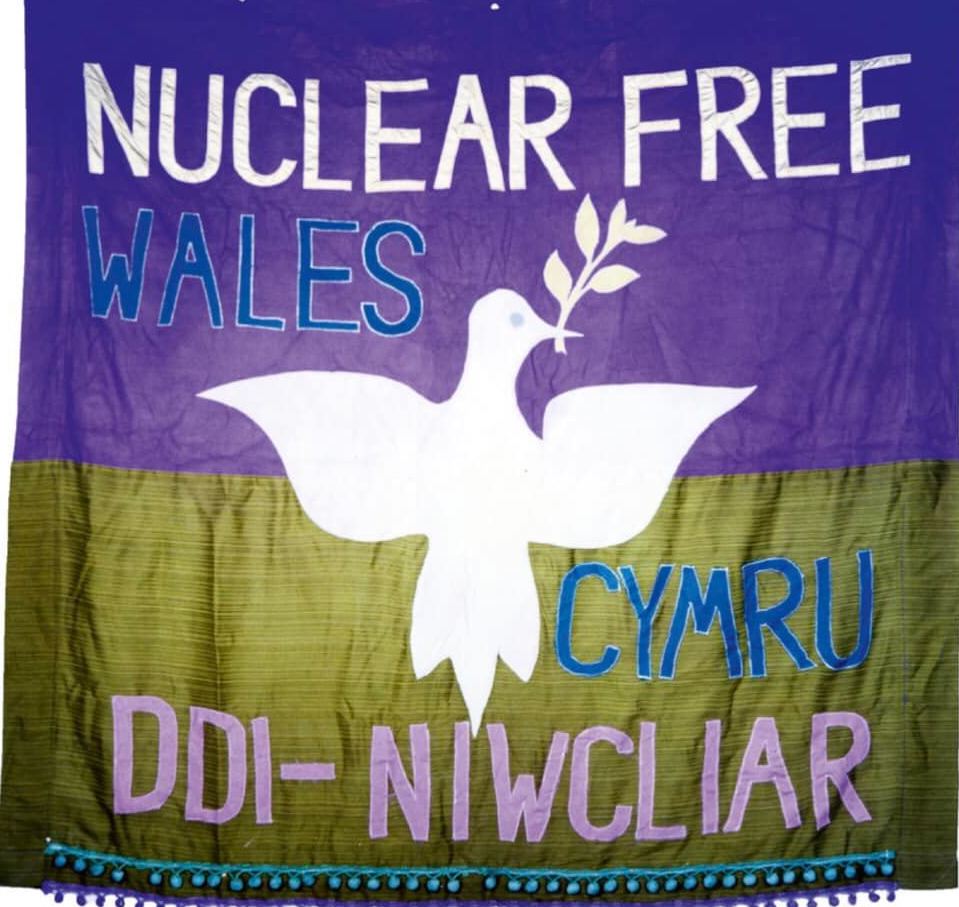
Several sponsors of the Declaration commented at its launch in October: Jill Evans and Jill Gough, CND Cymru: “CND Cymru congratulates Welsh anti-nuclear groups on their ‘No to Nuclear, Yes to Renewables Declaration’ issued in Wrexham today! We remain proud of our work over many years in strengthening the aspiration amongst local authorities, groups and individuals for a Nuclear-Free Wales — as first declared on February 23rd 1982. With climate change, nuclear accidents and pollution of our environment, the ambition for Wales and internationally has become even more important in the 21st century“ .
Brian Jones, No Nuclear Llynfi: “When we were campaigning for a nuclear-free Wales in the 1980s, renewable electricity generation barely existed. Now renewable energy has become mainstream, and is so much cheaper than nuclear power, it’s hard to understand why some people still want nuclear power, despite the dangers, cost, and the unsolved problem of dealing with the nuclear waste.”
Linda Rogers, Welsh Green Party and North-West Wales Green Party: “Advocates of nuclear power have tried to persuade us it is cheap, then that it would avert climate change and now, with the increased weaponization of nuclear plants, they would persuade us it is good for security. Nuclear power destabilizes the system, is dangerous and only increases the crisis of climate change.”
Headline photo of an anti-nuclear protest in Wales.
The opinions expressed in articles by outside contributors and published on the Beyond Nuclear International website, are their own, and do not necessarily reflect the views or positions of Beyond Nuclear. However, we try to offer a broad variety of viewpoints and perspectives as part of our mission “to educate and activate the public about the connections between nuclear power and nuclear weapons and the need to abandon both to safeguard our future.”
 Beyond Nuclear International