 Beyond Nuclear International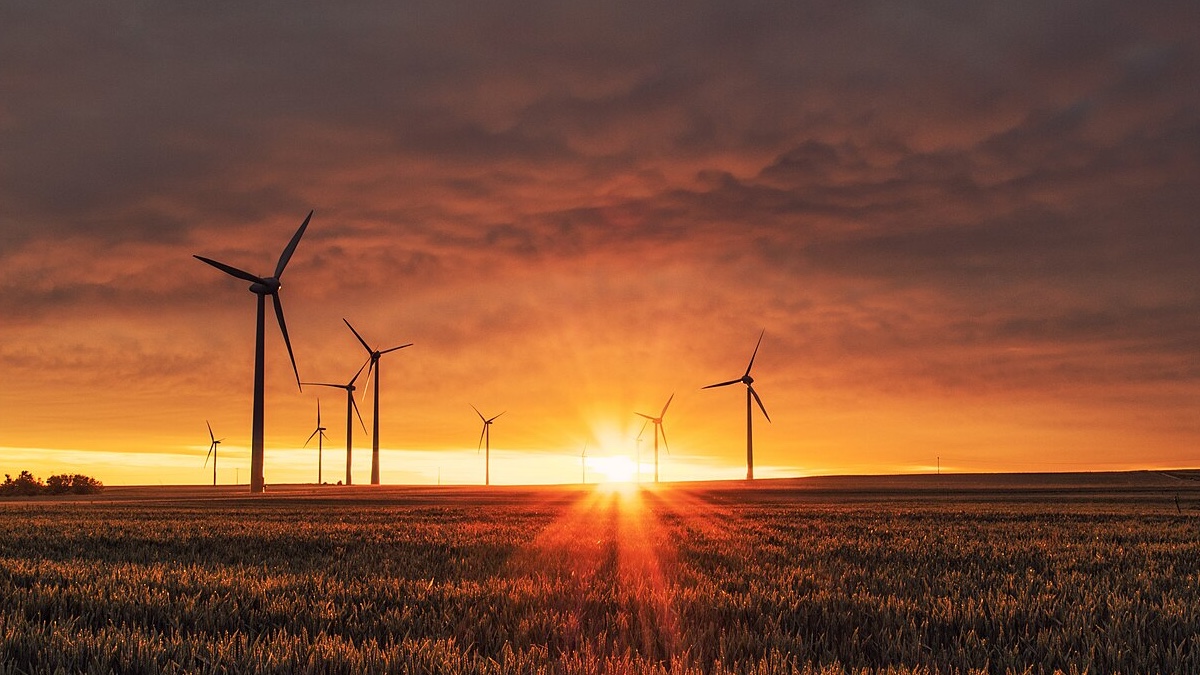
Solar and wind alone cut global greenhouse emissions by 12% writes David Toke
Wind and solar power are making major cuts in global carbon dioxide emissions. Greenhouse gas emissions would be at least 12 per cent higher if not for solar and wind power. Almost all of today’s solar and wind generation has arisen since 2010. Meanwhile nuclear’s contribution has remained almost the same in volume terms (as in 2010), and has greatly declined in terms of proportion of total electricity generated. This is despite the never-ending talk of a ‘nuclear renaissance ’.
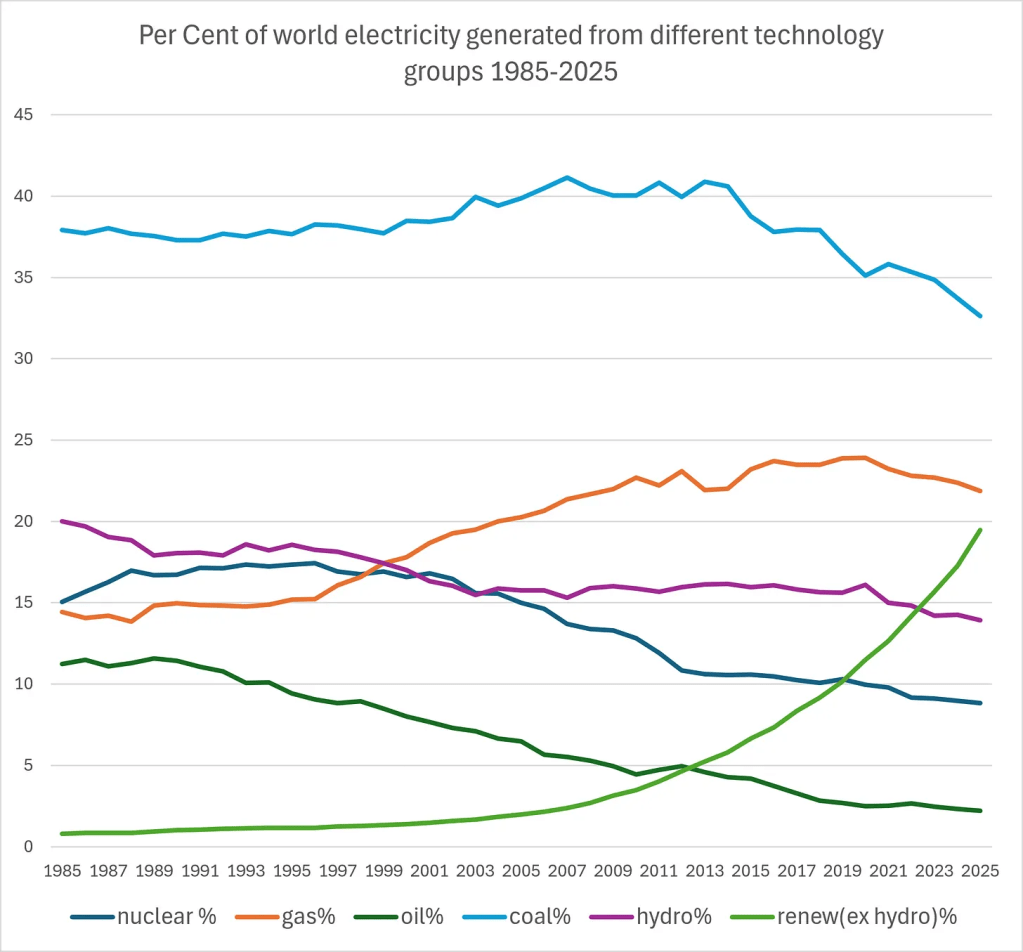
Solar and wind’s contribution to world electricity generation has increased to nearly 20 per cent in 2025, whilst nuclear’s contribution has fallen from a peak of 18 per cent in 1996 to just 9 per cent in 2025. This can be seen in Chart 1. The fact that solar and wind are making increasingly large cuts in carbon emissions is often overlooked. In addition, the impact of the closure of the Hormuz Straits has been lessened by renewable energy. Again, the contribution of renewables is often overlooked. Renewables, alongside energy efficiency and batteries, are turning out to be the leading force for energy security.
Chart 1
Wind and solar’s undercounted contribution
When energy statistics are collected, there is a clear statistical, if not actual political, bias against non-fossil fuels other than nuclear power and biomass. This is because in energy statistics all of the energy output of producing energy is counted, even though most of it is wasted. Fossil fuel energy is also wasted when used in inefficient machines such as motor vehicles or gas boilers. In the case of nuclear power, only one third of the energy is turned into electricity – the rest is wasted in warm water sent to rivers and seas. So in the energy statistics nuclear power counts for three times as much as solar, wind or hydro-electricity.
But the real impact of non-biomass renewables in cutting carbon emissions is at least three times their actual output. That is because otherwise fossil fuels would be producing the electricity, and electric machines are much more efficient at point of use (eg cars). Efficiency varies among power plants, with gas-fired generation generally wasting less energy than coal or oil plants. Overall, around 60 per cent of world fossil fuel energy is wasted in producing electricity.
But then, on top of this, you have to consider the carbon emissions that are saved by substituting fossil fuels for renewable electricity. For example, electric vehicles use around a third as much energy used by fossil fuel vehicles. Walking and cycling use even less! Heat pumps will use the electricity at least three times as efficiently as gas boilers. These gains are on top of the efficiencies gained in electricity production.
Electricity now makes up over 22 per cent of world final energy use, and this proportion is increasing (see Here). However, the problem, globally, is not as one reads in the media that electricity use is hurtling upwards as a result of plans for data centres (many of which never get built). Rather, it is that electrification is not happening fast enough! We need a great push for energy-efficient technologies. The EU has set a target for electrification of 46 per cent of final energy by 2040.
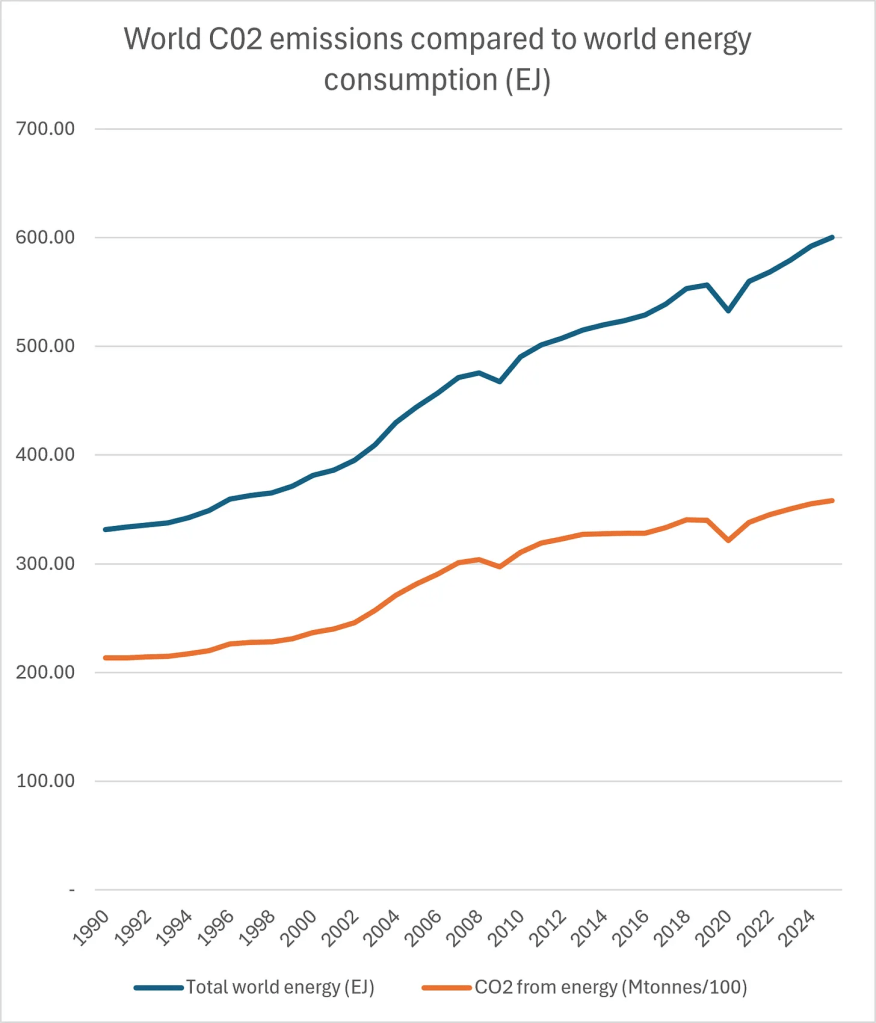
Chart 2 shows how energy consumption has changed since 1990 (in EJ) alongside a (scaled) representation of carbon dioxide emissions in million tonnes divided by 100. Chart 2 just includes the impact of carbon emissions. You can see that there has been some decoupling of the rate of energy consumption increase compared to the increase in carbon dioxide emissions. Not nearly enough, obviously, but there’s a start at least. So all those naysayers who say renewables are making no difference should go and…think again!
Chart 2
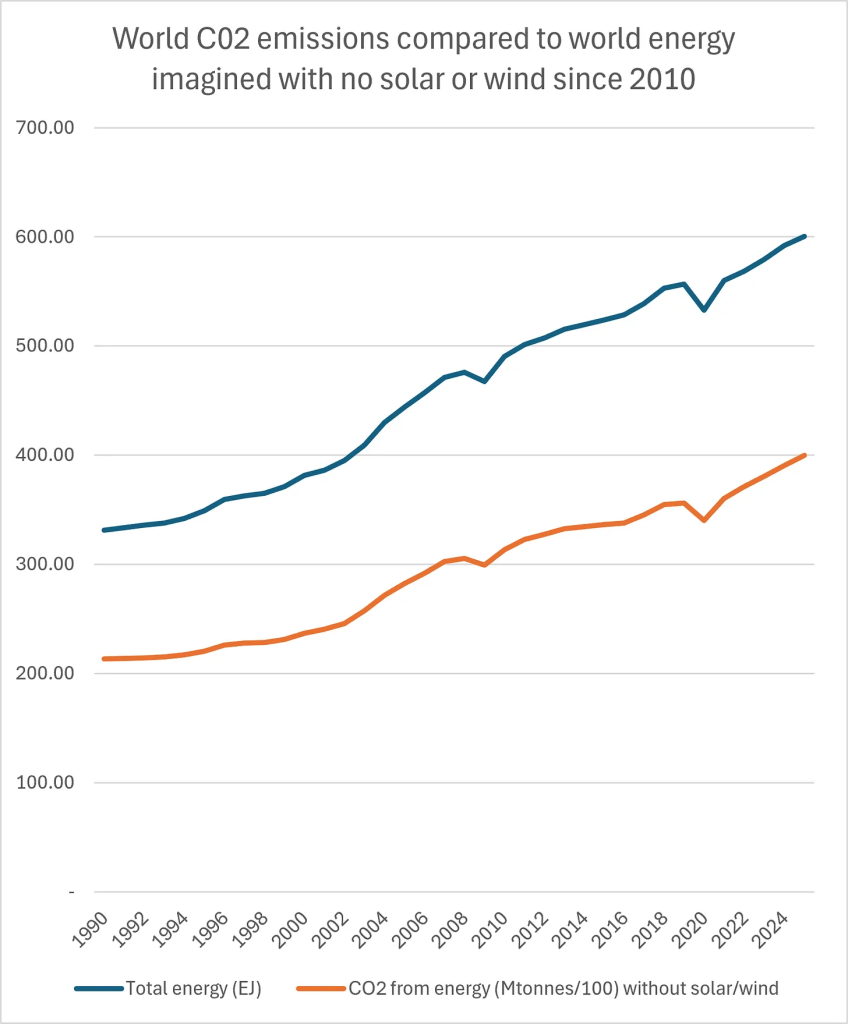
In Chart 3 below you can see a ‘counterfactual’ of what would have happened if there had been no solar and wind expansion since 2010. There is less of an obvious decoupling. What is missing from Chart 3 is the fact that greenhouse gas emissions would have been more than 12 per cent higher if not for solar and wind production (as shown in Chart 3). I say ‘at least’ because in addition to the ‘counted’ carbon emissions, solar and wind consumption would also have avoided consumption of other greenhouse gases such as methane leakages and nitrous oxide generation. If you add hydroelectricity to wind and solar, then the amount of carbon dioxide displaced by renewables rises to over 20 per cent.
Chart 3
Nuclear non-renaissance
Of course nuclear revival is always (in the media) just around the corner. Until, of course, little turns up afterwards. Tony Blair talked up a nuclear revival in 2006, soon after his US buddy George Bush had promoted laws, in 2005, which offered massive loans for new nuclear power plants. However, only two nuclear power plants were built, eventually, very much over-cost, especially to electricity consumers in Georgia where the plants were based (at the same site). Another two plants were started in South Carolina, but the projects proved disastrous and were abandoned unfinished.
Now we’ve got the same thing happening again under Trump – but with a twist – in the USA at least there aren’t any new plants being built at all! (see HERE). That’s despite Donald Trump’s government offering large loans to fund them. Ah yes, there’s the ‘small modular reactor’ programme. But that, as I have already discussed in an earlier post, is a fantasy. Their electricity would cost a lot more than even conventional reactors (see HERE).
But of course a small number of power plants will get built called SMRs. They will not be followed by any amount of capacity that will rival even Denmark’s renewable programme on its own. I understand a lot of stress is also being placed on the completion of small micro-reactors that are to be used by the US military (instead of diesels?). Well, US military, good luck with that. Just keep them away from the drones!
True, the Chinese have been building quite a few nuclear power stations – indeed, half of all nuclear power plants in the world under construction are in China. But then China’s nuclear programme is dwarfed by its renewable energy programme. Around 75 nuclear power plants might be built by 2035 in the world. However, what is often not mentioned is that this may not be much more than the number of plants that are retired, which runs at around 7 a year.
In the UK the latest excuse for the non-completion of the Hinkley C reactor is that the poor hapless (French) state-owned EDF is being forced to reduce the number of fish that it kills during operation. But is this an excuse for the plant being already behind its 2025 start-up date and heading for start-up beyond 2030? I think it is. Its sister plant, Sizewell C, which is slated to follow on, is, according to the UK Government’s own admission, already more expensive than Hinkley C. And that is before the rest of the cost overruns rack up and before any of that coveted first concrete is poured.
When will Sizewell C be in operation? I wouldn’t bet on it this side of 2040! The main function provided by new nuclear power to governments such as the UK and the USA is that of a notional fig leaf to exorcise a failure to push ahead more vigorously with a strategy based on renewables and energy efficiency.
Conclusion
The world needs energy to be used efficiently through electricity. It needs this to be supplied by renewable energy. Anything else that doesn’t help this is most likely a distraction at best. That also includes the methods used to count energy, which are dysfunctional because the bulk of the energy they count is wasted. This appears to reduce the real impact of renewables and electricity. Electrification means technologies like heat pumps and EVs, and the real power of electrification will be running heating, transport, and industrial mechanical activity through renewable energy.
David Toke is the author of the book ‘Energy Revolutions – profiteering versus democracy’ (Pluto Press); He is Reader in Energy Politics at the University of Aberdeen and Director of 100percentrenewableuk. This article first appeared on his substack and is republished with permission of the author.
Headline photo by Karsten Würth/Unsplash/Wikimedia Commons.
The opinions expressed in articles by outside contributors and published on the Beyond Nuclear International website, are their own, and do not necessarily reflect the views or positions of Beyond Nuclear. However, we try to offer a broad variety of viewpoints and perspectives as part of our mission “to educate and activate the public about the connections between nuclear power and nuclear weapons and the need to abandon both to safeguard our future”.
 Beyond Nuclear International
Pingback: Just the uranium/nuclear industry news this week « nuclear-news
Pingback: Nuclear stagnates while renewables soar « nuclear-news