 Beyond Nuclear International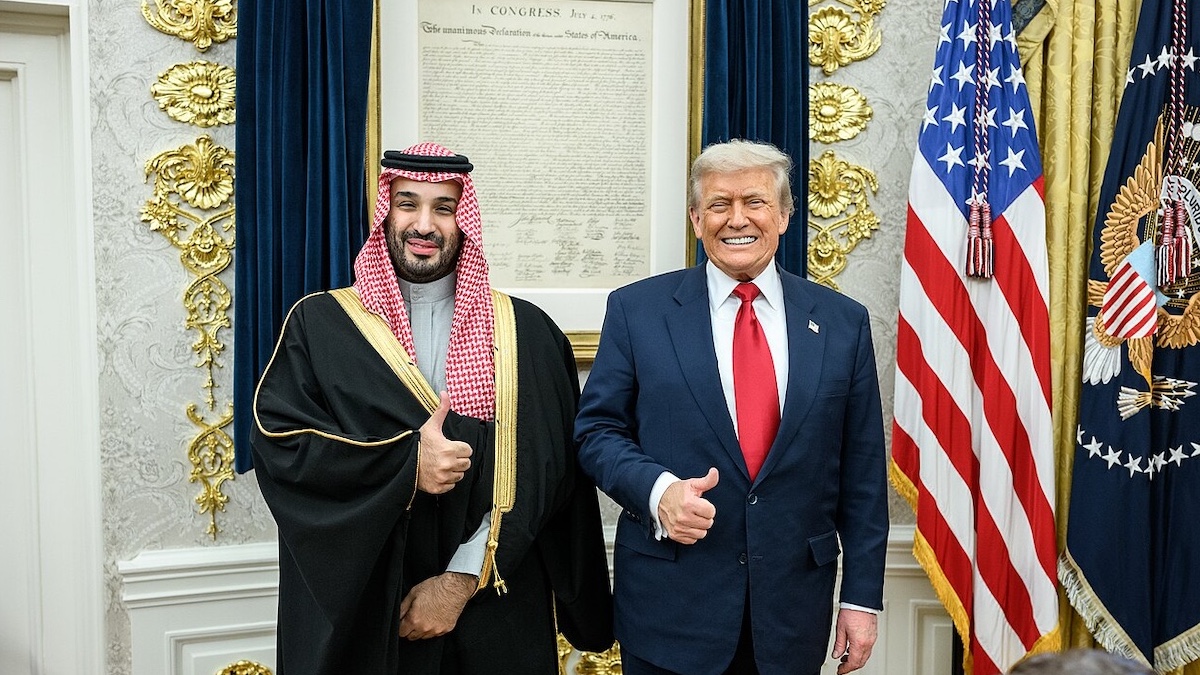
Is it actually a boon for US companies, or another scheme to enrich Trump, his family and cabinet colleagues, asks Linda Pentz Gunter
On August 25, Trump sent his nuclear deal with Saudi Arabia to the US Senate for consideration. This started a 90-day clock during which time the Senate could choose to accept or reject the proposal.
But what exactly was in it? The usual Trump White House opacity — which often includes word not matching deed — prompted a letter on September 16 from 18 US senators, including two Republicans and one independent, asking for more details.
”Access to the full text is required for the Senate and the public to have a clear understanding of the commitments being made on the nation’s behalf and those being made by Saudi Arabia to the United States,” said the letter, led by Senators Ed Markey (D-MA) and Jeff Merkley (D-OR) and addressed to Secretary of State Marco Rubio and Energy Secretary Chris Wright
By September 25, six of the Democrats who had signed the first letter wrote again to Rubio and Wright.
“We are gravely disappointed to see the Trump Administration enter a deal to provide nuclear technology to Saudi Arabia that fails the Gold Standard nonproliferation test. The Gold Standard has longstanding bipartisan support and reflects internationally recognized best practices. By abandoning it the agreement would allow Riyadh to acquire the means to potentially produce weapons-grade nuclear materials without the strictest nonproliferation safeguards the U.S. has long championed as a condition of such cooperation.
“The U.S.-Saudi nuclear deal calls for a study lasting up to two years on uranium enrichment in Saudi Arabia. After that, the United States could build a uranium enrichment plant on Saudi soil. The United States has never directly transferred an enrichment plant to a non-nuclear-weapon state, let alone one whose leaders have threatened to pursue nuclear weapons. The recklessness of this arrangement underscores the importance of utilizing the most stringent safeguards and protections, as reflected by the Gold Standard.”
The reference to Saudi leaders threatening to pursue nuclear weapons refers to a statement made by Saudi Crown Prince Mohammed bin Salman during a March 15, 2018 interview with CBS News, during which he stated: “Saudi Arabia does not want to acquire any nuclear bomb, but without a doubt, if Iran developed a nuclear bomb, we will follow suit as soon as possible.”
In theory, the Saudi nuclear deal is what is known as a “123” agreement, a legally binding 30-year bilateral pact required by Section 123 of the U.S. Atomic Energy Act of 1954 that establishes the framework for significant civil nuclear cooperation between the United States and another nation.
What is clearly in Trump’s Saudi deal is approval to provide Westinghouse AP1000 reactors to Saudi Arabia, a deal worth tens of billions of dollars to the company.
Westinghouse is most notorious for going bankrupt and coming close to handing the same fate to its parent company at the time, Toshiba, while attempting to build four AP 1000s in South Carolina and Georgia. Construction began in 2013 but the South Carolina reactors were abandoned mid-constriction and the Georgia pair arrived seven years late and cost $36 billion, well above the original $14 billion estimate.
What is at issue, and which disturbed the senators, is whether the deal would allow for uranium enrichment within Saudi Arabia. Wright was quick to dismiss that concern at a press conference held the same day the deal was sent to the Hill.
“There’s no reason to bring uranium enrichment to Saudi Arabia,” Wright said at the press conference, which was announcing the equally reckless ATLAS project that would put nuclear reactors on commercial shipping as well as develop floating reactors. But, added Wright about the Saudi Westinghouse deal,“They don’t even have a nuclear reactor yet. So I would say that’s something many years down the road.”
The Westinghouse reactors are also likely to be “many years down the road” given the company’s track record. But all of the fanfare about how great this deal is for American business appeared to ignore the fact that Westinghouse is no longer actually an American company.
Today, Westinghouse is owned by two Canadian companies, Cameco and Brookfield Asset Management, a US-based company that is a subsidiary of Brookfield Corporation (formerly Brookfield Asset Management Inc.), a Canadian multinational investment company. Needless to say, the road from there leads straight back to the White House.
As the New York Times reported in July, Brookfield Asset Management “is a frequent business partner with Newmark, the real-estate firm run and owned in part by the sons of Commerce Secretary Howard Lutnick.”
Brookfield Asset Management also has connections with White House ‘senior envoy for peace’ and Trump son-in-law, Jared Kushner. In 2018, the Kushner family was struggling to maintain control of a Manhattan luxury property —the somehow appropriately numbered 666 Fifth Avenue tower block. It was Brookfield Asset Management that came to the rescue. As the New York Times revealed then, “The deal will be a boon to the Kushners, who are struggling to recoup their investments in their flagship building.”
Of further concern in the deal is that Saudi Arabia is not required to adopt the IAEA Additional Protocol. This is significant because without that extra power for the International Atomic Energy Agency to check Saudi Arabia’s nuclear sites for covert nuclear weapons activities, the pathway is of course a lot easier to do precisely that.
It’s also significant because Saudi Arabia has already talked about developing a full uranium fuel cycle, including uranium mining as well as making its own reactor fuel. Verifications and inspections are important to ensure that any country with a civil nuclear program is not developing nuclear weapons.
In addition to the genuine proliferation concerns surrounding the Saudi nuclear deal, it is also patently obvious that if Saudi Arabia really wanted to replace the oil it is currently burning with an alternative, less carbon-emitting energy source, it has absolutely no need to choose nuclear power, the most expensive, slowest and most dangerous energy source with an unsolved radioactive waste problem.
The kingdom is more than 90 percent desert, making solar and potentially also wind the obvious choice as an energy replacement for oil, which the Saudis claim they want to burn less of (or, more realistically, export more of abroad.) In fact, the Saudis already know this, given they have a 600-megawatt solar project that is currently supplying electricity at 1.04 US cents per kilowatt-hour, a world record for the lowest contracted price for solar power generation.

As Massachusetts Senator Ed Markey, then a Congressman, asked pointedly of then Energy Secretary Samuel Bodman back in 2008 during a hearing before the House Select Committee on Energy iIndependence, “But aren’t you suspicious that the Saudis don’t want a solar agreement? Saudi Arabia is the Saudi Arabia of solar. There it is. It sits there as a desert with sun 12 months a year, blistering hot. Why wouldn’t this administration be suspicious that they are asking for nuclear rather than solar power exchange in order to meet their long-term energy needs?”
Of course, it’s not clear whether, even if the deal is approved by Congress, the Saudis are actually going to sign off. Trump has made it a condition that the Saudis sign on to the Abraham Accords, which force them to normalize relations with Israel. Saudi Arabia has flatly rejected that demand so far, absent a viable path to an independent Palestinian state.
Linda Pentz Gunter is the Executive Director of Beyond Nuclear and writes for and edits Beyond Nuclear International. She is the author of the book, No To Nuclear. Why Nuclear Power Destroys Lives, Derails Climate Progress And Provokes War, published by Pluto Press. Any opinions are her own.
Headline photo of Saudi Crown Prince Mohammed bin Salman and President Donald Trump by The White House/Wikimedia Commons.

