 Beyond Nuclear International
Anti-nuclear protesters from the 1970s were back in force at Lowell, MA to protest a pro-nuclear gathering of northeastern governors who didn’t turn up, reports David Detmold
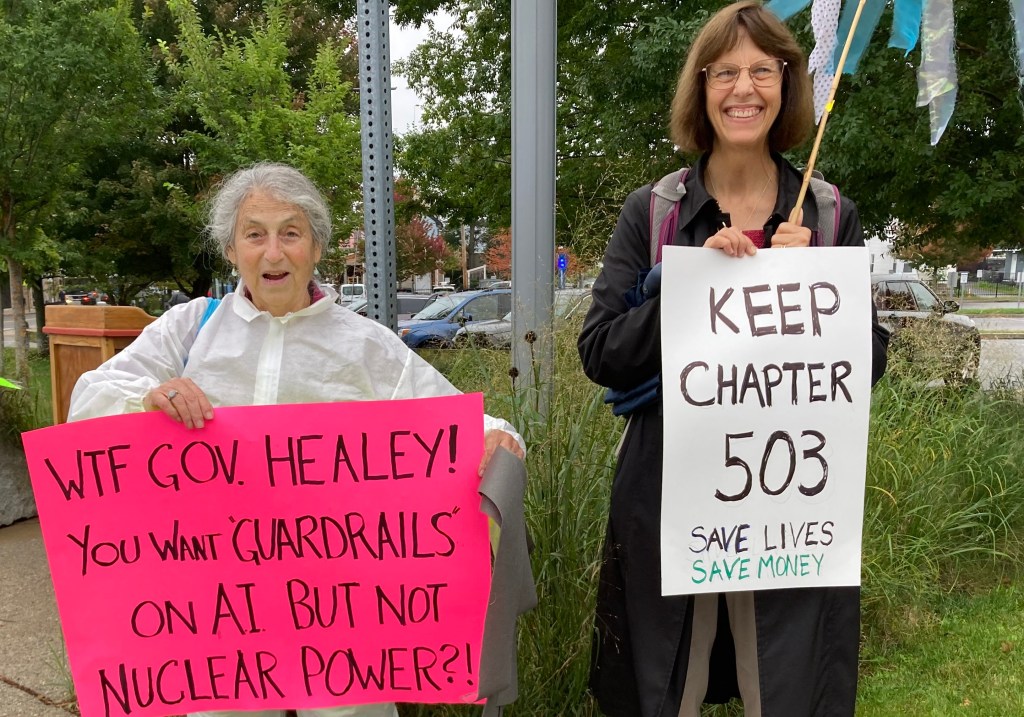
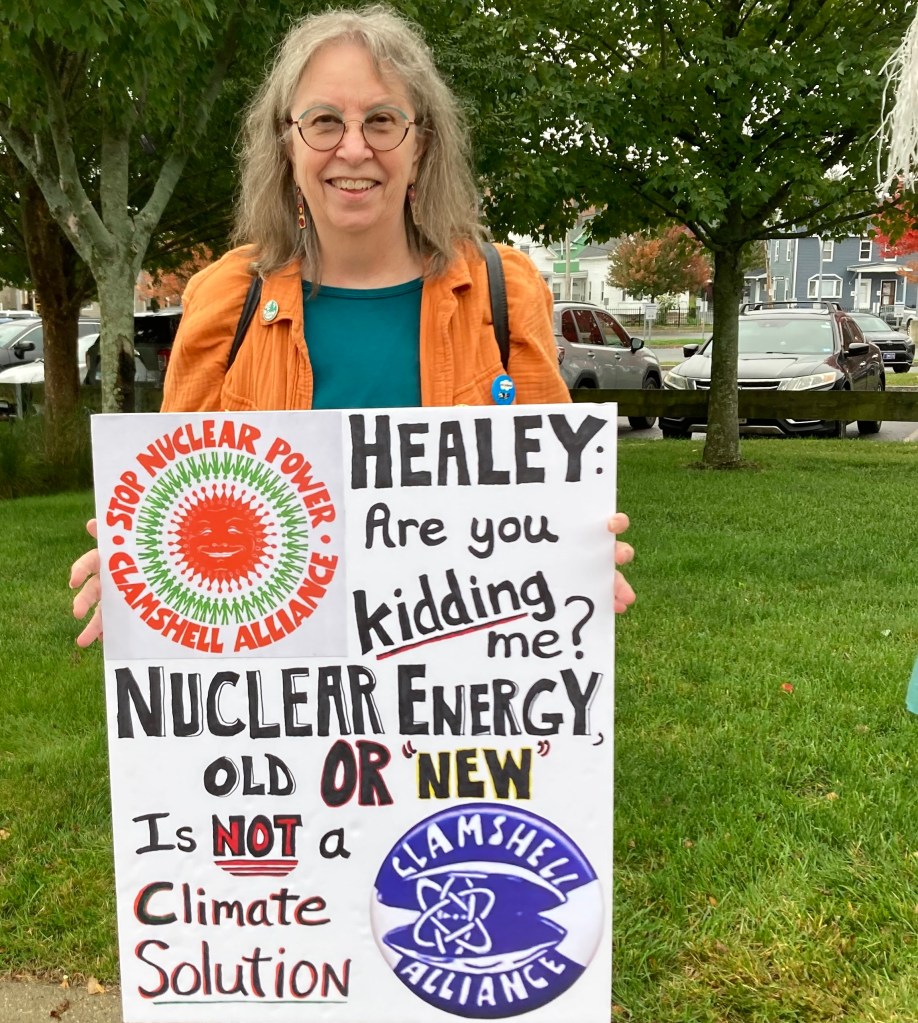
In a protest vaguely reminiscent of the 70s, three dozen antinuclear, pro-democracy activists from New Hampshire, Vermont and Massachusetts gathered in front of the Meehan Center at UMass Lowell on September 30 to tell the governors of the six Northeastern states, “No Nukes.” The governors had been invited to attend a conference promoting the advantages of next generation nuclear power in the Northeast.
Outside the conference hall, the small crowd of protestors seemed a bit dazed by the circularity of time and circumstance since they first got together to stop the construction of the Seabrook nuke in the mid-70s, and to decommission the Vermont Yankee reactor in the early 80s.
You could almost hear the lyrics from an old Talking Heads song hovering in the background.
“How did we get here?”
We got there, as Deb Katz, director of the Citizens Awareness Network put it, because “the governors have drunk the nuclear Kool-Aid.”
That acid has been offered up by the Visigoths who have taken over Washington DC and sacked the Department of Energy. Even as the last of Revolution Wind’s 65 giant turbines snuck past the federal blockade from their long winter on the drydocks of New London, CT this month to begin providing 704 megawatts of renewable energy to the region, T. Rump’s minions put up $17.5 billion in taxpayer subsidies as incentive for the first five states to climb on board the radioactive bandwagon and start building new nukes.
Read the fine print on those government low interest loans and you will find the Present Resident of the White House personally invested with a 20% stake in a $6 billion merger between Trump Media and Technology Group (DJT) and the nuclear fusion start-up TAE Technologies, another example of the power of corruption and the corruption of power.
Reactors for war?
This summer, in a further attempt to jumpstart the moribund domestic nuclear power industry, the White House ordered the Department of War to construct nuclear reactors on five Army bases, at an estimated cost to the taxpayers of $2.5 billion. In an end-run around the rickety regulatory framework that once tried to prevent workers and the general public from being exposed to excessive radiation from the daily operation of civilian nukes, these military nukes would be exempt from even the nominal oversight of the neutered Nuclear Regulatory Commission.
Under the current regime, all pretense of protecting the public has been tossed overboard at the NRC, which is ditching its ALARA (As Low As Reasonably Achievable) radiation standard and going all out to make nuclear power profitable for its balky investors, public health be damned.
The governors of the six Northeastern states can read the nuclear tea leaves as well as anyone, and Governor Maura Healey of Massachusetts is the chief culprit here. She was the one who invited her five neighboring chief execs for the pronuclear booster day rally on September 30 in Lowell.
None of the governors bothered to show up, including Healey, but they sent their aides to declare to the media: “We’ve all Gone Fission.”
The real action was outside the canned conference where members of antinuclear groups like CAN and the Clamshell Alliance held a lively press conference under the overarching umbrella of the Coalition for Democracy and Safe Energy.
Block Healey’s bad bill
Protestors speculated that the entire conference was cooked up by Healey to put pressure on the six Massachusetts legislators who are negotiating a final version of her sprawling energy bill.
The Massachusetts House version of that bill went along with the governor and included a repeal of the 1982 law passed by referendum – with more than 2/3rds majority support – requiring that a safe storage facility be up and running for nuclear waste before the voters themselves sign off on any proposed new nuclear reactor in Massachusetts.
The Massachusetts senate resisted Healey’s bid to repeal this inconvenient law, which stands in the way of her plans for new nukes to power AI facilities in some far-off county to the west of Boston.
The senate and house conferees are expected to reconcile their versions of Healey’s energy bill this month. Everyone concerned should take a few moments to send and share with friends the following action letter to the six Massachusetts legislators in the conference committee.
“We are here today to demand our governors do better than bringing experimental nukes and data centers to our communities,” said Deb Katz, director of CAN, the Citizens Action Network. “Our governors abdicated their responsibility to address the high level nuclear waste crisis in our backyards. They abdicated their responsibility to protect us.
“Millions upon millions of curies of nuclear waste are trapped at reactor sites around the Northeast with no solution. Nuclear waste that remains dangerous for thousands of years. This is the broken promise of the nuclear industry, the federal government and our governors,” Katz said.
Katz, who lives in the small Franklin County hill town of Rowe, knows whereof she speaks. Seven metric tons of high level nuclear waste lie on the banks of the Deerfield River in unprotected storage casks at the former Yankee Atomic site in Rowe, a few miles from her home.
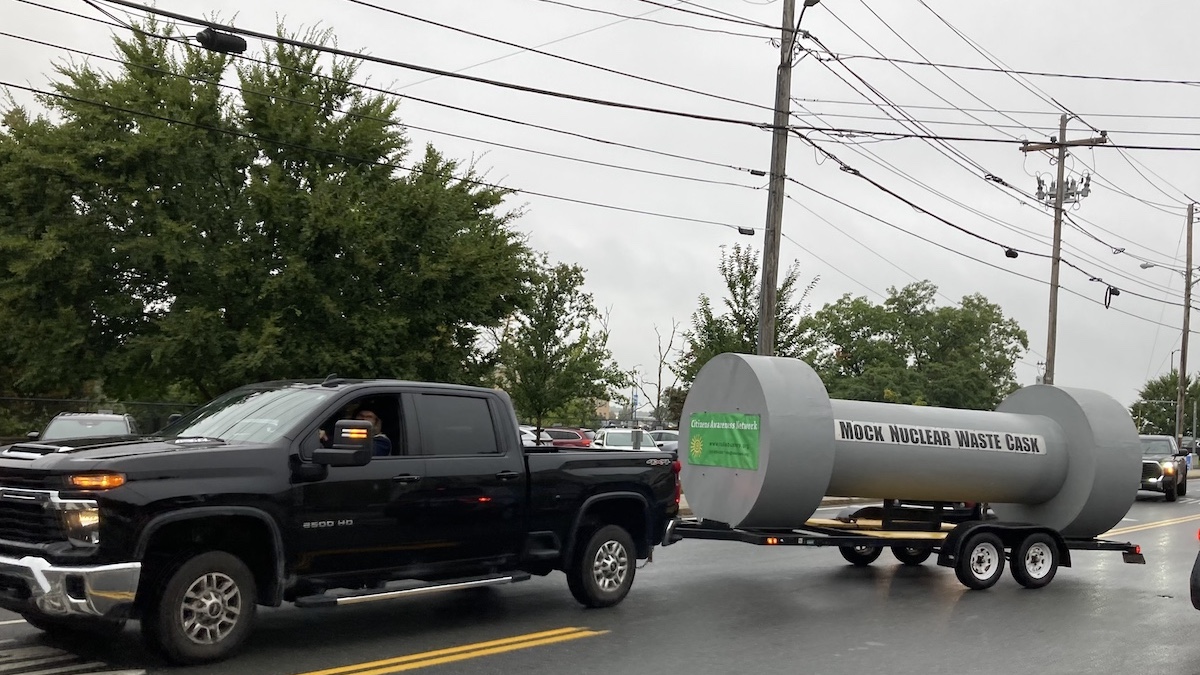
For the duration of the two hour protest, Schuyler Gould of Brattleboro, past president of the New England Coalition on Nuclear Pollution, drove around the Meehan Center towing a full-scale model of a nuclear waste storage cask in an unending circle. It was an apt illustration of how the federal and state governments are dealing with the ‘final disposal’ of nuclear power’s carcinogenic end product.
Chris Williams, speaking on behalf of the Vermont Yankee Decommissioning Alliance, dispensed with the balky sound system (a battery powered megaphone) to address the crowd.
“As I drove down here this morning from my home in Hancock, VT, and I passed the site of the Vernon nuke, I felt good because: We Won! In 2014, we shut Vermont Yankee down.
“Now, Vermont governor Phil Scott would have you believe nuclear power is clean energy. But the ratepayers just spent $650 million of their own money cleaning up that site, and it is still contaminated. Fifteen hundred boxcars brought the low level nuclear waste from Vermont Yankee to a West Texas town called Andrews, and I can assure you the people of Andrews, Texas are not happy about it. And 700 tons of high-level waste from Vermont Yankee remain onsite, on the banks of the Northeast’s longest river. There is nothing clean about nuclear power.”
Cancer cluster evidence
Dr. Peter Moyer, chair emeritus at Boston University’s School of Medicine, spoke on behalf of Physicians for Social Responsibility, citing two recently published epidemiological studies by the Harvard T.H. Chan School of Public Health, evaluating the human health impact of living within 20 miles of a nuclear reactor.
“I was not surprised to find an increase in cancer fatalities statistically correlated to living in proximity to nuclear reactors,” said Moyer, who added the worst area for excess cancer fatalities in Massachusetts is Plymouth County, near the mothballed Pilgrim reactor site.
The Harvard studies found that around the country, since the year 2000, 115,000 excess cancer deaths were statistically associated with living in proximity to nuclear reactors, according to data published in Nature Communications in February of this year.
Drawing on statistics from the Massachusetts Cancer Registry, a second Harvard study (published in December of 2025) found an excess of 20,600 cancer deaths in Massachusetts linked to nuclear reactor proximity in the same time period, with a spike around Plymouth.
Dr. Moyer urged everyone in the audience to read a book published by a nuclear physicist named M.V. Ramana called Nuclear Power is Not the Solution, which details the high costs, slow deployment, and radioactive hazards of this uniquely unforgiving technology. Perhaps a collection could be taken up to buy a copy for each of the Northeastern governors.
“Amplify your voice”
Clamshell Alliance member Nelia Sargent, traveling south to join the protest from her home in Claremont, NH, exhorted the small crowd to think big.
“When we started the Clamshell Alliance we were few in numbers,” she reminded her listeners, as she detailed the rapid increase in nonviolent civil disobedience arrests at the nuke site in Seabrook, where 18 protestors were arrested on August 1, 1976. Half a year later, 1414 people trained in nonviolence and formed in affinity groups were arrested in a massive act of civil disobedience there on April 30, 1977, launching a worldwide movement of opposition to nuclear power.
“Each of you should go home today and find a way to amplify your voice and spread the message,” Sargent urged.
Taking issue with the entire tenor of the protest, a brazen interloper in a bespoke purple suit and polka dot tie going by the name of Will Newcomb commandeered the megaphone to jeer at the Lowell protestors.
“We are done with the mob rule you like to call democracy. It’s time for the divine right of kings!”
As protestors tried to wrest the megaphone from his clutch, Newcomb kept his cool and made one last pitch before he was hustled away.
“Modular nuclear reactors are the coming thing. I have one right over here in the trunk of my Tesla I could sell you at a terrific discount. Before Maura Healey forces you to put one in your driveway at cost. Get ‘em while they’re hot! Mine come with a free toaster….”
Ann Darling, of Easthampton, MA, speaking calmly for the Commonwealth Coalition for Democracy and Safe Energy asked for sanity and a defense of the democratic system. “Our House of Representatives included the repeal of Chapter 503 in their energy bill, but the Senate did not – because hundreds of people just like you made calls and sent emails and wrote letters to the editor. Now these two bills must be reconciled and voted on by the entire legislature this fall. We need to keep up the pressure. The governor is hosting this summit today to make it seem like nuclear power is inevitable and widely accepted. It is not!”
Democracy is a fragile thing.
Note: Massachusetts residents can use this link to sign the action letter to tell the six Massachusetts legislators negotiating our nuclear future not to repeal the safeguard law passed by the people.
Conference Committee members to call are:
Sen. Michael Barrett: 617-722-1572 / Mike.Barrett@masenate.gov (Room 312-B)
Sen. Cynthia Creem: 617-722-1639 / Cynthia.Creem@masenate.gov (Room 312-A)
Sen. Bruce Tarr: 617-722-1600 / Bruce.Tarr@masenate.gov (Room 308)
Rep. Mark Cusack: 617-722-2030 / Mark.Cusack@mahouse.gov (Room 43)
Rep. Bradley Jones: 617-722-2100 / Bradley.Jones@mahouse.gov (Room 124)
Rep. Aaron Michlewitz: 617-722-2990 / Aaron.M.Michlewitz@mahouse.gov
(Room 243)
David Detmold is an author, carpenter, journalist and activist based in Montague, MA.
Headline photo: A mock radioactive waste cask is driven by Schuyler Gould through Lowell to the protest.
The opinions expressed in articles by outside contributors and published on the Beyond Nuclear International website, are their own, and do not necessarily reflect the views or positions of Beyond Nuclear. However, we try to offer a broad variety of viewpoints and perspectives as part of our mission to educate and activate the public about the connections between nuclear power and nuclear weapons and the need to abandon both to safeguard our future.

