 Beyond Nuclear International
A new French fairy tale

Nuclear wolf can’t fool us in grandma’s clothing
By Axel Mayer
“Bread and games”(Panem et circenses) were the enforcement strategies in the Roman Empire to maintain power. “Cheap petrol, cheap electricity and football” are popular campaign strategies under a democracy, says Axel Mayer, Vice-President of the Trinational Nuclear Protection Association (TRAS).
In France, the nuclear industry is in decline and the nuclear company EDF is heavily in debt. At the same time, President Macron is once again promising cheap nuclear power and wants to have new small nuclear power plants built. A small part of the French nuclear industry’s financial problems is to be solved with EU money.
In this context, the fairy tale of cheap French nuclear power is happily spread in France and also in Germany and the use of nuclear energy is praised as the miracle weapon in the losing war against nature and the environment. However, the price of electricity in France is only apparently cheap.
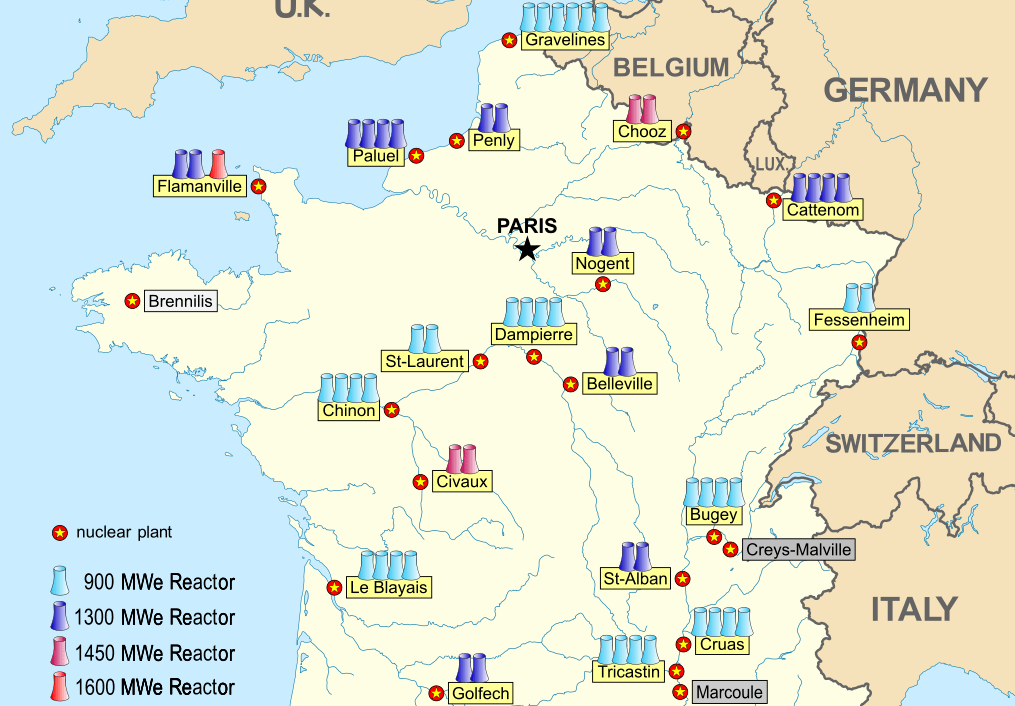
According to a report of the supreme audit court in France, the research and development, as well as the construction of the French nuclear power plants, cost a total of 188 billion euros. Since in France the “civilian” and the military use of nuclear power cannot be separated, the sum is probably much higher. Retrofitting France’s outdated reactors will cost over 55 billion euros. Liberation magazine reports retrofitting costs of nearly 100 billion euros by 2030.
Read MorePeace boat’s message is clear
Golden Rule mission urges support for nuclear ban treaty
By Gerry Condon
Editor’s note: The Golden Rule is making a historic voyage for peace around the US currently. This article, by the president of the Veterans For Peace Golden Rule Project, Gerry Condon, from May 2023, is reflective of the stops and activities carried out by the boat’s crew during this epic journey.
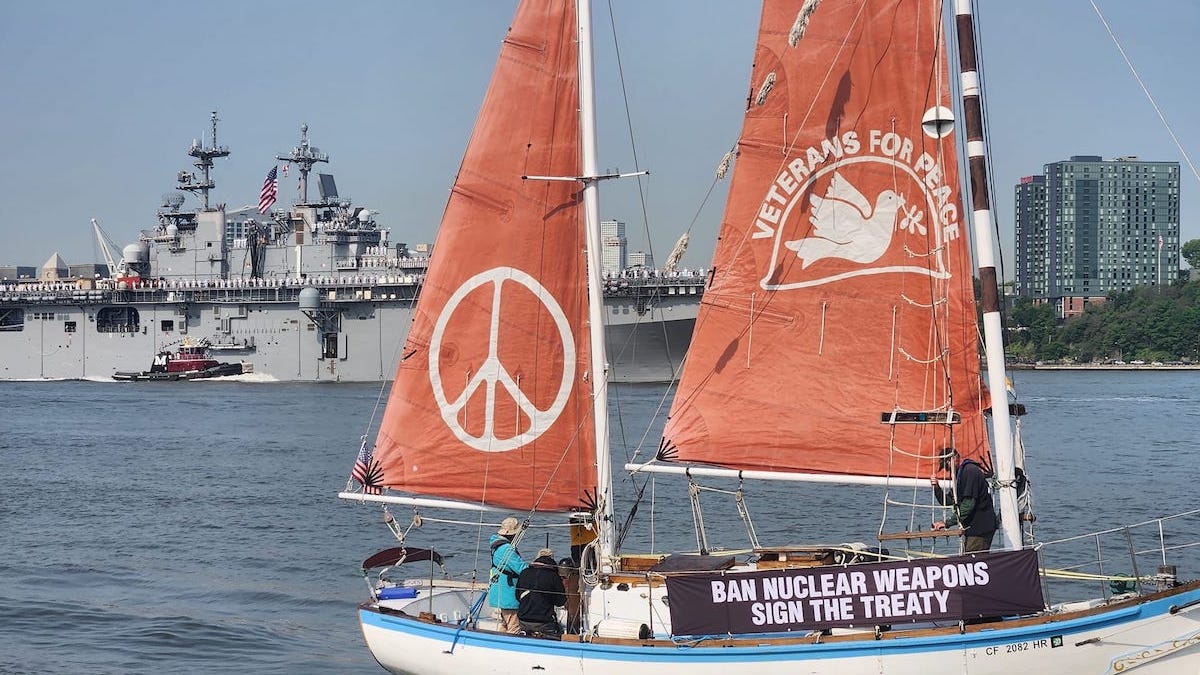
The Golden Rule anti-nuclear sailboat and her intrepid crew arrived to Chelsea Piers in New York City on May 17 to a wonderful reception, followed by ten days full of amazing events. Emotional meetings featured family members of the original crew who sailed toward the Marshall Islands in 1958 to interfere with US nuclear bomb tests. A lunch meeting was hosted by Amalgamated Bank, the only US bank that refuses to invest in nuclear weapons. And the historic peace boat made an (uninvited) guest appearance in New York City’s Fleet Week “Parade of (war) Ships.” With its ruddy tan bark sails emblazoned with a peace sign and the logo of Veterans For Peace, the Golden Rule was a jaunty counterpoint to the Navy’s grey display of weapons of mass destruction.
Multiple events were organized daily by Veterans For Peace, the Friends House (Quakers), the War Resisters League, the Catholic Workers (Maryhouse), Pax Christi, the Peoples’ Forum and others. The City Council issued a welcoming proclamation. The Golden Rule also crossed the Hudson River several times to New Jersey for events with environmental activists and Indigenous leaders.
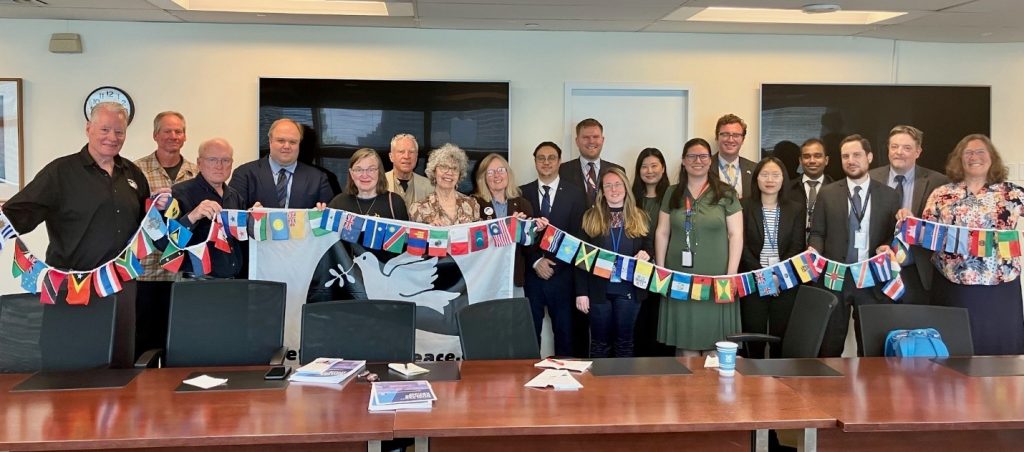
Perhaps most exciting of all were our meetings with United Nations missions from around the world. Mexico’s mission hosted a meeting where Veterans For Peace and the Golden Rule team met with 12 U.N. missions, including New Zealand, Malaysia, Vietnam, Cuba, South Africa, Austria, Indonesia, Ireland, Costa Rica, Kiribati, and the Holy See.
The U.N. representatives responded enthusiastically to a 10-minute version of Making Waves, the Rebirth of the Golden Rule, and made frequent references to the award-winning film during a very positive exchange with the Golden Rule delegation, led by Veterans For Peace’s president Susan Schnall, and Representative to the U.N. Ellen Barfield.
We are used to speaking ‘state-to-state,” said the First Committee representative from South Africa, the one country that actually eliminated its nuclear weapons. “It is a breath of fresh air to be talking with citizen activists.” He continued, “I was struck by the images of you sailing by the warships. It really is David and Goliath. We are doing diplomatic work but you are the ones doing the heavy lifting. You are out there doing it. We thank you very much.”
This point was echoed by the Mexican representative: “Yes, people do not know about the treaty. What you are doing, education, educating is key and very helpful for us.”
“I really appreciate how you bring in the environment,” the representative from Indonesia noted. “Environmental concerns are an important area not discussed enough when we are talking about nuclear weapons.”
All but one of the nations represented had signed the U.N. Treaty on the Prohibition of Nuclear Weapons (TPNW), which is a primary focus of the Golden Rule’s educational mission. The meeting ended with pledges to stay in touch and to work together toward the goal of abolishing nuclear weapons, including the upcoming Second States Meeting in New York Nov. 27 through Dec. 1.
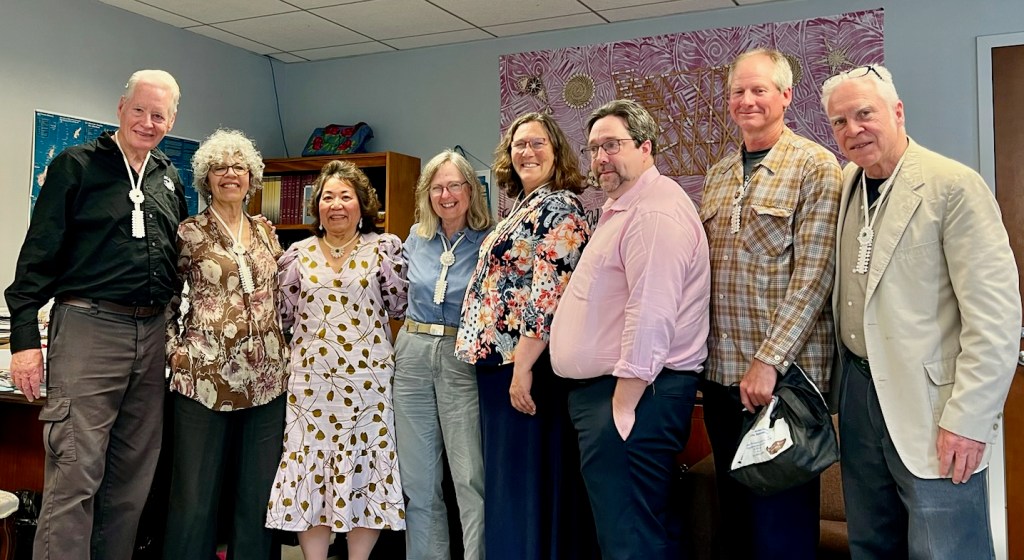
Later the same day, the Veterans For Peace delegation visited with the Permanent U.N. Representative from the Republic of the Marshall Islands. Ambassador Amatlain Elizabeth Kabua gave a very warm welcome in her cozy U.N. office and spoke with the group for over two hours.
The veterans were most concerned when they learned that, despite the very high rate of cancer in the Marshall Islands – the legacy of 67 US nuclear explosions from 1945 to 1958 – there is no chemotherapy available in the Marshall Islands. Nor is there a Veterans Administration clinic for the many Marshallese veterans of the US military. This is a concern that will be raised within Veterans For Peace and beyond. Coincidentally, the very next day, the New York Times ran an article about the lack of a VA clinic in the Marshall Islands. Ambassador Kabua gifted her six visitors with beautiful necklaces that were handmade by Marshallese women from coconut and sea shells. The meeting ended with a warm farewell and promises to keep in touch.
But the international diplomacy had not ended. Three days later, Cuba’s Permanent U.N. Representative and Deputy Permanent Representative came down to Chelsea Piers to visit the Golden Rule. Ambassadors Gerardo Penalver Portal and Yuri A. Gala Lopez thanked the Golden Rule crew for sailing to Cuba in January and for calling for an end to the 61-year old U.S. economic blockade of Cuba. In my capacity as VFP board member and president of the Golden Rule Committee, I thanked the Cuban diplomats for the warm welcome the Golden Rule had received in Cuba.
As president of the Veterans For Peace Golden Rule Project, I was honored to receive the Cuban ambassadors on the historic anti-nuclear ketch. I told them that Veterans For Peace was reminding people that the world almost had a nuclear war in 1962 during the so-called ‘Cuban Missile Crisis.
If it were not for US imperial hostility to Cuba’s freedom and independence, this would not have happened. Why, after more than 60 years, is the United States still making the Cuban people suffer? Veterans For Peace has long opposed the US embargo, and once again we demand that it be ended once and for all.
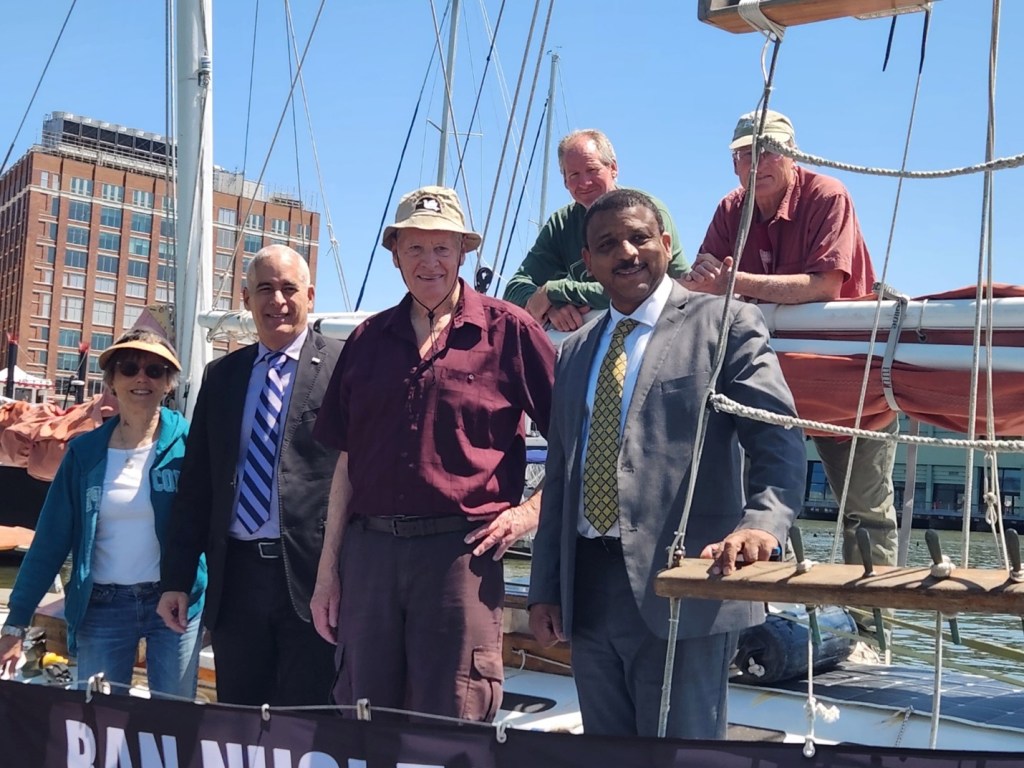
The Cuban diplomats responded that the embargo had been further tightened under President Trump, who had imposed many new sanctions on Cuba and declared it a “state sponsor of terrorism,” making it even harder for Cuba to engage in normal international trade. President Biden has not reversed the Trump sanctions or the “state sponsor of terrorism” designation. We must push him to do so.
Most people in the US, when they hear about this mean-spirited policy toward Cuba, think it is outdated and unfair. Unfortunately, however, very few people in the US know that our government is economically strangling Cuba and causing great suffering to the Cuban people. It is our job to let them know, and to build political pressure to end the long era of US hostility to Cuba. We love the Cuban people and we want to be friends.
For eight years the Golden Rule peace boat has been an inspiring vehicle for educating people about the importance of abolishing nuclear weapons. She is now proving to be an effective tool for international solidarity as well. The historic 34-ft. wooden ketch sailed by the United Nations building on its way out of New York City, heading for Long Island, Connecticut and up the New England Coast all the way to Portland, Maine, where Veterans For Peace was founded in 1985.
At the time of writing, the Golden Rule was two-thirds of the way through its epic 13-month, 11,000 mile “Great Loop” voyage throughout the eastern half of the United States. To see its upcoming schedule of port stops and events, and how you can participate, go to www.vfpgoldenrule.org.
Special thanks to Anthony Donovan of New York City Veterans For Peace for coordinating many events for the Golden Rule in New York and New Jersey, and for the great photos in this article.
This article first appeared on Peace and Planet and is republished with permission of the author.
Headline photo: The Golden Rule upstaged an aircraft carrier at the “Parade of Ships” that kicked off “Fleet Week” in New York City. (Photo: VFP Golden Rule Project/Facebook)
The opinions expressed in articles by outside contributors and published on the Beyond Nuclear International website, are their own, and do not necessarily reflect the views or positions of Beyond Nuclear. However, we try to offer a broad variety of viewpoints and perspectives as part of our mission “to educate and activate the public about the connections between nuclear power and nuclear weapons and the need to abandon both to safeguard our future”.
Undue influence
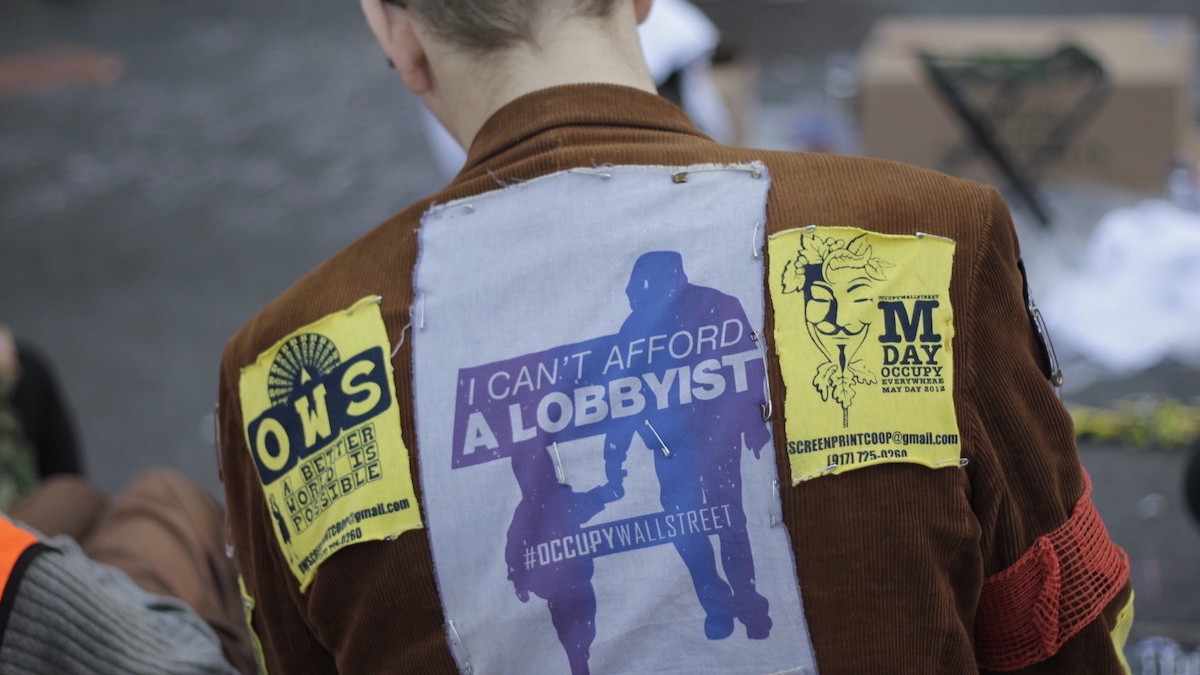
As money changes hands on Capitol Hill, is it lobbying or bribery?
By Linda Pentz Gunter
In part two of our investigation into bribery and corruption in the nuclear power sector, we look at lobbying. Does it cross a fine ethical line of undue influence? And how does it really differ from the crimes committed by nuclear executives and corrupt politicians, as we detailed in our July 2nd article? This is the second part of a single article originally published in Capitol Hill Citizen, a print-only newspaper published by Ralph Nader, briefly updated for current events and republished with the kind permission of the editor. Capitol Hill Citizen comes out in print only. To subscribe or purchase single copies, click here.
The temptation toward nuclear bribery and corruption as we detailed in earlier stories on Ohio, South Carolina and Illinois, and updated on July 2, may prove not to be a unique event. The pattern of struggling nuclear power plant owners is countrywide, as the aging US reactor fleet becomes ever more uneconomical, even as owners seek second 20-year operating license extensions out to 80 years.
After a flurry of nuclear plant closures, mainly in the Northeast and Mid-Atlantic regions, new laws have changed the economic landscape and some plant owners are now making the grab for federal and even state subsidies to keep reactors scheduled for shutdown — or, in the case of Palisades in Michigan, already shut down — running for many more years.
But these subsidies may not be enough. And the owners of old reactors are not the only ones with their hands out.
So-called “new” reactor designs, most of which fall under a category known as Small Modular Reactors (SMRs), are likewise too expensive to fund unaided.
For example, even billionaire Bill Gates asked for and got what was effectively a “matching grant” from Congress for his company, TerraPower, to cover the at least $4 billion cost of his proposed Natrium molten salt fast reactor. The US government has agreed to provide Gates with $1.9 billion for the Natrium, $1.5 billion of which will come out of the bipartisan infrastructure bill that includes $2.5 billion for advanced nuclear reactors.

The Inflation Reduction Act (IRA) already provides various incentives for new reactors, including a $25-per-MWh production tax credit during a new plant’s first 10 years of operation, or a 30 percent investment tax credit for those plants that start operation on or after 2025.
But, as TerraPower CEO Chris Levesque, reminded the press in a November 2021 video call, “One important thing to realize is the first plant always costs more.”
Read MoreWe are all Hibakusha
The global footprint of nuclear fallout
By M.V. Ramana
The front page of the Times of India of August 7, 1945, carried the headline World’s deadliest bomb hits Japan: Carries blast power of 20,000 tons of TNT. For millions around the world, headlines of that sort would have been their first intimation of the process of nuclear fission on a large scale.
But, a careful stratigrapher, who studies layers in the soil or rock, might be able to discern that, in fact, nuclear fission had occurred in July 1945. The stratigrapher would just have to look for plutonium at Crawford Lake in Ontario, Canada, the site proposed as the “golden spike” spot to mark the start of the Anthropocene (recognising the problems with its definition as highlighted in Down To Earth’s interview with Amitav Ghosh).
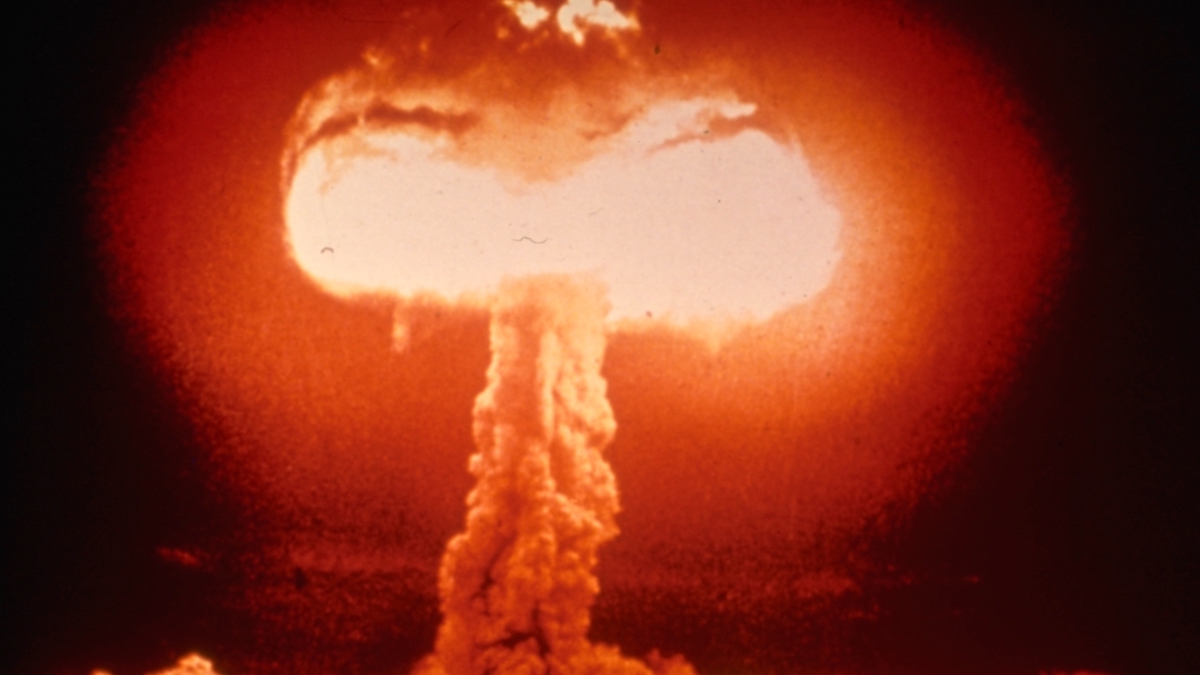
What happened in July 1945 was, of course, Trinity, the world’s first nuclear weapon test, now familiar to many through the film Oppenheimer. A group of researchers recently reconstructed how the plutonium released during that explosion would have been transported by the wind. They calculated that direct radioactive fallout from that test would have reached Crawford Lake within four days of the test, “on July 20, 1945 before peaking on July 22, 1945”.

Since Crawford Lake is nearly 3,000 kilometres from the Trinity test site in New Mexico, it stands to reason that many other places would also have received radioactive fallout from the Trinity test. Now consider the fact that there have been at least 528 nuclear weapon tests around the world that took place above the ground, plus the bombs dropped on Hiroshima and Nagasaki—and you can easily imagine how radioactive fallout must have fallen practically everywhere, whether on land or in the oceans.
Not included in the abovementioned list of 528 is the debated 1979 “Vela incident” that most likely involved an Israeli nuclear weapon test with help from South Africa. It is described as debated only because political elites in the United States, whose Vela satellite 6911 detected a double-flash of light that is characteristic of nuclear explosions, did not want to impose sanctions on Israel.
Read MoreNASA joins the lunatic fringe

Space agency and bro billionaires conspire to trash the moon
By Linda Pentz Gunter
Russia just crash-landed on the moon. India’s lunar rover is trundling across its surface. Are their intentions purely benign? Just about science? Or something more?
There are no such doubts lingering over US lunar plans, however. The mistakes made on Planet Earth will now be repeated on the moon.
In his fascinating and frightening 2012 book — A Short History of Nuclear Folly — that I somehow maddeningly missed on publication, Rudolph Herzog writes:
“There are places where radioactive substances have no business being. One of them is space.”
Herzog, son of the famous film director Werner, and whose book, written in German, was translated into English in 2013, details a whole panoply of terrifying nuclear accidents and near-misses, including disasters that could have befallen us in and from space.
But no lessons have been learned and no such warnings heeded.
Consequently, we now learn that NASA and the US Defense Department have awarded nuclear weapons company, Lockheed Martin, a contract to build a nuclear powered rocket to speed humans on their way to Mars.
“Higher thrust propulsion” is what Lockheed Martin is seeking to develop, but is travel speed to Mars really the only motivation? Of course not. The Pentagon admits it is also keen to develop nuclear reactor technology that will power satellites with more “fuel-efficient fuel sources” so that they can maneuver in space in such a way as to “make them more difficult for adversaries to target” reported the Washington Post.
As Herzog recounts in his book, we have been here before, and the outcome could have been catastrophic. In his chapter, Flying Reactors, he recounts how in the 1960s, the then Soviet Union developed miniature nuclear reactors to power their RORSAT military surveillance satellites. At the end of their life they were simply blasted into deeper space where their radioactive load would decay far from human exposure risk. Or, at least, that is what was supposed to happen.

EDF’s fishy behavior
Nuclear plant builder seeks to avoid installing fish deterrent
From Stop Hinkley and Together Against Sizewell C with additional contributions from the Beyond Nuclear International editor
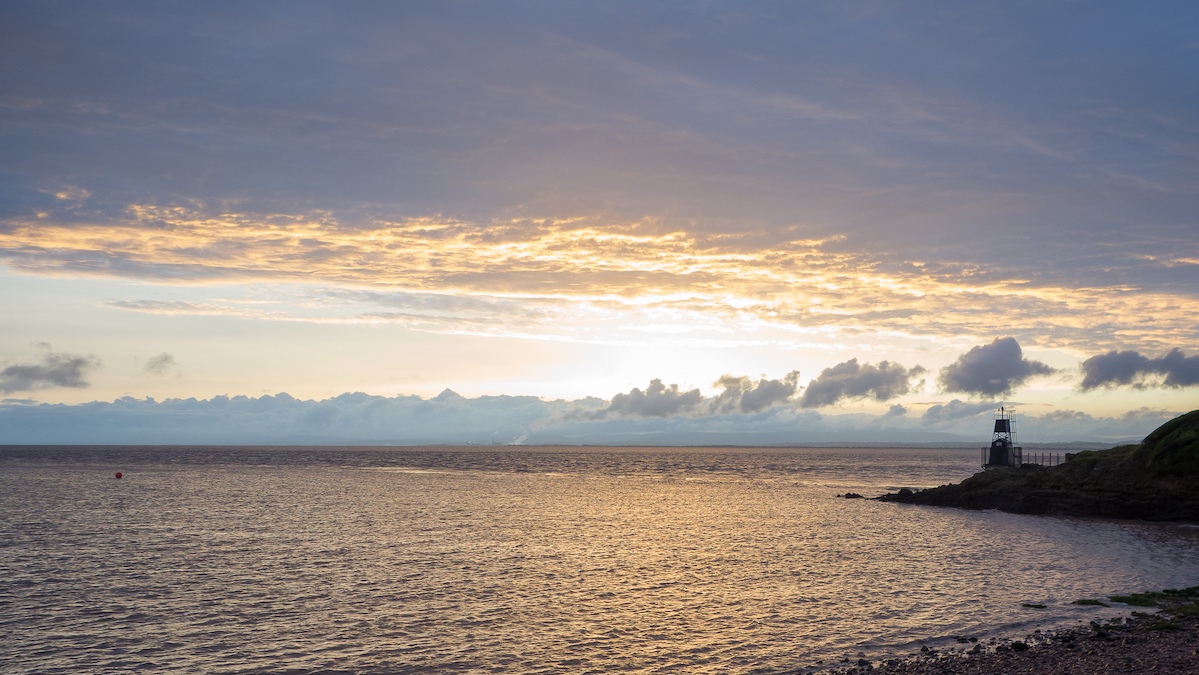
As Hinkley Point C (HPC) power plant is being built in South West England by Électricité de France (EDF), hundreds of thousands of fish living in the Severn estuary, including protected Atlantic salmon, are under threat from the plant’s cooling turbines. The UK Environment Agency (EA) has decided that this wholesale slaughter is perfectly okay.
On August 1, the EA announced that it had removed the requirement to install an acoustic fish deterrent (AFD) at the head of its seawater intake in the Bristol Channel.
“In doing so, the EA has condemned millions of fish and other marine creatures to their fate of impingement, injury and death adding to the many millions of fish fry, fish eggs, small fish and other marine biota that will be killed when entrained in the cooling system of the plant,” said Together Against Sizewell C (TASC) in a press statement. An identical two-reactor EPR project is targeted for the Sizewell nuclear site in Suffolk.
The HPC Pressurized water reactors will need vast amounts of cooling water for their steam power generation. The intake indiscriminately sucks in huge amounts of living creatures, ranging from marine mammals, crustaceans, fish, eggs and their larvae, most of which won’t survive the journey through 3km of pipe work at high pressure to the condenser and the discharge back to the Estuary.
Consequently, EDF was required in its 2013 Development Consent Order to meet a number of conditions, including the installation of an Acoustic Fish Deterrent (AFD) that generates sound waves to deter sound-sensitive fish away from the water intakes. Although EDF originally proposed the installation of the AFD as part of their environmental protection package, they then proposed to avoid it, despite the fact that the Severn Estuary supports up to 110 fish species, with fish nurseries serving the whole of the Bristol Channel and Celtic Sea and an average of 74,000 wintering birds each year.

EDF claimed the AFD would be too costly and impractical. But rather than evaluating other methods to cool the power plant, EDF instead reduced its original estimates of fish losses to suggest the AFD speakers wouldn’t make much difference after all, so that construction should be allowed to continue without them. It claimed the speakers would add a “minimal benefit” to wildlife and its construction would prove a “safety risk to workers”. Bear in mind that the amount of fished killed by Hinkley B station was 2.05 tonnes per day. Hinkley C is likely to kill far more. Apparently, the EA agreed.
Removing this piece of environmental protection will threaten the biodiverse ecosystem of the UK’s largest estuary and designated Special Area of Conservation. It could also set a precedent for future projects like Sizewell nuclear power stations in Suffolk.
Read More Beyond Nuclear International