 Beyond Nuclear International
A life uprooted and stolen
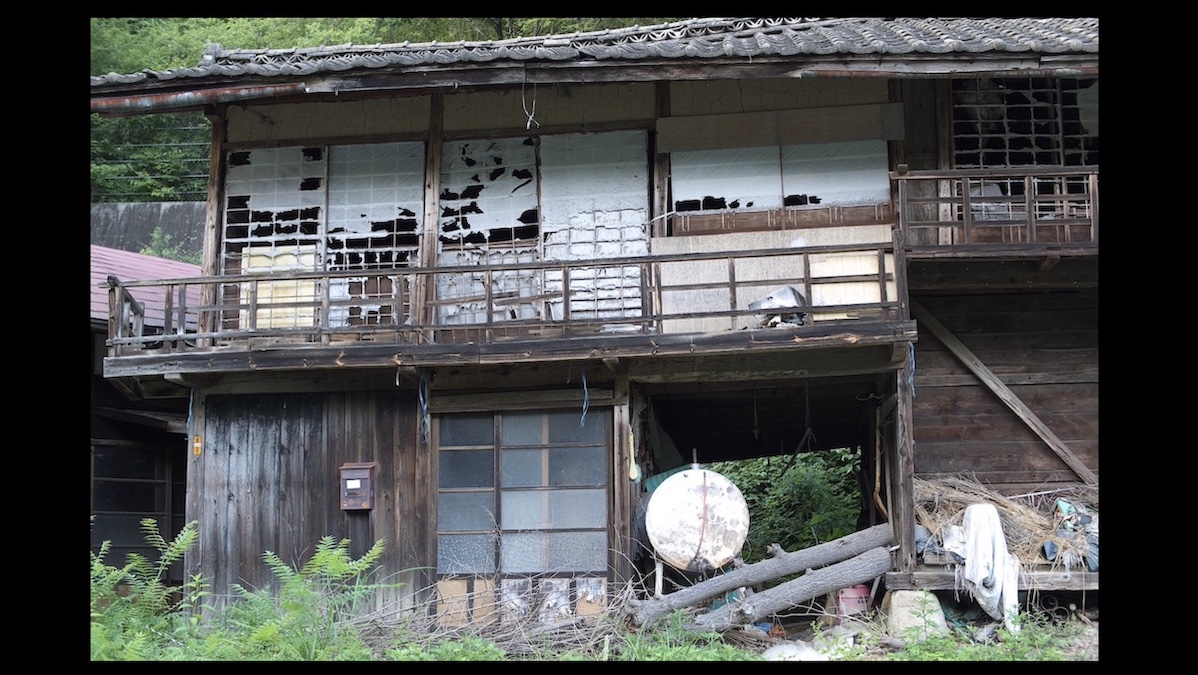
Wherever they went, it wasn’t home
From Voices of Nuclear Victims, a project of Nos Voisins Lontains. 311
The callous dismissal of those who suffered, were sickened, or died as a result of the Fukushima Daiichi nuclear disaster, is pervasive among the nuclear lobby. But even as they dismiss those directly affected by the nuclear accident, they ignore victims of the earthquake and tsunami who, because of the high radiation levels caused by the subsequent nuclear disaster, could not be rescued. (See our earlier article about the short film Munen (Remorse) on this.) Shouldn’t their deaths also be ascribed to the nuclear accident, asks Fukushima evacuee, Mizue Kanno? Her poignant testimony forms the second installment of the short film series, Voices of Nuclear Victims. You can watch her 12-minute testimonial below and also a short interview feature with Ms. Kanno made by Friends of the Earth Japan. (Note: We are unable to find a source to verify Ms. Kanno’s claim that people who could not be rescued from the earthquake/tsunami destruction were left to starve to death. This does not necessarily mean it did not happen and it possibly refers to those who were also physically trapped or injured.)
Mizue Kanno tells her story:
There is one thing I would like to tell you: there are lives that could have been saved, if the nuclear accident had not occurred. The coastal areas of our municipality were severely affected by the tsunami, and that on March 11, there were people who were frantically searching: they were firefighters.
Because of the earthquake and tsunami, all electricity sources were cut off. As there was no emergency power supply, at nightfall, it was impossible to light up the sea. There were moans and groans. “Hold on, we’ll be back!” shouted the rescuers. “We’ll be back at dawn!” There were voices of victims responding.
In the pre-dawn darkness of March 12, firefighters and families took the path to the sea.
But it was forbidden to enter within a 5 km radius of the plant. This was because of the nuclear accident. Because radioactive elements were present. That’s why it was forbidden to enter. Family members who had taken refuge in our house returned to rescue the victims, but they were prevented from entering the coastal area.
Finally, when the ban on entry was lifted, among the dead, autopsies revealed many who had died of starvation. These are lives that could have been saved. If the nuclear accident had not happened, these people would have been rescued.
Haven’t they also died because of the nuclear accident?
If it hadn’t been for the nuclear accident, they would still be alive. They were waiting for rescue. They couldn’t survive on their own. And they starved to death. I think they should be counted among the dead due to the nuclear accident. But our government does not recognize that these are deaths due to the nuclear accident.
Read MoreTritium dump paused

Citizen opposition blocks discharge of radioactive water from Indian Point nuke into Hudson River, for now
Note: Beyond Nuclear is holding online teach-ins on tritium. The first — Tritium: Don’t Dump It! Tritium in the US Nuclear Power Sector — will take place on Tuesday, May 16, 10am-11:30am EDT and features: Dr. Ian Fairlie providing an overview of tritium and the harm it causes; Mary Lampert of Pilgrim Watch describing opposition to tritium dumping by Holtec into Cape Cod Bay from the closed Pilgrim, MA nuclear power plant; and lawyer, Michel Lee of the Council on Intelligent Energy & Conservation Policy, who will discuss the similar threat of tritium dumping by Holtec from the Indian Point nuclear power plant in New York into the Hudson River. Register here.
By Julia Conley, Common Dreams
Clean water and public health advocates in New York’s Hudson Valley applauded on April 13 as the energy technology company Holtec International announced it will not move ahead with plans to dump wastewater in May from the former Indian Point Nuclear Power Plant, following intense pressure from local communities and state lawmakers.
The company had initially planned to complete its first discharge of wastewater from pools that were used to cool spent nuclear reactor fuel rods late this summer, but recently announced that in May it would discharge 45,000 gallons of the water into the Hudson River, which at least 100,000 people rely on for their drinking water.
The company ultimately plans to release one million gallons of wastewater into the river.
Holtec International said it was taking a “voluntary pause” in the plan to better explain the process of decommissioning the plant, which was shut down in 2021, to the local community and elected officials.
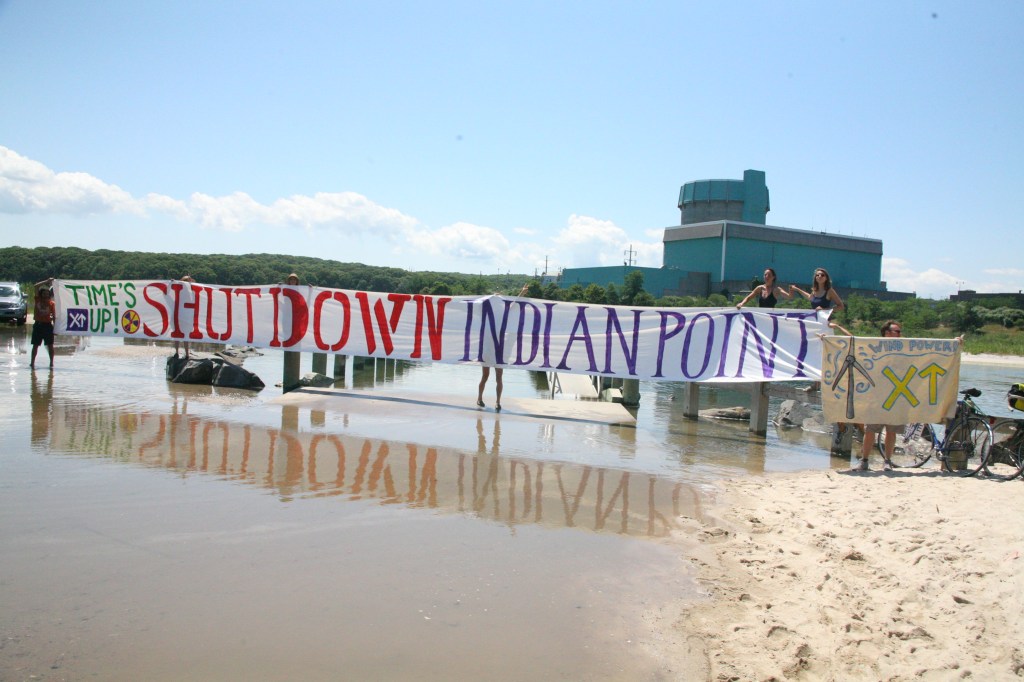
Local clean water group Riverkeeper expressed appreciation that Holtec “heard the concerns of public” and said advocates will continue pushing for an alternative to releasing the wastewater into the Hudson.
Read More“We won’t be scapegoats!”

A new tongue-in-cheek rebellion has risen in France, but the cause is deadly serious
By Linda Pentz Gunter
In France, civil disobedience and defiance of authority — and authoritarianism — is in the national DNA. We have seen it most recently in the demonstrations against the raising of the retirement age, and against proposed agricultural reservoirs known as mega-basins. Before that it was the “yellow vests”, angered at a rise in fuel prices. Further back came the Resistance during World War II, and even further back, of course, the Revolution of 1789.
The French anti-nuclear movement is no exception and has engaged in protests that deliver considerable numbers and abundant creativity — and sometimes a lot of useful tractors as well.
It’s no surprise then to learn that such continued defiance has now spread: to goats.
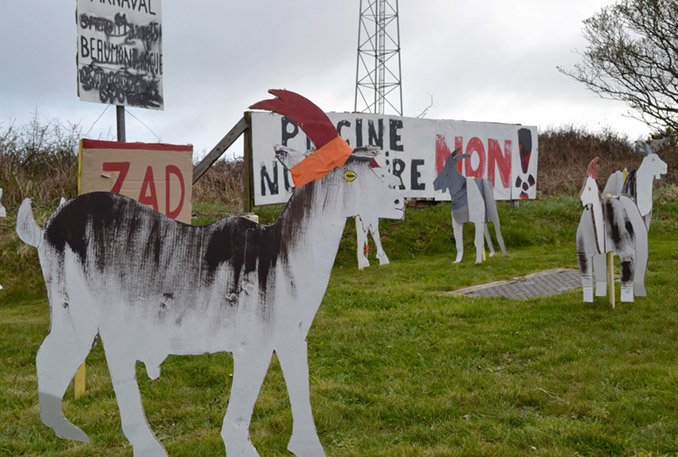
Before continuing, it’s necessary to explain what a ZAD is. In French, it stands for Zone À Défendre (zone to defend.) ZADs are usually occupations or blocades created by citizens protecting something they deem precious from development or destruction. There are scores of ZADs across France, deemed illegal by French authorities. ZADs have sometimes won, most notably at Notre-Dame-des-Landes, where an unpopular airport project was stopped.
But raids on ZADs can sometimes turn violent, and authorities can over-react as they did in February 2018 at Bure, when 500 gendarmes went in to remove just 15 anti-nuclear activists occupying and attempting to protect the forested site targeted to become the country’s high-level radioactive waste dump.
Dressed in riot gear, the gendarmes used bulldozers, trucks, helicopters, drones and chainsaws to confront the occupiers, self-described “owls” who had been living in tree houses and lookout towers for the past 18 months.
Now, activists around the La Hague nuclear reprocessing site on the northern Cherbourg peninsula, have redefined the ZAD acronym to stand for Zone À Déchets (Waste Zone), and specifically radioactive waste.
Read MoreDogs of war
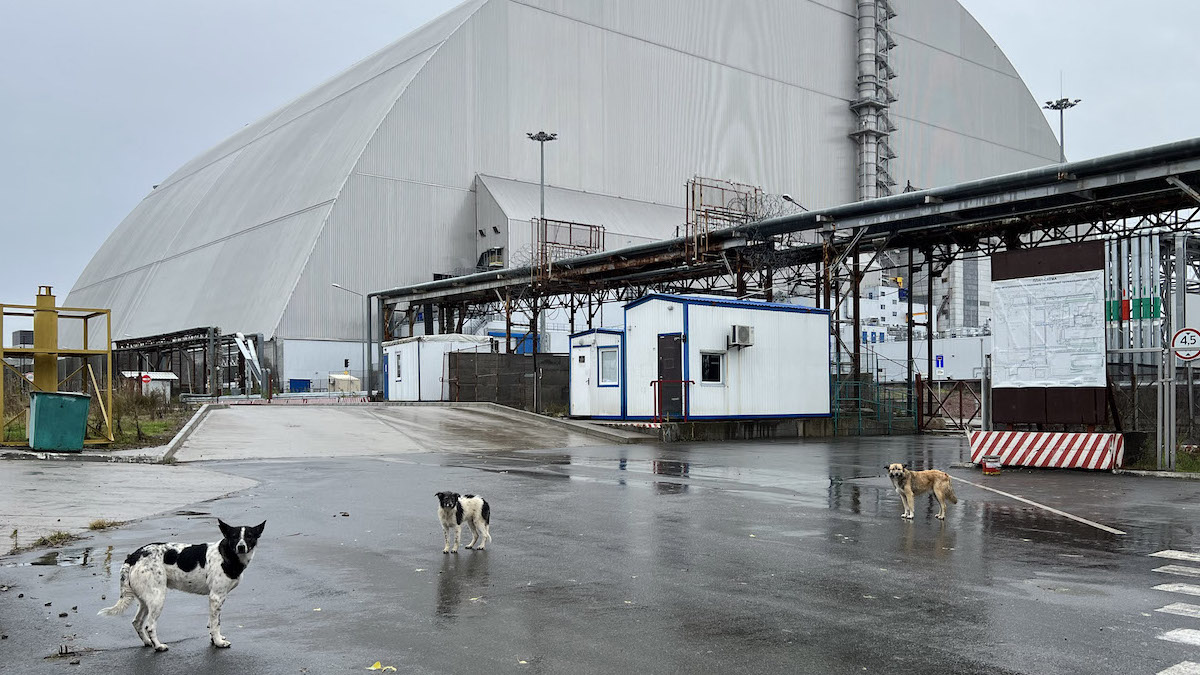
DNA research among Chornobyl’s dogs could provide answers about the effects of living in a radioactive environment
By Linda Pentz Gunter
Pity the poor dogs (and cats) of Chornobyl. Abandoned in 1986 by owners fleeing the nuclear disaster, their descendants live on in the Chornobyl Exclusion Zone, an area deemed too radioactive for human habitation and in a country now at war.
Shortly after the 1986 nuclear accident, that saw Chornobyl unit 4 explode and spew deadly radioactive fallout across the former Soviet Union and Western Europe, Soviet authorities made an effort to cull the abandoned pets. (For animal lovers who watched the Sky/HBO drama series, “Chernobyl”, this was a particularly disturbing episode.)
Now, Chornobyl’s hapless lost dogs and cats find themselves living in a war zone as well. Russian troops marched into the Exclusion Zone at the very start of the invasion, in late February 2022, and occupied the Chornobyl power plant site by force. When they moved on, they left behind churned up topsoil that disturbed radioactive fallout and increased radiation levels in the area. As the war drags on, it is impossible to predict whether the Russian troops will be back.

The presence today of at least several hundred semi-feral domestic dogs living around the Chornobyl plant and beyond, indicates that the 1986 cull was not, of course, entirely successful. The Dogs of Chornobyl — and their more furtive feline friends — continue to survive down the generations in a highly radioactive environment. There are other threats too, including exposure to rabies and wolf packs that prey on the dogs and their puppies.
Read MoreDaniel Ellsberg is still fighting

Legendary whistleblower keeps giving in his final months
By Linda Pentz Gunter
Most of us who have been around long enough in this movement probably have their own Daniel Ellsberg story. With the 91-year old famous whistleblower’s recent announcement that he has terminal pancreatic cancer, with just months to live, many were re-telling theirs. It was an apt outpouring of admiration, respect and love. So much so, that April 24-30 is now Daniel Ellsberg Week.

My own Ellsberg story is reasonably prosaic. It was spring 1998, and I was newly-arrived in Washington, DC and also newly on the anti-nuclear beat. I had spent 20 years as a journalist, including in Los Angeles, where, for a brief time I had the theoretically enviable task of attending celebrity-studded parties and openings in order to prize a minimal nugget of prose from a sometimes reluctant Hollywood star.
Actually, I have to admit that most of those A-listers (and occasionally Bs) were incredibly accommodating and warm and down-to-earth. It was a job and one I enjoyed in an entirely unfangirlish way. But then I met Daniel Ellsberg.
He was standing off to the side at an activist pizza party in DC. I had just started a new job in an almost entirely unfamiliar field, working at the Safe Energy Communication Council. The event was — and still is (Covid permitting) — held annually by the activist group now called Alliance for Nuclear Accountability, but then still the Military Production Network. I didn’t recognize Ellsberg. Someone pointed him out. I was stunned. Daniel Ellsberg is here with us? At this humble event? Is it really him?
Thus I came to learn that one of the great heroes of our time, who was prepared to sacrifice a lifetime of freedom for a just cause, was indeed a man of quiet humility and one who has filled that lifetime that he views as some sort of unexpected bonus, with endlessly generous gifts of writing, insight, analysis and conviction.
Read MoreUK ignites new depleted uranium weapons debate

UK will send DU weapons to Ukraine prompting “nuclear” rhetoric from Russia
By Linda Pentz Gunter and Maria Arvaniti Sotiropoulou
On March 21, 2023 Britain confirmed that it was sending depleted uranium (DU) weapons to Ukraine , prompting a response from Russian president, Vladimir Putin, that, “If all this happens, Russia will have to respond accordingly, given that the west collectively is already beginning to use weapons with a nuclear component.”
Russian defense minister, Sergei Shoigu, warned that such steps moved us closer to a “nuclear collision.”
Days later, Putin announced he had made an arrangement with neighboring Belarus to station tactical nuclear weapons there.
According to ICAN, Putin “will start training Belarusian personnel to use them” and that “up to 10 Belarusian aircraft are already prepared to use these weapons and Russia would complete the construction of a storage facility for nuclear warheads in Belarus by July.”
The Belarus nuclear weapons deal was more likely a response to the continued expansion of NATO — with Finland now the newest member — rather than retaliation for Britain arming Ukraine with depleted uranium weapons.
However, there are many wrongs in this situation to unpack.
Possessing or threatening the use of nuclear weapons is a violation of the human rights that are embedded in the Treaty on the Prohibition of Nuclear Weapons. The use of depleted uranium weapons is also abhorrent, with compelling, if still somewhat anecdotal, evidence from the wars in the Balkans and Iraq/Kuwait to suggest these toxic exposures cause serious long-term health effects.
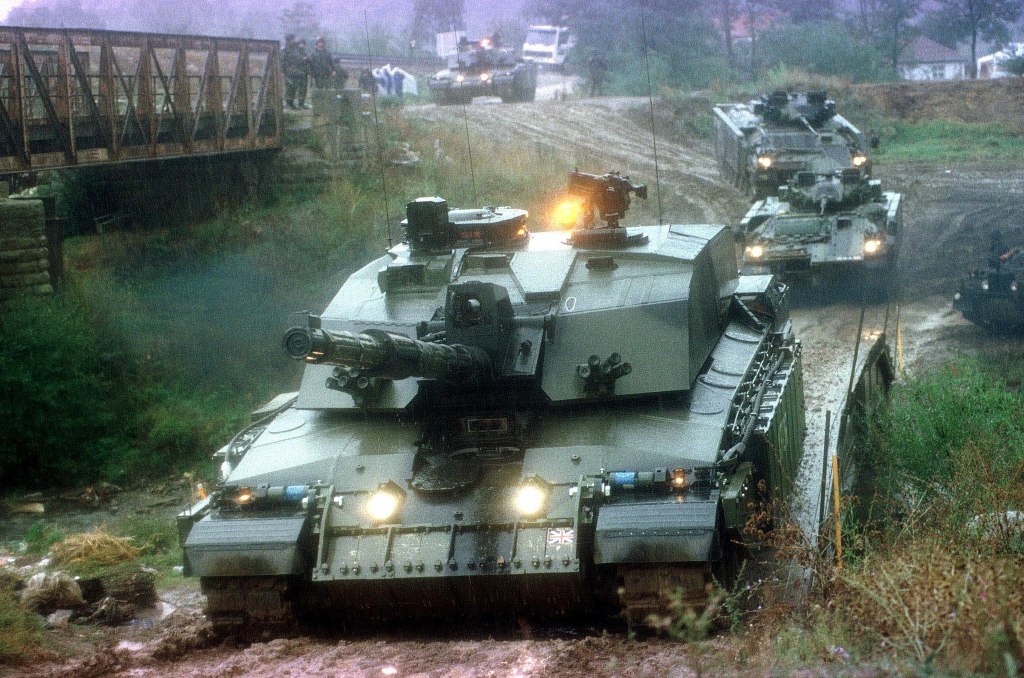
Despite Putin’s thinly veiled threat mount a nuclear response to DU weapons, the International Campaign to Ban Uranium Weapons (ICBUW) points out that this would be disproportionate because “DU projectiles are not nuclear weapons at all, but conventional weapons of high chemical-radiological toxicity and harmfulness.”
Adds Dr. Frank Boulton of the British IPPNW affiliate, MEDACT: “Much if not most of the toxicity of DU is biological rather than radiological (DU is a heavy metal with biological effects similar to that of lead)”.
The US and NATO used around 980,000 rounds of uranium shells in Iraq and Kuwait, 10,800 in Bosnia, 31,000 in Kosovo , another 7,000 in S. Serbia and Montenegro, and an unknown number in Afghanistan, while Russia also used such weapons in Chechnya.
Read More Beyond Nuclear International