 Beyond Nuclear International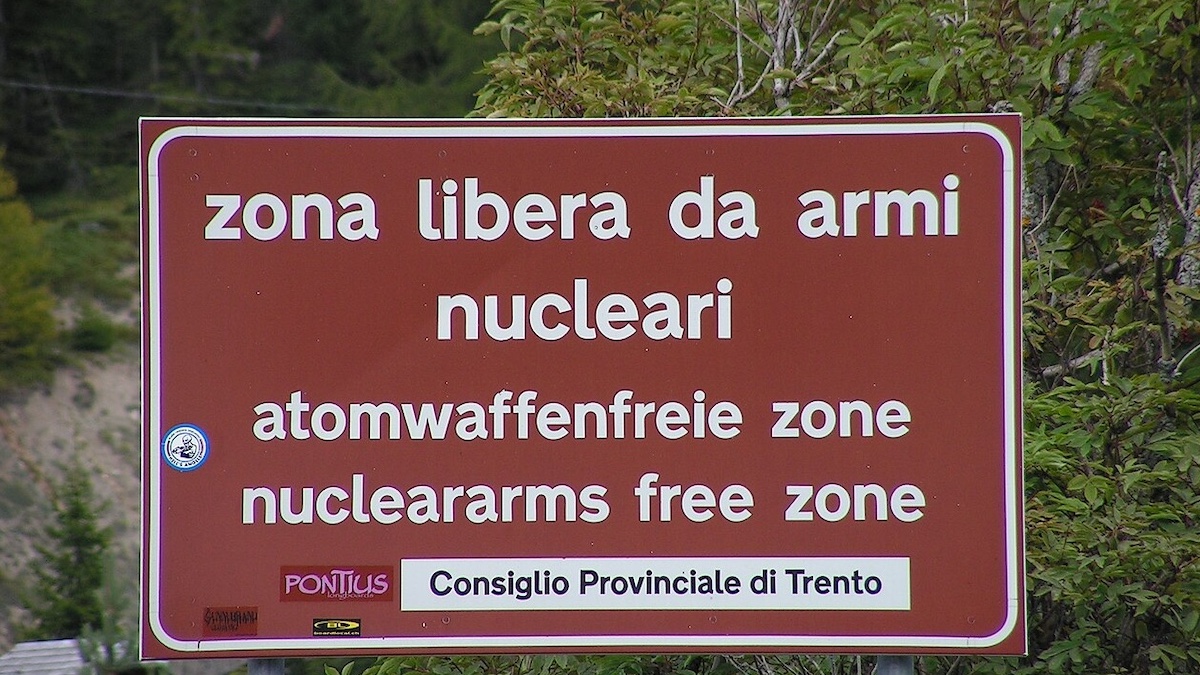
Tim Wallis’s book provides an optimistic view, but it’s also a methodical journey toward the nuclear-free world we all want, writes Linda Pentz Gunter
The Review Conference of the Parties to the Treaty on the Non-Proliferation of Nuclear Weapons (NPT) is about to begin in New York City. There is no reason to be particularly optimistic about any positive outcome. Meanwhile, signatories to the treaty itself continue to defy it, most specifically the United States.
The US is a signatory to the NPT, which in its Article VI states: “Each of the Parties to the Treaty undertakes to pursue negotiations in good faith on effective measures relating to cessation of the nuclear arms race at an early date and to nuclear disarmament, and on a treaty on general and complete disarmament under strict and effective international control.”
It is the second shortest clause in the entire treaty. And yet, what we are seeing instead is a clear intent by the major nuclear powers, especially the US, Russia and China, to arm up rather than down.
Meanwhile, two nuclear armed states — the US and the undeclared nuclear weapon nation Israel — are busy attacking a non-nuclear armed state, Iran, that is also a signatory to the NPT. (Israel cannot join because it officially neither confirms nor denies whether it has the upwards of 200 nuclear weapons that everyone knows it does have.)
Iran has long declared that it is abiding by the terms of the NPT and enriching uranium for a civil nuclear power program, not to build nuclear weapons. This “inalienable” right is granted to any NPT signatory that forswears nuclear weapons in Article IV that says: “Nothing in this Treaty shall be interpreted as affecting the inalienable right of all the Parties to the Treaty to develop research, production and use of nuclear energy for peaceful purposes without discrimination and in conformity with Articles I and II of this Treaty.”
Article IV is arguably the fatal flaw of the NPT — and, regrettably, of the UN Treaty on the Prohibition of Nuclear Weapons (TPNW) which repeats the clause verbatim — since it effectively leaves the back door open to transition to nuclear weapons via access to materials, technology and know-how. This is precisely the suspicion harbored by the US, Israel and Iran’s other enemies about Iran’s nuclear program. It was also used as the pretext for the current attack, almost certainly a cover story given both US intelligence and the International Atomic Energy Agency have consistently insisted that Iran is not moving toward nuclear weapons production.
The ramping up of nuclear weapons arsenals by the existing nuclear weapon nations, and the aspirations by other countries to acquire them — now potentially made more keen by the attack on Iran — moves us ever closer to the nuclear abyss.
It is a frightening scenario, and one brought vividly alive by Annie Jacobsen’s chilling book, Nuclear War. A Scenario.
But, says Timmon Wallis, founder of NuclearBan.US, let’s not abandon our optimism too quickly. Surely there is a different way to think about this, and even a possibility that we can, after all, achieve our global nuclear disarmament goals?
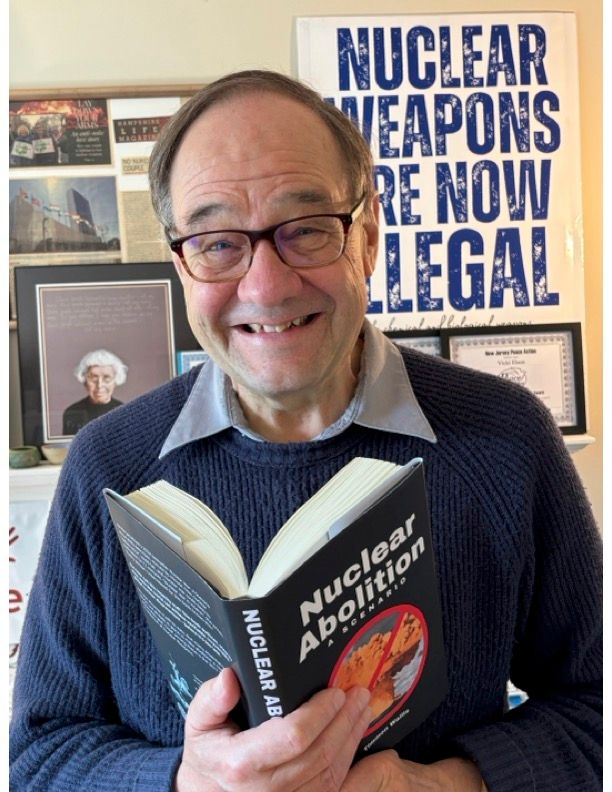
Wallis’s book, Nuclear Abolition. A Scenario, takes a very different tack, and approaches the process through a form of mathematical calculation by subtraction, by moving the arms of the Doomsday Clock — currently at 85 seconds to midnight — gradually further away from that grim moment of Armageddon. (Wallis’s book was published when the clock sat at 89 seconds to midnight, still dire enough.)
Wallis begins by asking the question aspired to by his book — “What if there were no nuclear weapons in the world?” —then asks us to savor the joy of that feeling for a while. It’s what most of us want, after all, but somehow we have elected a rash of megalomaniacs who don’t seem to share that worldview.
Wallis also bats away the patently absurd notion, nevertheless advanced by those same politicians, that somehow having nuclear weapons keeps us safe, something he declares as “nonsense” while reminding us that “Nuclear weapons are the biggest racket of all time — billions of dollars going from taxpayers to giant corporations to produce things everyone hopes will never be used!”
To ensure they are never used, Wallis argues, we must do away with them altogether. But can we really arrive at that moment, when we can turn the Doomsday Clock off altogether? Unlike many of us, Wallis has not lost that hope. His book provides the pathway to get there. The central obstacle, however, is the world’s arms manufacturers, who profit from the existence of nuclear weapons — and of course from the manufacture and unending use of conventional weapons.
Wallis’s central thesis, therefore, is that pressure must be exerted on the nuclear weapons companies to turn them into advocates for nuclear abolition. And that pressure, Wallis asserts, can come first and foremost from the now 99 countries that have signed the TPNW, 74 of which have also ratified it.
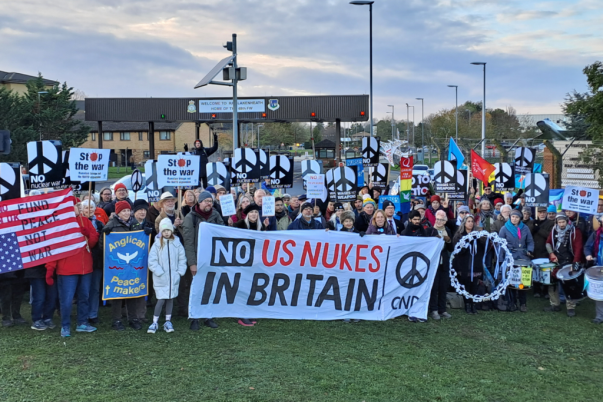
And so, Wallis takes us on a trip around the world, showing how countries both large and small can exert that pressure and move us out of the nuclear age. Wallis provides a check box of tactics per chapter, ending with “US bombs out of Europe,” an imperative that has become even more urgent now it is clear that US bombs have likely returned to British soil — at RAF Lakenheath, in reality a US Air Force base — for the first time since 2008. Ironically, this also comes at a time when US President Trump’s rhetoric has threatened a lifting or even folding up of the so-called “nuclear umbrella” with which the US, still a member of NATO, suggests it is protecting its European allies.
Pressure needs to come from within the US, too, Wallis writes. Wallis was an essential ally as we fought here in Takoma Park, Maryland, to maintain our nuclear-free status (we have, but the city has largely abandoned any efforts to promote perhaps its most famous achievement, having been one of the first US cities to become a Nuclear-Free Zone back in 1983.) What if every US city and town declared itself a nuclear-free zone, we had asked our city council? Wallis does not expect every city and state to do so, but he makes a strong case in his book for the power of local activism, especially in boycott and divestment, a proven tactic.
Finally, Wallis expresses the hope that Trump himself could denuclearize. This notion emanated from early, less irrational declarations from the White House at the beginning of Trump’s second term. Trump has indeed said one or two slightly sensible things here and there, denuclearizing being an example. But the ride has become considerably wilder since then.
I wonder if Wallis would feel as optimistic today? We are undoubtedly in an “alternate universe” as he states late in the book. Is it one in which Trump leads the world to nuclear weapons abolition? That’s an optimistic leap that most of us probably aren’t willing to take. But Wallis takes it, because optimism is what drives his writing and his activism, and because it’s an essential fuel if we are to persist in our mission to achieve global nuclear abolition. That work may seem hard to impossible. But what’s the alternative?
The hands of the Doomsday Clock cannot and must not inch any closer to midnight. Wallis’s book gives us a detailed guide to moving the clock — and the world that is watching its inexorable and ominous progress toward zero hour — slowly back to a time when no one had to worry about nuclear weapons. After all, as Wallis points out, that wasn’t really so long ago. Everyone alive before 1945 slept much better at night than we do.
Headline photo: Nuclear-Free Zone sign in Trento, Italy by Snowdog/Wikimedia Commons.
Linda Pentz Gunter is the Executive Director of Beyond Nuclear and writes for and edits Beyond Nuclear International. She is the author of the book, No To Nuclear. Why Nuclear Power Destroys Lives, Derails Climate Progress And Provokes War, published by Pluto Press. Any opinions are her own.


Pingback: Nuclear-related news – week to 2 May « nuclear-news
Pingback: Nuclear Abolition. A Scenario « nuclear-news