 Beyond Nuclear International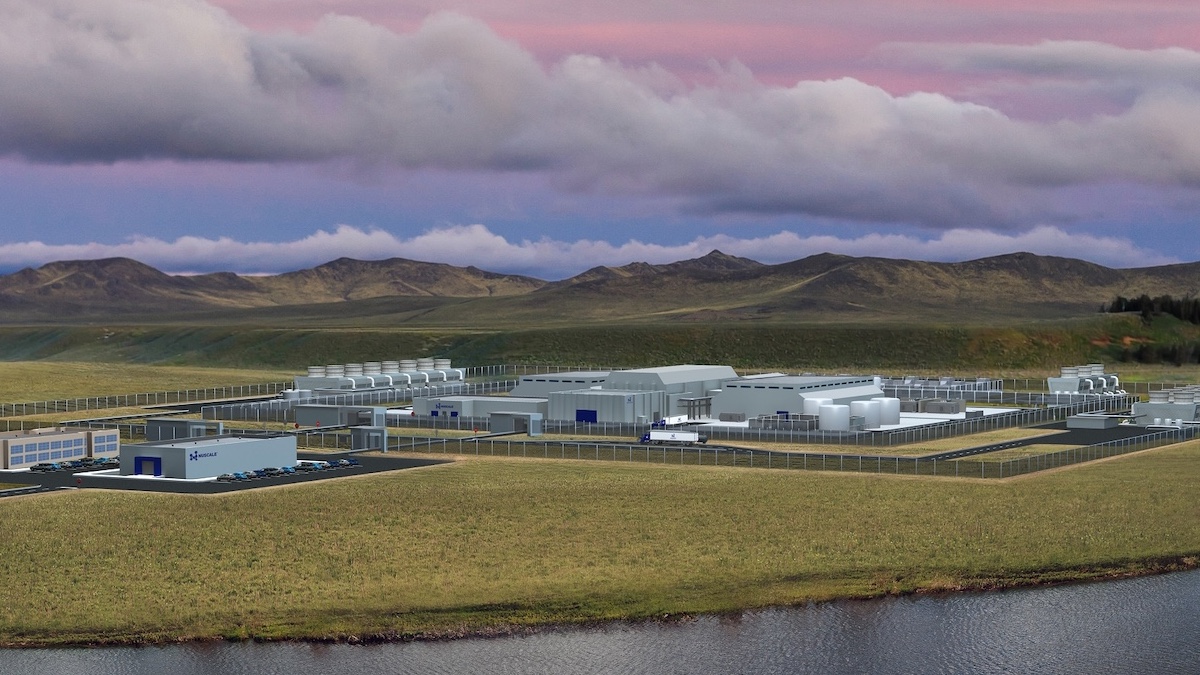
NuScale’s foundering flagship could sink without leaving port, writes Linda Pentz Gunter
As most of us immersed in the nuclear issue know well, there is little else so far that quite so starkly illustrates the fool’s errand that is the stubborn pursuit of small modular reactors than the sorry tale of NuScale.
As dramas go, it’s hard to know whether to list it under tragedies or comedies.
Founded in 2007 as a project at Oregon State University, NuScale announced around 2013 that it had established a demonstration SMR project in partnership with the Utah Associated Municipal Power Systems and Energy Northwest, a consortium of publicly-owned utilities across seven states that would purchase shares in the power to be delivered by 12 50 megawatt (MW) reactors built at Idaho National Laboratory and expected to be completed by 2030.
By the time the whole scheme collapsed in 2023, with construction costs ballooning from an estimated $3 billion to $9.3 billion, its customers were running for the exits. By then, NuScale had sold just a 21% share of its planned electricity output, and the costs for that electricity had risen from an expected $58 a megawatt hour (MWh) to $89 MWh.

At the eleventh hour, NuScale had quickly scaled the project down to six 77MW reactors — known as VOYGR — but it was too late. Instead, the company had spent sixteen years and at least $800 million and had nothing to show for it. Its shares promptly plummeted by 37%.
The United States’s widely proclaimed “flagship” SMR project had sunk in choppy seas without even leaving port.
But now, NuScale is back with its 77MW VOYGR reactor, which, according to NuScale’s website, represents “America’s first small modular reactor” and is “the only SMR on the market that has begun factory production for first modules.”
It has begun production on reactor components, but what the company doesn’t tell you about those components for “America’s first small modular reactor” is that they are being manufactured at a factory in South Korea. So much for the jobs argument. (NuScale also laid off 154 members of its US workforce after the 2023 collapse.)
The VOYGR is still curiously described as a “flagship”, even though there is now a veritable fleet of wannabe SMR designs desperately searching for customers. Technologically, it is not particularly “new” or “advanced.” It is effectively just a scaled down version of the existing pressurized water reactor technology in use today, those being typically sized at around 1,000MW.
But investors still aren’t excited. NuScale was one of the stocks that recently got shorted (See The Big Small Modular Reactor Short) and financial advisors such as Motley Fool caution that “most investors will probably be better off waiting until NuScale Power has at least signed a definitive contract for one of its SMRs.”
Further, while the company posted $75,000 in revenue for a single quarter in 2026, its expenses for that same time period were more than $64 million.
NuScale’s early majority owner, Fluor Corporation — a company deeply involved in the US nuclear weapons complex — sold all of its 126 million shares in NuScale between October 2025 and April 2026, reaping $2.43 billion in gross proceeds.
Fluor emains in place as an engineering contractor. However, Fluor’s departure as an investor — albeit a windfall for them —is not such great news for NuScale, as it continues to burn through money while seeking new capital sources.
Not only are VOYGR parts being made overseas, NuScale is also looking primarily at the export market for sales, because domestic deployment is not on the immediate or even potentially longterm horizon. Instead, NuScale is eyeing markets in Poland and Romania although it does have a technology agreement with Standard Power to develop two SMR-powered facilities in Ohio. However, these, as with many small modular reactor schemes, are specifically meant to power data center operations there.
This serves as a reminder that the general public will not be aboard the VOYGR. The fixed-price power purchase agreements that NuScale is securing from hyperscale data center operators “are providing the bankable demand certainty required to stimulate new manufacturing investment,” says Enkiai, a San Francisco-based market analysis platform.
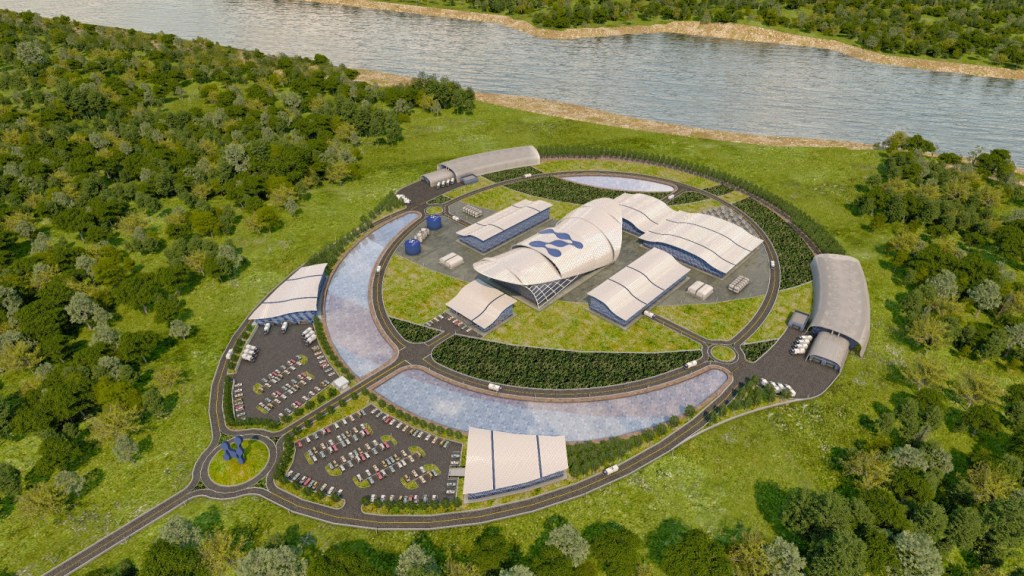
The unveiling of the artist’s rendition of the “new” VOYGR (see image above) is similar to the original overly romanticized drawing for the first VOYGR (see headline photo.) Both feature a benign looking set of buildings in a bucolic setting, miles from anywhere, including from reality.
But since the VOYGR is actually intended to power AI data centers in likely far more built-up areas, I thought I’d ask AI itself what it thought of the prospects for NuScale’s foundering flagship?
“NuScale’s VOYGR small modular reactor faces severe economic and design hurdles that make commercial operation highly improbable under current market conditions,” it replied.
Alternatively, it could have exercised a little wit along with brevity and answered simply: “Not Now, VOYGR.”
Linda Pentz Gunter is the Executive Director of Beyond Nuclear and writes for and edits Beyond Nuclear International. She is the author of the book, No To Nuclear. Why Nuclear Power Destroys Lives, Derails Climate Progress And Provokes War, published by Pluto Press. Any opinions are her own.
Note: Now, Voyager was a film starring Bette Davis. The last line is “Oh, Jerry, don’t let’s ask for the moon. We have the stars.”
Headline photo: Artist’s rendition of the original NuScale plan for Idaho National Laboratory. (Image by Oregon State University/Wikimedia Commons.)

