 Beyond Nuclear International
Put on your pearls and pummel ‘em!

Dr. Helen Caldicott: the anti-nuclear movement’s most fearless and indefatigable matriarch
By Linda Pentz Gunter
I have nothing against Birkenstock sandals. Well, not much anyway. Nor tie-dye really. Nor, do I think, does Dr. Helen Caldicott. But there was a time — and maybe there still is — when she would advise any woman anti-nuclear activist venturing into verbal combat with the other side to “wear pearls and pantyhose.”
This was not an anti-feminist stance. Far from it. It was the sign of a smart tactician. Leave the Birkenstocks and the peace sign jewelry at home. Don’t give them what they want. Don’t let them stereotype you. Put on those pearls and then pummel ‘em!
Caldicott, probably the world’s most famous anti-nuclear campaigner, has done her fair share of pummeling for the best part of close to six decades. She is 80 now and tired and she wants us to do it. Especially us women. Although she is as disappointed and frustrated as the rest of us that we still have to. We should have won by now, I am sure she would say. I do.
In my now 21 years in the anti-nuclear movement I have come across countless people, mostly women, who have told me, “I got onto this movement because of Helen Caldicott. She inspired me.” Usually it took just one encounter, a single speech. Helen had a way of rattling people’s conscience. After listening to her, you couldn’t not join the anti-nuclear movement (against both nuclear power and nuclear weapons.) The alternative was to walk away, remove the mirrors from your walls, and sleep badly the rest of your life.
Small modular reactors are dead on non-arrival

Despite heavy promotion, SMRs are too expensive and there are no buyers
By Jim Green
With near-zero prospects for new large power reactors in many countries, the nuclear industry is heavily promoting the idea of building small modular reactors (SMRs). These reactors would have a capacity of under 300 megawatts (MW), whereas large reactors typically have a capacity of 1,000 MW.
Construction at reactor sites would be replaced with standardised factory production of reactor components then installation at the reactor site, thereby driving down costs and improving quality control.
The emphasis in this article is on the questionable economics of SMRs, but a couple of striking features of the SMR universe should be mentioned (for details see the March issue of Nuclear Monitor).
Fossil fuels and militarism
First, the enthusiasm for SMRs has little to do with climate-friendly environmentalism. About half of the SMRs under construction (Russia’s floating power plant, Russia’s RITM-200 icebreaker ships, and China’s ACPR50S demonstration reactor) are designed to facilitate access to fossil fuel resources in the Arctic, the South China Sea and elsewhere.
Another example comes from Canada, where one application of SMRs under consideration is providing power and heat for the extraction of hydrocarbons from oil sands.
Small modular reactors want to make headlines

Instead, they are already in the obituary column
Beyond Nuclear has produced a step-by-step handout on key arguments against pursuing SMRs.
By Linda Pentz Gunter
So now the IAEA is on the act. Although actually, promoting nuclear power IS the IAEA’s act. From October 7-11, the IAEA will hold the “International Conference on Climate Change and the Role of Nuclear Power” in its hometown of Vienna, Austria. In its breathy and enthusiastic introduction to the conference, the agency describes its “statutory objective” as being “to accelerate and enlarge the contribution of atomic energy to peace, health and prosperity throughout the world.”
Peace, health and prosperity? Nuclear power has arguably never contributed any one of these. In the current economic climate it never will. It’s brazen hubris of course, but it comes from a place of desperation. Climate change is finally in the headlines. The nuclear power industry wants to be, too. Instead, it’s in the obituary column.
That’s where Dr. Jim Green of Friends of the Earth Australia, decided to assign the SMR in his excellent article which we reproduce this week. He called it an obituary, but arguably, SMRs have not yet even been born, so we called them “dead on non-arrival” in our headline.
Among the presentations at the IAEA conference, will most certainly be a flurry of enthusiastic expositions on the golden future of the so-called Small Modular Reactor. Again, it’s the fancy footwork with words that makes this notion sound palatable. Small? Good. Modular? Sounds simple to assemble. Good again. Like Lego, an image Dr. M.V. Ramana even used in a recent slide presentation on the fallacies of the SMR. The word “nuclear” is carefully omitted from the name. Why? Because we’ve been here before and it didn’t work out so well then, either.
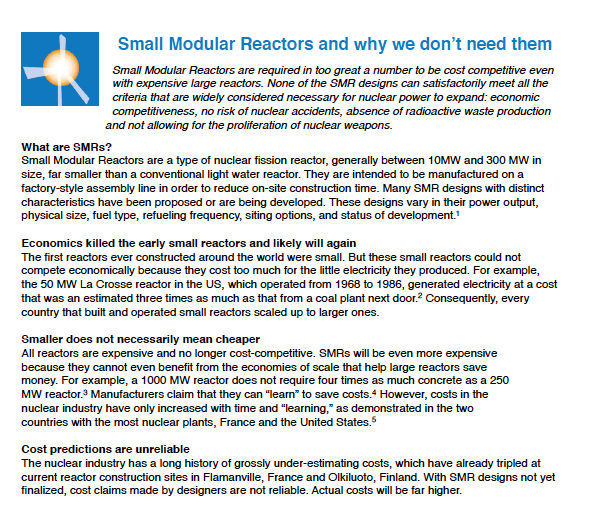
An excerpt from Beyond Nuclear’s new fact sheet on Small Modular Reactors.
The even madder plan to build a new nuclear plant on the beach
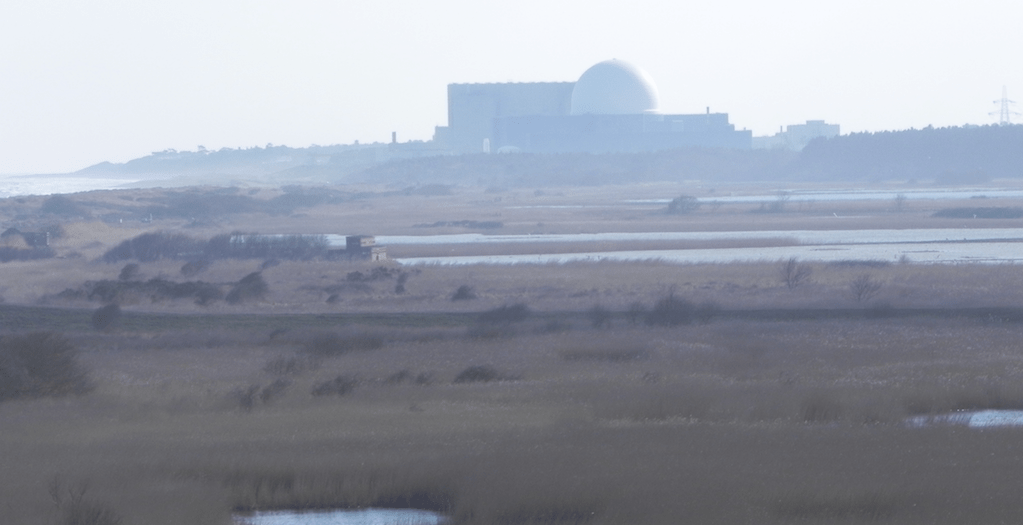
The case against Sizewell C
By Linda Pentz Gunter
In December 2018 we ran an article — The mad plan to store nuclear waste on the beach — which has become one of our most read stories. Now, as the climate crisis worsens, here comes a possibly even madder plan — a new nuclear power plant on a beach with a shifting coastline famous for erosion.
In the spring of 2013 — at least what is usually billed as spring — Paul Gunter and I represented Beyond Nuclear at meetings and talks around the proposed Sizewell C reactor on the UK east coast. An abnormally frigid wind from the Siberian mountains was blowing in off the North Sea — on whose coastline the Sizewell reactors sit. We strode along those unforgiving Suffolk sands dressed as if re-enacting an Ernest Shackleton expedition. Our “sightseeing” venture to the nuclear site allowed us to approach surprisingly close to the two shuttered and Soviet-looking Sizewell A reactors and their neighboring and still operating Sizewell B reactor — the UK’s only commercialized pressurized water reactor. There was an apparently invisible border — like a sort of Maginot line — marking where the nuclear property began, but not a security soul in site.
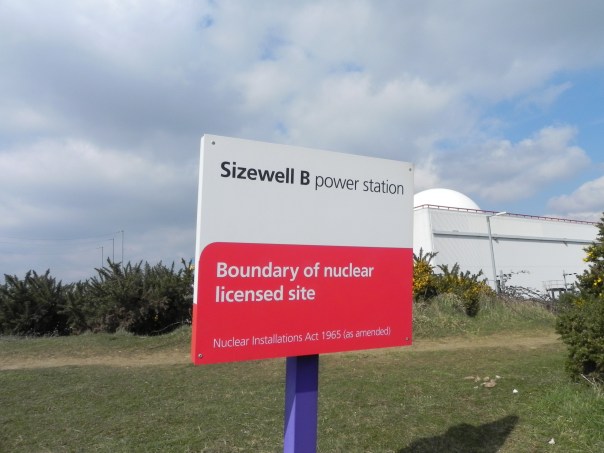
A boundary marker, but no actual fence, at the Sizewell nuclear power plant. (Photo: Linda Pentz Gunter)
Residents around TMI exposed to far more radiation than officials claimed
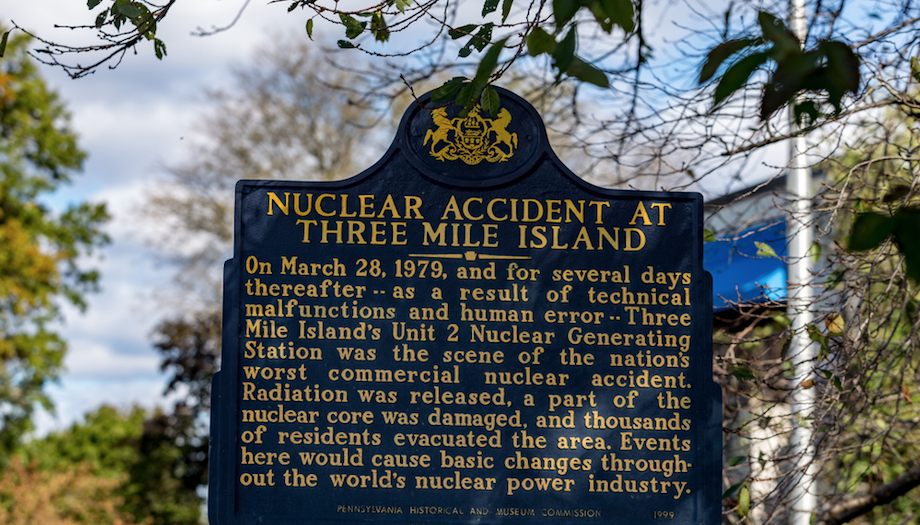
Researchers under gag order couldn’t investigate true health impacts after Three Mile Island nuclear disaster
By Cindy Folkers
Residents around Three Mile Island were exposed to much more radiation from the nuclear disaster than was claimed by officials, a fact that was kept from researchers and the public for years.

Residents at the time had questions about health risks but the fund established to pay for public health research related to the disaster was under a research gag order issued by a court. (Photo: Child Aloft by Robert Del Tredici)
After the Three Mile Island reactor core melted and radioactivity was released to the surrounding population, researchers were not allowed to investigate health impacts of higher doses because the TMI Public Health Fund, established to pay for public health research related to the disaster, was under a research gag order issued by a court. If a researcher wanted to conduct a study using money from this Fund, they had to obey two main parameters set forth by Federal Judge Sylvia Rambo, who was in charge of the Fund.*
- Those studying the health impact of Three Mile Island radiation emissions were prohibited from assessing “worst case estimates” of radiation releases unless such estimates would lead to a conclusion of insignificant amount of harm — that being “less than 0.01 health effects”.
- If a researcher wanted to claim more harm or investigate a worst-case scenario, an expert selected by nuclear industry insurers would have to “concur on the nature and scope of the [dosimetry] projects.”
Too cheap to meter now needs a bailout?
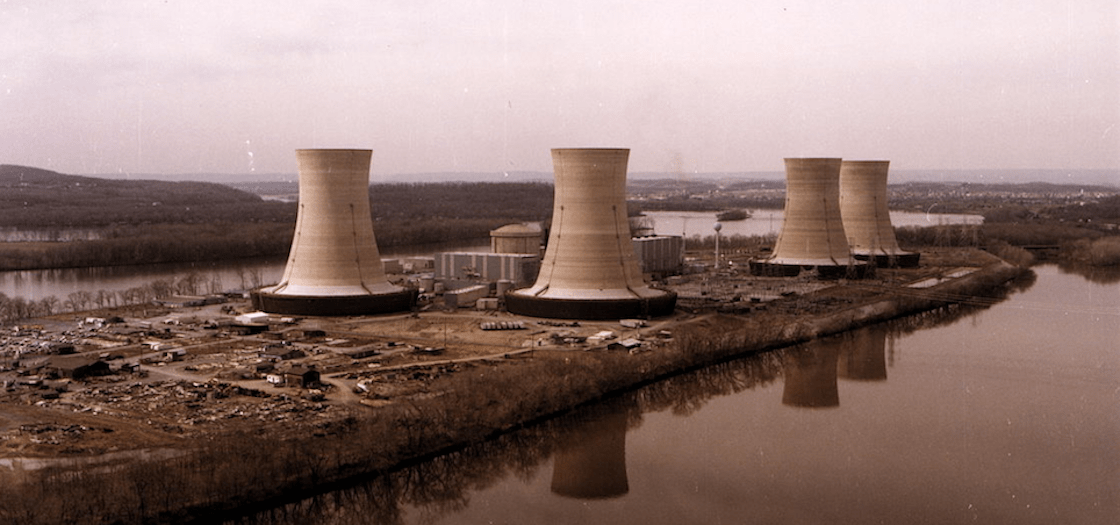
Forty years since the nuclear accident, Three Mile Island needs to close
By Eric Epstein
It wasn’t that long ago when Pennsylvania legislators proclaimed that the market was best suited to determine what energy technologies should move Pennsylvania forward.
And it wasn’t that long ago that nuclear power generators, after receiving $9 billion from ratepayers, embraced the marketplace and deregulation.
Now two nuclear corporations, Illinois-based Exelon Energy and Ohio-based First Energy no longer believe in the Pennsylvania marketplace. These corporations want to charge consumers a nuclear tax, and ship the profits to Illinois and Ohio. Not the good neighbor policy most of us had in mind.
Remember Three Mile Island?
Three Mile Island Unit 1, the current bailout candidate, became operational in 1974. Like most nuclear plants, it was behind schedule and over budget. Unit-2 came on line in 1978, and was also behind schedule and over budget. Hostage ratepayers paid $1.1 billion in 1970s dollars to build Three Mile Island.
 Beyond Nuclear International