 Beyond Nuclear International
CODEPINK’s Medea Benjamin takes a look inside Iran
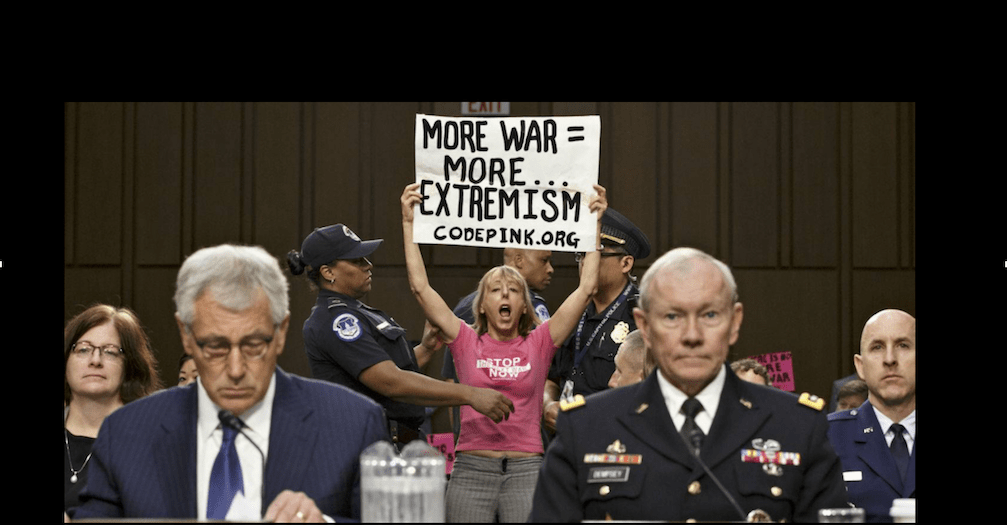
Anti-war activist wants peace talks with Iran, not crushing sanctions
By Sophia Akram, The Iranian
Medea Benjamin’s entry into the public sphere came with disruptive vigor in May 2013, when she interrupted an address by former US President Barack Obama to object to his then policy on the use of armed drones.
Obama responded to Benjamin at the time saying, “The voice of that woman is worth paying attention to… these are tough issues, and the suggestion that we can gloss over them is wrong.”
The incident perhaps gave Benjamin a bigger audience for her activism via the organization CODEPINK, through which she had been involved for years. And through which she’s tackled a number of global issues across the world.
Having looked at the Kingdom of Saudi Arabia in a book published in 2016, she’s now taking on Iran.
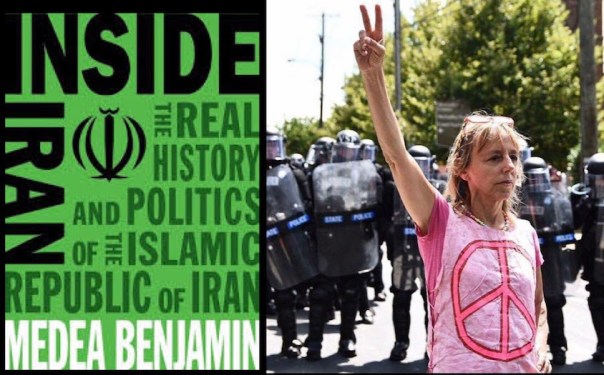
CODEPINK co-founder, Medea Benjamin, has a new book out about Iran and is a dedicated campaigner for peace and justice.
Trump’s chaos campaign
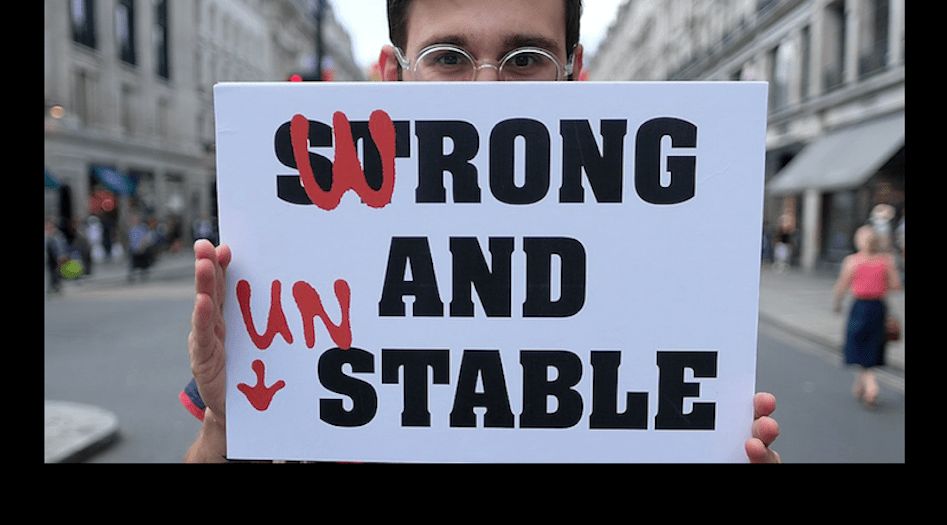
Iran honored its nuclear deal. But Trump’s sanctions could plunge the region into conflict
By Vijay Prashad, Independent Media Institute
On August 4, Iran’s President Hassan Rouhani went on television to talk about the reinstatement of sanctions by the United States against his country. He prepared the country for more privations as a result of the sanctions. Responding to Trump’s offer for a meeting, Rouhani said pointedly, “If you stab someone with a knife and then say you want to talk, the first thing you have to do is to remove the knife.”
It is clear to everyone outside the U.S. government that Iran has honored its side of the 2015 nuclear deal that it made with the governments of five permanent members of the UN Security Council (the U.S., the UK, France, China and Russia) as well as the European Union. In fact, quite starkly, the European Union’s foreign policy chief—Federica Mogherini—said, “We are encouraging small and medium enterprises in particular to increase business with and in Iran as part of something that for us is a security priority.” In other words, Mogherini is asking companies to resist Trump’s policy direction. What she is saying, and what Rouhani said, is that it is the United States that has violated the nuclear deal and so no one needs to honor the U.S. sanctions that have been reinstated.
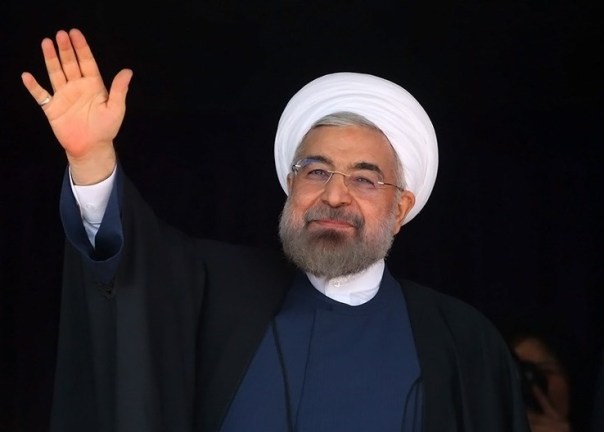
Iran president, Hassan Rouhani, says it is the United States that has violated the nuclear deal, so no one need honor U.S. sanctions. (Photo:WikiCommons)
Mogherini pointed to “small and medium enterprises” because these would not be the kind of multinational corporations with interests in the United States. But it is more than small and medium enterprises that are going to challenge the U.S. sanctions. China, Russia and Turkey have already indicated that they will not buckle to U.S. pressure.
China: “China’s lawful rights should be protected,” said the Chinese government. China has no incentive to follow the new U.S. position. First, China imports about $15 billion of oil from Iran each year and expects to increase its purchases next year. Chinese state energy firms, such as China National Petroleum Corporation (CNPC) and Sinopec, have invested billions of dollars in Iran. CNPC and Sinopec have also got shares in Iran’s major oil fields—CNPC has a 30 percent share in the South Pars gas field and has investments in the North Azadegan oil field, while Sinopec has invested $2 billion in Yadavan oil field. China’s Export Import Bank, meanwhile, has financed many large projects in Iran, including the electrification of the Tehran-Mashhad railway. Other Chinese investment projects include the Tehran metro and the Tehran-Isfahan train. These projects are worth tens of billions of dollars.
Second, China is in the midst of a nasty trade war with the United States. In late August, Trump’s government slapped 25 percent tariffs on $16 billion of Chinese imports into the United States. China responded with its own tariffs, with the Chinese Commerce Ministry saying that the U.S. is “once again putting domestic law over international law,” which is a “very unreasonable practice.” The “once again” is important. China is seized by the unfairness of the reinstatement of sanctions on Iran, not only for its own economic reasons but also because it sees this as a violation of international agreements and a threat to Iranian sovereignty—two principles that China takes very seriously. Sinopec, knee-deep in Iran’s oil sector, has now said that it would delay buying U.S. oil for September. Iran has now been drawn into the U.S. “trade war” (on which, read more here). The Chinese have been quite strong in their position. The Global Times, a Chinese government paper, wrote in an editorial, “China is prepared for protracted war. In the future, the U.S. economy will depend more on the Chinese market than the other way around.” This fortitude is going to spill over into China’s defense of Iran’s economy.
Russia: Russia and Iran do not share the kind of economic linkages that Iran has with China. After the 2015 sanctions deal, Iran did not turn to Russian oil and gas companies for investment. It went to France’s Total—which signed a $5 billion deal. Russia and Iran did sign various massive energy deals ($20 billion in 2014), but these did not seem to go anywhere. Russia’s Gazprom and Lukoil have toyed with entry into Iran. In May, Lukoil directly said that it would be hesitant to enter Iran because of the proposed U.S. reinstatement of sanctions. Lukoil’s hesitancy came alongside that of European firms such as Peugeot, Siemens and even Total, which decided to hold off on expansion or cut ties with Iran. Daimler has now officially halted any work in Iran. It was a surprise earlier this year when the Iranian Dana Energy firm signed a deal with the Russian Zarubezhneft company to develop the Aban and West Paydar oilfields. The contract is for $740 million, which in the oil and gas business is significant but not eye-opening.
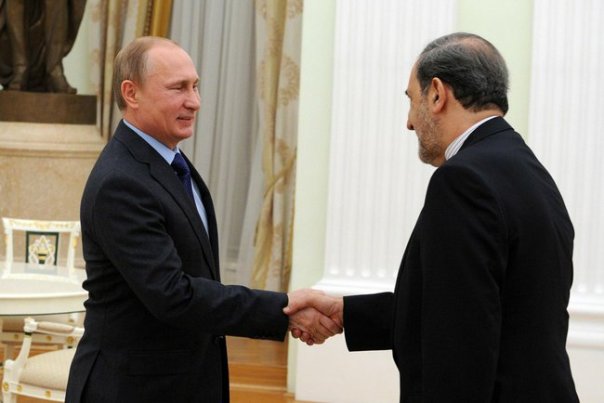
Iran’s senior leader, Ali Akbar Velayati, right, meets Russia’s Vladimir Putin. (Photo: WikiCommons)
In July, Iran’s senior leader Ali Akbar Velayati met Russia’s Vladimir Putin in Moscow. He left the meeting saying, “Russia is ready to invest $50 billion in Iran’s oil and gas sectors.” Velayati specifically mentioned Rosneft and Gazprom as potential investors—“up to $10 billion,” he said. When Putin had been in Tehran last November, Russian companies signed preliminary deals worth $30 billion. Whether these deals will go forward is not clear. But, after Trump’s reinstatement of sanctions, Russia’s foreign ministry said that it would “take appropriate measures on a national level to protect trade and economic cooperation with Iran.” In other words, it would see that trade ties are not broken.
Turkey: Both Iran and Turkey face great economic challenges. Neither can afford to break ties. Turkey’s foreign minister Mevlut Cavusoglu has said that his government will only honor international agreements, and that the U.S. reinstatement of sanctions is not part of an international framework. Turkey, therefore, will continue to trade with Iran. Iran’s oil and gas are crucial for Turkey, whose refineries are calibrated to Iran’s oil and would not be able to easily and cheaply adjust to Saudi Arabian imports. Almost half of Turkey’s oil comes from Iran.
Turkish-U.S. relations are at a low. Conflict over the detention of a U.S. pastor—Andrew Brunson—has led to the U.S. sanctioning two Turkish ministers—Minister of Justice Abdulhamit Gul and Minister of Interior Suleyman Soylu. Gul is a leader of the ruling party, AKP, while Soylu came to the party at the personal invitation of Turkey’s President Recep Tayyip Erdoğan. These are not men to be intimidated by U.S. pressure.
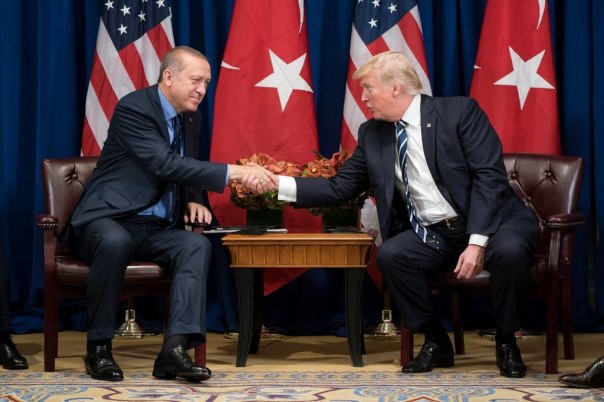
Turkey’s President Recep Tayyip Erdoğan meets with Donald Trump but US-Turkish relations are now at an all-time low (Photo: WikiCommons)
A U.S. mission—led by Marshall Billingslea, assistant secretary of the U.S. Treasury—went to Turkey to convince the government to join the U.S. sanctions. Meanwhile, the U.S. has begun to put pressure on Turkey’s Halkbank, one of whose senior officials was found guilty of violation of the U.S. sanctions on Iran by a court in the United States earlier this year. This kind of pressure is not sitting well with the Turkish government.
Inside Iran: Pressure mounts inside Iran. Protests have begun across the country, a reflection of the distress felt by the population as the country’s currency—the rial—slides around and as fears of inflation mount. In early August, the Iranian government fired the head of Iran’s central bank—Valiollah Seif—and replaced him with Abdolnasser Hemati. It reversed the foreign exchange rules, including the failed attempt to fix the value of the rial that was put in place in April. Hemati had been the head of Iran’s state insurance firm and before that of Sina Bank and Bank Melli. He is a highly trusted person by the government, which had already appointed him as ambassador to China before hastily rescinding that offer and moving him to the central bank. Whether Hemati will be able to balance the stress inside the Iranian economy is to be seen. Faith in the currency will need to be strengthened.
As part of that, Iran’s government has cracked down harshly against financial fraud, particularly scandals over foreign exchange. The man who signed the 2015 nuclear deal—Iran’s Deputy Foreign Minister Abbas Araghchi—now watches as his nephew—Ahmad Araghchi, the central bank’s vice governor in charge of foreign exchange—is arrested with five other people as part of an inquiry over fraud. The message: no one, not even the Araghchi family, is immune from the long arm of the law.
Trump’s belligerence, the refusal of key countries to abide by Trump’s sanctions (including the European Union, but mainly Russia and China) as well as the internal pressure in Iran could very likely create the conditions for a military clash in the waters around Iran. This is a very dangerous situation. Sober minds need to push against the reinstatement of these sanctions—which the Iranians see as economic warfare—as well as the escalation into military war.
Vijay Prashad is a writing fellow at the Independent Media Institute. He is the chief editor of LeftWord Books and the director of Tricontinental: Institute for Social Research.
This article was produced by Globetrotter, a project of the Independent Media Institute. It was first published on August 8, 2018 on AlterNet and is reproduced by Beyond Nuclear International with kind permission from the author.
Headline photo by Alisdare Hickson, UK, WikiCommons.
The woman who tore up the curtain of silence

Through song and activism, Darlene Keju taught her fellow Marshall Islanders the truth about US atomic atrocities
By Linda Pentz Gunter
Early in her life, Marshall Islander, Darlene Keju, did not know the extent to which her fellow Marshallese had suffered as a result of the 67 atomic detonations inflicted on the region by the United States during the Cold War. But as she gained her education in Hawaii, the terrible truth began to reveal itself. And after that, Keju could not remain silent.
Once Keju began to research and understand more about the US atomic tests, she was stunned to discover how little information was available to most adults living in the islands and just how far the harm extended. Faced with the immense scale of damage and injustice, Keju went to work, touring, speaking, educating and using music, dance and song to reach her people, work that was cruelly cut short when Darlene’s life was taken by cancer on June 18, 1996, just two months after her 45th birthday. Many of the revelations about the true depth of depravity surrounding the US atomic tests only emerged well after Keju’s death.

Darlene Keju in 1989 in Hawaii on a brief respite from activism. (Photo: Giff Johnson)
All of this is beautifully chronicled in a book by Darlene’s American husband, Giff Johnson. In “Don’t Ever Whisper,” he describes how Darlene “expressed her outrage over repeated resettlements of Marshall Islanders, continual and unnecessary exposure of people to nuclear test fallout and the resulting health problems, and the US government’s refusal to admit that many more islands than Bikini, Enewetak, Rongelap, and Utrik were affected.” (You can hear an interview by Pacific Media Watch with Johnson about the book here.)
An A-Z against nuclear power
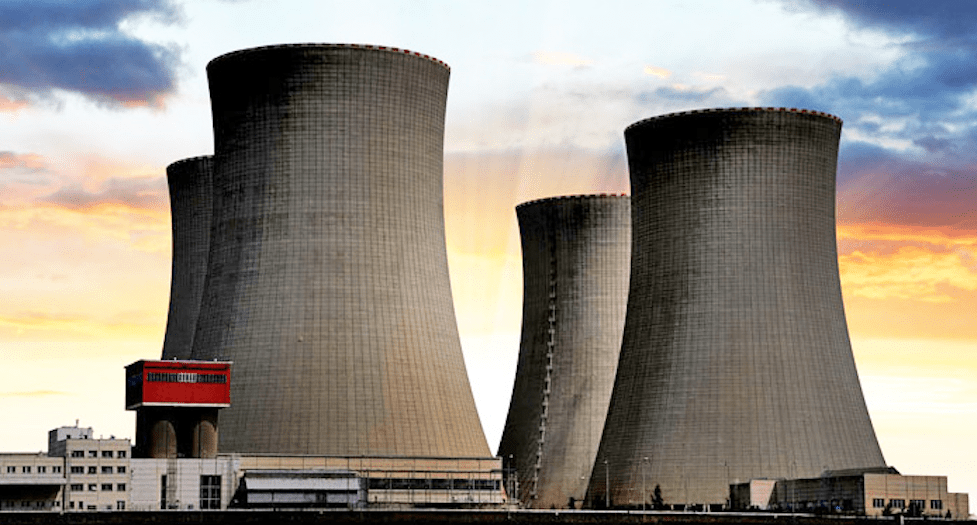
The Overview section of our new Handbook provides simple explanations of the entire nuclear fuel chain
By Beyond Nuclear staff
What is the difference between an open pit and an in-situ leach uranium mine? How does a nuclear power plant produce electricity? What happens to reactor fuel once it’s no longer usable? What is the difference between high-level and low-level radioactive waste and where is it stored? Why isn’t reprocessing really “recycling”?
We may know the answers to some or all of these questions. But can we deliver a succinct, clear, accessible answer to explain them to someone not already steeped in the issue?
As any activist engaged in anti-nuclear advocacy knows, nuclear power is a complex topic and describing each phase of the nuclear fuel chain can quickly bog us down in long, technical explanations. And once we go there, eyes glaze and we lose our audience.
Proponents of nuclear energy have taken full advantage of this, downplaying and minimizing the risks and using facile and superficially appealing sound bites, unsupported by facts, to convince people that nuclear power is benign and useful for climate change.
Facts are what we believe will change people’s minds. But the idea that bombarding someone with a deluge of irrefutable facts about the dangers of nuclear power will automatically win them to our cause has proven to be an illusion. It doesn’t necessarily work.
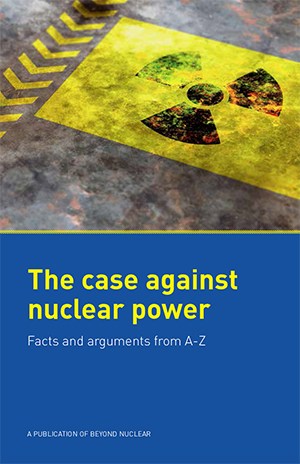 We do need facts, of course. And that is where our Handbook — The Case Against Nuclear Power: Facts and Arguments from A-Z — comes in. We must be able to accurately describe why nuclear power is dangerous, uneconomical and unjust. But we must do so in succinct, simple lay language. And then, once the basics are understood, we need to move people. And that is why the Beyond Nuclear International website came to be born, providing a natural home for the Handbook and expanding from facts to compelling narratives.
We have already compiled three Handbook chapters which you can find on the Beyond Nuclear International website under Handbook. So far, we have published: An Overview that offers simple explanations for every phase of the nuclear fuel chain; Radiation and harm to human health, which lays out the detriments to health of every phase of nuclear power operations; and Climate change and why nuclear power can’t fix it. More chapters are in the works.
French environment minister resigns
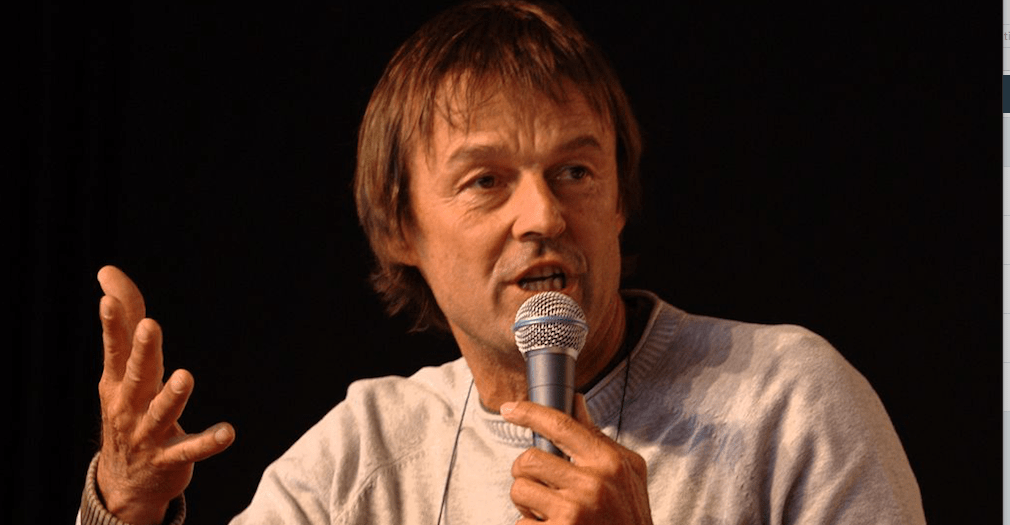
Update: A newly leaked report examines the possibility of France building six new EPR reactors starting in 2025, after a prolonged period of inactivity in the industry. The report was ironically commissioned by Hulot and economy minister, Bruno Lemaire, and concludes that France “cannot stop building” reactors in order to maintain industrial know how and provide jobs, according to the newspaper, Les Echos, which broke the story. The report’s finding may have contributed to Hulot’s decision to resign. However, the notion that France would build six more EPRs was met with derision by nuclear critics who pointed out that the French nuclear industry has been unable to complete even one EPR in either France of Finland, where both projects are years behind schedule and massively over-budget.
Is the departure of Nicolas Hulot significant?
By Linda Pentz Gunter
Opinion in France is decidedly mixed about the sudden resignation of French environment minister, Nicolas Hulot. He made his announcement on a radio show, taking the government of centrist, Emmanuel Macron, by surprise.
Certainly, the ecological crown had sat uneasily on Hulot’s head throughout his tenure in government. He arrived there ostensibly from the activist ranks — he was also a journalist — and was thought to be strongly anti-nuclear. But when French gendarmes raided and destroyed an opposition encampment at the proposed high-level radioactive waste repository site in Bure last February, Hulot failed to come to the defense of the anti-nuclear activists, some of whom were arrested. Even when challenged in the French parliament for his silence, he bobbed and weaved, relying on evasive rhetoric.
Yet when he resigned on Tuesday, he claimed it was to stop “having to lie to myself” and told the radio program on which he made the announcement that nuclear power is “a useless folly.”
Fighting for life in the “place of death”
Traditional owners won’t give up 40-year opposition to Yeelirrie uranium mine
By Linda Pentz Gunter
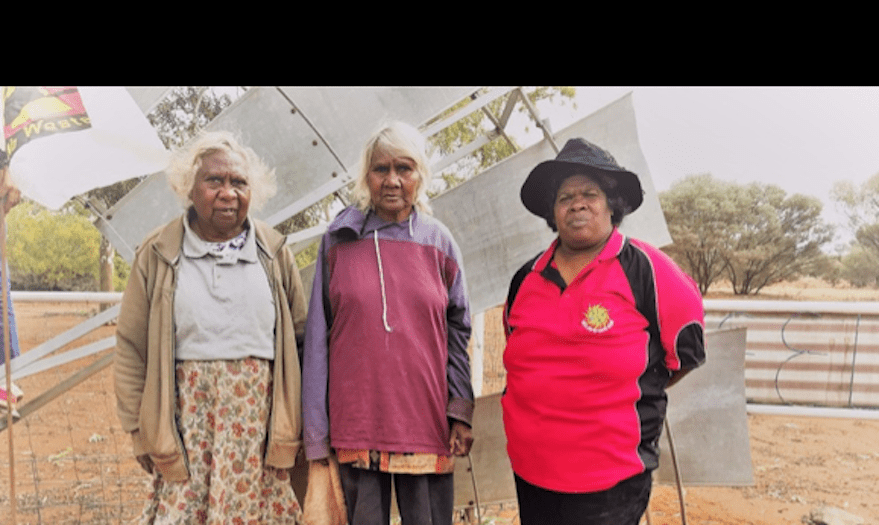
In the local Aboriginal language, the name Yeelirrie means to weep or mourn. It is referred to as a “place of death.” Yeelirrie is on Tjiwarl Native Title lands in Western Australia, where it has long been faithfully protected by Aboriginal traditional owners. The Seven Sisters Dreaming songline is there. It is home to many important cultural sites. And for 40 years, due to resolute indigenous opposition, and thousands of community submissions of protest, it had been spared plans by the Canadian mining company, Cameco, to plunder it for uranium.
The earth guardians know that such a desecration would cause the extinction of multiple species of subterranean fauna. It would release death. It would destroy Yeelirrie.
Now the fate of those tiny creatures hangs in the balance, their future in the hands of three brave women, backed by environmental organizations, after the outgoing Western Australian government decided to allow the Yeelirrie uranium mine project to go forward.
 Beyond Nuclear International