 Beyond Nuclear International
Nuclear flame fizzles in Japan
But leaders still cling to failing nuclear power
Prime Minister Shinzo Abe and the “nuclear village” hoped the Olympics would normalize Japan’s radiological aftermath. But the Fukushima effect has meant zero nuclear exports, leading the government to shore up the nuclear industry at home at the expense of renewables.
By Cassandra Jeffery and M.V. Ramana
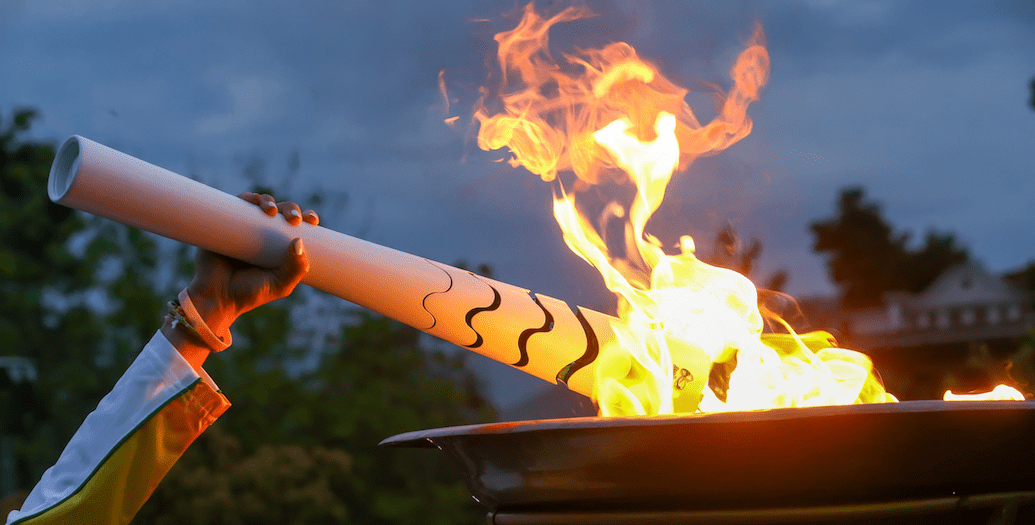
Last week, International Olympic Committee President Thomas Bach and Japanese Prime Minister Shinzo Abe agreed to delay the 2020 Summer Olympic Games because of the COVID-19 pandemic. However, they will keep the Olympic flame burning in Fukushima Prefecture. The torch relay route was to have begun there, a poor decision, given the meltdown of multiple reactors in Fukushima nine years ago in March 2011. While radiation levels may have declined since 2011, there are still hotspots in the prefecture, including at the sports complex where the torch relay would have begun and along the relay route.
The persistence of this contamination, and the economic fallout of the reactor accidents, should remind us of the hazardous nature of nuclear power. Simultaneously, changes in the economics of alternative sources of energy in the last decade invite us to reconsider how countries, including Japan, should generate electricity in the future.
Japan is not alone in having experienced severe nuclear accidents. The 1986 Chernobyl accident also contaminated very large areas in Ukraine and Belarus. As in Japan, many, many people had to be evacuated, about 116,000 according to the 2000 report of the United Nations Scientific Committee on the Effects of Atomic Radiation. Many of the evacuees never did return; thirty-four years after the accident, thousands of square kilometres remain closed off for human inhabitation.
Events such as these are, naturally, traumatic and result in people viewing nuclear power as a risky technology, a view that has led to persistent and widespread public opposition around the world.
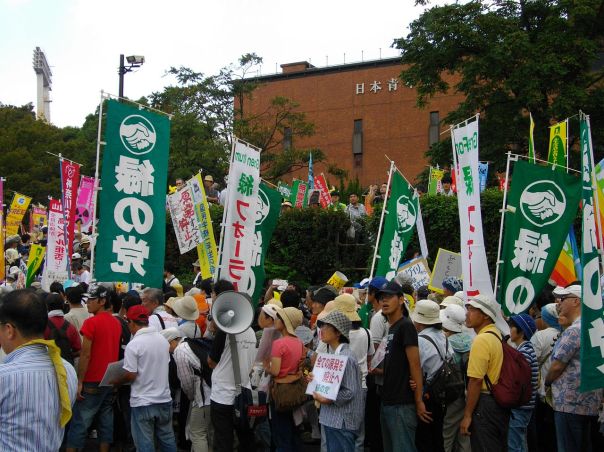
There is widespread opposition to nuclear power in Japan as well as around the world. (Photo: 保守 for Wikimedia Commons)
This opposition is evident in Japan too, where opinion polls show overwhelming lack of support for the government’s plans to restart nuclear plants that have been shut down after the Fukushima accidents. One poll from February 2019 found 56 percent of respondents were opposed to resuming nuclear operations; only 32 percent in favour of resumption. Other polls show significant local opposition, one example coming out of the Miyagi Prefecture, where some local residents have filed an injunction to ban the Miyagi governor from approving a utility plan to restart a nearby reactor.
Nuclear lessons from the coronavirus
No place for atomic power amidst climate chaos and pandemics
By Linda Pentz Gunter
There is nothing like being shut in your own home, alone with your human and animal nearest-and-dearests, to focus the mind on the crises that now swirl outside.
And it is “crises” in the plural, because while all the focus is of course on the novel coronavirus, there is one giant crisis steamrollering toward us that will wreak orders of magnitude more devastation, but somehow does not merit the same kind of emergency action. And that, of course, is climate change.
Reflecting on the coronavirus pandemic from my peaceful office eyrie, with no traffic rolling past my windows and only the now audible city birdsong to distract me, it is clear how we got climate change. It is exactly the same mentality that brought us the covid crisis. Recognize a problem; assume it might just right itself; then assume it might not get as bad as predicted; then realize it’s pretty bad but do too little to stop it; then confront a crisis now impossible to adequately mitigate.
Denial seems to be one of the greatest of human achievements. It’s also why we have nuclear power. It will be too cheap to meter. An accident will never happen. We will solve the radioactive waste problem later.
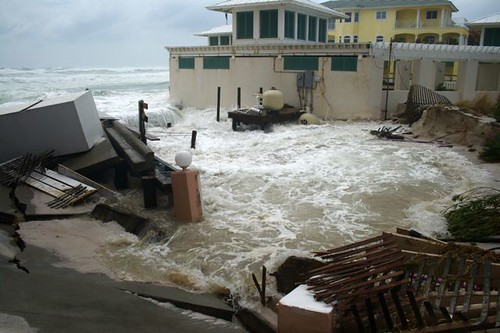
Storm surges and sea level rise are an inevitable risk to all coastal properties, but especially nuclear power plants. (Photo: Creative Commons)
With the climate crisis upon us, it should be patently obvious that building new nuclear power plants anywhere is not an intelligent plan. Sea level rise is a certainty, and fires, flooding, storm surges, and earthquakes are likely to increase both in frequency and force. Building power plants that contain an inventory of long-lived lethally radioactive fuel in such an environment is insane. And then to build them on shorelines, as is currently happening at Hinkley, and is threatened for similar settings at Sizewell and possibly Wylfa — all of them in the UK— is irresponsible in the extreme.
Nuclear espionage
Cyber security should be a concern at nuclear plants worldwide
By M.V. Ramana and Lauren J. Borja
On October 28, 2019 a computer security analyst tweeted that computer hackers had gained “Domain controller-level access at Kudankulam Nuclear Power Plant” (KKNPP) in Tamil Nadu.
KKNPP has two operational nuclear reactors that had been connected to the electric grid in October 2013 and August 2016.
The tweet was based on an information drop on the Dtrack virus at VirusTotal, which is an online repository of malware code. A version of the Dtrack virus found on the VirusTotal website included credentials specific to KKNPP’s internal network, indicating that Dtrack had infected computers inside the nuclear power plant.
Nuclear energy is a unique source of electricity. One of its peculiarities is its capacity to suffer severe accidents that can spread hazardous radioactive contamination across thousands or even tens of thousands of square kilometres requiring evacuation of populations for decades or centuries.
To avoid such accidents, the construction of nuclear power plants requires vast quantities of concrete and steel, exacting manufacturing standards, and layers upon layers of control systems at nuclear plants.
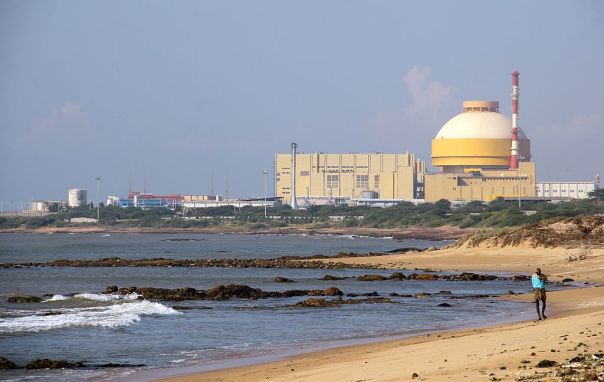
Kudankulam nuclear power plant, India. (Photo: indiawaterportal.org /Wikimedia Commons)
Despite such measures, there have been a number of accidents, of both small and large magnitude, since the beginning of the nuclear age. Each accident typically exposes a new vulnerability and often these accidents occur through pathways that were not conceived of by plant designers. The realization that hackers might be able to infect the computers in a nuclear power plant, potentially affecting the physical operation of the nuclear reactors themselves, is another safety vulnerability that had initially not been fathomed.
Out from under the uranium shadow
A community in Mali that defeated a uranium mine now looks to ease hardships
By Pr. Many Camara
The Municipality of Faléa is located in the Western part of Mali and borders Guinea and Senegal. The population is estimated at 17,000 inhabitants. Most of the population is young (between 15 and 35 years old) and female (approximately 62%), comprising the ethnic groups: Djalonke, Mandinka, Fula and Diakhanké.
The Berlin conference held in 1884/1885 drew the borders and organized the distribution of the African continent as we currently know it. Today multinational corporations hold the rights to exploit and collect the riches of Africa’s arable land and resources, including the uranium of Faléa.
About 20 years ago the French multinational COGEMA – later known as AREVA and today Orano – discovered deposits of uranium, copper and silver in Faléa. In 2007 the government of Mali concluded an agreement with the Canadian company Delta Exploration, now Rockgate Capital Corp, and afterwards Denison Mines concerning the future exploitation of its primary resources. The conditions of the contract were not made public.
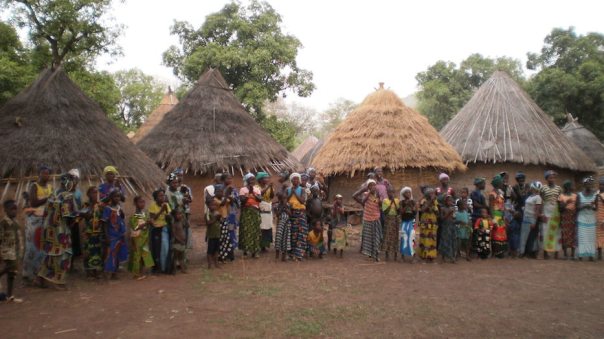
A village gathering in Falea. (Photo: Courtesy ASFA21)
Locals were neither informed nor consulted. The Council of the Wise, the “modern” municipal council, in place since 1999, and the local population were all left out of the process. Then, in 2008 an airstrip was suddenly built within 50 meters of the primary school.
Uranium. What is it?
Why is it harmful and why do we even use it?
Do people really understand what uranium is or how it is used to generate electricity? The Uranium Network decided to produce a short film — Uranium Mining — what are we talking about? — that explains it, step by step. A booklet of the same name is now also available to accompany the film.
From The Uranium Network:
When in 2007 / 2008, the price of uranium skyrocketed from around US$ 20 per pound to nearly US$ 140 per pound, mining companies from all over the world set out to find uranium – a new uranium rush had started.
Local populations were unprepared for the onslaught of the mining companies – and for the most part, people were unaware of what uranium is, let alone knowing about its uses or impacts from mining.
Africa became a major target for uranium exploration.

Golden Misabiko (left) of the Democratic Republic of Congo, and Almoustapha Alhacen of Niger, are active against uranium mining human rights violations in Africa. (Photo: © Orla Connolly)
The general public in the vast majority of African countries had no experience or knowledge about uranium or its exploitation; thus, it was easy for interested companies to veil their intentions when exploring for uranium; Governments instead emphasized the jobs which would be created, and the energy that might be generated, rather than the risks and dangers associated with uranium and its exploitation.
The half lives of the abandoned
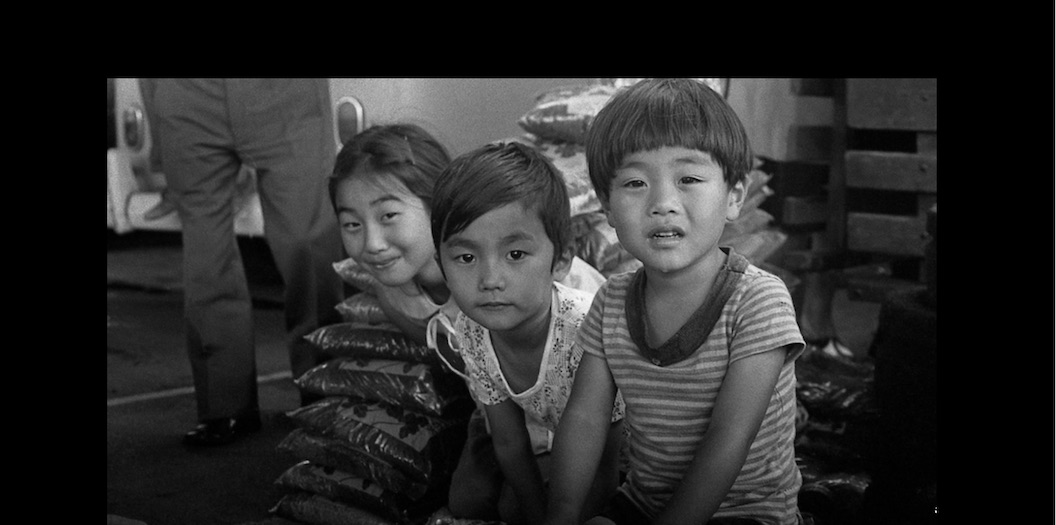
Daily life in Fukushima’s radioactive environment
By Cindy Folkers
“Whatever I do, all pleasure has disappeared from my life…we are living with a narrow range of activities.”
Akemi Shima was a resident of Date (duh-tay) City when the reactors at Fukushima exploded, spewing radioactive particles into the air, across the land, and into the waters. (She tells her story in her own words this week as well. See here.)
Her family had moved there years earlier to live closer to nature. It was supposed to be healthy. But for residents of Date City, still blanketed nine years later by radioactive contamination, the struggle for protection of health continues amid accusations of scientific error, betrayal and abandonment.
Shima, now 50, has been living through these accusations and her children’s health issues, while trying to keep her family safe in a contaminated land that has caused fractures within her community. Her experience is not only shared by other victims of Fukushima, but is a cautionary tale for any communities that have nuclear reactors in their midst. We share pieces of her story here for the first time in English.
“The victims have been unable to talk about the damage. … I don’t want to cry. I don’t want to be dismissed… Let me say that something is wrong.”
Instead of establishing mandatory evacuation zones based on contamination level, the government of Japan limited mandatory evacuation to 20 km from the destroyed reactors. Date City had highly contaminated areas but was 60 km away. Therefore, the residents were left to their fate as the City, under direction from the national government, had decided to recommend specific “spots” for evacuation. “Spots” actually meant individual houses and the recommendation to evacuate was based on a number of inconsistent and confusing criteria. This caused division among residents because a “recommended spot” (house) was eligible for evacuation aid, while a house that was often next door received none.
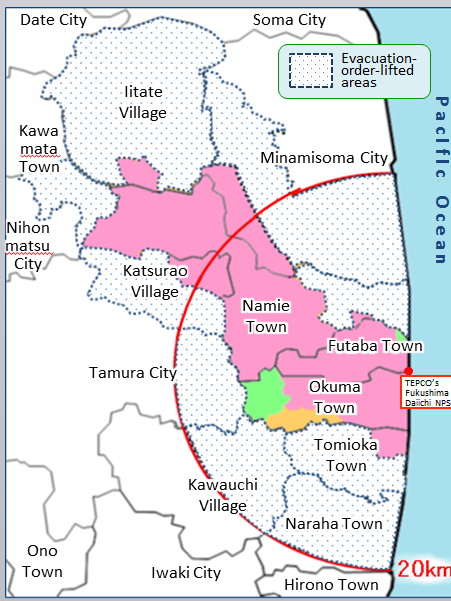
Evacuation map. Pink area denotes “difficult to return” zones, dots where evacuation orders have been lifted.

