 Beyond Nuclear International
Take a bow to the renewable revolution. The nuclear renaissance that never was is already fizzling, writes Linda Pentz Gunter
These days the mainstream media routinely parrot the nuclear industry party line that it is enjoying a “global renaissance.” These meek media sycophants don’t stop to question the veracity of this claim at all, or to notice that the rhetoric does not appear to match reality.
But if we are really living through a “nuclear renaissance”, which one is it? The old nuclear renaissance of 2006? Or a new re-renaissance? And where is their Michelangelo? Bill Gates appears to have made billions, but he hasn’t made masterpieces.
You have to wonder about the nuclear industry’s marketing mavens, though. Why on earth would they rebrand what they are trying to suggest is the new world dominance of nuclear power as an essential energy source by giving it the same name as their most abject failure?
Meet the new nuclear renaissance. Same as the old nuclear renaissance. All promise and, so far, no delivery.
That first nuclear renaissance wasn’t a renaissance at all, it was a stillbirth. And as a student of Italian, I have to say it peeves me that the nuclear industry dares to use the name at all.

The actual renaissance, which began in Italy, fully blossomed across Europe in the fifteenth and sixteenth centuries. It was an extraordinary simultaneous flowering of culture, intellectualism, art, music, science, economics and technology, a genuine “rebirth” after the relatively primitive Middle Ages.
As former energy department official Joe Romm so aptly put it during a recent briefing on nuclear power on Capitol Hill: “if the actual renaissance had been anything like the nuclear renaissance, we’d still be in the dark ages. But I guess in some respects, we still are.”
The first nuclear renaissance was launched around 2006 with about the same hubris as President Nixon’s famous claim that there would be 1,000 nuclear reactors operating in the US by the year 2000. (There were 104.)
The Nuclear Renaissance Part One promised 34 new reactors. We got two, limping in at Plant Vogtle in Georgia, years late and wildly over budget, ballooning from an original price tag of $14 billion to more than $35 billion and raising electricity rates to new heights.
Two more reactors — at the V.C. Summer site in South Carolina — broke ground but were canceled before completion, also raising electricity rates and sending executives to prison for bribery and corruption.
But now it’s the nuclear renaissance all over again! The John Carter of the nuclear world (John Carter, a 2012 Disney release, was one of the biggest box office bombs in movie history).
Everything is on track for it to be as big a dud as last time, except for one important difference. In 2026 we have an administration that is vehemently, and criminally, anti-renewable energy, casting aside actual climate solutions to prioritize fossil fuels and new nuclear projects and trashing reactor safety regulations — and the nuclear regulator — to ensure it happens.
This is all designed to clear the path — or superhighway — to allow an unprecedented acceleration of new reactor development and deployment. The theory is that it is overly stringent safety regulations that hold up nuclear power expansion.
But the field is now populated by ingenue startup companies with no reactor development experience. History shows that even with a known and familiar technology, there are frequent stumbles that hold things up that have nothing to do with the already compliant regulator — the US Nuclear Regulatory Commission currently being constrained and circumvented — or popular opposition (we wish!) It’s called “negative learning.” A tried and true technology should get cheaper and faster to develop. With nuclear power, it’s just the opposite.
But even with the NRC stripped of its oversight, Nuclear Renaissance the Sequel could still be a box office flop. That’s because, despite everything, renewables are simply doing it for themselves. Battery technology is advancing by leaps and bounds — crucially important not only to ensure renewable reliability but also to move away from extractive minerals mining with all its attendant predatory colonialism.
And renewables are soaring worldwide, despite the wrong-headed policies of far too many of the world’s governments — and especially our own governors here in the US — who have insisted on leaping aboard the atomic Titanic.
In 2025, renewables accounted for almost 86% of the total global power capacity added. Globally, renewable power capacity is projected to increase almost 4,600 GW between 2025 and 2030 – double the deployment of the previous five years, according to the International Energy Agency. This will see renewables become the largest global energy source, used for almost 45% of electricity generation by 2030.
The irony is, that even as he spouts gibberish about wind farms causing cancer, while directing billions towards an energy technology — nuclear power — that actually does, President Trump has accidentally boosted an already robust global green energy revolution by bombing Iran and forcing the closure of the strait of Hormuz, a key passageway for the transport of fossil fuels.
To compensate for this sudden shortage of fossil fuels — a bizarre mixed blessing given we absolutely shouldn’t be using them anyway— countries are quickly finding alternatives. What they aren’t finding are those new nuclear power plants, the paper atomic airplanes still in the design phase.
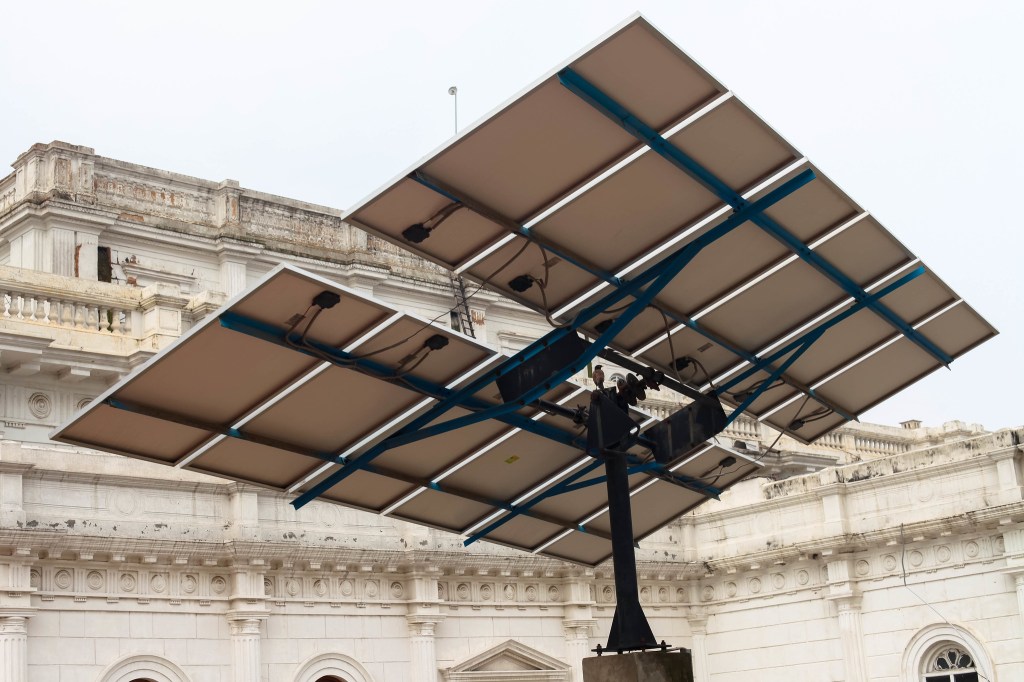
Instead, they are switching on renewables, which can be deployed in months to a handful of years, at a far lower cost, and of course without all the attendant complications of radioactive waste production or meltdowns that could irradiate entire regions effectively forever.
And it’s really not that hard, as we already know. The barriers to renewables are not technological, they’re political. But when nations’ hands are forced, how quickly things change.
Just look at Pakistan. In 2020 the country was struggling to get access to Liquified Natural Gas. It was at 3% solar. Today Pakistan is at 30% solar capacity.
“Storage will make renewable energy dominant,” says the International Renewable Energy Agency, borrowing Trump’s favorite word.
So no, we won’t get fooled again by the promise of a new nuclear renaissance. We are watching the renewable revolution take a bow instead.
Linda Pentz Gunter is the Executive Director of Beyond Nuclear and writes for and edits Beyond Nuclear International. She is the author of the book, No To Nuclear. Why Nuclear Power Destroys Lives, Derails Climate Progress And Provokes War, published by Pluto Press. Any opinions are her own.
Headline photo by Trish Hamme/Wikimedia Commons
 Beyond Nuclear International
Pingback: Take a bow to the renewable revolution. The nuclear renaissance that never was is already fizzling « nuclear-news