 Beyond Nuclear International
Report tracks global success of renewable energy
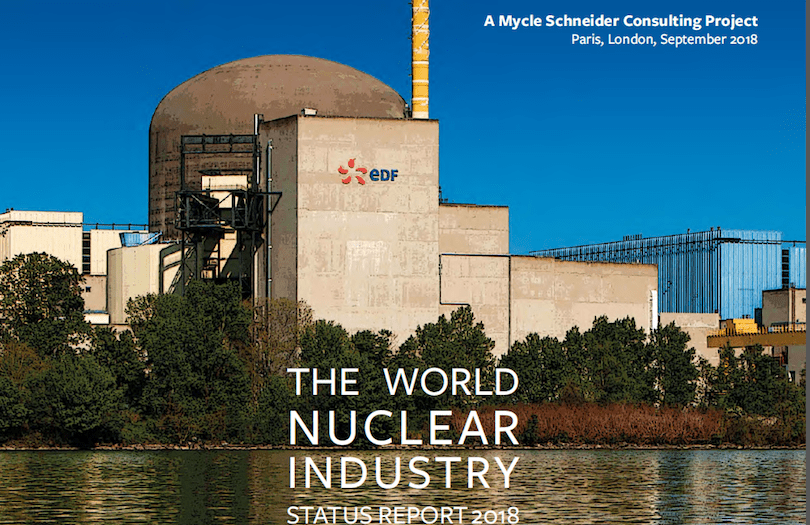
Annual dose of empirical data shows nuclear power in continued decline
By Linda Pentz Gunter
When arguing the case for or against nuclear energy, you can go with the masters of spin and omission or you can go with the empirical data. We prefer the latter. And for that, there is the welcome annual edition of the World Nuclear Industry Status Report.
After that, the job becomes easy. There IS no case for nuclear power. It’s fundamentally over. Yet governments — mainly those of nuclear weapons states — cling on to it even as their fingers are loosened one at a time from the ledge. They refuse to fall. Why?
These questions are largely answered in the 2018 edition of the WNISR which rolled out in London, UK on September 4, and is available for download — in full or as an executive summary — from the WNISR website. (The US rollout is October 9 in Washington, DC.)
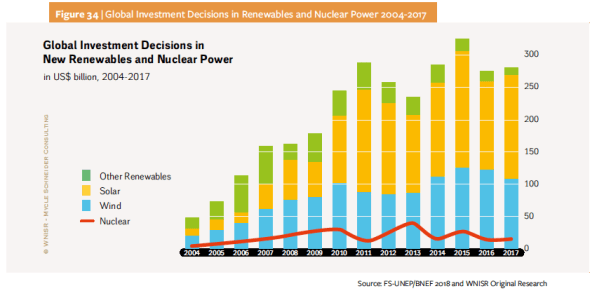
The report each year contains a roadmap trajectory of the nuclear power industry’s fate worldwide. For some time now, that trajectory has pointed downwards. There may be the occasional slight bump upwards (mostly due to China) or plateau, but fundamentally over the long haul, nuclear power is in decline.
Radioactivity harms us and no dose is “safe”

A “small” dose can do immense damage; our new handbook explains how and why
By Cindy Folkers and Linda Pentz Gunter
All nuclear power plants routinely release radioactive gases and water contaminated with radioactive isotopes. When a nuclear plant has a serious accident — as occurred at Three Mile Island, Chernobyl and Fukushima — orders of magnitude more radioactivity is released into the environment.
Uranium mining also releases harmful radioactive isotopes and leaves behind radioactive waste. The 1979 uranium tailings pond spill at Church Rock, NM — 90 million gallons of liquid radioactive waste and 1,100 tons of solid mill waste — was the largest accidental release of radioactive waste in US history and permanently contaminated the Puerco River.
Radioactive releases occur all along the uranium fuel chain, beginning with uranium mining and culminating in radioactive waste “management.”
All of these releases — whether large or small (because there is no “safe” dose) — impact human health with varying degrees of severity. And yet most of the time, these impacts are poorly understood, hushed up, or even dismissed. When discoveries are made — such as increased rates of leukemia in populations living near nuclear power or reprocessing plants — there is an immediate effort by industry, often supported by governments, to undermine, challenge or negate such findings.
The fact remains, however, that both the immediate and long-term damage done to human health — which can last for generations — is the single, most compelling reason not to continue with the use of nuclear power and the extractive, polluting industries that must support it.
The Radiation and Harm to Human Health chapter of the Beyond Nuclear anti-nuclear handbook, is available now for download and printing as a standalone booklet. In it, we endeavor to both explain and synthesize the many ways that radioactivity released through the nuclear power sector damages human health, especially the most vulnerable members of our population — women, pregnancy, babies and young children.
The most contaminated corner of Georgia?
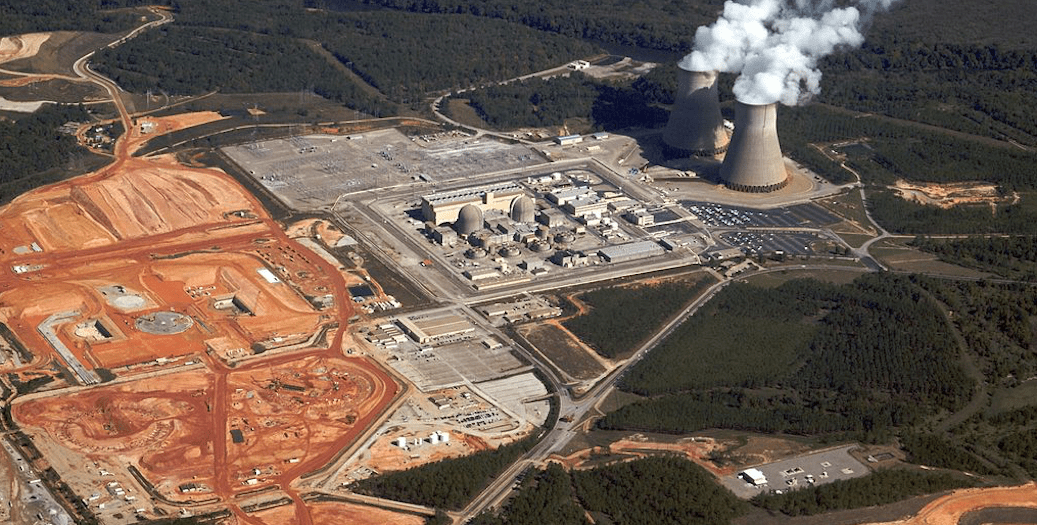
Utilities just voted to continue Vogtle reactor construction; residents want cleanup
By Jeremy Deaton, Nexus Media
You could be forgiven for taking a Geiger counter on a visit to Shell Bluff, Georgia. The town lies just across the Savannah River from a nuclear weapons facility and just down the road from an aging nuclear power plant. The river is one of the most toxic waterways in the country. The weapons facility is one of the most contaminated places on the planet, and the power plant is about to double in size.
Locals are outraged.
“We believe that Plant Vogtle is going to exacerbate the existing contamination that’s already in the area and make things worse,” said Lindsay Harper, deputy director of Georgia WAND, a women-led advocacy group working to end nuclear proliferation and pollution. “We believe that more money should be put toward cleaning up the contamination instead of continuing to produce more.”
Organizers from Georgia WAND and other advocacy groups gathered in Atlanta recently to discuss Plant Vogtle and related environmental issues and to register voters. The town hall marked the first stop on a bus tour organized by environmental leaders from across the South.
The Freedom to Breathe Tour will highlight environmental hazards facing marginalized communities — starting with the expansion to Plant Vogtle, the only nuclear project under construction in the country.
Nuclear power industry embraces its military roots — but wants us to pay
Desperate to keep uncompetitive nuclear plants open, industry claims they are needed for ‘security’
By Victor Gilinsky and Henry Sokolski
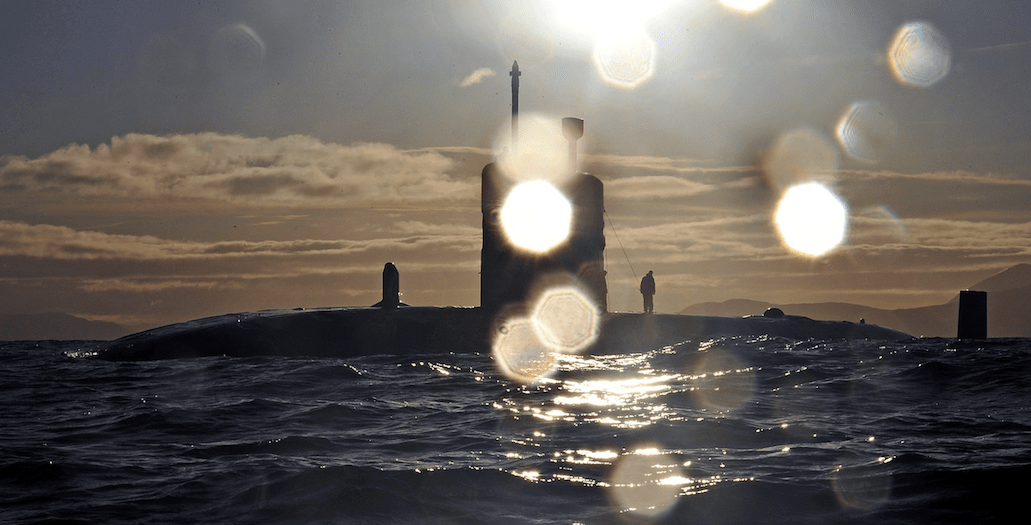
For years, the nuclear industry insisted that civilian nuclear power had nothing to do with weapons programs. That was then. Now, in a desperate attempt to keep no-longer-competitive nuclear plants from being shuttered, the industry claims there really has been a connection all along, and electricity customers should pay a premium to keep it going. It is one claim too many.
In its latest public effort, the nuclear industry got several dozen retired generals and admirals, former State, Defense and Energy Department officials, three former chairmen of the Nuclear Regulatory Commission, and a sprinkling of former senators, governors, industrialists and other worthies to sign a June 26, 2018, letter to Energy Secretary Rick Perry attesting to the connection between U.S. nuclear power plants and national security. The letter urged him to weigh in with federal and state rate-setting bodies to raise customers’ electricity bills to keep U.S. nuclear plants from shutting down, however much that will cost.
The letter didn’t, of course, put it in such crass terms. It talks about taking “concrete steps” to ensure electricity markets valued the nuclear plants’ “national security attributes”— a vague enough formulation to ease getting signatories. Most of them, as one of the signers (former Virginia Senator John Warner) himself put it , “are not intimately familiar with the ins and outs of the financial side of the power grid.” They do, however, apparently believe that they see the big picture—”the national security attributes of nuclear power”—more clearly than the parochial federal and state officials who set electric rates.
But are they any clearer on nuclear power’s national-security attributes than they are on the financial side of the industry?
Stanislav Petrov asked for nothing. We owe him everything
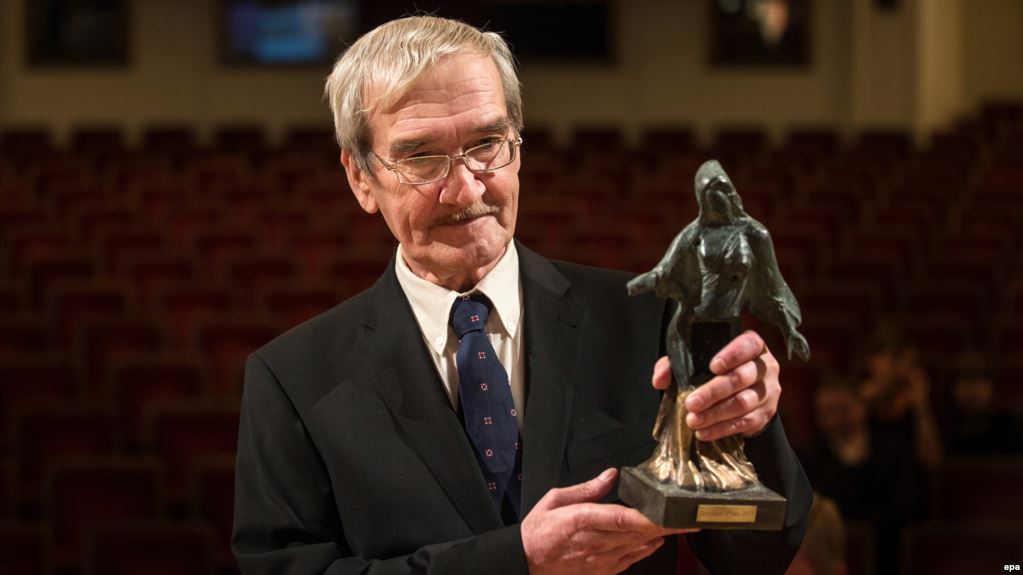
He averted nuclear war but his life — and death — were shrouded in ignominy
By Linda Pentz Gunter
Sometimes heroes are not who you want them to be. Sometimes they are just grumpy old men who would rather you just go away and leave them in peace.
But peace is exactly what Stanislav Petrov guaranteed on the night of September 26, 1983. Over the space of a few minutes he made a decision that would earn him the accolade, “the man who saved the world.” He should probably have won the Nobel Peace Prize. Yet Petrov, who died in May 2017, at 77 is virtually unknown.
The news of his death did not even reach the outside world immediately because it was never reported. A documentarian had phoned to deliver birthday greetings to Petrov and had instead received the news of his passing from Petrov’s son, Dimitry. I learned of it shortly after the conclusion of that year’s Nuclear-Free Future Award ceremony in Basel, Switzerland, and just days before the anniversary of the moment when Petrov actually did save the world.
Without Petrov, we would have had no nuclear-free future, and likely no future at all.
Where’s our “Dr. Strangelove?”
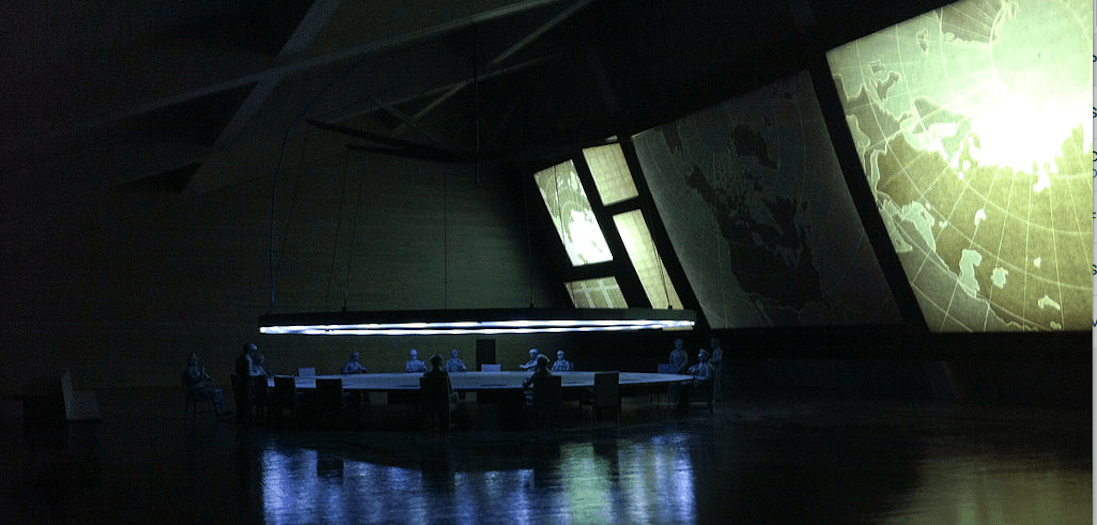
In the Trump era, America desperately needs a great movie about nuclear apocalypse
By Jon Schwarz, The Intercept, originally published July 1, 2018
Published by Beyond Nuclear International with permission from The Intercept
The most peculiar thing about America’s 2018 apocalyptic imagination is the dog that isn’t barking. We have “Westworld” and “Terminator” and “Ex Machina” and a dozen more movies about artificial intelligence that decides to kill us. We have “The Day After Tomorrow” and “An Inconvenient Truth” and “Mother!” and maybe “Interstellar” and “Game of Thrones” about global warming. But we are notably bereft of movies, television shows, and novels about nuclear war.
You might believe this is because the danger of a nuclear Armageddon vanished with the Cold War. Or that we aren’t given to imagining it because it’s unimaginable. But neither of those things is true. In fact, we’ve stopped imagining the most terrifying possible future for ourselves at exactly the moment we most urgently need to do so, if we’re going to have any chance of avoiding it.
The good news – or at least the not incredibly horrible news – is that Donald Trump may be doing us the unexpected favor of kickstarting our nuclear imagination and sending us down a path where we can save ourselves.
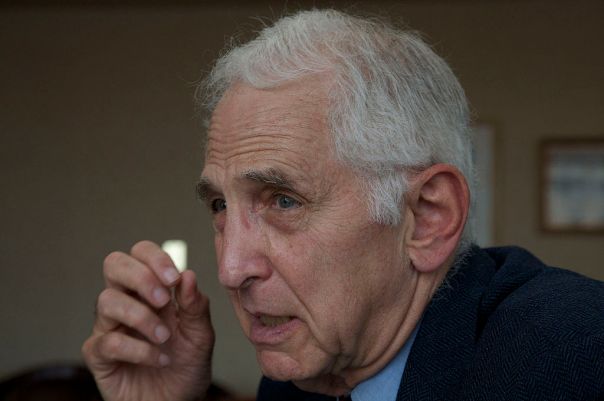
Daniel Ellsberg, author of The Doomsday Machine, has warned we are unlikely to survive another 100 years if we don’t completely eliminate nuclear weapons. (Photo: WikiCommons)
 Beyond Nuclear International