 Beyond Nuclear International
Poisoning more than pigeons in the park
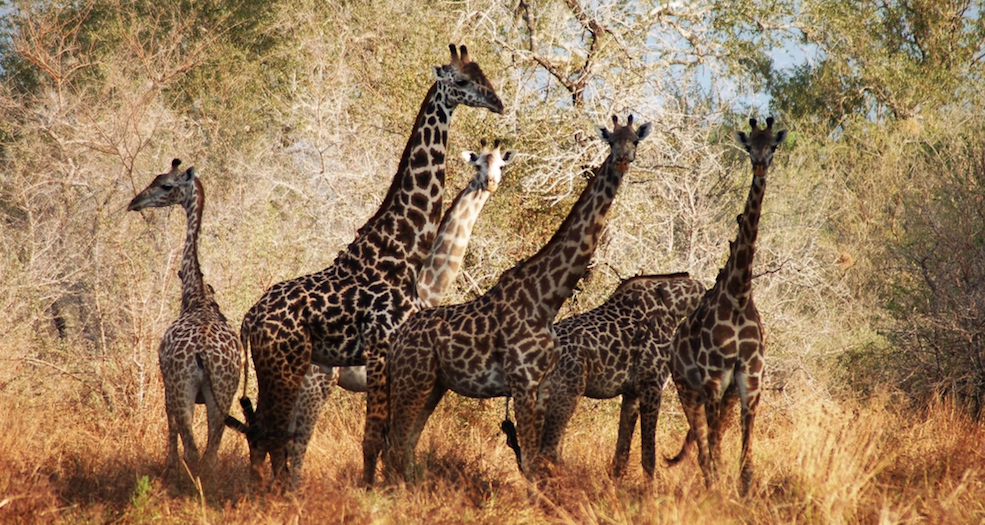
The Selous Game Reserve in Tanzania is under threat of uranium mining
By Linda Pentz Gunter
We still call these parks “game” reserves but the animals there are no longer game. With the exception of poachers and Donald Trump’s sons, (and yes, of course other butcherous egotists), we don’t shoot these animals, we protect them.
But this is not to be the case in Tanzania’s precious Selous Game Reserve. Despite being a World Heritage Site, animals there will be slaughtered en masse, slowly, insidiously, over millennia. We will do it with uranium mines.
Selous is rich with wildlife, including elephants, giraffes, lions and hippos — although the Selous elephants are under siege from poaching, and according to the World Wildlife Fund, could be wiped out by 2022 if poaching continues at current levels.
Inexcusably, it was the World Heritage Committee itself that opened the door to the poisoning of these animals in a park that was supposed to be their sanctuary. In July 2012, it agreed to accept a “minor boundary change” that would allow the development of a major uranium mine — the Mkuju River Uranium Project — a joint Russian-Canadian venture. The change was heavily lobbied for by the Tanzanian government.
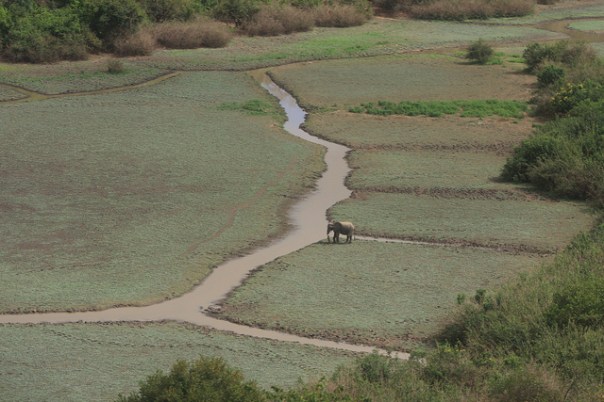
The vast Selous park is home to the biggest population of elephants in Africa.
These Russians aren’t going away
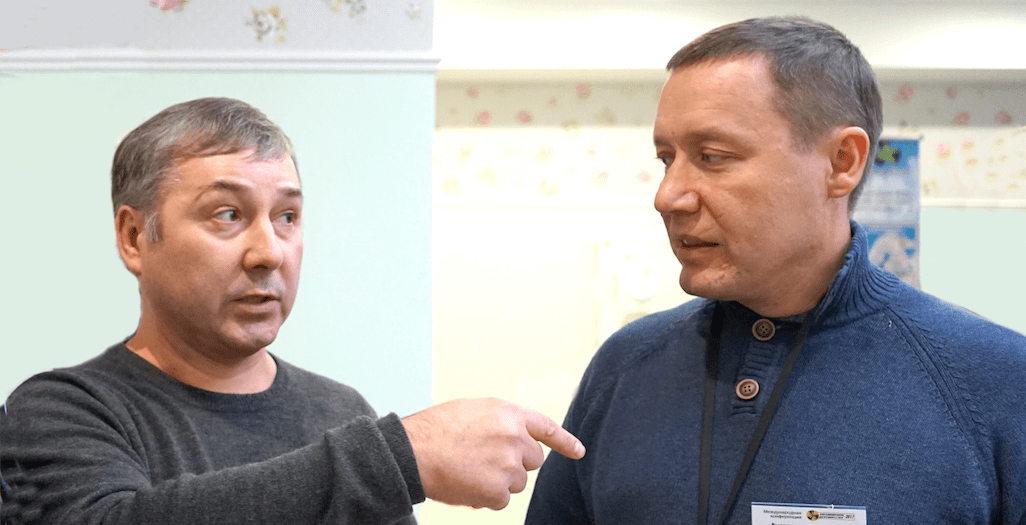
Labeled “extremists” and “foreign agents”, Fedor Maryasov and Andrey Talevlin put country and courage first
By Oleg Bodrov
The first time Fedor Maryasov realized that something might be very wrong in his community was as a teenager. Growing up in the uranium mining city of Zarafshan, Uzbekistan, young Fedor and his friends would swim in artificial ponds holding discharge water from the uranium mines. They fished there too, but they began to notice the fish were disfigured by genetic abnormalities, displaying red spots and growths. Still, the authorities were saying nothing. And the teenage boys, like most people in Zarafshan, knew little about how radiation affects living organisms.
By 1993, Maryasov was studying at the university in Tomsk, Siberia. That year, there was a radiation accident at the Siberian Chemical Combine, operated by the Russian state nuclear corporation Rosatom. The city of 300,000 escaped danger as the radiation release went in a different direction. But rumors began to spread that other populations were not so fortunate and that inhabitants of nearby villages had been evacuated. Maryasov noticed fire trucks at the entrance to his city, washing the wheels of passing vehicles. Something serious had happened. The population began to panic and to buy dosimeters.
It was then that Maryasov realized that radiation was a danger very close to home, with the capacity to affect everyone.
In 2015, Andrey Talevlin, and the environmental movement that he leads — For Nature — were named a “foreign agent” by, ironically, the Russian Ministry of Justice. Why “ironically”? Because genuine justice is what Talevlin has been fighting for throughout his professional career as a lawyer. So while the label clearly represented a danger to Talevlin’s personal safety, it was also a sort of triumph. The dubious recognition meant that Talevlin was having a major impact in his efforts to get justice for populations whose environmental interests were compromised by the import and reprocessing of irradiated nuclear fuel.
Today, Maryasov is a pioneering journalist, Talevlin a campaigning lawyer, and anyone who has seen the fate of those who oppose the regime in Russia, knows just what kind of risks both men take to commit to their conscience.
Does living near a nuclear plant give children cancer?
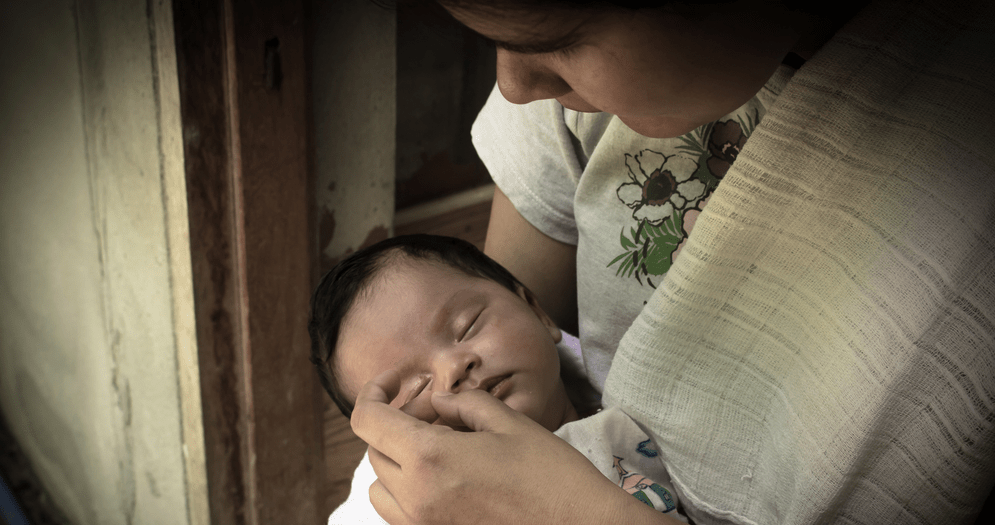
Nuclear regulators don’t want you to know
By Cindy Folkers
More than 60 studies have shown increases of childhood leukemia around nuclear facilities worldwide. Despite this finding, there has never been independent analysis in the US examining connections between childhood cancer and nuclear facilities. The US Nuclear Regulatory Commission (NRC) had tasked the National Academy of Sciences (NAS) to conduct such a study, but then withdrew funding, claiming publicly that it would be too expensive.
In fact, documents obtained through the Freedom of Information Act (FOIA) process reveal that NRC employees had already determined the study would show no impact. Internal emails indicate that staff was presupposing a conclusion for which they had no evidence, demonstrated by statements like “even if you found something that looked like a relationship [between cancer and radiation], you wouldn’t know what to attribute it to,” and “[m]ost people realize that all the evidence shows you’re not going to find anything.” The evidence, however, had not yet been fully collected and examined.
Not protective and unaccountable
While the NRC claims it protects public health, its radiation exposure standards fail to account fully for:
- impacts on the placenta
- impacts on fetal blood forming cells
- impacts on fetal and embryonic organs
- estrogenic impacts
- disproportionate impacts on women
- genetic impacts past the second generation
- cumulative damage of repeated radiation exposure
An international delegation talked Vietnam out of nuclear power
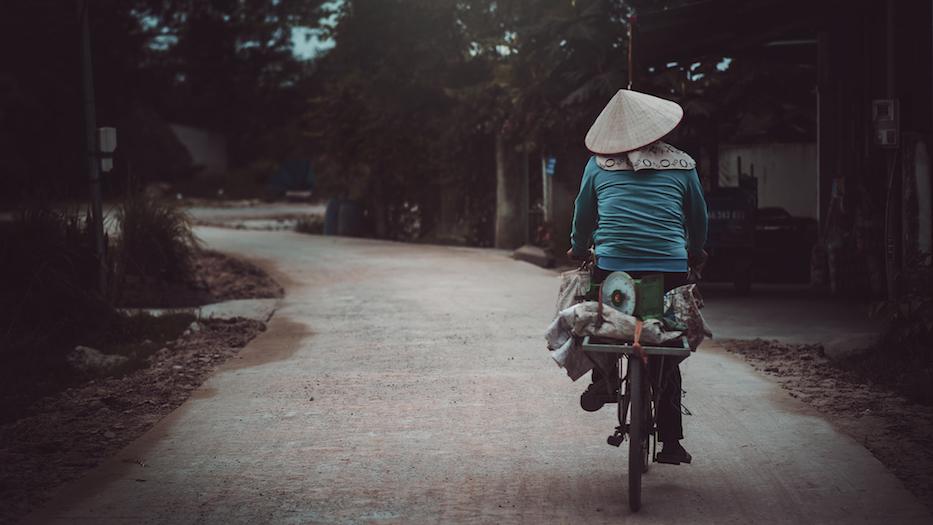
A convincing list of arguments persuaded Vietnam to change its mind
Vietnam had been planning to build 14 nuclear reactors, with the first provided by Russia. But on November 22, 2016 the country abruptly canceled its nuclear energy plans. This occurred shortly after an international delegation visited officials and presented them with the “road map” below. Originally titled, Nuclear Power in Vietnam: challenges and alternatives, this article was based on scientific information, experiences from Germany, Japan and South Africa, and two workshops on “Nuclear power development in Vietnam and worldwide”, organized in Hanoi in early October 2016 . This is a deterrence road map that every country considering a nuclear power program should read.
The full list of authors can be found at the end of the article. One of them, Nguy Thi Khanh of Vietnam, won this year’s Goldman Environmental Prize in part for this work. Although Vietnam has now signed a “framework agreement” with India that includes nuclear energy, this appears to be for a “research reactor.” Commercial nuclear power for electricity remains unlikely.
Twelve compelling arguments against nuclear power in Vietnam
1. Laws and security regulations must be secured in advance
As nuclear power is one of the most dangerous technologies ever invented, the strictest possible safety laws have to be adopted, and regularly updated, in order to prevent accidents. Beside the two “meltdowns” in Chernobyl and Fukushima, more than 30 accidents have been categorised according to the International Nuclear Event Scale (INES), and countless smaller accidents have not been recorded internationally.
Laws and regulations regulating security concerns have to be adopted before the concrete planning phase of nuclear power plants begins. They need to cover the whole nuclear life-cycle, including a comprehensive plan for nuclear waste storage. Special attention needs to be paid to policy coherency, i.e. consistency with other relevant laws.
A clear division of tasks is crucial to avoid overlaps and loopholes in decision-making processes. This division of tasks needs to be clear for the operation of nuclear sites (plants, transport ways, and waste storage) and a clear chain of command is especially important in case of accidents.
Dancing in the dust of death
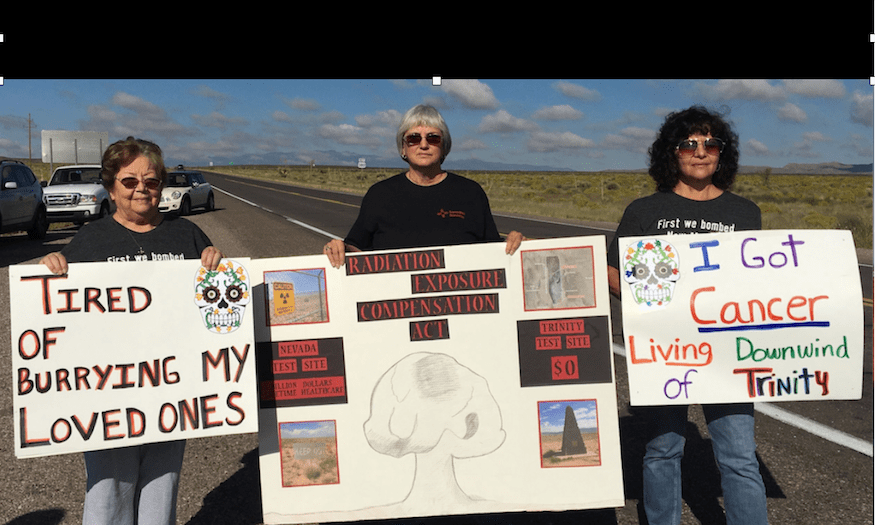
Time to recognize New Mexico’s Trinity downwinders
By Linda Pentz Gunter
When Barbara Kent was twelve years old she went away to dance camp. It was July 1945. A dozen young girls were enjoying a summer retreat, sleeping together in a cabin, and sharing their love of dance. On July 16 they danced with something deadly.
After being jolted unexpectedly out of bed, they went outside pre-dawn when it should have been dark, to find it bright as day with a strange white ash falling like snowflakes. “Winter in July,” Kent, now 86 years old, has called it.
The girls rubbed the “snowflakes” on their bodies and caught them with their tongues. Before they all turned 40, 10 of the 12 girls had died.
No one had warned the girls, or their teacher, or anyone in the community, that the US government had just exploded the first atomic bomb a little more than 50 miles away at the Alamogordo Bombing and Gunnery Range in New Mexico, now known as the Trinity Test Site. The “snowflakes” were deadly radioactive fallout and just the beginning of an endless — and likely permanent — cycle of disease, death and deprivation.
“While it was not the end of the world, it was the beginning of the end for so many people,” said Tina Cordova, co-founder of the Tularosa Basin Downwinders Consortium, an organization that “seeks justice for the unknowing, unwilling and uncompensated participants of the July 16, 1945 Trinity test in southern New Mexico.”
Are we afraid yet?
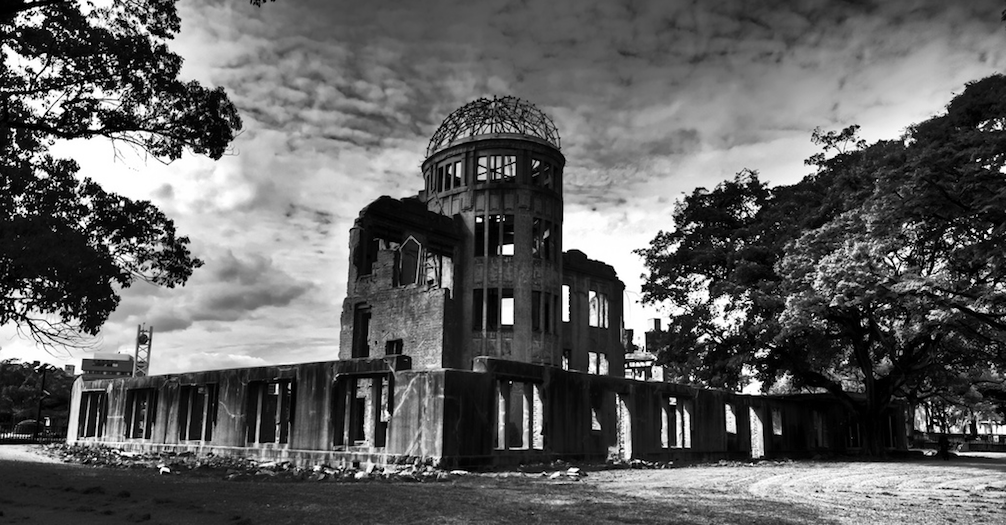
Why don’t we feel a greater sense of pending doom over the fear of a nuclear wipeout?
By Rashmee Roshan Lall
What comes to mind today when nuclear war is mentioned? The shifting dynamic between two volatile leaders, Donald Trump of the United States, the world’s most advanced nuclear power and Kim Jong-un of newly nuclear-capable North Korea? Or the pair’s boasts about their nuclear capability?
All of the above might be expressed in various dramatic genres. There is absurdism, action, black comedy, suspense. What seems to be missing is existential angst. For a world that’s supposed to be trying to avert nuclear catastrophe, we don’t seem overly engaged in discourse about the pending end of our days.
Why aren’t we obsessively discussing the immediate, day two, year five and quarter century consequences of using a hydrogen bomb, which can be 1,000 times more powerful than the atomic bombs dropped on Japan by the US in 1945.
Those two bombs on Hiroshima and Nagasaki killed more than 200,000 people. A hydrogen bomb could vaporise an entire city. The difference, according to Korean studies professor Andrei Lankov, is as follows: “With an atomic bomb, you can kill half of Manhattan at most. [A hydrogen bomb] could evaporate the entire city of New York completely. No one would stay alive.”
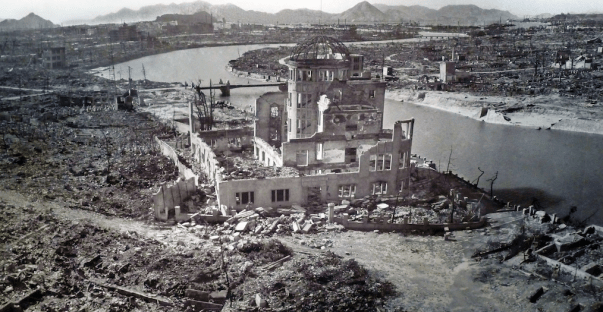
Hiroshima dome after the atomic bombing. (Photo: DozoDomo. DozoDomo.com)
 Beyond Nuclear International