 Beyond Nuclear International

The little piggies that won’t go to market

Wild boars remain too radioactive to eat, 32 years after Chernobyl
By Linda Pentz Gunter
Wild board in Europe, parts of the former Soviet Union and Japan are too radioactive to be safe for human consumption. That sounds like good news for the boars. But only partly so.
The boars are radioactively contaminated due to fallout from the April 26, 1986 Chernobyl, Ukraine nuclear power plant explosion. They were vulnerable because they love mushrooms and truffles. These fungi absorbed the cesium-137 fallout released by the Chernobyl nuclear explosion.
Because they lack stems and roots, mushrooms and other fungi use absorption to obtain nutrition from the atmosphere through their surface cells. As a result, they are prone to absorbing radioactive substances such as cesium-137 and other radionuclides.
When the boars eat the mushrooms and truffles, that radioactive contamination moves up the food chain. The mushrooms are also too radioactive for human consumption.

Wild boar in Germany. Photo: Frank Vincentz
Between 2014 and 2016, nearly half of the 614 wild boar inspected in the Czech Republic were too radioactive to eat. In Germany, more than one in three boars killed by hunters were also radioactive.
The woman who paints insects

Swiss artist, Cornelia Hesse-Honegger, finds and draws bugs deformed by Chernobyl and other nuclear accidents and exposures
By Claus-Peter Lieckfeld
We speak of “dumb creatures” because animal utterances are largely incomprehensible to the human ear. But animals can show us things. And if you know how to look, they might even give you warning signals. Bugs, for example, give warnings where human perception fails. But to understand those warnings, you have to learn how to read their signals.
You can find the insect drawings of the Swiss artist and scientific illustrator, Cornelia Hesse-Honegger, in museums and galleries all over the world. Most of them reflect (and praise) the breathtaking beauty of the insect realm. But their beauty can be deceptive.
 In 1987, one year after the Chernobyl nuclear disaster, Hesse-Honegger came across deformed leaf bugs in areas of Sweden that had been hit hard by fallout from Ukraine. She sensed that something was seriously wrong, even though what she saw did not come as a total surprise. Hesse-Honegger had already been working for many years as a scientific illustrator for the Natural History Museum at the University of Zurich. As early as 1967 she had drawn mutations of drosophila fruit flies and houseflies that had been exposed to radiation in the lab.
In the June 19, 2014 video below by Michael Segal for Nautilus, Hesse-Honegger explains her background and work.
Mother Earth and the “too late” time

We are getting perilously close, warn First Nations
By Linda Pentz Gunter
“I’m choked up. My heart is pounding right now,” said Chief April Adams-Phillips of the Mohawk Nation of Akwesasne through tears. “We give back thanks to our Mother Earth every day,” she said. But because of our disrespect and our destructive ways, she warned, Mother Earth is “going to get rid of us soon. She’s going to shake us.”
We are heading deeper into the “too late time” when it comes to climate change. “And that too late time is not far away,” said Chief Clinton Phillips of the Mohawk Nation. “Science is saying that. Animals are saying that. Animals who are living where they should not be living are saying that.”

Chief April Adams-Phillips of the Mohawk Nation of Akwesasne
Are we listening yet? “People are not listening,” Chief Clinton Phillips says. Global warming is upon us and yet we persist with nuclear power whose wastes poison the water, air, land, people and animals. The original guardians of those precious elements of our existence — indigenous peoples — are trying once again to be heard.
The Facts About Chernobyl

The true impacts of the 1986 nuclear disaster on people and the environment
By Beyond Nuclear staff
The strategy of the desperate is to downplay and dismiss. A major nuclear disaster is more than just an inconvenient truth for an industry that doesn’t want you to know it kills people. As a result, when a serious nuclear accident happens — arguably always preventable and therefore not strictly an accident — there is a scramble to present the event as largely insignificant.
Many myths are quickly put about, usually centered on how few people immediately died, a completely misleading statistic since nuclear power plant disasters do not usually kill people instantly. But over the long-term, their legacy is indeed both considerable and often deadly.
In the newest edition of our periodic Thunderbird newsletter, we look at the facts about the Chernobyl disaster — and touch on one welcome piece of fiction in the form of a novel.

Children’s shoes, abandoned Pripyat middle school. Photo: Jose Franganillo
The dogs of Chernobyl

Chernobyl dogs fed by nuclear workers are now getting help
By Lucas Hixson
It’s a common misconception that the Chernobyl Nuclear Power plant is devoid of life – in fact there are at least 3,500 people each day who work among the more than 250 stray dogs that roam the grounds.
These dogs can be found in nearly every area of the Chernobyl site, including controlled, indoor areas. The workers have adopted the dogs in a way, and save scraps of the their own meals to feed them.

The dogs are driven out of the woods to the power plant by packs of wolves and a lack of food to support themselves in the Exclusion Zone. There is even evidence that some of the Chernobyl dogs are breeding with wolves in the area.
In the spring of 1986, the Unit 4 reactor at the Chernobyl Nuclear Power Plant in Ukraine exploded and spread radioactive materials into the environment. In response to the disaster, the former Soviet Union established a 30-km exclusion zone around the facility and evacuated over 120,000 people from 189 cities and communities. The evacuees were not allowed to bring anything that they could not carry. Pets were abandoned.
Linda Walker’s healing touch
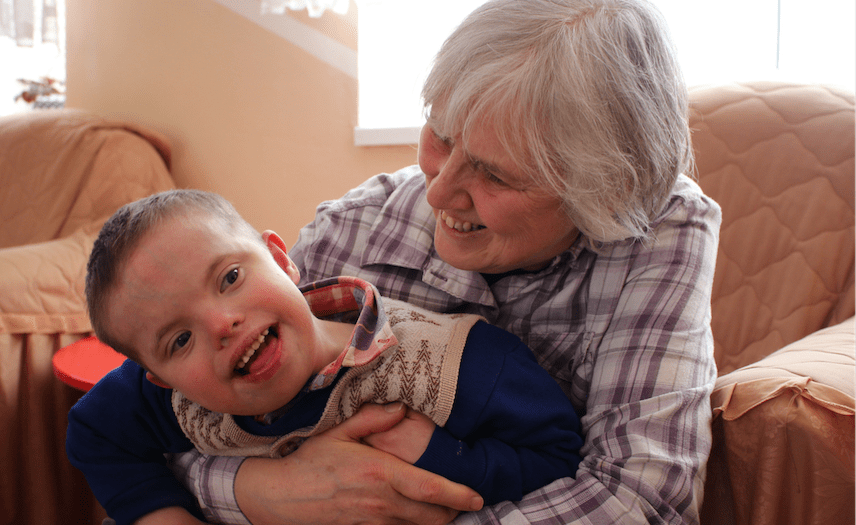
Her Chernobyl Children’s Project UK helps the young seek respite and joy
By Linda Pentz Gunter
When a deadly nuclear power plant accident spreads radiation across the world, you can’t take it back. That contamination, from the 1986 Chernobyl disaster in the Ukraine, hit neighboring Belarus the hardest. Not only those living there at the time, but children born since, have suffered the health effects of exposure to long-lasting radioactive fallout.
The long-term solution, of course, is to rid the world of nuclear power plants, ensuring that no one need suffer from their deadly poison again. But in the short-term, solutions are also needed to help those suffering today. That is where Linda Walker stepped in.
Linda started her charity Chernobyl Children’s Project UK in 1995, inspired by Chernobyl Children International, founded in 1991 in Ireland by Adi Roche. Linda quickly realized that in addition to bringing children from Chernobyl-affected areas to the UK for so-called “radiation vacations,” something more was needed. She decided that her group needed to be active on the ground as well, in particular in Belarus. She has been traveling to the country on a frequent basis ever since.

