 Beyond Nuclear International
The great ratepayer robbery

How new nuclear rips off its customers
By Linda Clare Rogers
A recent BBC documentary called Big Oil versus the World exposed the excellent job by oil companies in fending off what could have been an existential threat to their future, at the cost of one for the rest of us. The program revealed how the oil industry brought us near to catastrophe while knowingly lying about the role of fossil fuels in creating global warming.
There are vital lessons to be learned from this about the nuclear power industry. As with the oil industry, the nuclear industry continues to mislead us about the need for nuclear power to save the planet, in order to preserve itself. And, like the oil industry, it contributes to the catastrophe of global warming.
Nuclear power stations take too long to build to help mitigate the effects of global warming, and divert money from renewable power and other more immediate means of doing so.
To add insult to injury, we, as taxpayers, are now being asked to contribute to this catastrophe by paying for the building of yet more destructive nuclear power stations. The astronomical cost of nuclear power means that the industry itself can’t and won’t take on the economic risk.
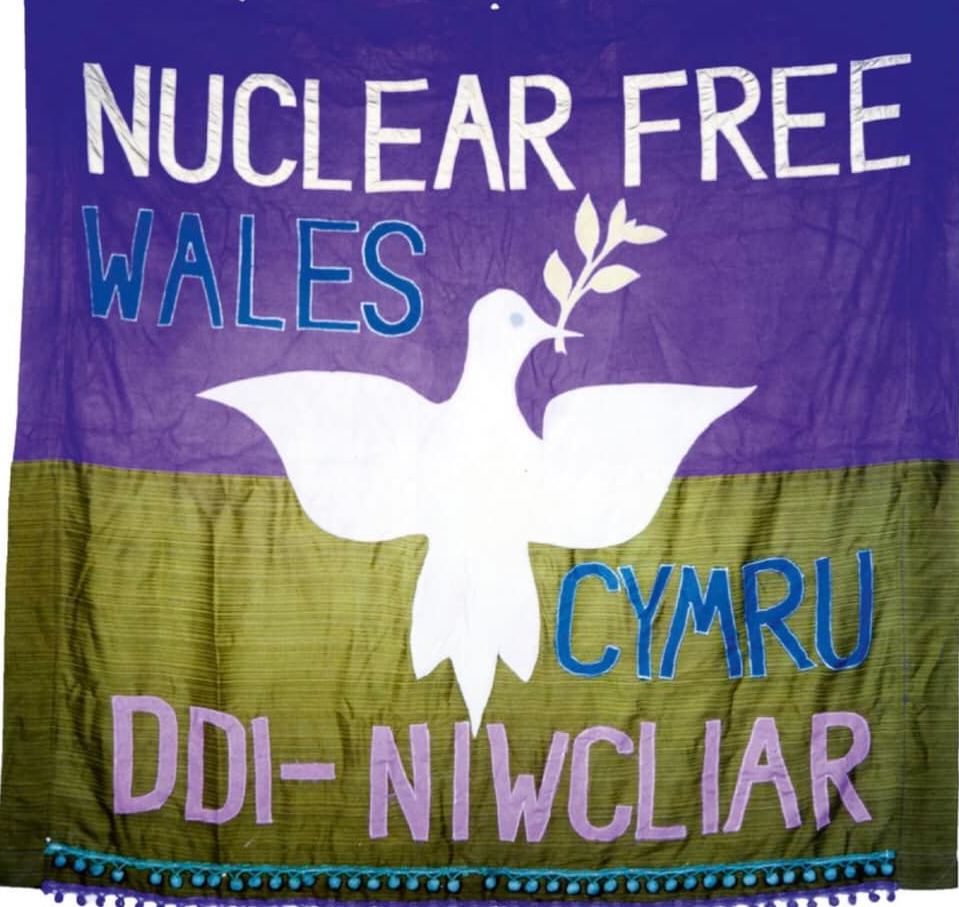
Instead, money taken from our earnings and our benefits (in the U.K, low-income people on Universal Credit are not to be exempted), to set up new nuclear build, is meant to encourage other investors to take the risk in the future. This is before the plants are actually built.
The name of the UK government scheme , or, more accurately, scam, is the Regulated Asset Base model, known as RAB. (Editor’s note: In the U.S., a similar fleecing of ratepayers exists in some states, known as Construction Work In Progress or CWIP.)
In the introduction to RAB — the Ministerial Foreword to the Statement on Procedure and Criteria for Designation — we are told that the government will be taking one nuclear project to Final Investment Decision this parliament and two projects to Final investment Decision in the next parliament, including small modular reactors. The push for this scenario is undermining safety, fleecing the taxpayers at a time of economic crisis, and disregarding the real problems increasingly associated with nuclear power.
The Nuclear Energy Financing Act 2022 implements the nuclear RAB model and is meant to facilitate investment in the design, construction, commissioning and operation of new nuclear energy generation projects.
Read MoreClimate pragmatism or Faustian bargain?
What the new US climate law does—and where it fails
By Liane Schalatek, Heinrich Böll Stiftung
Analysis: U.S. climate policy is currently putting observers through a roller coaster of emotions: just a few weeks ago, the Supreme Court limited the authority of the U.S. Environmental Protection Agency to issue far-reaching climate regulations. Now, after decades of unsuccessful legislative attempts, the U.S. Congress has passed the most comprehensive American climate legislation ever by a razor-thin majority. The $369 billion package is now law with President Biden’s recent signature. The legislation is intended to lead to drastic emissions reductions over the next decade and transform the U.S. energy sector and the U.S. economy. What some see as an expression of goal-oriented climate pragmatism, in which the perfect must not become the enemy of the good, others see as a Faustian bargain that tightens rather than loosens the fossil fuel industry’s stranglehold on the U.S. economy. So what exactly is in the package?
The sweeping climate package, embedded alongside health care and tax reforms in the surprise passage of the more than 700-page Inflation Reduction Act, represents the largest U.S. funding boost to date to reduce greenhouse gases and promote climate-friendly “green” technologies. It is roughly four times what was authorized for climate action under President Biden’s Democratic predecessor Obama in 2009 in what was then the American Recovery and Reinvestment Act. This spending is in addition to the more than $200 billion in clean energy and climate action investments that a majority Democratic Congress already approved last year in a massive infrastructure funding bill.

Passage of the bill is a much-needed win for the Biden administration, whose approval ratings are extremely low given the impact of inflation on American households. It comes just months before the November midterm elections, in which Republicans are expected to win.
Carrots instead of sticks: financial incentives instead of bans
The law includes neither a carbon price nor a CO2 cap under a federal emissions trading system. It also fails to radically address the main cause of climate change, namely the extraction and burning of fossil fuels. Thus, the measure clearly relies on carrots rather than sticks, in part because previous attempts to push a climate bill through Congress that relies on carbon taxation have repeatedly failed over the past several decades. Then-Vice President Al Gore’s push in 1993 failed to gain traction, as did the Markey-Waxman emissions trading plan of 2010.
So instead of punitive measures and restrictions, the package prioritizes financial support as an incentive and emphasizes how much the investments will support the American economy, create jobs and benefit consumers. This also secured the almost euphoric support of the U.S. business sector for the proposed legislation, with letters of support from more than 1,000 companies, investors and trade groups, including major oil companies, as well as labor unions. The Biden administration has purposefully pursued this approach, which justifies climate protection with green jobs and economic growth, since the beginning of his term in office as part of his reconstruction strategy to Build Back Better after the pandemic-related economic crisis.
Accordingly, the White House stressed that the Inflation Reduction Act “secures America’s position as a world leader in domestic manufacturing and clean energy supply chains,” creates and sustains “good-paying union jobs in construction and manufacturing, including in rural communities,” and lowers annual energy costs for Americans by an average of up to $1840, according to expert estimates.
Read MoreDon’t nuke the future

As we strike for climate, we must strike nuclear power from our energy plans
By David Kraft, NEIS
The Fridays for the Future Climate Strike on September 23 called out tens of thousands of people worldwide – over 300 in downtown Chicago — to protest the inadequate governmental response to the Climate Code Red, and identify the many corporate criminals who are responsible for the bulk of the crisis.
While it is necessary to identify and hold accountable those who are the source of the problem, if the Planet is to survive the predicted catastrophic temperature rise and resulting environmental impacts, it is equally important to identify real and viable solutions to the crisis, given the limited amount of time left to act.
On that note it cannot be stressed more emphatically that nuclear power is not a viable climate solution.
Why is this the case? With eight years left before the IPCC’s 2030 deadline to literally reinvent and implement a climate friendly energy infrastructure, nuclear power serves as a drag and barrier to reaching that target. It is too costly; to slow to build out to the levels needed; displaces less atmospheric carbon per dollar spent than cheaper and quicker alternatives; and not only fails to solve its current list of unsolved problems (for example, nuclear waste disposal), but adds to this list the threat of increased nuclear proliferation and accidents, especially in war zones like Ukraine, and potentially elsewhere (India/Pakistan; China Taiwan; Iran/Saudi Arabia, etc.).

Worse, money spent on bailing out the economically failed nuclear power plants we have is money not available to be spent on real climate solutions we already know work: more renewable energy, more energy efficiency, improved transmission/distribution systems, and energy storage.
Who says so? Only: two former CHAIRPERSONS of the U.S. Nuclear Regulatory Commission; former public utilities chairs and utility CEOs from the states of California, New York, and Maine; energy experts and scientists like Amory Lovins and Mark Jacobson of Stanford University, and Dr. Andy Stirling of University of Sussex.
Cost analysts at Lazards demonstrate that nuclear (both the present old generation, and the proposed “next generation” of so-called small modular nuclear reactors) is too expensive compared to renewables and other alternatives; while those at Moody’s point out that reactors will be at severe risk of operating safely in a climate disrupted world without extraordinary added expense to enhance safety – again, money that won’t be available for real alternatives.
Read MoreInterview: Nuclear tests in Polynesia

Hinamoeura Cross wants to “educate and to denuclearize memories”
By Jean-Tenahe FAATAU, outremers 360°
Now in her thirties, Hinamoeura Cross is battling leukemia. It’s an illness she has endured, and which has been part of her life, since she was 25. The leukemia diagnosis served as an electric shock, spurring the Polynesian into activism, and she has not hesitated to speak up ever since at international tribunals to denounce the thirty years of atomic tests and their consequences suffered by her country since 1966. Most recently, Hinamoeura Cross went to Vienna for the meeting on the Treaty on the Prohibition of Nuclear Weapons organized by ICAN. And during the period when, on July 2, Polynesia commemorates the first of the 193 tests that tore open its sky and lagoons, she describes her commitment, her illness and her fight to “educate and to denuclearize Polynesian memories”.
Outremers 360: You participated in Vienna in a meeting on the Treaty on the Prohibition of Nuclear Weapons. Can you describe the goal of that meeting?
Hinamoeura Cross: I was invited by ICAN, an international organization that brings together a number of other organizations and which supports the abolition of nuclear weapons. More exactly, I was invited by ICAN France, represented by Jean-Marie Collin, and in fact it was his idea to have someone who could represent French Polynesia, because French Polynesia was the site of the atomic tests between 1966 and 1996.
But when we talk about the abolition of nuclear weapons we should note that the treaty includes two articles (numbers 6 and 7) which require that all territories affected by nuclear testing must have appropriate medical support. And it is in this sense that, for me, it was interesting to go there as a Polynesian and say that France, even though it has not ratified the treaty, does not respect articles 6 and 7, since we do not have medical support appropriate to what we have suffered for 30 years.

Indeed, we have one hospital and two clinics on the island of Tahiti. But still today, thousands of Polynesians have to seek treatment in France, specifically in Paris. And hundreds of children with leukemia are treated there. I know a young person from here who has been getting treatment in Paris with her mother for almost four years. I find it scandalous that we don’t have a hospital worthy of the name, given the 193 nuclear tests that have taken place in Polynesia. I think everyone with radiation-induced diseases should be treated in Polynesia.
I also went to Vienna to say that France does not recognize transgenerational diseases. As far as France is concerned, all the children who became sick after December 31, 1998 were not affected by exposure to radioactivity, whereas in other countries it is seen as obvious. Personally, I subscribe to the transgenerational evidence since my grandmother, my mother and my aunt all had thyroid cancer. My aunt had breast cancer as well. I had nothing until I was 24; then I discovered I have leukemia, something I am still fighting today. So I signed up to this fight as a witness, and as a Polynesian, but also as a victim of the French nuclear tests because my illness is a radiation-induced disease.
Read MoreInterview: Essais nucléaires en Polynésie
Hinamoeura Cross veut «éduquer et dénucléariser les mémoires»
Par Jean-Tenahe FAATAU, outremers 360°
Du haut de sa trentaine, Hinamoeura Cross se bat contre une leucémie. Une maladie qu’elle porte et qui fait partie de sa vie, depuis ses 25 ans. Comme un électrochoc, cette leucémie a forgé la vocation militantiste de la Polynésienne qui depuis, n’hésite pas à monter aux tribunes internationales pour dénoncer les trente années d’essais nucléaires et leurs conséquences que subit son pays depuis 1966. Dernièrement, Hinamoeura Cross s’est rendue à Vienne à la réunion du Traité d’interdiction des armes nucléaires organisé par l’ICAN. Et alors que la Polynésie commémore ce 2 juillet le premier des 193 essais nucléaires qui déchirèrent son ciel et ses lagons, elle raconte son engagement, sa maladie et son combat pour « éduquer et dénucléariser les mémoires » polynésiennes.
Outremers360: Vous avez participé, à Vienne, à une réunion sur le traité d’interdiction des armes nucléaires. Pouvez-vous nous expliquer quel était le but de cette réunion ?
Hinamoeura Cross: J’ai été invité par ICAN, une organisation internationale qui réunit plusieurs autres organisations et qui défend l’abolition des armes nucléaires. J’ai été plus précisément invité par ICAN France, représenté par Jean-Marie Collin, et en fait son idée, c’était d’avoir une personne qui puisse représenter la Polynésie française, parce que la Polynésie française a été le terrain d’essais nucléaires de 1966 à 1996.
Quand bien même on parle d’abolition des armes nucléaires, ce traité comporte deux articles (les art. 6 et 7) qui exigent que tous les territoires victimes du nucléaire doivent avoir un accompagnement médical adapté. Et c’est en ce sens que pour moi, c’était intéressant en tant que Polynésienne d’y aller et de dire que la France, quand bien même elle n’a pas ratifié le traité, ne respecte pas ces articles 6 et 7, car nous n’avons pas une médecine adaptée à ce que nous avons subi pendant 30 ans.
Effectivement, nous avons un hôpital et deux cliniques sur l’île de Tahiti. Mais encore aujourd’hui, des milliers de Polynésiens doivent se soigner en France, plus précisément à Paris. Et les centaines d’enfants atteints de leucémie y sont soignés. Je connais ici une personne mineure qui se fait soigner à Paris depuis bientôt quatre ans avec sa maman. Je trouve cela scandaleux qu’on n’ait pas un hôpital digne de ce nom, par rapport aux 193 essais nucléaires qui ont eu lieu en Polynésie. Je pense que toutes les personnes atteintes de maladies radio-induites devraient être soignées en Polynésie.
Je suis allé à Vienne pour dire aussi que la France ne reconnaît pas les maladies trans-générationnelles. Pour la France, tous les enfants malades après le 31 décembre 1998, ce n’est pas dû à la radioactivité, alors que dans d’autres pays, c’est une évidence. Personnellement, je m’inscris dans cette trans-générationnalité car ma grand-mère, ma mère et ma tante ont toutes eu un cancer de la thyroïde. Ma tante a même eu un cancer du sein en plus. Moi, je n’avais rien jusqu’à mes 24 ans, puis j’ai découvert que j’avais une leucémie que je combats encore aujourd’hui. Donc je m’inscris aussi par rapport à ce combat en tant que témoin, en tant que Polynésien, mais aussi en tant que victime des essais nucléaires français parce que ma maladie est une maladie radio-induite.
Read MoreAnother close call
Missile strike near Ukrainian nuclear plant raises new fears. But the real question is why is it there at all?
By Linda Pentz Gunter
“What is Russia thinking?” asked CNN news anchor Ana Cabrera of her guest, retired Air Force colonel, Cedric Leighton, after reports that Russian missiles landed within 328 yards of the South Ukraine nuclear power plant on September 19.
But here’s the question that should have been asked — but rarely is: why are we still using such a profoundly dangerous technology to generate electricity? What are WE thinking? (We will leave aside here the conflicting accusations about who is shelling the reactors. The point is their very presence in a war zone and all that implies.)
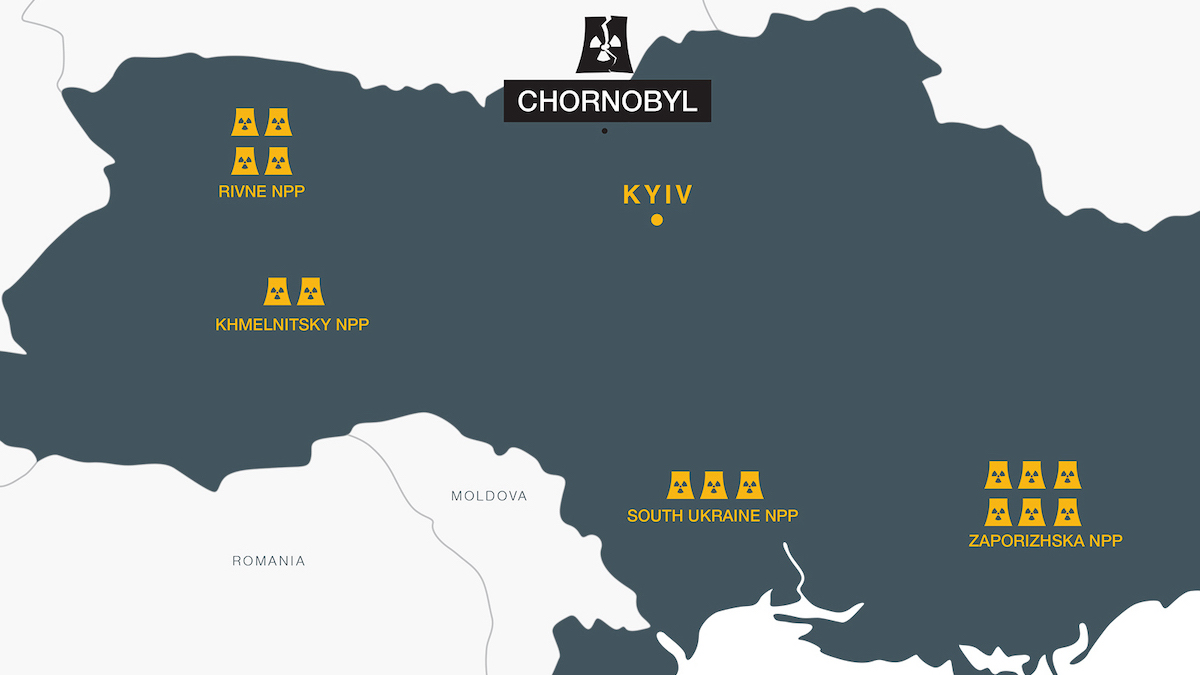
Nothing has brought that risk into sharper focus than the Russian invasion of Ukraine, where 15 operational reactors at four sites are sitting duck targets that could release a radioactive nightmare if struck — whether accidentally or deliberately — by either side as battle rages.
When the invasion began on February 24, it was the closed Chornobyl site — scene of the world’s worst, and most notorious, nuclear power plant disaster in 1986 — that was first occupied. Although none of the four reactors there are operating any longer, there is a significant radioactive waste inventory on site. This was stirred up by Russian forces and their heavy equipment. Soldiers even dug sleeping trenches, apparently unaware of the radiation exposure risks that resulted.

This time around, however, Chornobyl is of lesser concern than the four other nuclear sites in Ukraine, although it remains a potential disaster scene largely due to the irradiated fuel stocks on site.
Read More Beyond Nuclear International