 Beyond Nuclear International
In the dock
Holtec slammed over 1 million gallon radioactive water dump scheme
By Linda Pentz Gunter
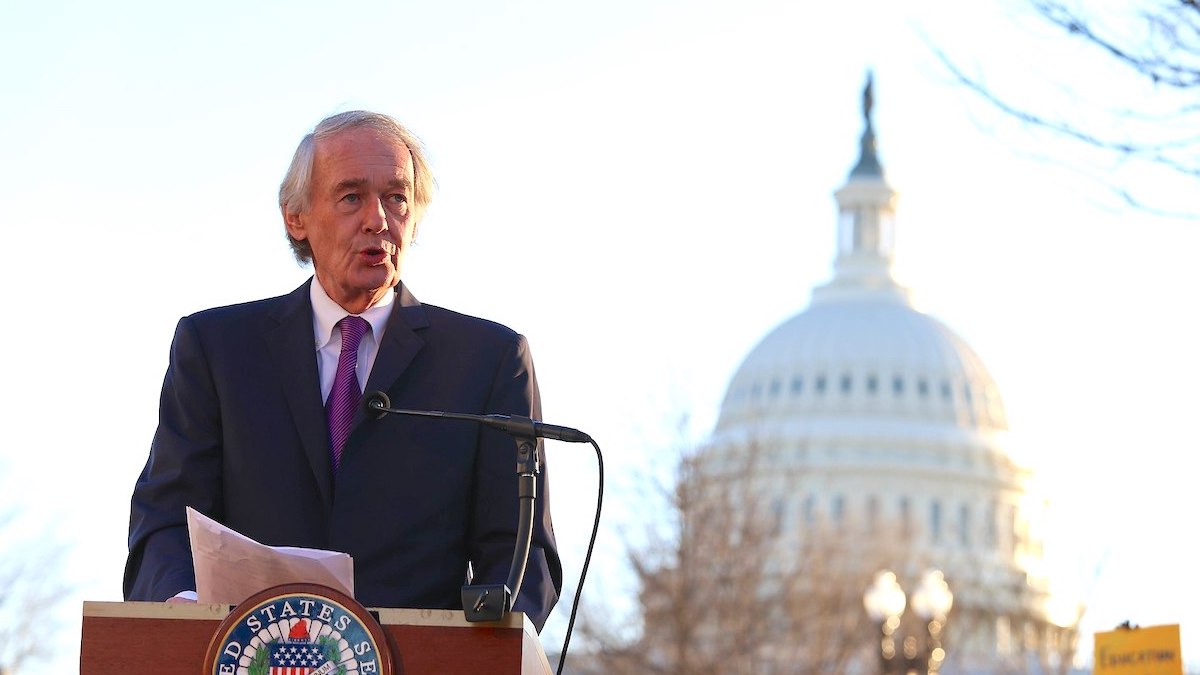
At the conclusion of a close to four-hour public “field hearing” held in the community of Plymouth, MA on May 6, 2022, Senator Ed Markey of Massachusetts pulled no punches.
The Senate hearing invited a number of witnesses to testify on “Issues Facing Communities with Decommissioning Nuclear Plants”, with this session specifically focused on the nearby Pilgrim nuclear reactor, which closed in 2019.
As part of the decommissioning process, Holtec International, the company that purchased the Pilgrim nuclear reactor in Massachusetts from previous owner, Entergy, is preparing to dump a million gallons of radioactive water from the site into Cape Cod Bay as part of its decommissioning activities.
As the hearing drew to a close, Markey questioned Holtec’s competency and the leniency of the US Nuclear Regulatory Commission (NRC), the federal regulator ostensibly tasked with protecting public health and safety.
“It’s possible these problems may be more a reflection of its inexperience, and not arrogance,” Markey said of Holtec. “That they don’t know what they are doing.”
A proposed NRC rulemaking is in the works that would “update” (read “weaken”) federal decommissioning regulations for the nuclear industry.
“The commission’s proposed decommissioning rule shows it to be a captive agency,” said Markey, one that “shows no interest in engaging the public, which would provide even a semblance of accountability.”
Referring to NRC’s failure to stop Holtec from looting its own taxpayer-funded decommissioning funds for company profit, Markey added that “without a stronger regulator, I fear that the only thing that will be emptier than the decommissioning trust fund will be the public’s trust in our government.”
Markey serves on the Senate Environment and Public Works Committee and is chair of its Subcommittee on Clean Air, Climate and Nuclear Safety.
Read MorePulling (radioactive) mussels from a shell?

Holtec’s “harmless” claims are baseless
For background on the planned radioactive water dump by Holtec at the Pilgrim nuclear power plant referred to in this article, please see the article “In the dock” on this website.
By Theodore Bosen
Holtec argued that their planned nuclear dump into the bay will have a negligible environmental impact because past aqueous releases did no harm over several decades of Pilgrim’s operation. Not so!
In the mid-80s, I consumed bushels of mussels from Warren Cove, around the corner from Pilgrim. Sometime later, on behalf of the Pilgrim Alliance, I helped bring renowned physicist Ernest Sternglass of the University of Pittsburgh, to Plymouth to speak on his research into cancers surrounding nuclear plants. When I told him of my shellfish consumption, tears welled up in his eyes as he said, “Son, I’m sorry, but you are going to get thyroid cancer in 20 years, if not worse.”
I stopped eating those mussels and went to the office of the Massachusetts Radiation Control Unit to check their records on local radiological testing. They had told our community at a public hearing in 1986 that they were testing fish and shellfish around the plant at least twice a year. That turned out to be false.

Their records showed only one or two fish from somewhere in the bay, and no more recently than three years prior, plus no mollusks whatsoever. I then asked them to test the mussels around Pilgrim. They agreed, asking me to bring them two quarts of mussel meat from around the plant, fresh-frozen, which I did two days later. Their analysis identified six radionuclides which they said were consistent with fission products from the plant. An independent lab verified that.
I sent the report to Pilgrim’s operator, Boston Edison, but they disagreed. They stated it was background radiation from Chinese atmospheric tests. How I know that was a lie is that the last ever atmospheric test by the Chinese was on Oct. 16, 1980, and a couple of the isotopes in the sample had short half-lives that precluded them from being that old. I learned that day that the nuclear industry doesn’t take low-level radiation seriously and will lie.
Read MoreThree myths about renewable energy and the grid, debunked

The expansion of renewables and new methods of energy management and storage can lead to a grid that is reliable and clean.
By Amory B. Lovins and M.V. Ramana
This story was originally published in Yale Environment 360.
As wind and solar power have become dramatically cheaper, and their share of electricity generation grows, skeptics of these technologies are propagating several myths about renewable energy and the electrical grid. The myths boil down to this: Relying on renewable sources of energy will make the electricity supply undependable.
Last summer, some commentators argued that blackouts in California were due to the “intermittency” of renewable energy sources, when in fact the chief causes were a combination of an extreme heat wave probably induced by climate change, faulty planning, and the lack of flexible generation sources and sufficient electricity storage. During a brutal Texas cold snap last winter, Gov. Greg Abbott wrongly blamed wind and solar power for the state’s massive grid failure, which was vastly larger than California’s. In fact, renewables outperformed the grid operator’s forecast during 90 percent of the blackout, and in the rest, fell short by at most one-fifteenth as much as gas plants. Instead, other causes — such as inadequately weatherized power plants and natural gas shutting down because of frozen equipment — led to most of the state’s electricity shortages.

In Europe, the usual target is Germany, in part because of its Energiewende (energy transformation) policies shifting from fossil fuels and nuclear energy to efficient use and renewables. The newly elected German government plans to accelerate the former and complete the latter, but some critics have warned that Germany is running “up against the limits of renewables.”
In reality, it is entirely possible to sustain a reliable electricity system based on renewable energy sources plus a combination of other means, including improved methods of energy management and storage. A clearer understanding of how to dependably manage electricity supply is vital because climate threats require a rapid shift to renewable sources like solar and wind power. This transition has been sped by plummeting costs —Bloomberg New Energy Finance estimates that solar and wind are the cheapest source for 91 percent of the world’s electricity — but is being held back by misinformation and myths.
Read MoreWrong turn

The establishment’s obsession with nuclear power just won’t die
By Jonathon Porritt
This is absolutely the right time for a new Energy Strategy. Unfortunately, we’ve got absolutely the wrong politicians in charge of it. In the UK, the combination of Prime Minister Boris Johnson and Chancellor of the Exchequer Rishi Sunak all but guarantees that the new Energy Security Strategy will fail on most counts.
– In Boris Johnson, we have a careless showman, drawn unerringly to ‘big ticket’ announcements, groomed by a nuclear industry that knows exactly how to play to these personality defects.
– In Rishi Sunak, we have a man so detached from the reality of most people’s lives that the prospect of five million UK citizens finding themselves in fuel poverty by the end of the year means literally nothing.
Careless Johnson and callous Sunak is a devastating double-act – with the inconsequential figure of Kwasi Kwarteng (UK Secretary of State for Business, Energy and Industrial Strategy) lurking around to pick up the pieces.
There will, of course, be some welcome commitments in the new UK Strategy, particularly on solar and offshore wind, with a hugely encouraging pipeline of new developments in both now underpinning the UK’s decarbonisation strategy. Onshore wind may well get more encouragement than in the past, but the aesthetic sensibilities of Tory Nimbies will still matter more to Johnson and Sunak than the opportunity to ramp up the single most cost-effective source of renewable electricity – coming in at an astonishing 20% of the cost of new nuclear! Yet again, those ‘hard-working families’ Johnson constantly refers to will pay the price for this appalling policy failure.

The UK establishment’s obsession with nuclear power just won’t die. Boris Johnson is heading off down a well-worn path. Margaret Thatcher promised to build a nuclear reactor every year for ten years at the start of her time in office. In 2006, Tony Blair vowed to bring back nuclear power ‘with a vengeance’. David Cameron’s Government identified opportunities for a massive expansion of nuclear.
However, apart from Sizewell B (which came online in 1995) and EDF’s grotesquely expensive monster emerging at Hinkley Point C, there’s nothing to show for all that overblown nuclear enthusiasm. The industry blames this 40-year failure on everyone else – including a generation of anti-nuclear campaigners. In truth, the blame lies entirely with the industry itself, mendaciously promoting outdated, dangerous, increasingly expensive technologies.
Read MoreNuclear empire building
New bill would fund dangerous nuclear extravaganza
By Linda Pentz Gunter
Lately, we have been witnessing the danger of one man with far too much power. In the United States, that one man is Joe Manchin. The Senator from West Virginia, a Republican in Democrat’s clothing, was key to derailing the Biden administration’s Build Back Better legislation to address the climate crisis.
Manchin also lined up with Republicans to defeat a bill to enshrine the right to abortion in federal law and to block changes to the filibuster that would have allowed voting rights legislation to pass with a simple majority.
Now, he has come up with his own bill. Manchin’s grandiose International Nuclear Energy Act of 2022 is not only couched in a good deal of America first-style rhetoric, it is utterly detached from reality. Not that this will hinder it in any way. As Nuclear Intelligence Weekly recently concluded, “The bill has a relatively good chance of passing, in part because Russia’s invasion of Ukraine has strengthened the push for energy independence”.
Needless to say, the bill’s language repeats the popular mantra “safe secure and peaceful use of nuclear technology”, even though it is none of these things and can never be.
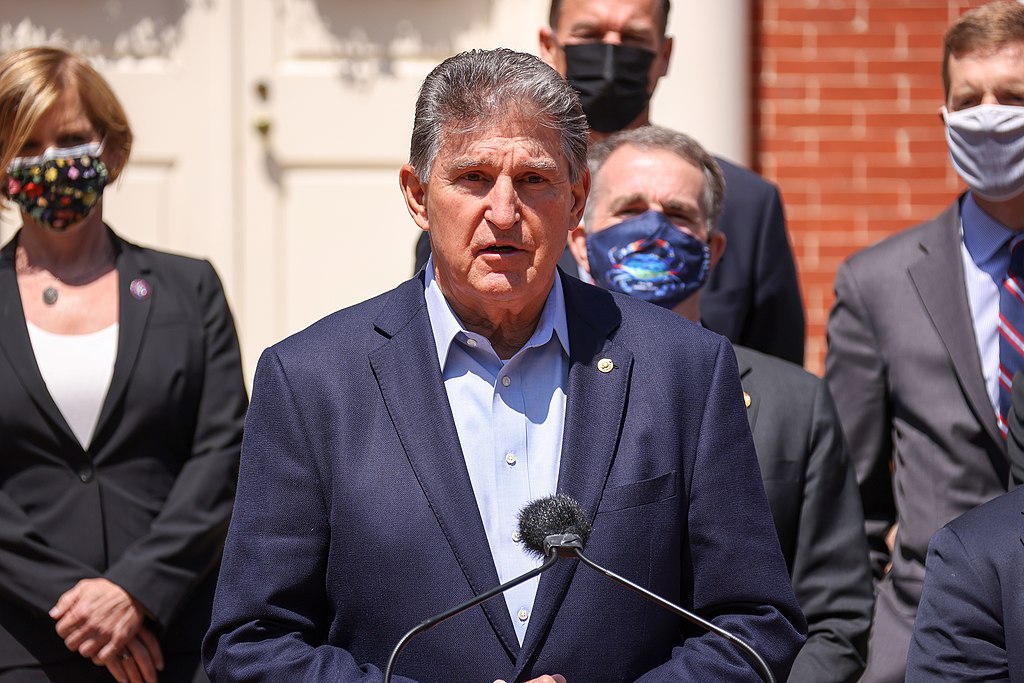
Manchin and Republican co-sponsor, Senator James Risch of Idaho, describe their aspirational Act as “a bill to facilitate the development of a whole-of-government strategy for nuclear cooperation and nuclear exports.”
It is, in effect, a grand scheme to build a veritable American nuclear empire, manufacturing and exporting everything from nuclear reactor technology to financing services and even “storage and disposal” of irradiated reactor fuel. It will, the senators say, “promote the fullest utilization of United States reactors, fuel, equipment, services, and technology in nuclear energy programs outside the United States”.
Read MorePlaying with fire at Chornobyl

After 36 years the nuclear site is again in danger
By Linda Pentz Gunter
For 36 years things had been quiet at Chornobyl. Not uneventful. Not safe. But no one was warning of “another Chornobyl” until Russian forces took over the site on February 24 of this year.
Russia’s invasion of Ukraine first took their troops through the Chornobyl Exclusion Zone, where they rolled armored vehicles across radioactive terrain, also trampled by foot soldiers who kicked up radioactive dust, raising the radiation levels in the area.
As the Russians arrived at the Chornobyl nuclear site, it quickly became apparent that their troops were unprotected against radiation exposure and indeed many were even unaware of where they were or what Chornobyl represented. We later learned that they had dug trenches in the highly radioactive Red Forest, and even camped there.
After just over a month, the Russians pulled out. Was this to re-direct troops to now more strategically desirable — or possibly more reasonably achievable — targets? Or was it because, as press reports suggested, their troops were falling ill in significant numbers, showing signs of radiation sickness? Those troops were whisked away to Belarus and the Russians aren’t talking. But rumors persist that at least one soldier has already succumbed to his exposure.

Plant workers at the nuclear site, despite working as virtual hostages during the Russian occupation and in a state of perpetual anxiety, where shocked that even the Russian radiation experts subsequently sent in, were, like the young soldiers, using no protective equipment. It was, said one, a kind of suicide mission.
What could have happened at Chornobyl — and still could, given the war is by no means over and the outcome still uncertain — could have seen history repeat itself, almost 36 years to the day of that first April 26, 1986 disaster.
Yet, Chornobyl has no operating reactors. So why is it still a risk? Doesn’t the so-called New Safe Confinement (NSC) structure protect the site?
Read More Beyond Nuclear International