 Beyond Nuclear International
An international delegation talked Vietnam out of nuclear power
A convincing list of arguments persuaded Vietnam to change its mind
Vietnam had been planning to build 14 nuclear reactors, with the first provided by Russia. But on November 22, 2016 the country abruptly canceled its nuclear energy plans. This occurred shortly after an international delegation visited officials and presented them with the “road map” below. Originally titled, Nuclear Power in Vietnam: challenges and alternatives, this article was based on scientific information, experiences from Germany, Japan and South Africa, and two workshops on “Nuclear power development in Vietnam and worldwide”, organized in Hanoi in early October 2016 . This is a deterrence road map that every country considering a nuclear power program should read.
The full list of authors can be found at the end of the article. One of them, Nguy Thi Khanh of Vietnam, won this year’s Goldman Environmental Prize in part for this work. Although Vietnam has now signed a “framework agreement” with India that includes nuclear energy, this appears to be for a “research reactor.” Commercial nuclear power for electricity remains unlikely.
Twelve compelling arguments against nuclear power in Vietnam
1. Laws and security regulations must be secured in advance
As nuclear power is one of the most dangerous technologies ever invented, the strictest possible safety laws have to be adopted, and regularly updated, in order to prevent accidents. Beside the two “meltdowns” in Chernobyl and Fukushima, more than 30 accidents have been categorised according to the International Nuclear Event Scale (INES), and countless smaller accidents have not been recorded internationally.
Laws and regulations regulating security concerns have to be adopted before the concrete planning phase of nuclear power plants begins. They need to cover the whole nuclear life-cycle, including a comprehensive plan for nuclear waste storage. Special attention needs to be paid to policy coherency, i.e. consistency with other relevant laws.
A clear division of tasks is crucial to avoid overlaps and loopholes in decision-making processes. This division of tasks needs to be clear for the operation of nuclear sites (plants, transport ways, and waste storage) and a clear chain of command is especially important in case of accidents.
Dancing in the dust of death
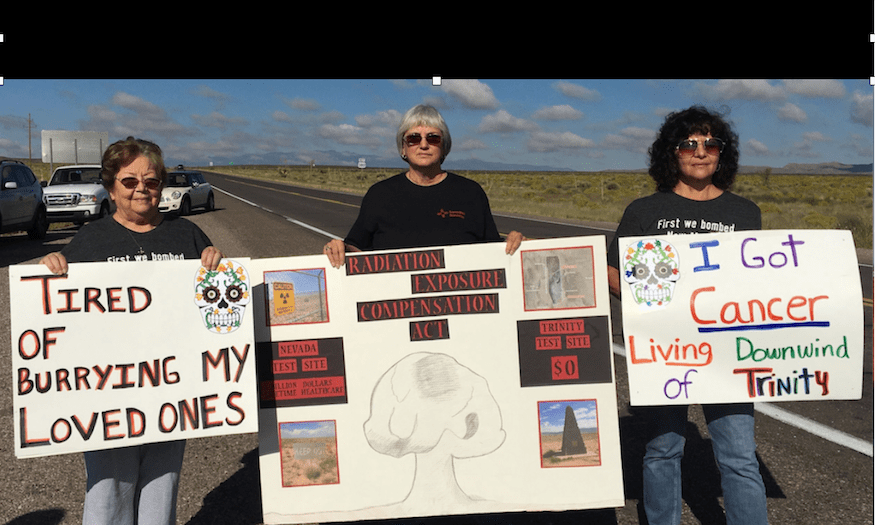
Time to recognize New Mexico’s Trinity downwinders
By Linda Pentz Gunter
When Barbara Kent was twelve years old she went away to dance camp. It was July 1945. A dozen young girls were enjoying a summer retreat, sleeping together in a cabin, and sharing their love of dance. On July 16 they danced with something deadly.
After being jolted unexpectedly out of bed, they went outside pre-dawn when it should have been dark, to find it bright as day with a strange white ash falling like snowflakes. “Winter in July,” Kent, now 86 years old, has called it.
The girls rubbed the “snowflakes” on their bodies and caught them with their tongues. Before they all turned 40, 10 of the 12 girls had died.
No one had warned the girls, or their teacher, or anyone in the community, that the US government had just exploded the first atomic bomb a little more than 50 miles away at the Alamogordo Bombing and Gunnery Range in New Mexico, now known as the Trinity Test Site. The “snowflakes” were deadly radioactive fallout and just the beginning of an endless — and likely permanent — cycle of disease, death and deprivation.
“While it was not the end of the world, it was the beginning of the end for so many people,” said Tina Cordova, co-founder of the Tularosa Basin Downwinders Consortium, an organization that “seeks justice for the unknowing, unwilling and uncompensated participants of the July 16, 1945 Trinity test in southern New Mexico.”
Are we afraid yet?
Why don’t we feel a greater sense of pending doom over the fear of a nuclear wipeout?
By Rashmee Roshan Lall
What comes to mind today when nuclear war is mentioned? The shifting dynamic between two volatile leaders, Donald Trump of the United States, the world’s most advanced nuclear power and Kim Jong-un of newly nuclear-capable North Korea? Or the pair’s boasts about their nuclear capability?
All of the above might be expressed in various dramatic genres. There is absurdism, action, black comedy, suspense. What seems to be missing is existential angst. For a world that’s supposed to be trying to avert nuclear catastrophe, we don’t seem overly engaged in discourse about the pending end of our days.
Why aren’t we obsessively discussing the immediate, day two, year five and quarter century consequences of using a hydrogen bomb, which can be 1,000 times more powerful than the atomic bombs dropped on Japan by the US in 1945.
Those two bombs on Hiroshima and Nagasaki killed more than 200,000 people. A hydrogen bomb could vaporise an entire city. The difference, according to Korean studies professor Andrei Lankov, is as follows: “With an atomic bomb, you can kill half of Manhattan at most. [A hydrogen bomb] could evaporate the entire city of New York completely. No one would stay alive.”
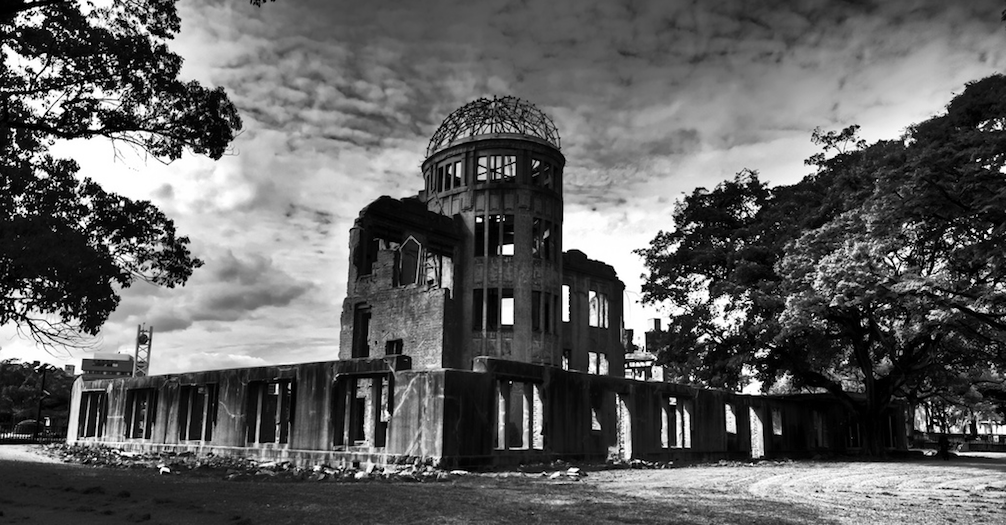
Hiroshima dome after the atomic bombing. (Photo: DozoDomo. DozoDomo.com)
Imprisoned, poisoned, tortured
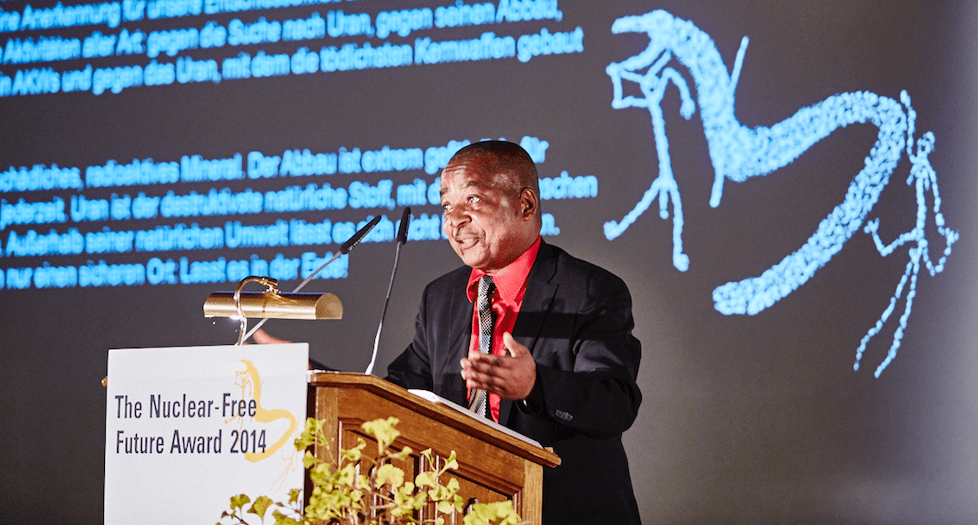
Nothing will stop Congo’s Golden Misabiko from standing up against uranium mining and the poison it spreads
By Linda Pentz Gunter
Arrested. Imprisoned twice. Poisoned by your government in an apparent, and mercifully unsuccessful, assassination attempt. Separated from your family. Forced into exile. In fear of your life and the lives of your wife and five children. How far would you go to exercise your human rights? How far would you go to try to stop the plundering of radioactive resources — in other words, uranium mining — in your country?
That story belongs to Golden Misabiko of the Democratic Republic of Congo. Today, he is still paying the price, shuttling from one country to another every few months, an exile, a citizen of nowhere.
From February to September 2001, Misabiko was locked in a dungeon, kept in solitary confinement and tortured. But he didn’t break. Between 2002 and 2004 he sought refuge in Sweden. But he returned to his country. It was home, it was where his family was. His people. It was where his heart belonged, and his struggled needed to continue.
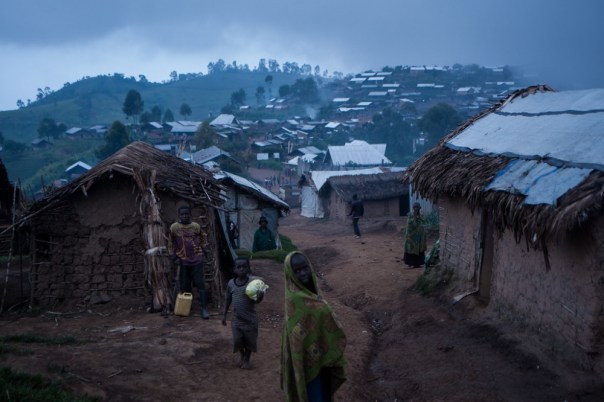
Congo has never known peace, says Golden Misabiko. Five million have died in the current conflict. Photo: Christian Jepsen/NRC
In 2009, Misabiko was arrested and tortured again. His government tried to poison and kill him. Amnesty International ran an “urgent action” on his behalf. On August 25, 2009, Misabiko was released and left his country once more, forced into unwilling exile, this time in South Africa.
The Congo he has left behind is the scene of an unacknowledged 21st century holocaust, with at least five million already dead in cross-border and internal violent conflict.
A forgotten community

The little town in Niger keeping the lights on in France
By Lucas Destrijcker & Mahadi Diouara
Reprinted with kind permission from African Arguments
Welcome to Arlit, the impoverished uranium capital of Africa.
From Niamey, the capital of the landlocked West African nation of Niger, we call ahead to a desert town in the remote north of the country.
“Journalists? On their way here? It’s been a while”, we hear down the phone from our contact. “We welcome you with open arms, but only on the pretence that you’re visiting to interview migrants on their way to Algeria. If they find out you’re poking your nose in their business, it’s a lost cause.”
That same evening, the public bus jolts as it sets off. Destination: the gates of the Sahara.
The stuffy subtropical heat gradually fades into scorching drought and plains of seemingly endless ochre sands. About two days later, we pass through a gateway with “Arlit” written on it in rusty letters.
The town of about 120,000 inhabitants is located in one of the Sahel’s most remote regions, not far from the Algerian border. The surrounding area is known to be the operating territory of numerous bandits and armed groups, including Islamist militants. It is like an island in the middle of the desert, an artificial oasis with only one raison d’être: uranium.
Children were dying. They took action
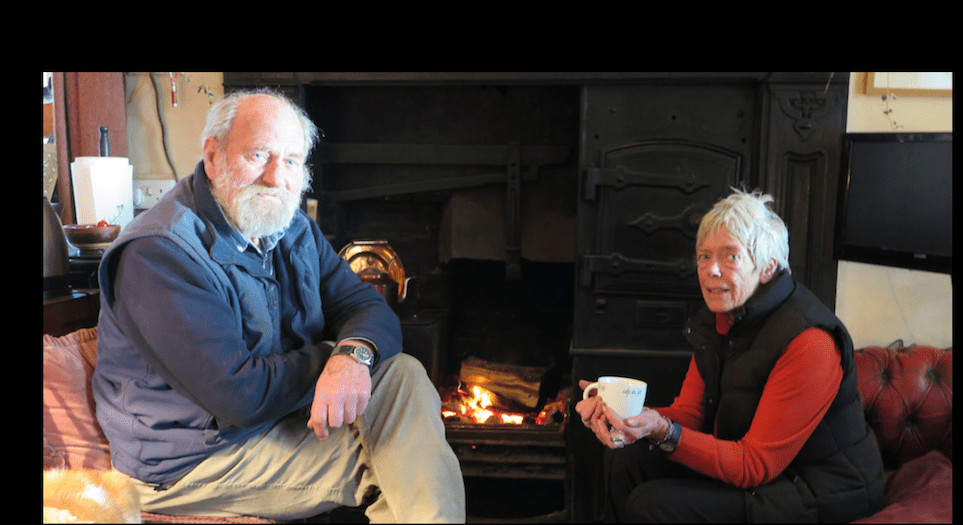
The British campaigners who shed light on deadly nuclear fuel reprocessing
By Linda Pentz Gunter
The road winds steeply up through bucolic countryside, some of the most spectacular in Britain. There are sheep bleating in the distant meadows. Then suddenly, you are out on the fell, stripped almost barren, black, empty. But still there are sheep, their wool the same smoky color as the landscape, dotted like the rocks that are scattered across these bleak tops, the hallmark of the storied Lake District. Then down we go again, past a stone-walled pub, up another hill, and we are pulling up in front of a whitewashed cottage straight from a Beatrix Potter story.
And indeed, that is where we are — in Potter country — about as far removed in atmosphere and idyll as it is possible to be from the ugly, industrial, and deadly blight that sits just a few miles away on the Cumbria shore. That would be the Sellafield nuclear fuel reprocessing facility, which spews radioactive waste into the sea, pumps it into the air, and has accumulated 140 tonnes of plutonium to absolutely no purpose.
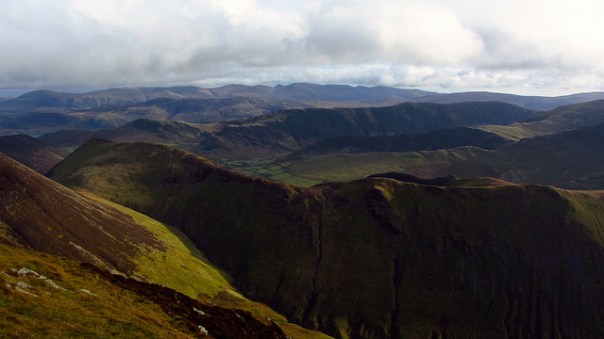
The dramatic beauty of the Lake District fells are just a stone’s throw away from the blight of the Sellafield reprocessing plant. (Photo: Peer Lawther, Flickr.)
A sheepdog runs out to greet us. A pair of elderly cats languish contentedly on a warm stone wall, basking in some late afternoon sunshine. Later, we are introduced to a small flock of Herdwick sheep who are “pets,” and a flock of pigeons, of which more later.
The people who live in the house are Janine Allis-Smith and Martin Forwood, the heart of the aptly named small activist group CORE — Cumbrians Opposed to a Radioactive Environment. They have dedicated more than three decades to challenging the continued operation of Sellafield and calling out the harm it has caused.
 Beyond Nuclear International