 Beyond Nuclear International
A deadly serious French farce
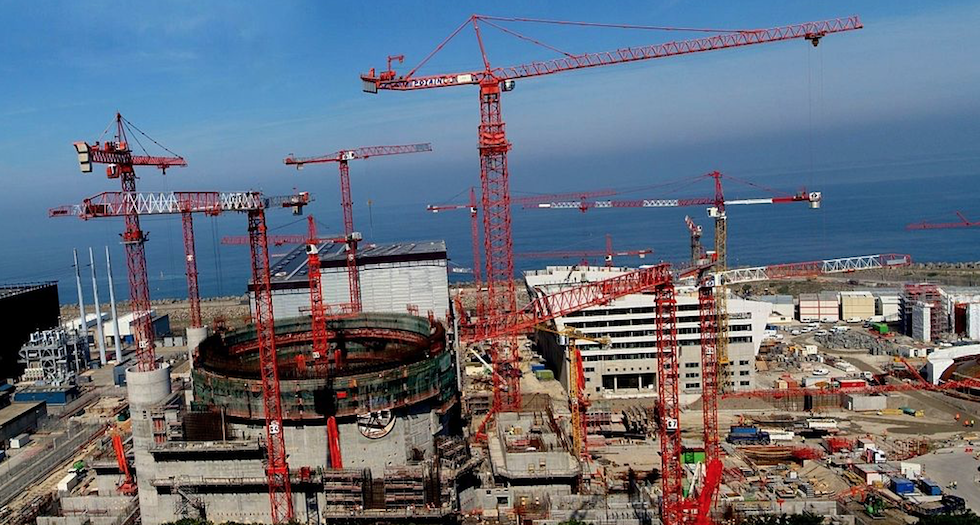
Flamanville reactor fiasco tops list of France’s giant nuclear con game
By Linda Pentz Gunter
At the Flamanville 3 reactor construction site, the falling French toast never lands with the jam side up. This isn’t a case of Murphy’s law, where anything that can go wrong will go wrong, eventually. It’s the worse version, called Sod’s law, in which everything always goes wrong and with the worst possible outcome.
Of course, in any normal business environment, no one in their right mind would continue on with such a reckless venture as is the nuclear reactor project at Flamanville on France’s Normandy coast. Nor would anyone look at the litany of technical, ethical and financial disasters at Flamanville and immediately sign up for their own version.
But this is nuclear we are talking about, where no such sanity applies. While a corporation would walk away from a deal as disastrous as Flamanville, the French and UK governments would rather fleece their citizens’ wallets and risk the survival of their own populations as long as it keeps their nuclear power projects moving forward. So Flamanville is still not canceled. And its evil twin, at Hinkley C on the English coast, isn’t either.
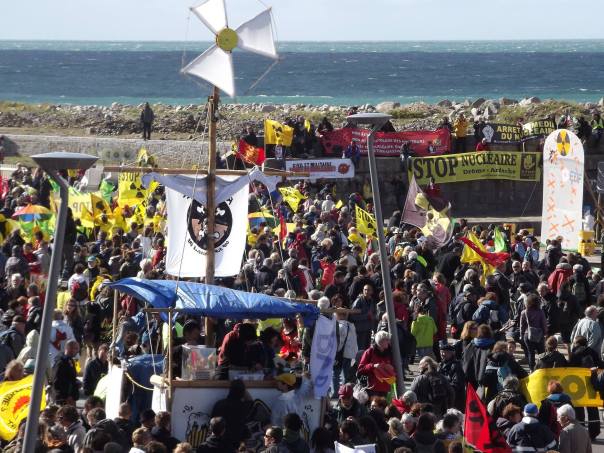
There have been frequent protests at Flamanville to stop construction
Is space for wonder or for war?
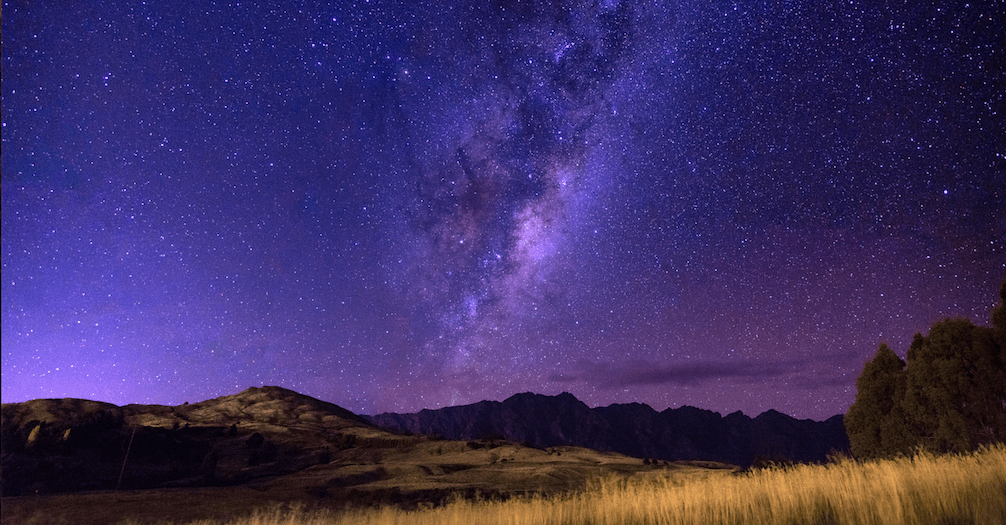
With Space Force, White House wants space as “a warfighting domain.”
By Linda Pentz Gunter
“What country is that?” asked Congressman Elijah Cummings on Tuesday, outrage choking his voice with emotion.
Cummings, a Congressman from Maryland, could have been asking his question about any number of policies. In this case it was about the internment of children at the US border. But it applies almost universally. And certainly to the prospect of provoking, even encouraging, war in space. But that’s also what the Trump administration is now doing.
“Space is a warfighting domain,” said the White House statement this week. It came as the Trump administration once again proclaimed that it plans to create a “Space Force.” What country is that?
Last time the Trump White House tried this, Pentagon officials objected, saying it would “lead to unnecessary costs and bureaucracy.” Maybe. What’s far far worse is that it would lead to unnecessary wars.
Have we lost all reason? Are we supposed, now, to lose all hope as well? Space is for wonder. It’s where we live. We are a small dot in the midst of enormity, floating in a dark vastness about which we know a surprising amount, and yet with so much more still mysteriously unknown.
We used to be able to gaze up into space and pretend to count the infinitesimal stars. Now, cloaked in the haze of light pollution, we actually can — maybe a dozen or so on a non-cloudy night for those of us who live in cities. We have lost our perspective, our sense of where we fit in the universe. Light pollution is a tragedy that has allowed us to forget who we are. It has drawn a veil over the most wondrous and imponderable thing in our existence.
The blue powder entranced. Then it killed
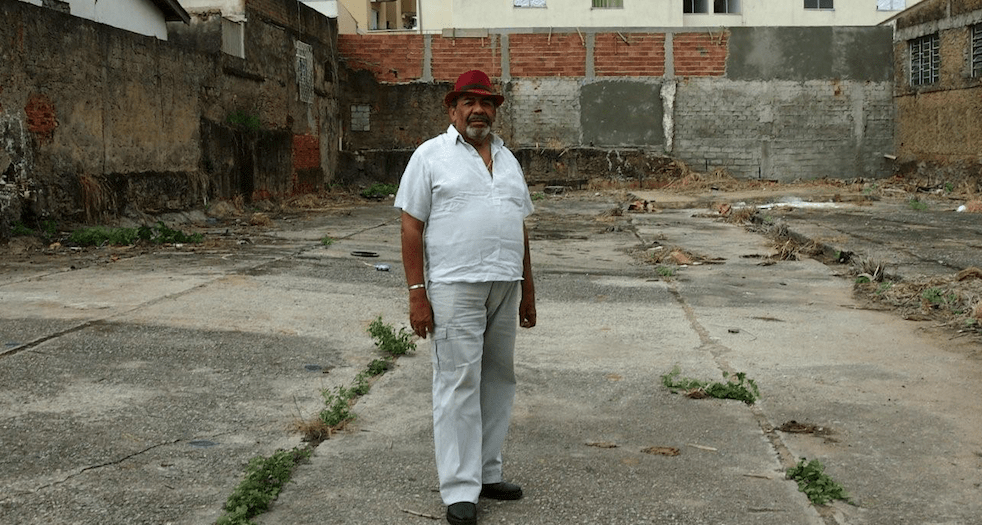
Odesson Alves Ferreira still fights for compensation for victims of deadly nuclear accident in Brazil
By Norbert Suchanek
On September 13, 1987, Brazilian scrap metal dealer, Devair Ferreira, unwittingly opened Pandora’s box. Out spilled a bright blue crystalline powder that fell glowing to the floor. Fascinated by the magical iridescence, Ferreira invited family members to his home to see the mysterious substance for themselves. They were entranced. They touched it and passed it around to other friends and relatives.
What none of them knew was that they had just set in motion Latin America’s worst nuclear accident. The blue powder was cesium chloride, encased inside a cesium-137 teletherapy unit that had been left behind in an abandoned cancer treatment hospital in the City of Goiânia, the capital of the State of Goiás. Two jobless youngsters had picked it up, pulled out the heavy lead cylinder containing 19 grams of cesium-137, and sold it to Ferreira.
Ferreira, and his friends and family, soon became sick. His brother Ivo took some of the powder to his house where his six-year old daughter Leide played with the glowing radioactive crystals on the floor just before dinner. When she ate boiled eggs with her contaminated fingers, the deadly cesium-137 entered her body. Twenty two Ferreira family members had direct contact with the cesium-137. But they unwittingly went on to contaminate others.

Decontamination of houses and streets in Goiânia
At least 40 people were hospitalized, and by October 28 four had died. They were Ivo’s daughter Leide and Devair Ferreira’s wife Gabriela — who had first sounded the alarm about the sudden mysterious sicknesses in her extended family — along with two of Devair’s employees.
All that would be destroyed
The Rokkasho reprocessing plant could ruin everything
By Kiyohiko Yamada, with additional contributions by Kurumi Sugita and Jon Gomon
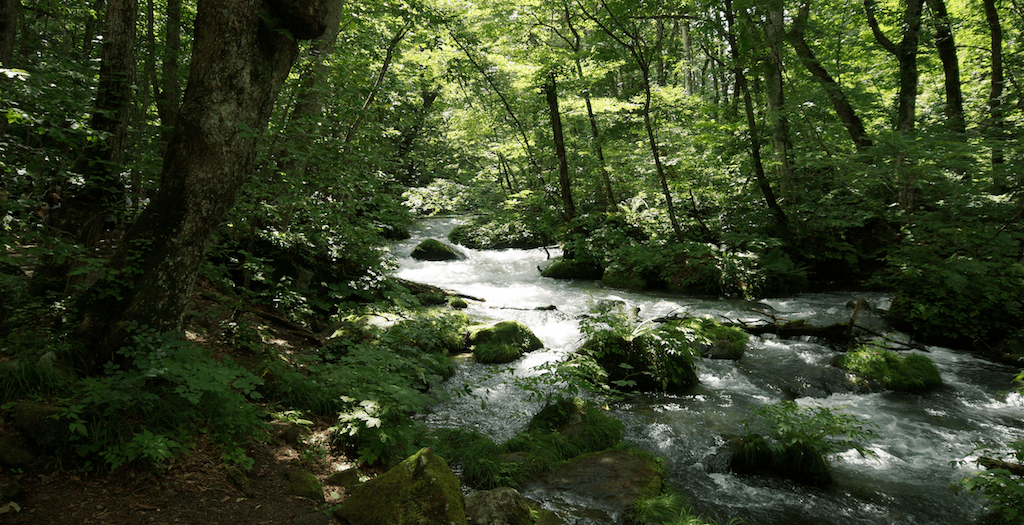
There is a nuclear fuel cycle center in Rokkasho village, located at the tip of Shimokita Peninsula in Aomori Prefecture, in the northernmost part of the main island of Japan.
On April 9, 1985, the governor of Aomori Prefecture gave the green light for the Rokkasho center to proceed. At first, it comprised three facilities:
•a uranium enrichment plant
•a fuel reprocessing plant
•a low-level radioactive waste repository
Later, two more facilities were added:
•a temporary storage facility of high-level radioactive waste returned from overseas after reprocessing,
•a MOX fabrication plant.
The nuclear fuel cycle center of Rokkasho village is operated by Japan Nuclear Fuel Limited (JNFL), notorious for its incompetent management. In October 2017, the Japanese Nuclear Regulation Autority (NRA) reported that JNFL violated safety measures. As the Mainichi Shimbun reported in an October 11, 2017 article, safety records were faked at the unfinished reprocessing plant.
“The NRA concluded on Oct. 11 that Japan Nuclear Fuel Ltd. (JNFL) has violated safety measures after it was learned that the firm failed to carry out the required checks and nevertheless continued to write down “no abnormalities” in safety check records. There has been a spate of incidents such as the flow of rainwater into facility buildings at the plant in the Aomori Prefecture village of Rokkasho.
“The plant, which is scheduled to reprocess spent nuclear fuel, was on the verge of hosting a final-stage NRA safety inspection, but the checkup is likely to be postponed considerably as JNFL now has to prioritize in-house inspections of all facilities at the plant.”
Where’s the beef?
Over-cooked rhetoric or actual progress at Singapore summit?
By Linda Pentz Gunter
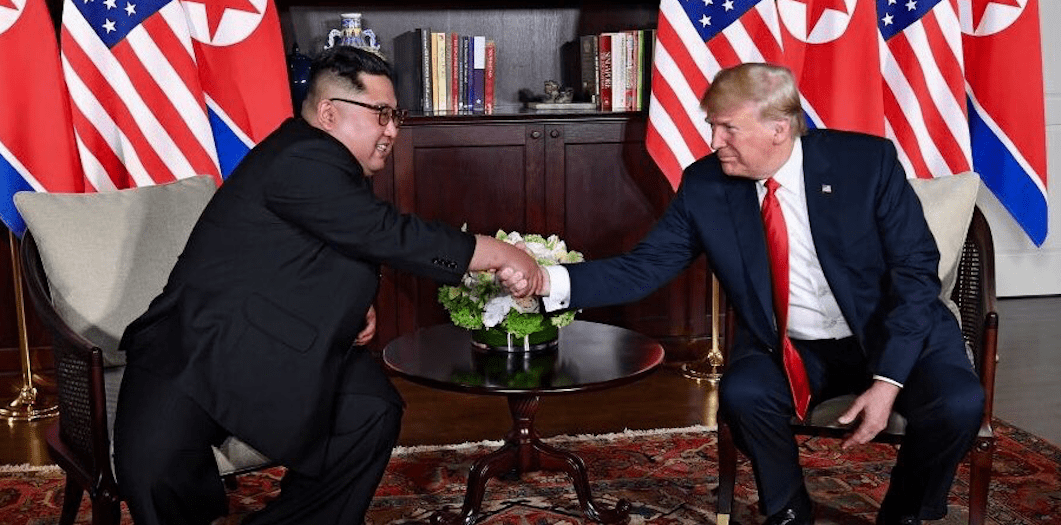
There was a lot at stake, said the pundits, when Donald Trump and Kim Jong-Un finally met at their much vaunted Singapore nuclear summit. Or should that have been at “steak”? After all, Trump touted a pile of steaks as his own brand after a 2016 primary win in Florida, even though Trump Steaks hadn’t sold a cut since 2007 and the brand trademark was canceled in 2014.
So what can we really trust about what was “agreed” to in Singapore?
The headlines roared that the agreement signed between the respective US and North Korean leaders, meant “complete denuclearization” of the Korean peninsula. But what emerged was a single piece of paper replete with glowing rhetoric, one grammatical error and little else. Not as fake as Trump steaks perhaps, but just as bland.
For sure the “optics” — to coin an annoyingly over-used term — served the two dictators well. Each legitimized the other’s authoritarian control over the news cycle and publicity stunts.
But like the proverbial hamburger, it wasn’t Wendy’s. It was more Peter Pan’s Never Never Land. And that’s about how likely it is that North Korea will “completely denuclearize”, and even more true about the US’s own intentions in that department. After all, it is pretty rich for the US to tell any country to get rid of all its nuclear weapons, when the US itself, in defiance of the nuclear Non-Proliferation Treaty — and now the new UN Ban Treaty — is bristling with close to 6,500 of its own. And planning to make new nuclear weapons.
Jeffrey Lee saved Koongarra from uranium mining
“My responsibility is on that land and I don’t own the land. The land owns me.”
By Stefan Disko
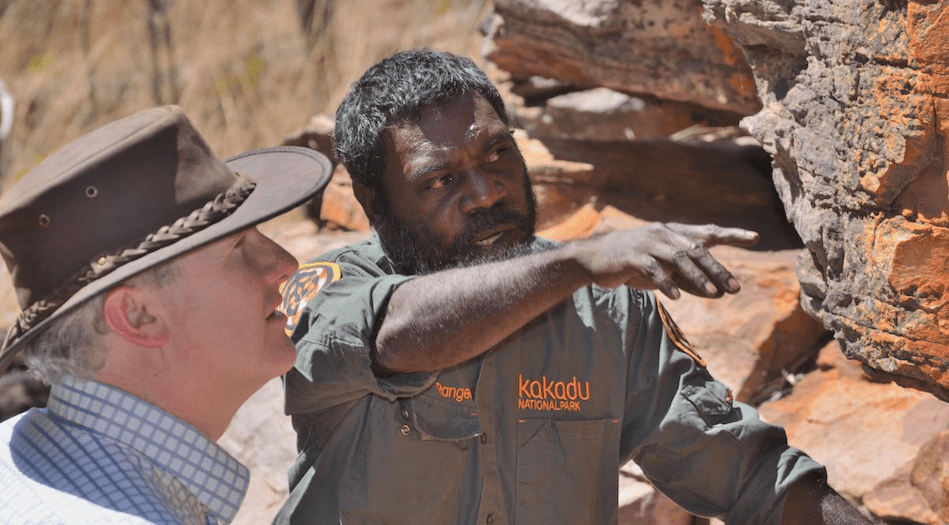
As the sole surviving member of the Djok clan, Jeffrey Lee is the traditional owner and senior custodian of the 12.5 square kilometer Koongarra Project Area, which was excluded from the World Heritage protection of Kakadu National Park when the Park was established in 1979, because it contains a major uranium deposit.
Kakadu National Park is an enormous, biodiverse nature reserve in Australia’s Northern Territory. The park has been home to Aboriginal people for more than 50,000 years, and many of the park’s extensive rock art sites date back thousands of years. The Koongarra enclave is situated in the eastern part of Kakadu and is completely surrounded by the World Heritage property.
The French nuclear energy giant Areva, which holds exploration licences for the uranium deposit, had been pressuring Lee for decades to let the company mine the area, knowing that as the only member of his clan, he in effect controlled the fate of Koongarra. Jeffrey would have become one of Australia’s richest people if he had allowed Areva to extract the estimated 14,000 tonnes of uranium from the area.
The short video with Lee below — A win for Kakadu — explains his quest to protect the land.

