 Beyond Nuclear International
The Big-Tech Warmongers’ American Dream

What they envisage would be a nightmare for the rest of us, writes William Hartung
Editor’s note: Since this article was first published on Common Dreams, Elon Musk is no longer wielding the metaphorical axe at DOGE, and DOGE has reportedly been disbanded, but the policies of cuts and purges continues.
Alex Karp, the CEO of the controversial military tech firm Palantir, is the coauthor of a new book, The Technological Republic: Hard Power, Soft Belief, and the Future of the West. In it, he calls for a renewed sense of national purpose and even greater cooperation between government and the tech sector. His book is, in fact, not just an account of how to spur technological innovation, but a distinctly ideological tract.
As a start, Karp roundly criticizes Silicon Valley’s focus on consumer-oriented products and events like video-sharing apps, online shopping, and social media platforms, which he dismisses as “the narrow and the trivial.” His focus instead is on what he likes to think of as innovative big-tech projects of greater social and political consequence. He argues, in fact, that Americans face “a moment of reckoning” in which we must decide “what is this country, and for what do we stand?” And in the process, he makes it all too clear just where he stands—in strong support of what can only be considered a new global technological arms race, fueled by close collaboration between government and industry, and designed to preserve America’s “fragile geopolitical advantage over our adversaries.”
Karp believes that applying American technological expertise to building next-generation weapons systems is not just a but the genuine path to national salvation, and he advocates a revival of the concept of “the West” as foundational for future freedom and collective identity. As Sophie Hurwitz of Mother Jones noted recently, Karp summarized this view in a letter to Palantir shareholders in which he claimed that the rise of the West wasn’t due to “the superiority of its ideas or values or religion… but rather by its superiority in applying organized violence.”
Count on one thing: Karp’s approach, if adopted, will yield billions of taxpayer dollars for Palantir and its militarized Silicon Valley cohorts in their search for AI weaponry that they see as the modern equivalent of nuclear weapons and the key to beating China, America’s current great power rival.
Militarism as a Unifying Force
Karp may be right that this country desperately needs a new national purpose, but his proposed solution is, to put it politely, dangerously misguided.
Ominously enough, one of his primary examples of a unifying initiative worth emulating is World War II’s Manhattan Project, which produced the first atomic bombs. He sees the building of those bombs as both a supreme technological achievement and a deep source of national pride, while conveniently ignoring their world-ending potential. And he proposes embarking on a comparable effort in the realm of emerging military technologies: “The United States and its allies abroad should without delay commit to launching a new Manhattan Project in order to retain exclusive control of the most sophisticated forms of AI for the battlefield—the targeting systems and swarms of drones and robots that will become the most powerful weapons of the century.”
And here’s a question he simply skips: How exactly will the United States and its allies “retain exclusive control” of whatever sophisticated new military technologies they develop? After all, his call for an American AI buildup echoes the views expressed by opponents of the international control of nuclear technology in the wake of the devastating atomic bombings of the Japanese cities of Hiroshima and Nagasaki that ended World War II—the futile belief that the United States could maintain a permanent advantage that would cement its role as the world’s dominant military power.
Nearly 80 years later, we continue to live with an enormously costly nuclear arms race—nine countries now possess such weaponry—in which a devastating war has been avoided as much thanks to luck as design. Meanwhile, past predictions of permanent American nuclear superiority have proven to be wishful thinking. Similarly, there’s no reason to assume that predictions of permanent superiority in AI-driven weaponry will prove any more accurate or that our world will be any safer.
Technology Will Not Save Us
Karp’s views are in sync with his fellow Silicon Valley militarists, from Palantir founder Peter Thiel to Palmer Luckey of the up-and-coming military tech firm Anduril to America’s virtual co-president, SpaceX’s Elon Musk. All of them are convinced that, at some future moment, by supplanting old-school corporate weapons makers like Lockheed Martin and Northrop Grumman, they will usher in a golden age of American global primacy grounded in ever better technology. They see themselves as superior beings who can save this country and the world, if only the government—and ultimately, democracy itself—would get out of their way. Not surprisingly, their disdain for government does not extend to a refusal to accept billions and billions of dollars in federal contracts. Their anti-government ideology, of course, is part of what’s motivated Musk’s drive to try to dismantle significant parts of the federal government, allegedly in the name of “efficiency.”

An actual efficiency drive would involve a careful analysis of what works and what doesn’t, which programs are essential and which aren’t, not an across-the-board, sledgehammer approach of the kind recently used to destroy the U.S. Agency for International Development (USAID), to the detriment of millions of people around the world who depended on its programs for access to food, clean water, and healthcare, including measures to prevent the spread of HIV-AIDS. Internal agency memos released to the press earlier this month indicated that, absent USAID assistance, up to 166,000 children could die of malaria, 200,000 could be paralyzed with polio, and 1 million of them wouldn’t be treated for acute malnutrition. In addition to saving lives, USAID’s programs cast America’s image in the world in a far better light than does a narrow reliance on its sprawling military footprint and undue resort to threats of force as pillars of its foreign policy.
As a military proposition, the idea that swarms of drones and robotic systems will prove to be the new “miracle weapons,” ensuring American global dominance, contradicts a long history of such claims. From the “electronic battlefield” in Vietnam to former President Ronald Reagan’s quest for an impenetrable “Star Wars” shield against nuclear missiles to the Gulf War’s “Revolution in Military Affairs” (centered on networked warfare and supposedly precision-guided munitions), expressions of faith in advanced technology as the way to win wars and bolster American power globally have been misplaced. Either the technology didn’t work as advertised; adversaries came up with cheap, effective countermeasures; or the wars being fought were decided by factors like morale and knowledge of the local culture and terrain, not technological marvels. And count on this: AI weaponry will fare no better than those past “miracles.”
First of all, there is no guarantee that weapons based on immensely complex software won’t suffer catastrophic failure in actual war conditions, with the added risk, as military analyst Michael Klare has pointed out, of starting unnecessary conflicts or causing unintended mass slaughter.
Second, Karp’s dream of “exclusive control” of such systems by the U.S. and its allies is just that—a dream. China, for instance, has ample resources and technical talent to join an AI arms race, with uncertain results in terms of the global balance of power or the likelihood of a disastrous U.S.-China conflict.
Third, despite Pentagon pledges that there will always be a “human being in the loop” in the use of AI-driven weaponry, the drive to wipe out enemy targets as quickly as possible will create enormous pressure to let the software, not human operators, make the decisions. As Biden administration Air Force Secretary Frank Kendall put it, “If you have a human in the loop, you will lose.”
Automated weapons will pose tremendous risks of greater civilian casualties and, because such conflicts could be waged without putting large numbers of military personnel at risk, may only increase the incentive to resort to war, regardless of the consequences for civilian populations.
What Should America Stand For?
Technology is one thing. What it’s used for, and why, is another matter. And Karp’s vision of its role seems deeply immoral. The most damning real-world example of the values Karp seeks to promote can be seen in his unwavering support for Israel’s genocidal war on Gaza. Not only were Palantir’s systems used to accelerate the pace of the Israeli Defense Force’s murderous bombing campaign there, but Karp himself has been one of the most vocal supporters of the Israeli war effort. He went so far as to hold a Palantir board meeting in Israel just a few months into the Gaza war in an effort to goad other corporate leaders into publicly supporting Israel’s campaign of mass killing.
Are these really the values Americans want to embrace? And given his stance, is Karp in any position to lecture Americans on values and national priorities, much less how to defend them?
Despite the fact that his company is in the business of enabling devastating conflicts, his own twisted logic leads Karp to believe that Palantir and the military-tech sector are on the side of the angels. In May 2024, at the “AI Expo for National Competitiveness,” he said of the student-encampment movement for a cease-fire in Gaza, “The peace activists are war activists. We are the peace activists.”
Invasion of the Techno-Optimists
And, of course, Karp is anything but alone in promoting a new tech-driven arms race. Elon Musk, who has been empowered to take a sledgehammer to large parts of the U.S. government and vacuum up sensitive personal information about millions of Americans, is also a major supplier of military technology to the Pentagon. And Vice President JD Vance, Silicon Valley’s man in the White House, was employed, mentored, and financed by Palantir founder Peter Thiel before joining the Trump administration.
The grip of the military-tech sector on the Trump administration is virtually unprecedented in the annals of influence-peddling, beginning with Elon Musk’s investment of an unprecedented $277 million in support of electing Donald Trump and Republican candidates for Congress in 2024. His influence then carried over into the presidential transition period, when he was consulted about all manner of budgetary and organizational issues, while emerging tech gurus like Marc Andreessen of the venture capital firm Andreessen Horowitz became involved in interviewing candidates for sensitive positions at the Pentagon. Today, the figure who is second-in-charge at the Pentagon, Stephen Feinberg of Cerberus Capital, has a long history of investing in military firms, including the emerging tech sector.
But by far the greatest form of influence is Musk’s wielding of the essentially self-created Department of Government Efficiency (DOGE) to determine the fate of federal agencies, programs, and employees, despite the fact that he has neither been elected to any position, nor even confirmed by Congress, and that he now wields more power than all of Trump’s cabinet members combined.
As Alex Karp noted—no surprise here, of course—in a February 2025 call with Palantir investors, he’s a big fan of the DOGE, even if some people get hurt along the way: “We love disruption, and whatever’s good for America will be good for Americans and very good for Palantir. Disruption, at the end of the day, exposes things that aren’t working. There will be ups and downs. There’s a revolution. Some people are going to get their heads cut off. We’re expecting to see really unexpected things and to win.”
Even as Musk disrupts and destroys civilian government agencies, some critics of Pentagon overspending hold out hope that at least he will put his budget-cutting skills to work on that bloated agency. But so far the plan there is simply to shift money within the department, not reduce its near-trillion-dollar top line. And if anything is trimmed, it’s likely to involve reductions in civilian personnel, not lower spending on developing and building weaponry, which is where firms like Palantir make their money. Musk’s harsh critique of existing systems like Lockheed’s F-35 jet fighter—which he described as “the worst military value for money in history”—is counterbalanced by his desire to get the Pentagon to spend far more on drones and other systems based on emerging (particularly AI) technologies.
Of course, any ideas about ditching older weapons systems will run up against fierce resistance in Congress, where jobs, revenues, campaign contributions, and armies of well-connected lobbyists create a firewall against reducing spending on existing programs, whether they have a useful role to play or not. And whatever DOGE suggests, Congress will have the last word. Key players like Sen. Roger Wicker (R-Miss.) have already revived the Reaganite slogan of “peace through strength” to push for an increase of—no, this is not a misprint!—$150 billion in the Pentagon’s already staggering budget over the next four years.
What Should Our National Purpose Be?
Karp and his Silicon Valley colleagues are proposing a world in which government-subsidized military technology restores American global dominance and gives us a sense of renewed national purpose. It is, in fact, a remarkably impoverished vision of what the United States should stand for at this moment in history when non-military challenges like disease, climate change, racial and economic injustice, resurgent authoritarianism, and growing neofascist movements pose greater dangers than traditional military threats.

Technology has its place, but why not put our best technical minds to work creating affordable alternatives to fossil fuels, a public health system focused on the prevention of pandemics and other major outbreaks of disease, and an educational system that prepares students to be engaged citizens, not just cogs in an economic machine?
Reaching such goals would require reforming or even transforming our democracy—or what’s left of it—so that the input of the public actually made far more of a difference, and leadership served the public interest, not its own economic interests. In addition, government policy would no longer be distorted to meet the emotional needs of narcissistic demagogues, or to satisfy the desires of delusional tech moguls.
By all means, let’s unite around a common purpose. But that purpose shouldn’t be a supposedly more efficient way to build killing machines in the service of an outmoded quest for global dominance. Karp’s dream of a “technological republic” armed with his AI weaponry would be one long nightmare for the rest of us.
William D. Hartung is a Senior Research Fellow at the Quincy Institute for Responsible Statecraft, and the author most recently of “Pathways to Pentagon Spending Reductions: Removing the Obstacles.” This article was first published on Common Dreams whose content is available in the Creative Commons.
Headline photo: Elon Musk and President of Argentina Javier Milei speaking at the 2025 Conservative Political Action Conference (CPAC) at the Gaylord National Resort & Convention Center in National Harbor, Maryland. (Photo: Gage Skidmore/Wikimedia Commons.)
The opinions expressed in articles by outside contributors and published on the Beyond Nuclear International website, are their own, and do not necessarily reflect the views or positions of Beyond Nuclear. However, we try to offer a broad variety of viewpoints and perspectives as part of our mission “to educate and activate the public about the connections between nuclear power and nuclear weapons and the need to abandon both to safeguard our future.”
Competition, Conflagration, or Coexistence?

The US-China relationship doesn’t have to be MAD, writes Joseph Gerson
Just over 60 years ago, in structuring the analytical abilities of freshmen who aspired to become US diplomats, including future President Bill Clinton, professor Carroll Quigley, who taught Evolution of Civilizations, insisted that his students accept that civilizations are based on six interrelated dynamics: political, economic, military, intellectual, social, and spiritual dimensions. He also taught that in different periods of history one or more of these dimensions are most important to defend and to the exercising of power beyond the society’s borders.
That analysis applies today when the struggle for great power hegemony is rooted in economic and intellectual competition as much as in traditional, but increasingly complicated, arms races. Twenty-first century economies and militaries cannot function without rare-earth metals and magnets. The list of civil and military products that cannot be manufactured without them begins with cell phones and LED screens to F-35 fighter jets, Virginia– and Columbia-class submarines, Tomahawk missiles, radar systems, and Predator drones. China has a near monopoly over both the minerals and magnets production although Greenland—an object of US President Donald Trump’s desire—can be a future source of those minerals.
Beijing’s export controls announced in October are the economic equivalent of a 1950s nuclear weapon test, demonstrating both its possession and willingness to use this ultimate economic weapon to impose global economic domination. This was not the first time that Beijing flaunted its economic superweapon. Hardly recognized by anyone in the United States, the ban came in reaction to US Commerce Department China hawks’ announcement of new technology export bans targeted primarily against China.
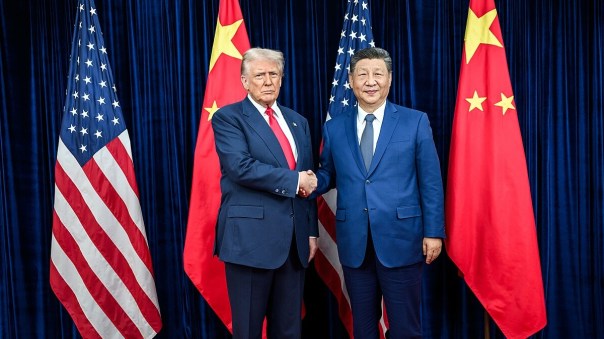
Power and security have always rested on economic foundations. Slavery and the industrial revolution made the European colonial era possible. Japan’s defeat in its Pacific War was dictated by the reality that it’s GDP was one-tenth that of the United States. And, as the country lacked a modern economy, the Russian revolution was won on the slogan of “Bread and Peace.”
This century’s economic and technological developments have been no exception. China now holds the US Seventh Fleet, which has guaranteed US dominance of the Pacific Ocean—“the American Lake”—at risk from its aerial denial missiles and massive naval fleet. Russian-Ukraine drone warfare, now augmented by AI coordinated drone swarms, and by the integration of AI and cyber warfare, now place conventional military and nuclear forces at risk. So too, essential civilian infrastructures, which place water and electrical supplies at risk.
Read MoreMinnesota’s aging nukes pose national threat

More than electricity, the reactors supply a steady dose of radioactive tritium in drinking water, writes Susu Jeffrey
“Sometimes before I give a speech, I ask the audience to stand up if they or someone in their family has had cancer,” says John LaForge of Nukewatch. “Eighty percent of the audience gets up.”
The Monticello nuclear power reactor is on the Mississippi River about 35-miles northwest of Minneapolis. Xcel’s twin Prairie Island reactors, plus about 50 giant dry casks storing waste reactor fuel, are all in the floodplain of the Mississippi. This waste is sited 44 to 51 miles southeast of Minneapolis and St. Paul.
There are no plans to move the waste off-island because there is no alternative destination. In fact, 34 more concrete encased steel casks are planned. There is no national hot radioactive waste repository. Think of these waste container sites as permanent radioactive waste dumps.

The greater Twin Cities’ 3.7 million people are in the nuclear “shadow” (within 50 miles) of all three nukes. The Mississippi River serves 20 million people with drinking water, way beyond the Minnesota state population of 5.7 million. Minnesota’s aging nukes are a national threat. For approximately the next six generations, radioactive tritium will be a part of the drinking water wherever those molecules wander.
The Monticello nuke was licensed in 1970 for 40 years, and went online in 1971, a year it had two radioactive cesium spills. In 2010, the license was renewed for another 20 years until 2030. Xcel Energy has even been granted an extension for another 20 years until 2050. It is a corporate financial security move not yet approved by the Minnesota Public Utilities Commission which holds the final consent. Paperwork is one thing, pipes are another.
Read MoreWhy citizen scientists and public information are so crucial

Russian activist Andrey Ozharovskii, who was detained in Mongolia for radiation testing, must be restored full rights, urges Nuclear Transparency Watch
Editor’s note: The letter and call to action below were originally made in August 2025 after Andrey Ozharovskii was first detained and then deported back to Russia from Mongolia. To date, his passport has not been returned. However, his story is also an excellent illustration of the need for independent citizen scientists working in the field to provide the public with accurate and unbiased information about the levels of radiation they may be being exposed to on a daily basis. And of course, it speaks to larger issues of freedom as well.
Nuclear Transparency Watch, including our colleague Jan Haverkamp, has published an open letter regarding the arrest of physicist and environmentalist Andrey Ozharovskii in Mongolia.
Andrey Ozharovskii was detained by Mongolian authorities while measuring radiation levels with a personal dosimeter near uranium mining sites operated by the French company Orano. Although released, his passport has not been returned, and he faces uncertainty about his freedom of movement.
Ozharovskii’s activities form part of a long-standing European tradition of “citizen science” in the nuclear field: independent experts and local communities taking radiation measurements to help ensure transparency, safety, and accountability. Nuclear Transparency Watch and its members have supported such initiatives across Europe in cooperation with regulators, laboratories, and NGOs.

The principle at stake is simple but crucial: environmental information, including radiation data, must be accessible to the public. This is at the heart of the Aarhus Convention, the international treaty guaranteeing the rights of access to information, public participation in decision-making, and access to justice on environmental matters. Under its Article 3(8), people exercising these rights must not face persecution or harassment.
Mongolia is currently considering accession to the Aarhus Convention. This incident highlights why such commitments matter: ensuring that those who act to protect the public and the environment can do so without fear. At this moment, Andrey Ozharovskii should regain access to his ability to travel freely.
Read MoreHuman security is climate security

The COP30 climate summit is about more than carbon, it’s about conscience, writes Dr. Ghassan Shahrour
Health professionals have long warned that climate change is a public health emergency. But it is also a moral emergency. At COP30, we must demand that climate action include disarmament, equity, and protection for the most vulnerable. As a physician and humanitarian, I have witnessed how environmental degradation and human suffering are inseparable — from war-torn landscapes to drought-stricken communities. This is not just about carbon. It is about conscience.
A personal journey toward environmental conscience
My relationship with the environment didn’t begin with declarations or data. It grew through lived experience and shared struggle. I first encountered the environmental toll of war not in theory, but in the field: the long- and short-term damage caused by landmines, cluster munitions, and other remnants of conflict. These realities were central to the discussions I joined in Damascus, Sharjah, the Dead Sea, Cartagena, and Beirut. Each meeting deepened my conviction that environmental justice is inseparable from human dignity.
In 2012, while coordinating the Arab Human Security Network, I participated in the National Meeting of Environmental Societies in Syria. There, I proposed that our active local organizations be part of the global environmental movement — one that began in earnest with the 1972 Stockholm Conference, the first to place the environment at the heart of international concern. I do not speak as an expert above others, but as someone who has witnessed how human suffering and environmental neglect are one and the same. In conflict zones, the air is poisoned not only by smoke but by silence. The soil is not only depleted but denied its right to renewal.
Belém: A test of global conscience
On November 10, 2025, COP30 opened in Belém, Brazil — the beating heart of the Amazon. This is not just a symbolic location; it is a living reminder of what’s at stake. A decade after the Paris Agreement, and amid worsening climate disasters and broken promises, we must recognize that this moment is not merely environmental. It is ethical. It is human.

Embroiled in war and embattled at home

Can president Zelensky survive a kickback scheme involving the state nuclear company that enriched associates and possibly even ministers in his own government, asks Linda Pentz Gunter
If you live in Ohio, and possibly even in Illinois and South Carolina, you might be getting a bit of a déjà vu feeling reading the news coming out of Ukraine about a corruption scandal involving Energoatom, Ukraine’s nuclear energy company. That’s because two independent Ukrainian anti-corruption bodies have just uncovered a massive graft scandal involving kickbacks from nuclear power projects.
In July 2020, then Speaker of the Ohio House, Republican Larry Householder, was arrested along with four others for involvement in what was described as “the largest bribery money-laundering scheme ever perpetrated against the people of the state of Ohio.”
In a year-long covert investigation by the US Attorney’s office and the FBI, a plot was uncovered that involved $61 million in dark money that flowed from FirstEnergy into the pockets of Householder and others to ensure a favorable vote in the House that would guarantee a $1.5 billion bailout of the company’s Davis-Besse and Perry nuclear reactors to keep them running. Once uncovered, indictments followed. Householder is currently serving a 20-year prison sentence.
Similar scandals rocked Illinois and South Carolina, also connected to nuclear power plant schemes and also leading to indictments and prison sentences.
In Ukraine, the two investigating agencies — the National Anti-Corruption Bureau (NABU) and the Specialized Anti-Corruption Prosecutor’s Office (SAPO) — have just named at least eight individuals who have reportedly been charged with bribery, embezzlement, and illicit enrichment, netting around $100 million off contracts with Energoatom.

Details about precisely how the scheme operated and which contracts were involved have not fully emerged. However, some sources have suggested it involved a wide range of Energoatom’s private subcontractors who were allegedly forced to pay kickbacks of 10-15% to secure or maintain their supplier status and ensure timely payments.
Read More Beyond Nuclear International