 Beyond Nuclear International
Won’t get fooled again

Take a bow to the renewable revolution. The nuclear renaissance that never was is already fizzling, writes Linda Pentz Gunter
These days the mainstream media routinely parrot the nuclear industry party line that it is enjoying a “global renaissance.” These meek media sycophants don’t stop to question the veracity of this claim at all, or to notice that the rhetoric does not appear to match reality.
But if we are really living through a “nuclear renaissance”, which one is it? The old nuclear renaissance of 2006? Or a new re-renaissance? And where is their Michelangelo? Bill Gates appears to have made billions, but he hasn’t made masterpieces.
You have to wonder about the nuclear industry’s marketing mavens, though. Why on earth would they rebrand what they are trying to suggest is the new world dominance of nuclear power as an essential energy source by giving it the same name as their most abject failure?
Meet the new nuclear renaissance. Same as the old nuclear renaissance. All promise and, so far, no delivery.
That first nuclear renaissance wasn’t a renaissance at all, it was a stillbirth. And as a student of Italian, I have to say it peeves me that the nuclear industry dares to use the name at all.

The actual renaissance, which began in Italy, fully blossomed across Europe in the fifteenth and sixteenth centuries. It was an extraordinary simultaneous flowering of culture, intellectualism, art, music, science, economics and technology, a genuine “rebirth” after the relatively primitive Middle Ages.
Read MoreSusan Mirsky wins “unsung hero” award
Beyond Nuclear honors an activist who understands that acheiving peace must mean for everyone, writes Linda Pentz Gunter
When Greta Thunberg, still best known as a young Swedish climate activist, made her first voyage with the Freedom Flotilla attempting to reach Gaza with humanitarian aid, a reporter not unsurprisingly asked her what she was doing there.
Ever on point, Thunberg responded: ”We cannot have climate justice without social justice. The reason I am a climate activist is not because I want to protect trees. I’m a climate activist because I care about human, planetary well-being — and those are extremely interlinked.”
For those of us who work on nuclear weapons or nuclear power or both, we, too, understand that this is an issue deeply interlinked to planetary wellbeing. We have to focus on a nuclear-free world, but we also know that this mission is part of a broader one for climate, for peace and for justice, and that we cannot fight the nuclear threat in isolation.
Accordingly, Beyond Nuclear chose as its winner this year of the Dr. Judith H. Johnsrud Unsung Hero Award, someone who understands this fully.
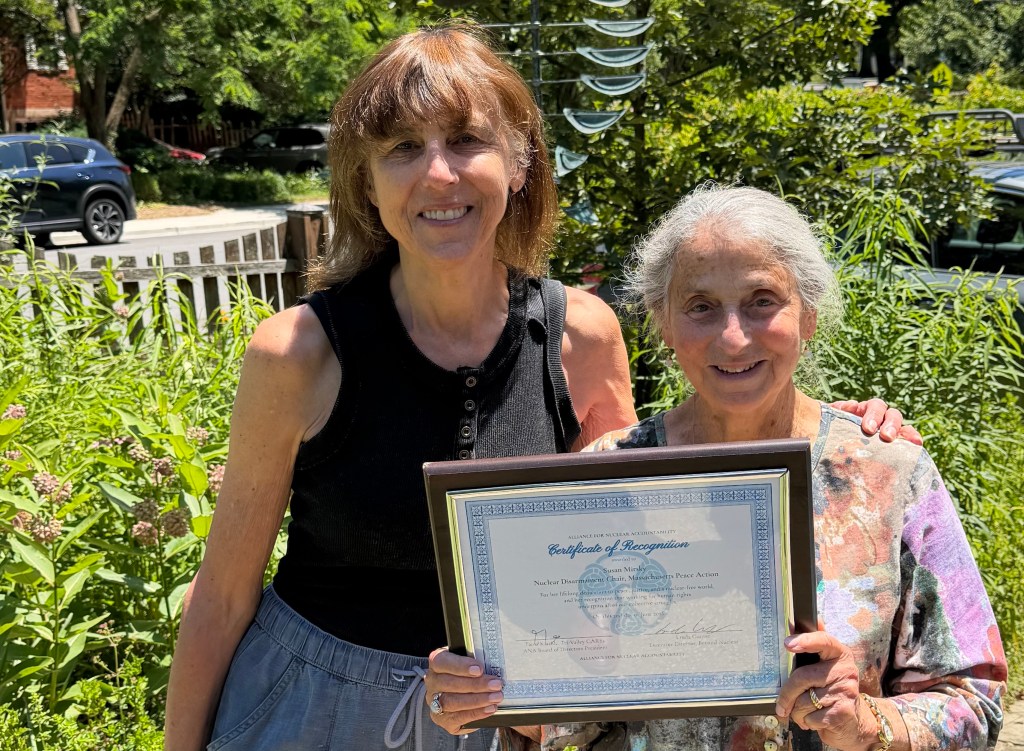
Susan Mirsky has been organizing for peace for a very long time — since high school and, for all we know, before that — when she organized a local Youth Committee on Sane Nuclear Policy in Essex County, New Jersey where she grew up.
Since then, she has gone on to embrace — and work for — a multitude of causes directly or indirectly related to peace, nuclear abolition and justice, all of which, as Thunberg pointed out, are intimately interrelated.
Now living in Massachusetts, Mirsky currently serves as Board Member and Nuclear Disarmament Chair for Massachusetts Peace Action, and as a founding member of Newton Dialogues on Peace and War.
The Johnsrud Award is presented by Beyond Nuclear each year as part of the annual Alliance for Nuclear Accountability awards held in conjunction with ANA’s DC Days of visits to legislative offices on Capitol Hill. The Award is named in memory of former Beyond Nuclear board member and stalwart anti-nuclear activist, Judy Johnsrud.
“Organizing for peace and social justice has been a part of my being,” said Mirsky, now in her early eighties. “Early on I was taught to understand that I was connected to all people everywhere — all beings, all of nature, that if one person was not free, I/we were not free.” This lesson gave her “a sense of individual responsibility and thus agency to make change,” she said.
Mirsky’s is a familiar voice in the anti-nuclear movement, often as the gentle moderator of webinars, or the in-person host of events — including in her own back garden — calling out the reckless expansion of nuclear power; the need to abolish nuclear weapons; demanding an end to the genocide in Gaza and the wars in Ukraine and Iran; seeking justice for Cuba; educating the Haitian diaspora on the threat of nuclear weapons; and helping to create greater understanding about China, among other topics.
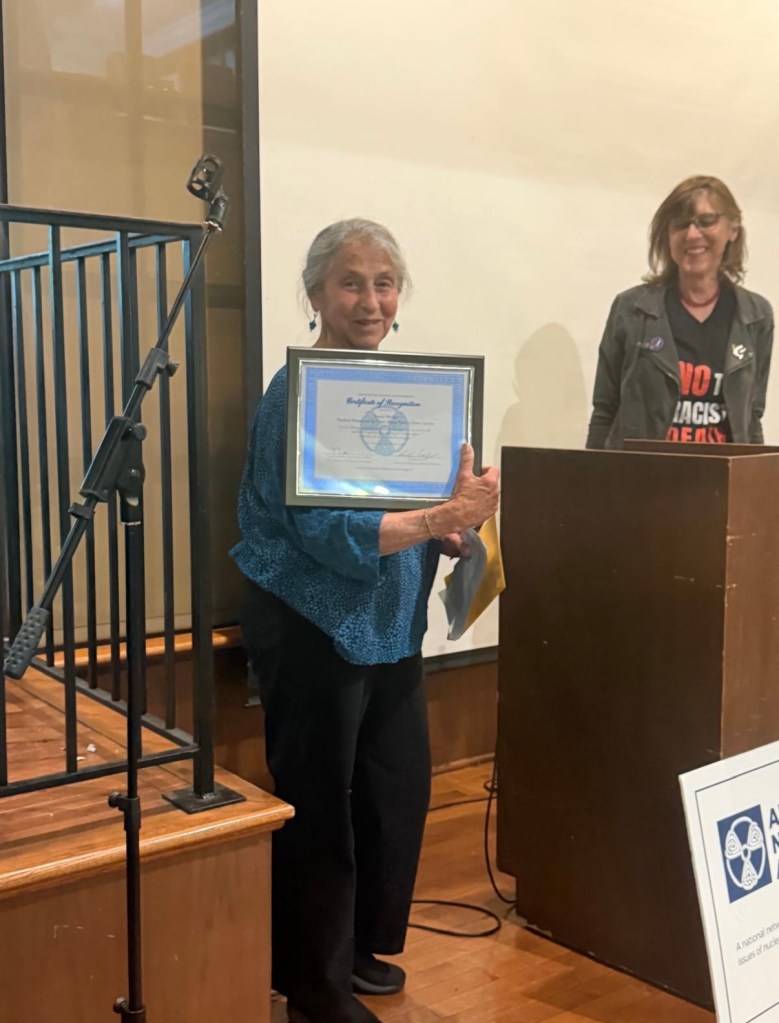
“I have always sought inclusion of other groups and people,” says Mirsky, who believes that “to make change in this society, which is based on corporate and political money, power and greed, we need to articulate what is most important for all people and enable them to take action however big or small to effect change.”
While Mirsky has had a primary focus on peace and nuclear weapons abolition through her work with MAPA, she has always not only understood the connection to nuclear power, but actively engaged in opposition to its continued and expanded use.
Most recently, MAPA has joined the Commonwealth Coalition for the Environment and Safe Energy, a Massachusetts-wide coalition of groups working to stop the state of Massachusetts from passing a bill that would remove long-standing regulatory barriers to new nuclear energy projects. The repeal has the support of the state’s governor, Maura Healey.
Specifically, the bill — “An Act Relative to Energy Affordability, Clean Power, and Economic Competitiveness” — misleadingly termed a “clean energy bill”, repeals a 1982 state law that previously required voter approval and special legislative certification to construct any nuclear power plant or low‐level radioactive waste storage and disposal facilities in Massachusetts.
The 1982 law, passed by referendum, requires a statewide vote to allow for a new nuclear facility and/or storage and disposal facilities, and the legislature to certify findings that include such issues as whether the site, technology, safety and waste disposal options are adequate.

But Healey, a Democrat in name, appears to have little interest in adhering to democracy in action. Healey proposed repealing the 1982 nuclear law on May 13, 2025, but as of early June 2026, the provision remains under legislative consideration, having advanced in the House.
Healey has also signed onto a statement endorsed by five other New England governors, that supports bringing new nuclear power plants and related nuclear projects into their state.
Mirsky has contested the continued use of nuclear power before, and does not restrict her activities to fights within her own state.
As an example, in December 2022, she filed comments opposed to the license extension for the Comanche Peak nuclear power plant in Texas. “I urge you to reject the application by Vistra to extend the operating licenses for the Comanche Peak nuclear power reactors for an additional 20 years,” Mirsky wrote to the US Nuclear Regulatory Commission. “To protect public health, safety, security, and financial health, the reactors should retire as licensed, on or before 2030 and 2033.”
It comes as no surprise to readers here that the NRC, already an industry lapdog and now immeasurably more compromised and constrained under the lawless Trump administration, duly granted license extensions for both reactors at Comanche Peak for another 20 years beyond their original closure date.
At a recent protest and press conference on Boston Common against the heartless attacks on Iranian civilians due to the bombing attacks by the US and Israel, Mirsky set up a memorial of children’s shoes, backpacks, and other belongings to honor young victims of the war.
Massachusetts Democrat, Senator Ed Markey, a longtime ally of both the anti-nuclear power and nuclear disarmament movements, also spoke at the event, which was held two days after President Trump threatened Iran, telling the world “a whole civilization is going to die tonight.”
“That was a threat of annihilation. That was a threat of genocide,” Markey said. “That was the language of a man who is unfit to hold the nuclear codes.”
When asked about the meaning of her shoes and backpack exhibit, Mirsky told reporters, “Parents and grandparents all over the world want their children to grow up in peace, and somehow we have to do something to make that happen and recognize that there are basic rights that all people want and should have, and that war is never the answer. Never.”
Linda Pentz Gunter is the Executive Director of Beyond Nuclear and writes for and edits Beyond Nuclear International. She is the author of the book, No To Nuclear. Why Nuclear Power Destroys Lives, Derails Climate Progress And Provokes War, published by Pluto Press. Any opinions are her own.
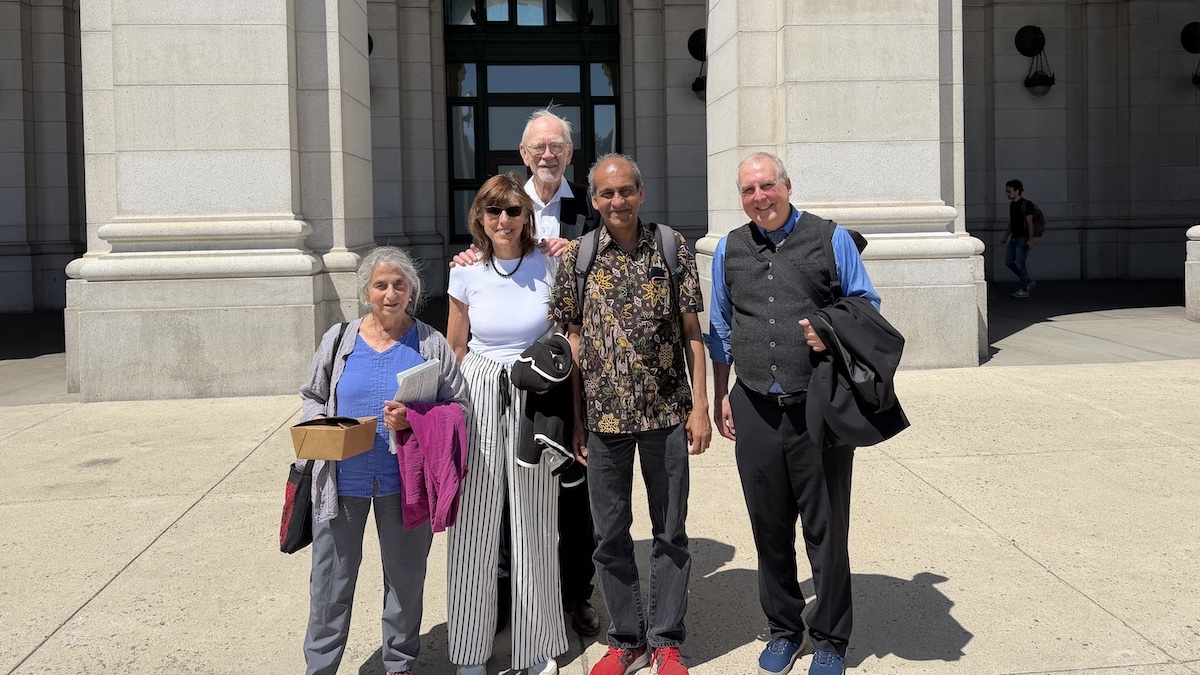
Headline photo: Susan Mirsky (far left) joins fellow ANA Award winner, MV Ramana (second from right), along with Linda Pentz Gunter and Paul Gunter of Beyond Nuclear, and Tim Judson of Nuclear Information and Resource Service in the nation’s capital during ANA DC Days.
Roll up, roll up, get your plutonium here!
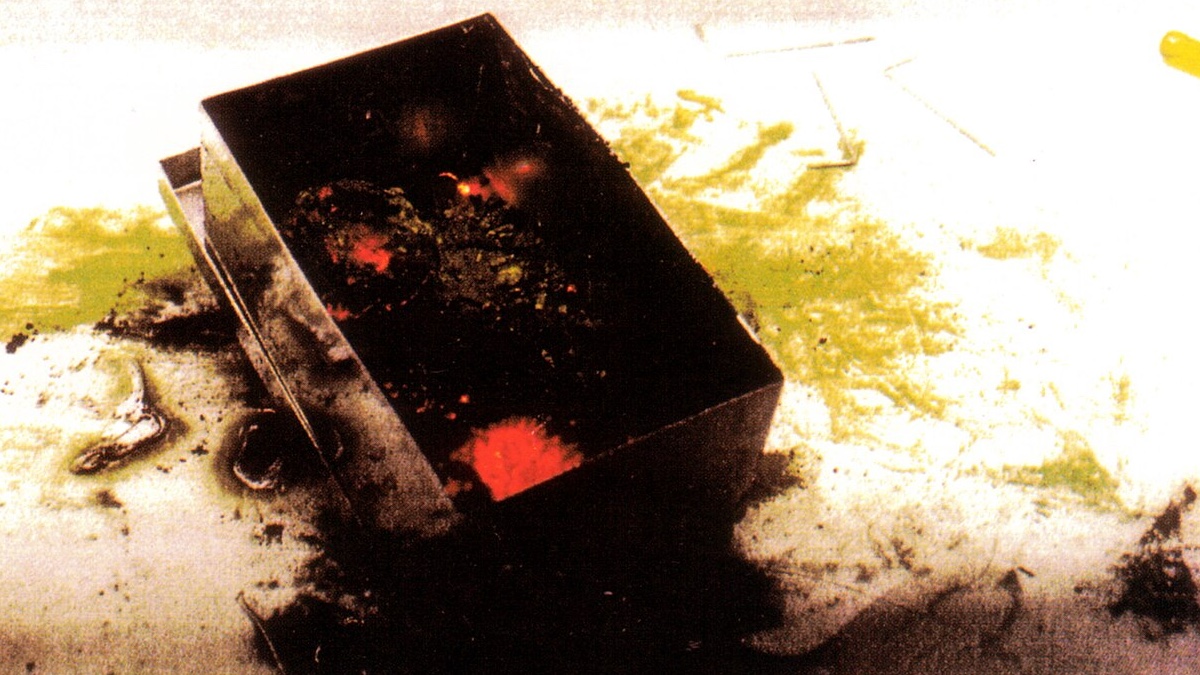
The White House plans to distribute plutonium to private industry players developing already risky new reactors, writes Linda Pentz Gunter
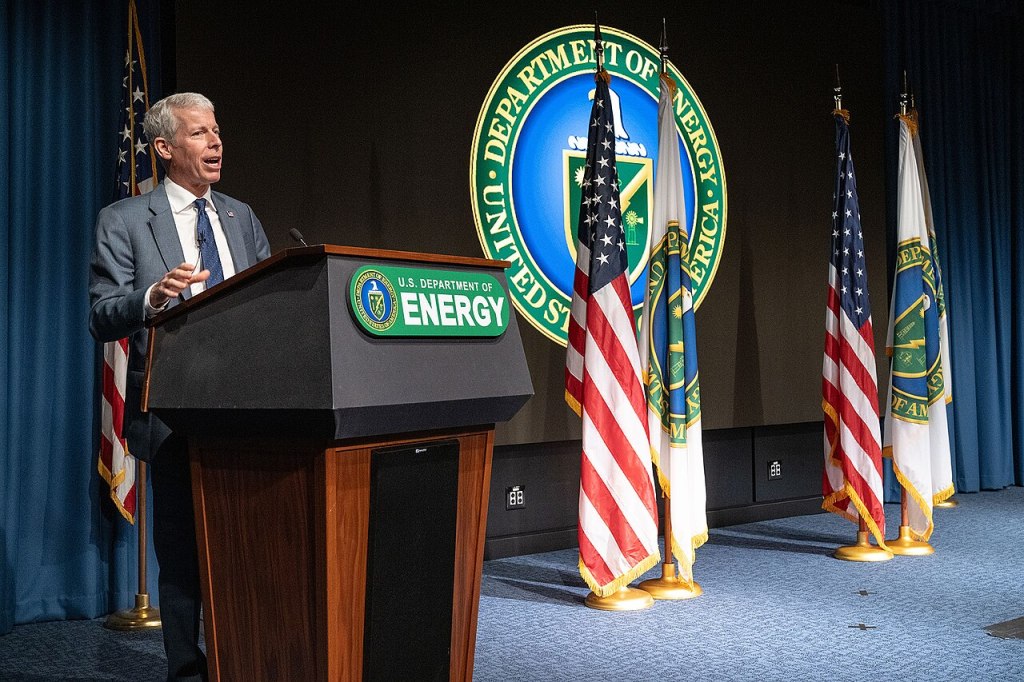
In yet another alarming development coming out of the White House, private corporations proposing risky and untested startup reactors are to be given access to plutonium, the trigger component in a nuclear bomb.
A May 27 exposé in the New York Times revealed that the Trump administration is proposing to allow private entities access to Cold War era leftover plutonium in order to convert it into fuel for risky new reactors that have yet to pass any kind of rigorous safety analysis.
The move marks a dangerous commercialization of plutonium and would treat plutonium like a commodity with value, instead of as a long-lived lethal waste. One of the first companies to benefit is Oklo, on whose board the current Energy secretary, Chris Wright, used to sit and whose stock rose on the announcement.
The other companies involved, according to reporting in the Times, are Standard Nuclear, Exodys Energy, SHINE Technologies and Flibe Energy.
The plutonium would come from a surplus stockpile of dismantled nuclear warheads. Previous efforts to use plutonium as reactor fuel collapsed due to extreme expense and technical challenges.
Part of the impetus comes from the need of some of the new reactor designs to use High Assay Low Enriched Uranium Fuel, known as HALEU and which is predominantly manufactured by Russia. Oklo, and its European partner, Newcleo — a nuclear “innovation”company registered in France — claim they can produce reactor fuel from surplus plutonium faster than waiting for HALEU production plants to get up and running in the United States. This, argues Ed Lyman, a physicist at Union of Concerned Scientists, is simply nonsense.
“The idea that plutonium could actually be used more quickly than uranium fuel is absurd because of the complexity, the attention to safety and security that a plutonium fuel facility would actually require,” Lyman said, speaking during a recent Capitol Hill briefing on the risks and unaffordability of new nuclear projects and hosted by Beyond Nuclear and Nuclear Information and Resource Service.
Read MoreSpecies at risk score a reprieve

Canadian court sends radioactive waste dump plan back to the drawing board in a win for wildlife and the Kebaowek First Nation and others who protect them
News from Canadian Coalition for Nuclear Responsibility, and Sierra Club Canada Kebaowek First Nation, Concerned Citizens of Renfrew County and Area, the Canadian Coalition for Nuclear Responsibility, and Sierra Club Canada Foundation.
Canadian Coalition for Nuclear Responsibility, and Sierra Club Canada, Kebaowek First Nation, Concerned Citizens of Renfrew County and Area, the Canadian Coalition for Nuclear Responsibility, and Sierra Club Canada Foundation welcome a significant victory following the decision of the Federal Court of Appeal to dismiss Canadian Nuclear Laboratories’ (CNL) appeal regarding the Species at Risk Act permit issued for the proposed Near Surface Disposal Facility (NSDF) at Chalk River.
The Court upheld the Federal Court’s earlier ruling and ordered Environment and Climate Change Canada (ECCC) to reconsider its decision to grant the permit.
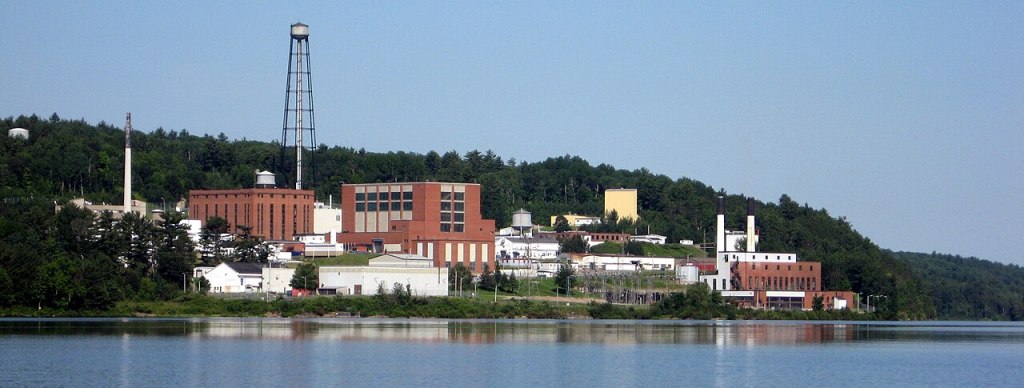
The permit would have authorized CNL to destroy endangered species and their habitats in order to construct a massive radioactive waste disposal facility less than 1.1 kilometres from the Ottawa River (Kichi Sibi), a watershed that provides drinking water to millions of Canadians.
In its decision, the Federal Court of Appeal concluded that ECCC failed to adequately explain how it determined that all reasonable alternatives had been considered and that the best solution had been selected, as required under the Species at Risk Act.
The Court emphasized that the Minister’s reasons lacked sufficient transparency, intelligibility, and justification, and directed ECCC to conduct a new determination.
The Court also confirmed that the Federal Court’s interpretation of section 73 of the Species at Risk Act is not binding on ECCC and that the Minister must independently provide a clear and reasonable analysis when reconsidering the permit application.
Furthermore, the Court found that the public notice issued by ECCC failed to provide a meaningful explanation to Canadians about why endangered species would be harmed in support of the project.
Read MoreDeadly drone dangers
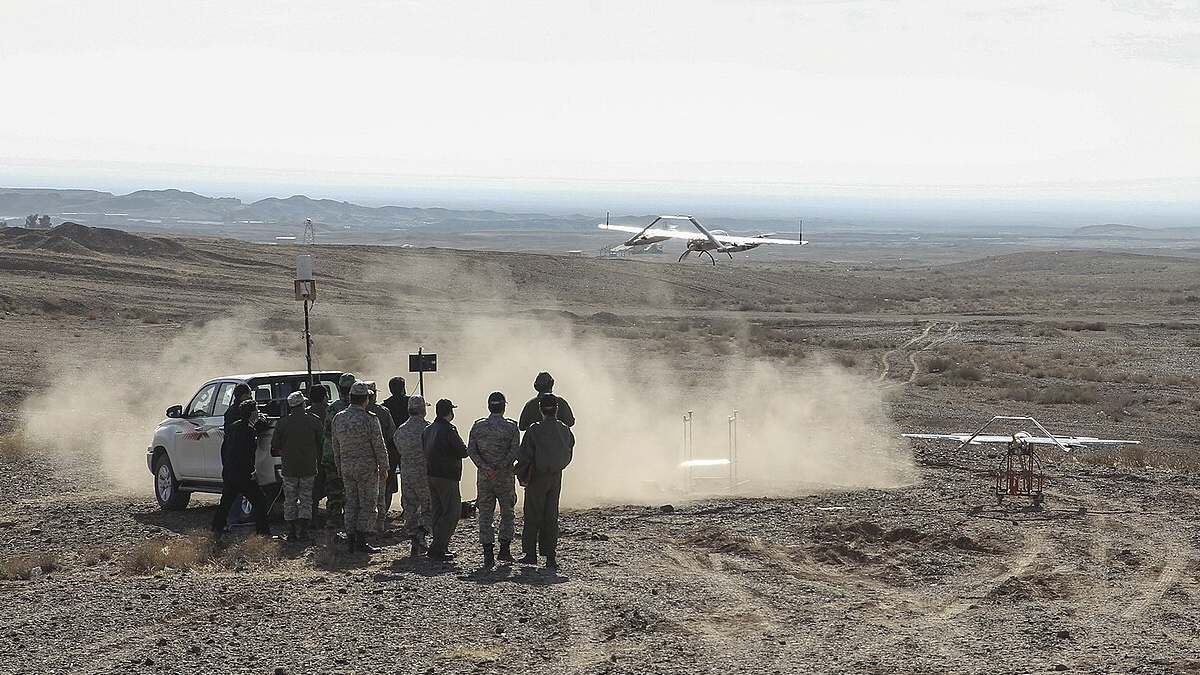
Nuclear power plants are already a liability in war zones. They also represent an open invitation for attack by armed drones, writes Linda Pentz Gunter
Drones are everywhere these days but not as ubiquitous as we once feared. Didn’t Amazon once threaten that all of its at-home deliveries would one day be made by drone? They are delivering some packages using drones — apparently dropping them from a height of 10 feet so the drones don’t collide with passersby — which is great if you ordered bed sheets, not so great for that new set of champagne flutes.
But where the drone industry has really taken off is in the business of warfare. On battlefields and beyond, drones are now routine. They are used to fire precision-guided munitions but also for targeted assassinations, and, whether deliberately or not, to hit nuclear power plants.
This, in particular, raises some extremely serious alarms, because today we have countries that have nuclear power programs that have also found themselves either directly or indirectly embroiled in wars.
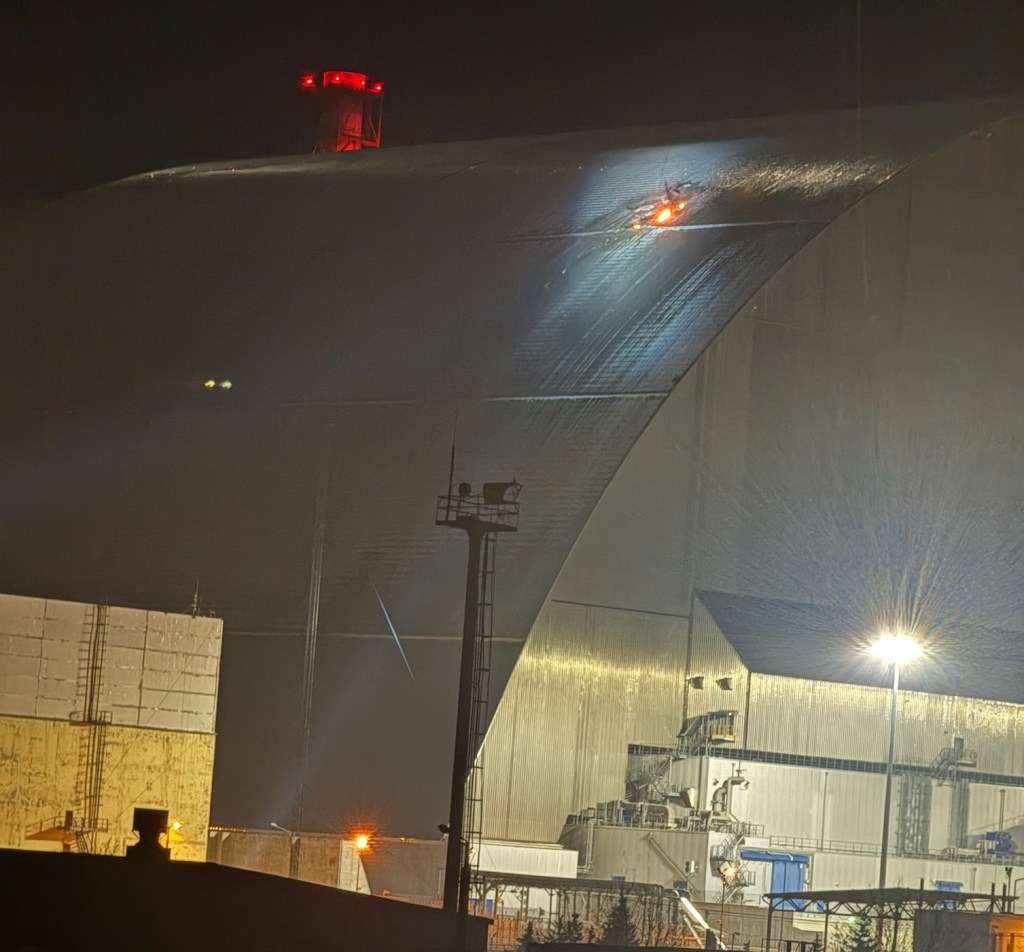
The most headline-grabbing incident so far was when, on 14 February 2025, a Russian drone hit what is known as the New Safe Confinement structure at the Chernobyl Nuclear Power Plant in Ukraine. The Confinement is the $2.7 billion dollar dome that was erected over the old sarcophagus originally built to contain the radiation still leaking from the destroyed Unit 4 that exploded and melted down in 1986.
The 2025 attack resulted in damage likely to cost around $582 million to repair.
At first, fears that radiation might be escaping as a result of the hole the drone blew in the dome’s roof were dismissed. But that situation could change dramatically given concerns that the old sarcophagus could collapse at any moment.
”That would be catastrophic because there’s four tonnes of dust, highly radioactive dust, fuel pellets, enormous amounts of radioactivity inside the sarcophagus,” Shaun Burnie of Greenpeace Ukraine told Agence France Presse in an interview.
Read MoreCorporate psychopaths
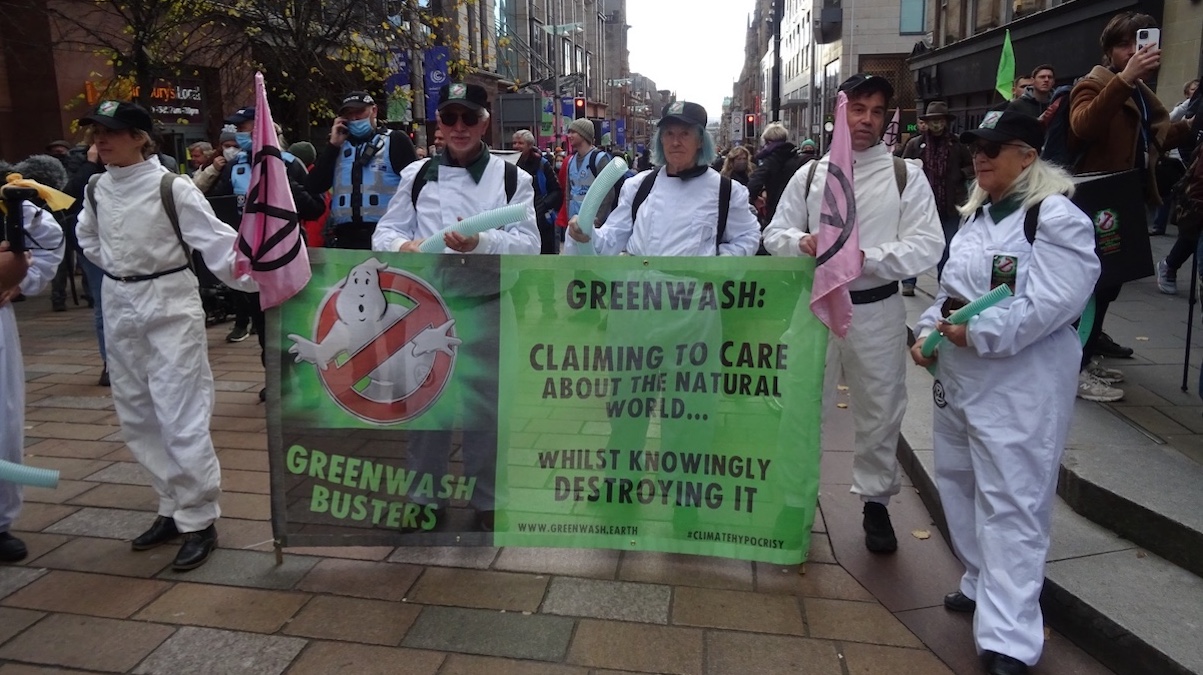
Greenwashing is rampant and governments need to rediscover that they really do have a mandate to put people before profits, writes Jonathon Porritt
I hate greenwashing companies almost as much as I hate the out-and-out, don’t-give-a-shit planet-trashers. So, when I heard what Danone was up to at its Harrogate Spring Water bottling plant, I found myself swearing out loud.
20 years ago, local school children in that vicinity planted a four-acre community woodland. It’s much loved. A lot of those kids, now grown up, still live locally, still feel deeply connected. But Danone/Harrogate Spring Water care nothing about that. They need to expand their bottling plant, so the woodland’s 1000 trees have to go – and council officers at North Yorkshire Council have recommended that local councillors should approve the proposal.*
So: a cut-and-dried case of deforestation. Replacing an established woodland with an industrial development. 1,300 objections have been submitted by people unpersuaded by Danone’s promise to plant 490 new trees very close to the woodland that will be lost – as well as a further 3,000 trees around the district.

And this is where the greenwashing kicks in: Danone is committed to being 100% deforestation-free in its supply chains by 2030 – and claims to be more than 97% of the way there. And it bangs on and on about its “Forest Positive” credentials.
This kind of blatant, utterly uncaring hypocrisy goes on day after day – and the whole idea of corporate sustainability now finds itself at a very low ebb indeed.
Read More
