 Beyond Nuclear International
“Advanced” isn’t the answer
Next in Talking Points series showcases USC takedown of non-light-water reactor delusions
By Linda Pentz Gunter
In the second in the Beyond Nuclear Talking Points series, we bring you Dr. Edwin Lyman’s definitive examination of so-called advanced reactors, or non-light-water reactors (NLWRs).
In a groundbreaking report, Lyman who is Director of Nuclear Power Safety at the Union of Concerned Scientists, debunks almost all of the industry claims for NLWRs, predominantly on the grounds of safety and security risks, but also touching on costs, time, regulations and waste.
The report — “Advanced” Isn’t Always Better. Assessing the Safety, Security, and Environmental Impacts of Non-Light-Water Nuclear Reactors — can be found in full here on the UCS website. We appreciated the opportunity to condense it into our second Talking Points, all of which are free to download, print and distribute widely.
As Lyman writes in the executive summary of the report, nuclear power in general is replete with flaws: “. . . the technology has fundamental safety and security disadvantages compared with other low-carbon sources. Nuclear reactors and their associated facilities for fuel production and waste handling are vulnerable to catastrophic accidents and sabotage, and they can be misused to produce materials for nuclear weapons.”
The study’s conclusion is that pursuing “advanced” nuclear reactors is too slow, too resource-intensive and too dangerous and won’t result in improvements over light-water reactors.
Time to draw down military spending

Progressives should unite to block new nuclear weapons
By Medea Benjamin and Marcy Winograd
Imagine this scenario:
A month before the vote on the federal budget, progressives in Congress declared, “We’ve studied President Biden’s proposed $753 billion military budget, an increase of $13 billion from Trump’s already inflated budget, and we can’t, in good conscience, support this.”
Now that would be a showstopper, particularly if they added, “So we have decided to stand united, arm in arm, as a block of NO votes on any federal budget resolution that fails to reduce military spending by 10-30 percent. We stand united against a federal budget resolution that includes upwards of $30 billion for new nuclear weapons slated to ultimately cost nearly $2 trillion. We stand united in demanding the $50 billion earmarked to maintain all 800 overseas bases, including the new one under construction in Henoko, Okinawa, be reduced by a third because it’s time we scaled back on plans for global domination.”

“Ditto,” they say, “for the billions the President wants for the arms-escalating US Space Force, one of Trump’s worst ideas, right up there with hydroxychloroquine to cure COVID-19, and, no, we don’t want to escalate our troop deployments for a military confrontation with China in the South China Sea. It’s time to ‘right-size’ the military budget and demilitarize our foreign policy.”
Progressives uniting as a block to resist out-of-control military spending would be a no-nonsense exercise of raw power reminiscent of how the right-wing Freedom Caucus challenged the traditional Republicans in the House in 2015. Without progressives on board, President Biden may not be able to secure enough votes to pass a federal budget that would then green light the reconciliation process needed for his broad domestic agenda.
Read MoreOvercoming resistance to a nuclear weapons-free world

Could giving the UN authority over international security do the job?
By Lawrence S. Wittner
Given the fact that nuclear war means the virtual annihilation of life on earth, it’s remarkable that many people continue to resist building a nuclear weapons-free world. Is the human race suicidal?
Before jumping to that conclusion, let’s remember that considerably more people favor abolishing nuclear weapons than oppose it. Public opinion surveys—ranging from polls in 21 nations worldwide during 2008 to recent polls in Europe, Japan, and Australia—have shown that large majorities of people in nearly all the nations surveyed favor the abolition of nuclear weapons by international agreement. In the United States, where the public was polled in September 2019 about the UN Treaty on the Prohibition of Nuclear Weapons, 49 percent of respondents expressed approval of the treaty, 32 percent expressed disapproval, and 19 percent said they didn’t know.
Nevertheless, surprisingly large numbers of people remain unready to take the step necessary to prevent the launching of a war that would turn the world into a charred, smoking, radioactive wasteland. Why?
Their reasons vary. Die-hard militarists and nationalists usually view weapons as vital to securing their goals. Others are the employees of the large nuclear weapons industry and have a vested interest in retaining their jobs. In the United States, that enterprise has long been very substantial, and the Trump administration, through massive infusions of federal spending, succeeded in fostering its greatest expansion since the end of the Cold War. According to a December 2020 article in the Los Angeles Times: “Roughly 50,000 Americans are now involved in making nuclear warheads at eight principal sites stretching from California to South Carolina. And the three principal U.S. nuclear weapons laboratories . . . have said they are adding thousands of new workers at a time when the overall federal workforce is shrinking.” Members of these groups are unlikely to change their minds about the importance of retaining nuclear weapons.
Read MoreOne more whack at the SMR mole
Why Small Modular Nuclear Reactors Won’t Help Counter the Climate Crisis
By Arjun Makhijani, Ph.D. and M.V. Ramana, Ph.D.
Small modular nuclear reactors, or SMRs, are designed to generate less than 300 megawatts of electricity – several times less than typical reactors, which have a range of 1,000 to 1,600 MW. While the individual standardized modules would be small, plans typically call for several modules to be installed at a single power generation site.
The nuclear industry and the U. S. Department of Energy are promoting the development of SMRs, supposedly to head off the most severe impacts of climate change. But are SMRs a practical and realistic technology for this purpose?
To answer, two factors are paramount to consider – time and cost. These factors can be used to divide SMRs into two broad categories:
- Light water reactors based on the same general technical and design principles as present-day power reactors in the U.S., which in theory could be certified and licensed with less complexity and difficulty.
- Designs that use a range of different fuel designs, such as solid balls moving through the reactor core like sand, or molten materials flowing through the core; moderators such as graphite; and coolants such as helium, liquid sodium or molten salts.
On both counts, the prospects for SMRs are poor. Here’s why.
Economics and scale
Nuclear reactors are large because of economies of scale. A reactor that produces three times as much power as an SMR does not need three times as much steel or three times as many workers. This economic penalty for small size was one reason for the early shutdown of many small reactors built in the U.S. in the 1950s and 1960s.
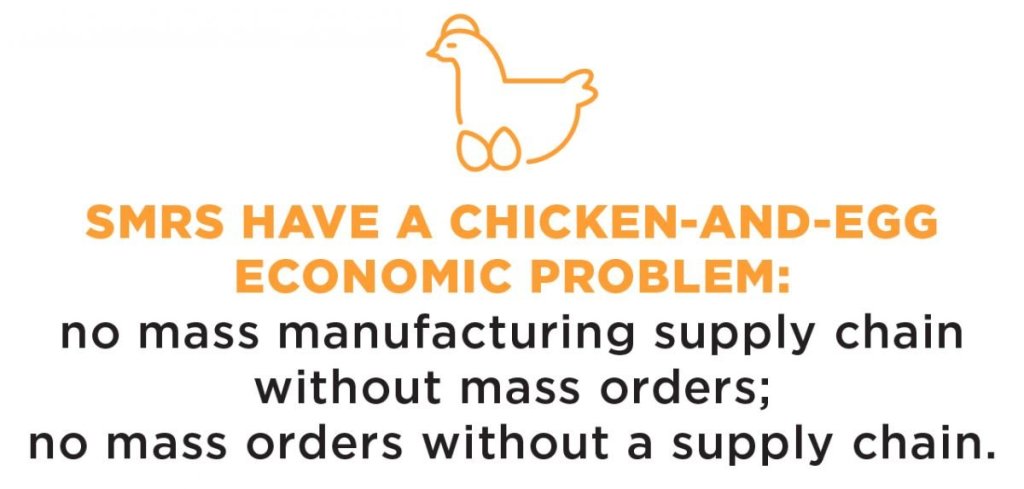
Proponents of SMRs claim that modularity and factory manufacture would compensate for the poorer economics of small reactors. Mass production of reactor components and their manufacture in assembly lines would cut costs. Further, a comparable cost per kilowatt, the argument goes, would mean far lower costs for each small reactor, reducing overall capital requirements for the purchaser.
Read MoreFission folly

Fukushima radioactive water dump plan disregards lives of marine animals too
By Linda Pentz Gunter
Many years ago, in what seems like another lifetime, I was a reporter on the tennis beat, walking through an airport with Martina Navratilova. The aroma of hot dogs wafted around, the one thing, as vegetarians, we agreed we missed.
But Navratilova was a proper vegetarian. I was still eating fish. “Fish have souls, too,” she admonished me.
More recently, Paul Watson of Sea Shepherd, and a co-founder of Greenpeace, wrote: “Seafood is simply a socially acceptable form of bush meat.”
Exposing our hypocrisy, he continued: “We condemn Africans for hunting monkeys and mammalian and bird species from the jungle yet the developed world thinks nothing of hauling in magnificent wild creatures like swordfish, tuna, halibut, shark, and salmon for our meals.
“The fact is that the global slaughter of marine wildlife is simply the largest massacre of wildlife on the planet.”

As we heard again in the news recently, Tepco and the Japanese government are once more preparing to “dispose” of 1.25 million tonnes — translating to hundred of millions of gallons — of radioactive water accumulating at the Fukushima Daiichi nuclear power plant site by pouring it into the Pacific Ocean.
I say “accumulating” because this water, needed to constantly cool the stricken reactors that exploded and melted down during and after March 11, 2011 — and that also runs down neighboring hillsides and across the site, picking up radioactive contamination — will continue to accumulate. This is not a one-stop-toss.
Read MoreThe Pacific Ocean is not Japan’s nuclear dumpsite

Regional collective of young Pacific activists condemns Japan’s plans
From Youngsolwara Pacific
Youngsolwara Pacific has joined the regional calls against Japan’s plans to discharge one million tons of wastewater from its Advanced Liquid Processing System (ALPS) at the Fukushima Daiichi Nuclear Power Station into the Pacific Ocean.
As a regional collective of young Pacific activists, we condemn Japan’s plans to dump nuclear waste in the Pacific Ocean which is the lifeline of our people. The Pacific Ocean is not Japan’s nuclear dumpsite.
The destructive legacy of nuclear contamination is still strongly felt throughout our region. States like the Marshall Islands, Maohi Nui (French Polynesia), Australia and Kiribati, were sites of 315 nuclear weapons tests. These have not been effectively remedied or addressed by the nuclear-armed nations of the United States, France and the United Kingdom respectively.
The harmful impacts are still being felt today by our people, manifesting in, among other impacts, debilitating health and intergenerational maladies. Moreover, our islands and waterways are still yet to be effectively environmentally remediated from these tests.
We ask, how can the Japanese government, who has experienced the same brutal experiences of nuclear weapons in both Hiroshima and Nagasaki, wish to further pollute our Pacific with nuclear waste? To us, this irresponsible act of transboundary harm is just the same as waging nuclear war on us as Pacific peoples and our islands.

We furthermore condemn the Japanese government’s own extensive history of dumping nuclear waste into the Pacific Ocean. We remember that the Pacific has protested in solidarity with Japanese civil society since 1979 when the Japanese government planned to dump nuclear waste nearby the Northern Marianas.
Read More
