 Beyond Nuclear International
Risques nucléaires: à quand la fin du monopole des experts internationaux?
Par Christine Fassert, Université Paris 1 Panthéon-Sorbonne and Tatiana Kasperski, Universitat Pompeu Fabra (This article is currently only available in French and is republished from The Conversation)
En décembre 2020, vingt ans après la fermeture définitive de la centrale, le ministère de la Culture de l’Ukraine a annoncé son intention de préparer la demande d’inscription de certains objets dans la zone d’exclusion autour de Tchernobyl sur la liste du patrimoine mondial de l’Unesco.
Le ministère prévoyait de soumettre sa demande au printemps 2021, une façon de marquer le 35e anniversaire de l’accident, le 26 avril.
Ce projet permettrait de mettre en place un dispositif de préservation du site, mais surtout de mettre en valeur son importance historique universelle.
Sur la liste de l’Unesco
Deux sites liés au passé sombre du nucléaire figurent déjà sur la liste de l’Unesco : le Mémorial de la paix d’Hiroshima et le Site d’essais nucléaires de l’atoll de Bikini.
Le site de Tchernobyl symboliserait, lui, la longue histoire des accidents qui ont marqué l’âge de l’atome, de Kyshtym à Windscale (1957) et de Three Mile Island (1979) à Fukushima (2011), dont on a marqué le dixième anniversaire cette année.
Qui plus est, l’accident de Tchernobyl marque un moment particulier de cette histoire, à savoir le début de l’institutionnalisation de la gestion internationale des conséquences des accidents nucléaires, dont on a pu pleinement mesurer l’emprise au moment de l’accident de Fukushima.
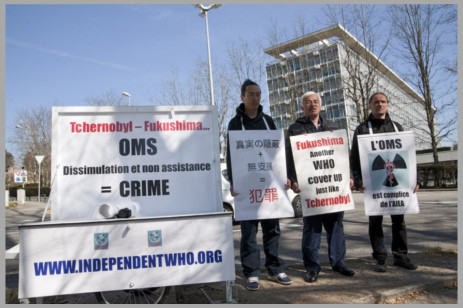
What do we remember about Chernobyl?
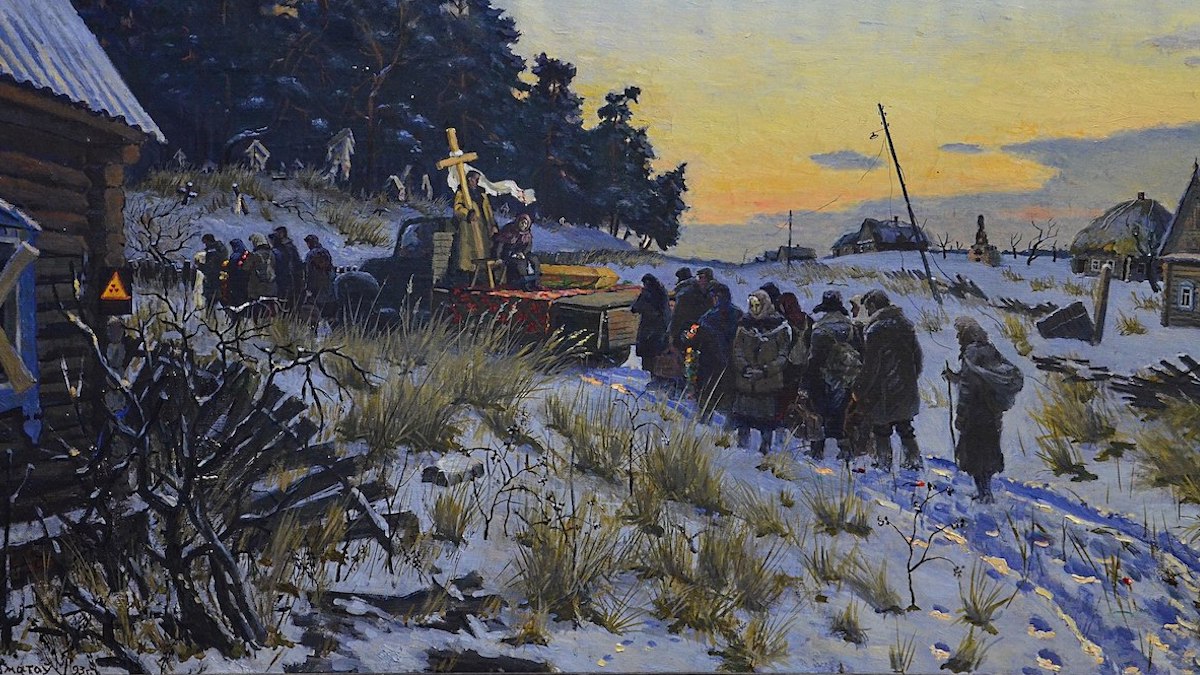
“Ordinary” people suffered “extraordinary” losses which should never be repeated
By Linda Pentz Gunter
“I wanted the baby to be a token of our love…..
“We were expecting our first baby. My husband wanted a boy and I wanted a girl. The doctors urged me to have an abortion. ‘Your husband was in Chernobyl for a long time.’ He’s a truck driver, and he was called up to go there in the early days. He was transporting sand and concrete. I wouldn’t believe them. I didn’t want to. I had read in books that love conquers all. Even death.
“My little baby was stillborn, and lacking two fingers. A girl. I cried. ‘If she could at least have had all her pretty little fingers’. She was a girl after all.”
Chernobyl. We remember it now, 35 years later. And it was remembered then, in the 10 years after if happened, by the people to whom it happened. Because tragedies struck several million of what we call “ordinary” people. (In Ukraine alone, 1.8 million people have official status as victims of the Chernobyl disaster.)
But there was nothing “ordinary” about the Chernobyl ordeal or the people who experienced it. And they related those experiences, like the one above, to Belarusian journalist, Svetlana Alexievich, whose book of testimonials, Voices from Chernobyl (called Chernobyl Prayer in the UK), gives the lie to the Chernobyl deniers.
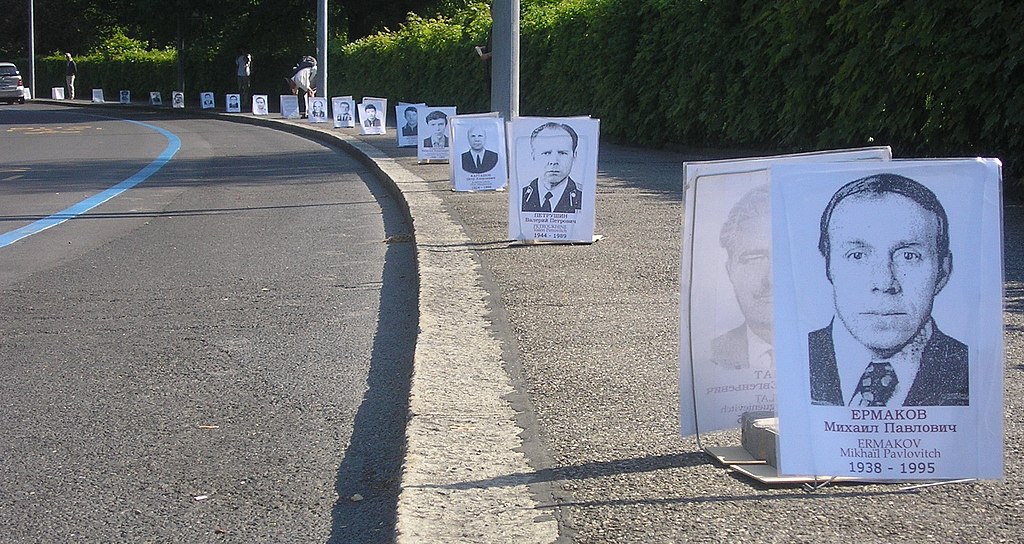
Some of those real people were liquidators, yes. And the problem that caused Chernobyl Unit 4 to explode was a technological one, compounded by human error.
“From up above, you could see everything. The ruined reactor, the mounds of building debris. And a gigantic number of tiny human figures. . . The little soldiers were running around in their rubber suits and rubber gloves. They looked so small seen from the sky.
“I fixed it all in my memory. Thought I’d tell my son. But when I got back: ‘Daddy, what did you see?’ ‘A war.’ I had no other words for it.”
Read MoreThe cows died

But mandatory slaughter of Fukushima’s radioactive cattle was just the beginning of a new tragedy
Japanese filmmaker, Tamotsu Matsubara’s, heartbreaking documentary — translated in English as Nuclear Cattle — is ostensibly about the cattle farmers in the Fukushima radiation zone, forced to make devastating choices. Do they slaughter their radioactive cattle, or keep tending to them, even though they can never sell the meat, or must throw all the milk away?
But the film is about something more than that — a loss of touch with our fundamental humanity, with nature, and with stewardship of all living things. It’s about a societal shift. If we are willing to rush the Fukushima nuclear disaster out of sight, and prioritize the economy over the well-being of human and animal lives, what does that say about where our society is headed?
The film was recently screened on line in France, before which Matsubara made his own statement. The film can be seen in its entirety on YouTube (it is embedded further down in this story). But Matsubara’s statement is a powerful one. We present it here, in full. (You can also watch it here in Japanese with French subtitles, from which we translated it.)
A statement by Tamotsu Matsubara
I made my documentary film over the course of five years starting in June 2011, filming within a 30km radius around the Fukushima Daiichi nuclear power plant, a zone where the public is forbidden from going. The film shows the suffering of farmers whose cows are radioactive.
At the start of the film, there is a horrific scene where we see cows in a barn who have died of hunger. It’s a scene that symbolizes the consequences of a nuclear accident. The inhabitants didn’t know what was happening. They told them to leave without taking anything with them, and without telling them where they were going.
The radioactive plume, a mass of highly radioactive air, was moving in the same direction as the evacuees — towards the Northwest. The inhabitants were exposed to radioactive fallout which came down in rain and snow.
The members of the government and TEPCO must have known the direction of the wind and the consequent risk but this information was not disclosed. The government and TEPCO deliberately held back this information.
This tragedy is not a result of natural causes but of human ones.
Read MoreNecessary trouble
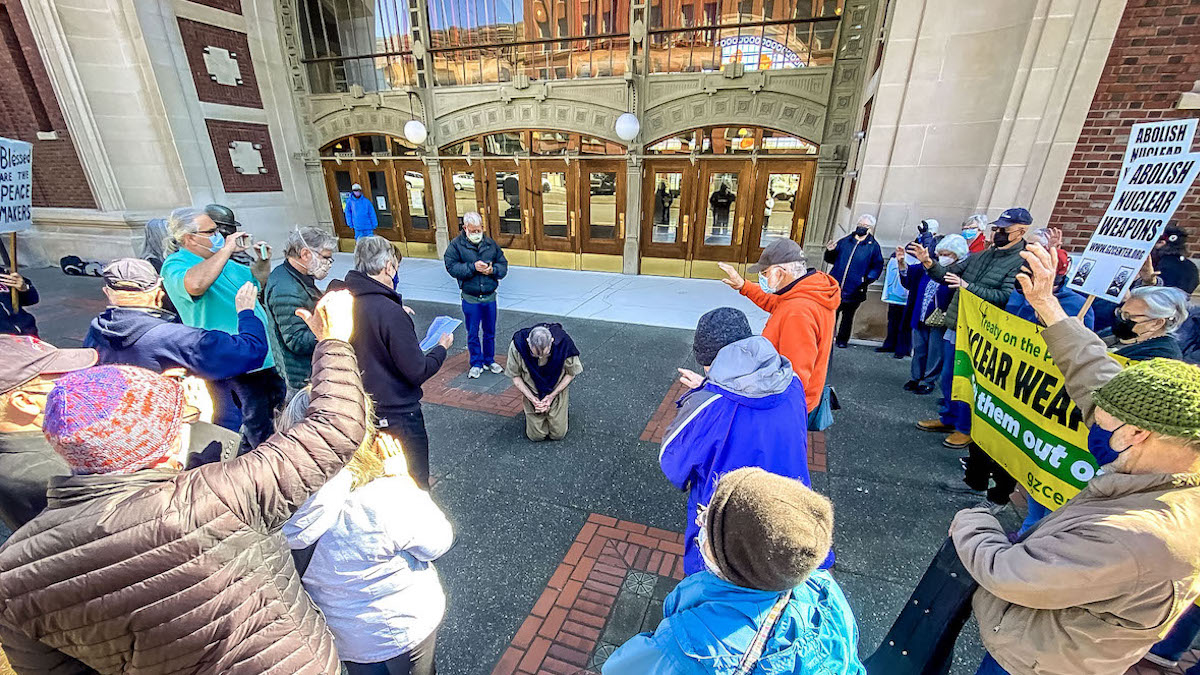
Released from jail, Fr. Steve Kelly insists no one is truly free under the threat of nuclear omnicide
By Leonard Eiger
When Father Steve Kelly, a nuclear resister and Jesuit priest, walked out of a Tacoma, Washington courthouse on April 13, 2021, he was still wearing his prison khakis. When he was taken from jail in Georgia in mid-December to be transported to Tacoma, he had left in chains.
Now Kelly was a free man. But for how long? In Tacoma, Magistrate Judge David Cristel sentenced Kelly to time served, and released him without conditions. Kelly had effectively served the maximum six-month prison sentence for violating conditions of his supervised release for a 2017 trespass conviction at the Trident nuclear submarine base in Silverdale, Washington during a Pacific Life Community nonviolent direct action.
But now Kelly must report to the probation department in Georgia to begin three years of supervised release to fulfill the terms of an earlier sentence for his part in the April 4, 2018 trespass onto the Kings Bay Trident submarine base there, an action by the Kings Bay Plowshares 7. And that will likely spell more necessary trouble.
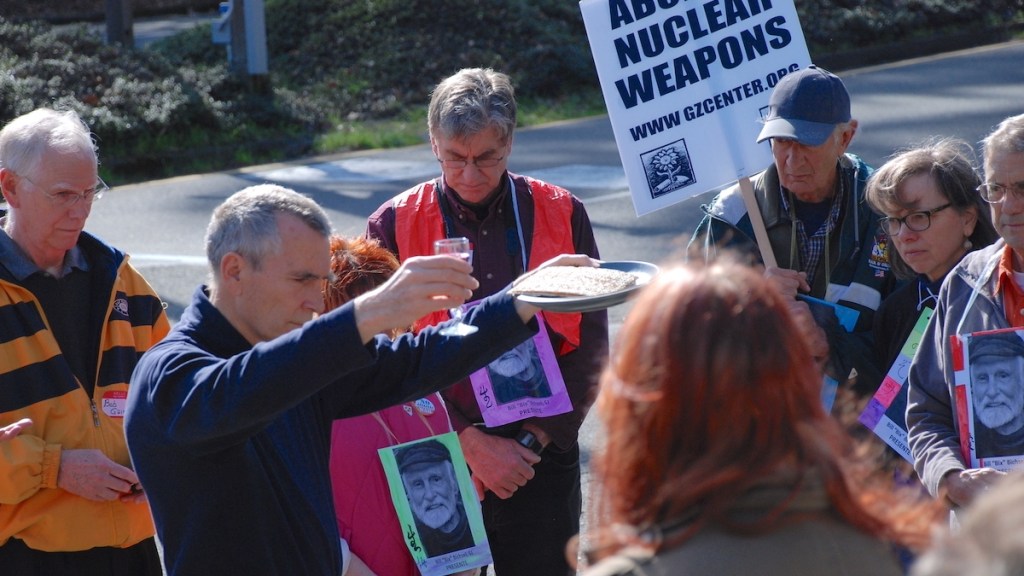
Prison garb and chains are not unfamiliar to Kelly, a man of conscience, who is unlikely to give up his peaceful non-violent protests against nuclear weapons any time soon. As he told the Tacoma court:
“This is the way to love everyone in this courtroom. This is the way to love our fellow human beings, is that I had to take a stand against the nuclear weapons. And of course what happened in Georgia… was a continuation of my acting in conscience. I think that it’s probably best said that while there are nuclear weapons out there, my conscience will probably be very consistent about this.”
Kelly won’t go to Georgia. It will be up to US marshals to bring him back there.
Read MoreOrkney’s uranium reprieve
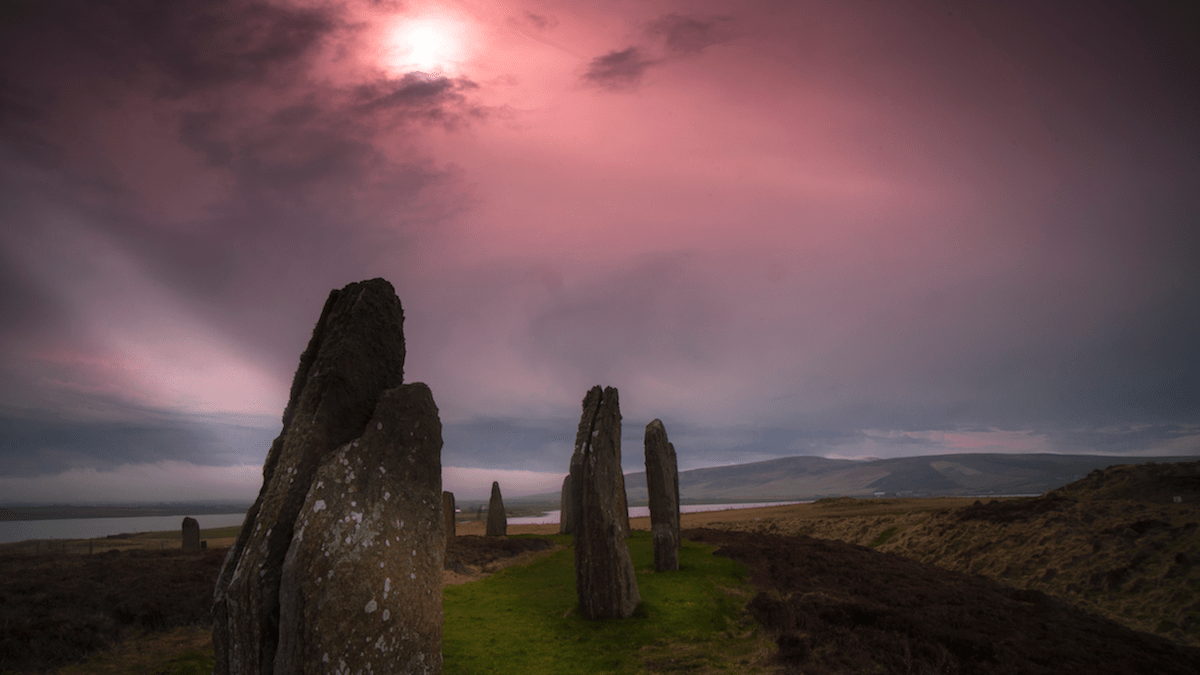
Maxwell Davies’ music memorializes an important victory
By Linda Pentz Gunter
On a midsummer day on Saturday, June 21, 1980, in a Victorian Hotel on the Orkney Islands, resident composer Peter Maxwell Davies and actress Eleanor Bron performed the composer’s newest piece — The Yellow Cake Revue. It was part of the Islands’ annual St. Magnus Festival, founded by Maxwell Davies, poet George Mackay Brown and Archie Bevan.
“Yellow cake” or uranium ore, seemed like an unlikely subject matter for a cabaret. But Maxwell Davies was an unlikely kind of musician — deeply connected to causes including gay rights, anti-war and the environment.
I first learned of the music of Maxwell Davies through Donald Ranvaud, another renaissance polymath, who was teaching at the University of Warwick when I was a student there and inspired in me a passion for Italian cinema, especially Bertolucci and Pasolini.
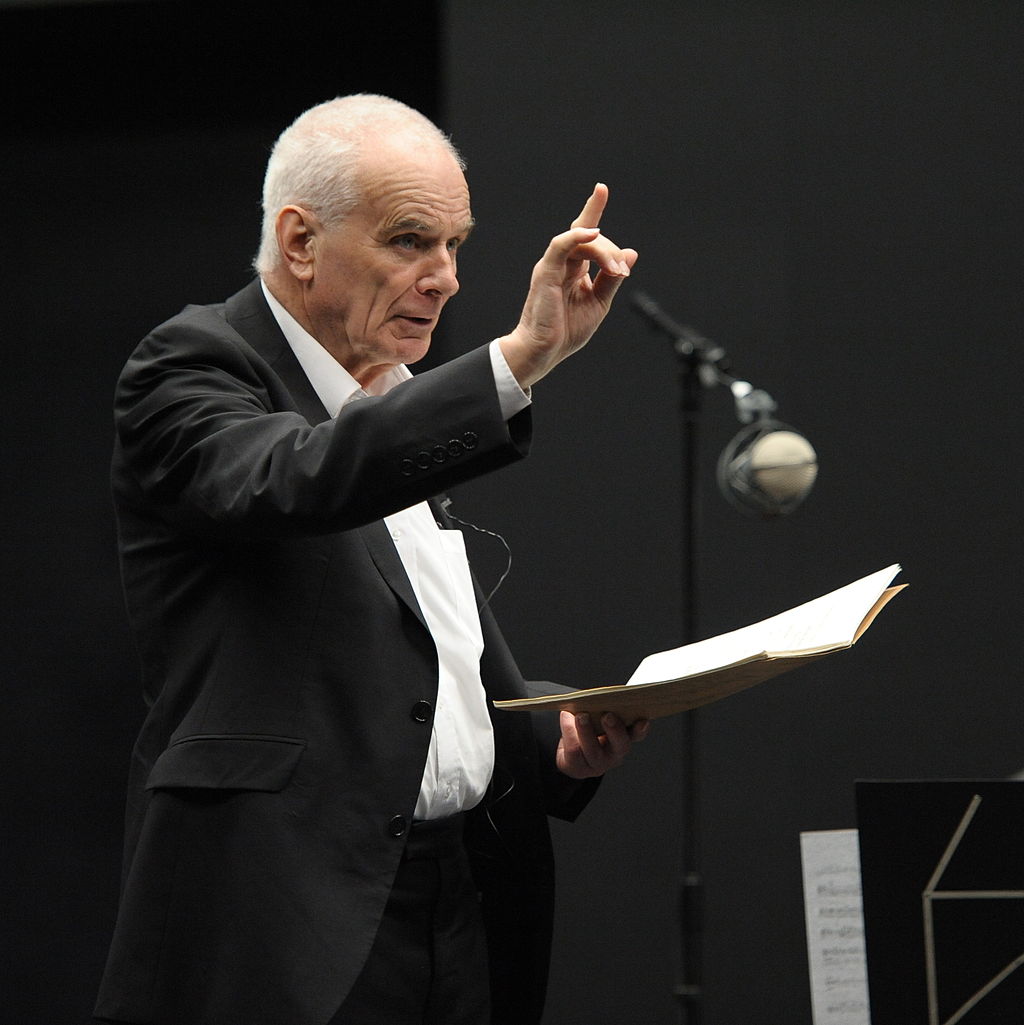
Don, who went on to become an internationally celebrated film producer, was also determined to introduce me to the music of “Max,” as he called the composer, and who he obviously knew personally, one of many leading lights in the arts who would become friends of Don’s — Bertolucci was another. (Ranvaud and Maxwell Davies died in 2016 and Bertolucci two years later.)
So off I went to London to hear the latest Maxwell Davies work, performed by the chamber ensemble, The Fires of London, co-founded by Maxwell Davies and fellow avant garde composer, Harrison Birtwistle.
That concert — bold, wild, different — was in 1975. But unbeknownst to me at the time, Maxwell Davies and his fellow residents of the Orkney Islands, — an archipelago located just off the northeastern coast of Scotland and where the Salford-born Maxwell Davies had chosen to settle — were already confronting an ominous new threat that would consume the islands for several years.
Read MoreKeeping it short…and right

New Talking Points lay out key messages against nuclear power
Beyond Nuclear is developing a new series of handy Talking Points. You can find these in a special Talking Points section on this website and also under Publications on the Beyond Nuclear website. Look for others in the series in the coming months.
By Linda Pentz Gunter
Closing a costly US nuclear power plant — which will only get costlier the older it gets — and buying efficiency instead, would actually save considerably more carbon than continuing to run that nuclear plant.
That’s a pretty significant statement. It tells us that the argument that we need to keep current nuclear plants running — because they are here, now, and, in the operational stage, low carbon emitters — is invalid. It would only be valid to argue for the continued use of current, aging nuclear power plants if every other alternative was more carbon-intensive, and more expensive and slower.
The same is true for the argument that we must develop and build new nuclear power plants to address climate change, because, argues the nuclear lobby, renewables just aren’t here now in great enough numbers to fill the gap.
In reality, diverting funds from real solutions, and spending these instead on developing slow, expensive, untested new nuclear plants, just makes this argument a self-fulfilling prophecy. With the same allocation of funds, renewables would have saved more carbon far faster and more cheaply.
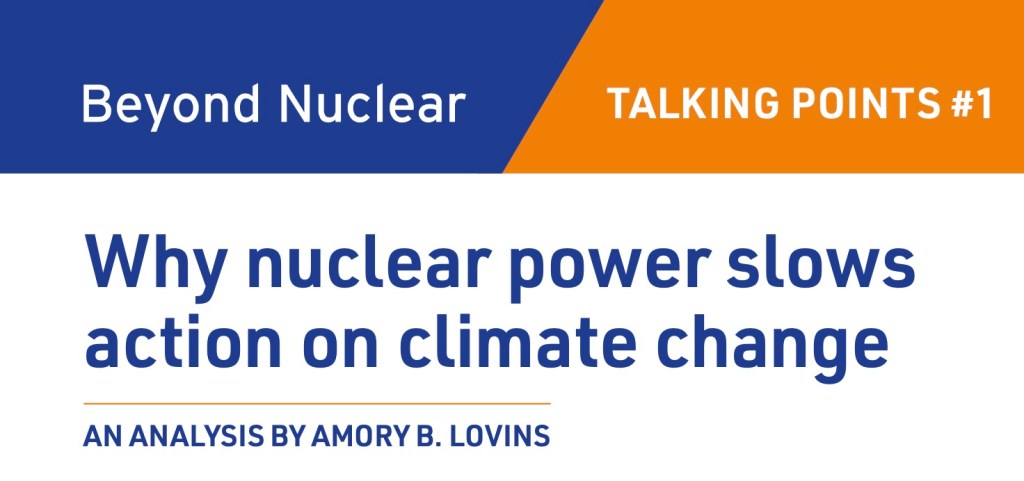
All this is argued effectively — and laid out simply —in the first of our series of Talking Points — a double-sided single page handout called Why nuclear power slows action on climate change.
We’ll be doing a series of these Talking Points, on different topics, drawn from the many excellent studies and reports out there, but which are sometimes a lot to take on board. However, when condensed down, they can provide a useful, empirically-supported script for our work, whether writing opeds or letters to the editor, educating and lobbying our elected officials, or doing media outreach. (If you’d like to support future such Talking Points, we gratefully accept donations to help pay for them.)
Read More
