 Beyond Nuclear International
Uranium mines harm Indigenous people
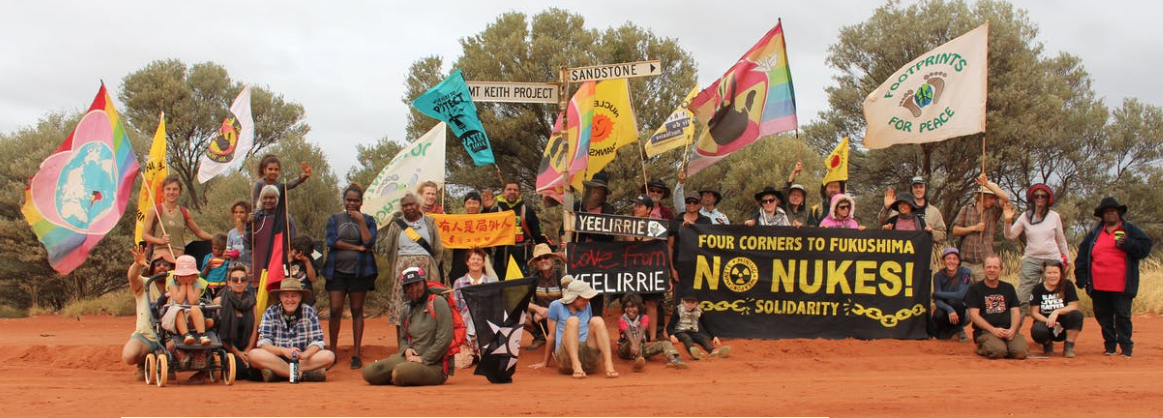
So why has the Australian government approved a new one?
By Jessica Urwin
In late April, the Australian federal government approved the Yeelirrie uraniam mine in Western Australia in the face of vigorous protest from traditional owners.
This Canadian-owned uranium mine is the newest instalment in Australia’s long tradition of ignoring the dignity and welfare of Aboriginal communities in the pursuit of nuclear fuel.
For decades, Australia’s desert regions have experienced uranium prospecting, mining, waste dumping and nuclear weapons testing. Settler-colonial perceptions that these lands were “uninhabited” led to widespread environmental degradation at the hands of the nuclear industry.
Read more:
It’s not worth wiping out a species for the Yeelirrie uranium mine
As early as 1906, South Australia’s Radium Hill was mined for radium. Amateur prospectors mined haphazardly, damaging Ngadjuri and Wilyakali lands. And an estimated 100,000 tonnes of toxic mine residue (tailings) remain at Radium Hill with the potential to leach radioactive material into the environment.
Uranium mines across Australia have similar legacies, with decades of activism from the Mirarr people against the Ranger and Jabiluka mine sites in Kakadu National Park.
US mayors call on candidates to declare their stance on nuclear weapons
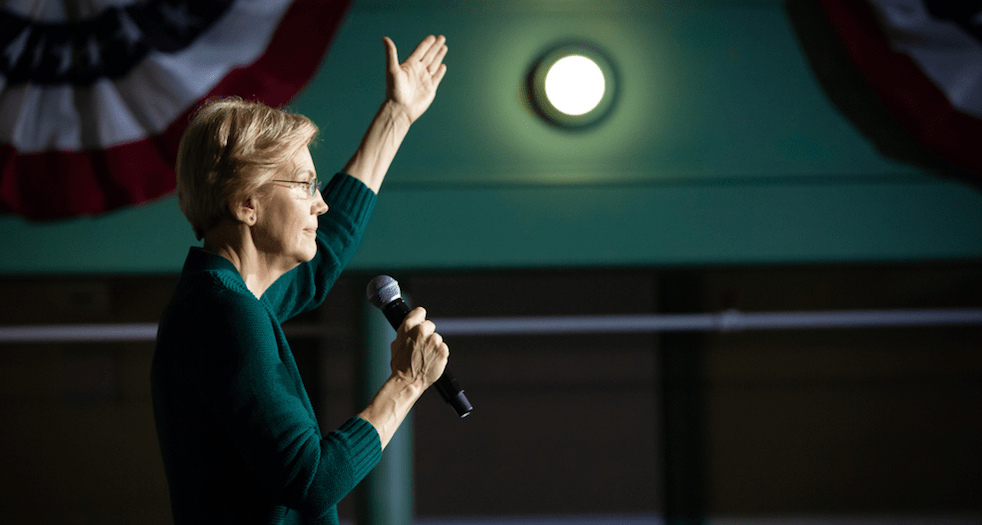
Presidential candidates should state their position, on campaign trail and in debates
By Jacqueline Cabasso
On July 1, at the close of its 87thAnnual Meeting, the United States Conference of Mayors (USCM), unanimously adopted a bold new resolution, “Calling on All Presidential Candidates to Make Known Their Positions on Nuclear Weapons and to Pledge U.S. Global Leadership in Preventing Nuclear War, Returning to Diplomacy, and Negotiating the Elimination of Nuclear Weapons”. The resolution calls on “all Presidential candidates of all political parties” to make these “priority issues in the 2020 Presidential campaign”.
The call comes at a time when the growing dangers of nuclear war have received little attention on the Presidential candidate debate stage or on the campaign trail. Citing the dangers of nuclear war and climate change as “twin existential threats,” in a July 6 op-ed, Dr. Ira Helfand of ICAN and IPPNW declared: “The enormity and imminence of these twin existential threats cannot be overstated and how to confront them must be the central issue of any presidential campaign.”
The USCM resolution quotes Renata Dwan, Director of the United Nations Institute for Disarmament Research, who “has declared that the risk of nuclear weapons being used again is at its highest since World War II, calling it an ‘urgent’ issue that the world should take more seriously”, and notes that according to the Congressional Budget Office, “U.S. spending for nuclear warheads, delivery systems and supporting infrastructure over the 2019 – 2028 period is projected to cost $494 billion, for an average of nearly $50 billion a year”.
In remarks to a plenary session of the USCM annual meeting on Sunday, June 30, Hiroshima Mayor Kazumi Matsui, President of Mayors for Peace, declared: “As mayors, you are working every day for the wellbeing of your citizens, but all your efforts could be for naught if nuclear weapons are used again. I would also like to point out that, while every one of the nuclear-armed states is spending billions of dollars to modernize and upgrade their arsenals, that money could be much more productively spent to meet the needs of cities and the people who live in them.”
Warning that “the U.S. announcement, followed by Russia’s, of their intention to withdraw from the Intermediate-Range Nuclear Forces (INF) Treaty effective in August 2019 are signs of deepening crisis among the nuclear-armed states,” the resolution “calls on all Presidential candidates to pledge their support for the joint 1985 declaration by U.S. President Ronald Reagan and Soviet President Mikhail Gorbachev, that ‘a nuclear war can never be won and must never be fought,’ as urged by United Nations Secretary-General António Guterres”.
Theatre for Fukushima: voices from the silence

The bare emotions of the Fukushima nuclear disaster as experienced by children
By Carmen Grau
Where were you and what were you doing on that fateful day, 11 March 2011?
Eight years have gone by, and the then six to eight-year-old children are now high school students who use theatre as a channel for self-expression. Through their performance, they attempt to tell the story of their home towns and cities. It is also a way for them to assimilate the experience that changed the face of an entire region.
Still Life is the name of the play performed by six girls and six boys from the Futaba Future public high school in Fukushima. Aged between 15 and 17, the parts they play are based on their own life experiences. They tell the story of what the children went through, laying bare the complex web of emotions they have been caught in till this day. It is a tangled tale of love, childhood and suicide, seen through the unadulterated eyes of young people, who were just small children when the triple disaster struck. They are the youngest and will therefore be the last generation to keep a memory of those tragic events. And it is important for them to be able to share it.
The brown colour of the sea. A uniform left behind when a school was hastily closed down following the radiation alert. A teddy bear with a broken heart and the incessant ringing of a telephone searching for missing grandparents. Lampposts swaying dangerously on a hill, while children huddle together, remembering the adults’ instructions not to be left on their own. Innocently playing in a classroom with the water and sand spilt by the earthquake and cleaning it all up before heading for safety. Sleeping in the car with all the family when not a space was left in the sports centre. Memories of an earthquake, a tsunami, of radioactivity and the fear surrounding the decontamination process.
Du théâtre pour Fukushima : des voix dans le silence
Les émotions nues de la catastrophe nucléaire de Fukushima telle que vécue par les enfants
Par Carmen Grau
Le 11 mars 2011, où étais-tu et que faisais-tu ?
Huit ans ont passé et les enfants alors âgés de six, sept et huit ans sont aujourd’hui des lycéens qui s’expriment par le théâtre. Ils jouent la comédie pour raconter et rappeler ce qu’était leur ville. Et aussi pour s’approprier l’expérience de la catastrophe qui a changé la physionomie de toute une région.
Nature morte est une pièce de théâtre dont les protagonistes sont six filles et six garçons du lycée public Futaba Futur de Fukushima. Âgés de quinze, seize et dix-sept ans, ils interprètent des rôles qui pourraient être les leurs. Ils racontent comment les enfants qu’ils étaient ont vécu cette journée, dévoilant la trame complexe de sentiments qui les accompagnent jusqu’à la fin de l’adolescence. L’amour, la jeunesse et le suicide s’entremêlent sous le regard pur des jeunes, alors enfants, frappés par le triple désastre. Leur génération est la plus jeune et, par conséquent, la dernière, qui gardera ce souvenir. Pour eux, c’est important d’en parler.
La mer devenue marron. Un uniforme abandonné dans une école fermée précipitamment à cause des radiations. Un ours en peluche au cœur brisé et un téléphone qui n’arrête pas de sonner, à la recherche des grands-parents. Des lampadaires chancelants dans une rue qui monte pendant que les enfants se rassemblent, obéissant aux instructions des plus grands qui leur ont dit de ne pas rester seuls. Jouer innocemment dans une pièce avec de l’eau et du sable amenés là par le séisme et tout nettoyer avant de se mettre à l’abri. Dormir avec toute la famille dans la voiture parce qu’il n’y a plus de place dans le gymnase. Souvenirs d’un tremblement de terre, d’un tsunami, de la radiation et aussi de la peur des opérations de décontamination.
Teatro para Fukushima: voces desde el silencio
Las emociones desnudas del desastre nuclear de Fukushima como lo experimentaron los niños
Por Carmen Grau
Aquel 11 de marzo, ¿dónde y qué estabas haciendo?
Han pasado ocho años y los que entonces eran niños de seis, siete y ochos años son ahora estudiantes de instituto que se expresan a través del teatro. Interpretan y lo hacen para contar y recordar sus ciudades. También para asimilar la experiencia que ha cambiado la fisonomía de toda una región.
Naturaleza muerta es la obra teatral protagonizada por seis chicas y seis chicos del instituto público Futaba Futuro de Fukushima. Tienen quince, dieciséis y diecisiete años y representan papeles que podrían ser los propios. Actúan y narran cómo los niños vivieron aquel día, mostrando la madeja de sentimientos que los envuelve hasta el fin de la adolescencia. El amor, la juventud y el suicidio se entremezclan con la mirada pura de los jóvenes, antaño niños, afectados por el triple desastre. Son la generación más joven y la última, por tanto, que guardará el recuerdo. Contarlo es importante para ellos.
El color marrón del mar. Un uniforme abandonado a toda prisa en una escuela clausurada por la radiación. Un osito de peluche con el corazón roto y un teléfono que no deja de sonar buscando a los abuelos. Postes de luz tambaleándose en una cuesta mientras los niños se repliegan juntos, recordando las directrices de los mayores de no quedarse solos. Jugar inocentemente en un aula con agua y arena derramadas por el temblor y limpiarlo antes de ponerse a salvo. Dormir con toda la familia en el coche porque ya no cabe nadie más en el gimnasio. Recuerdos de un terremoto, de un tsunami, de la radiación y también del miedo por la descontaminación.
Nukes and the bigger picture
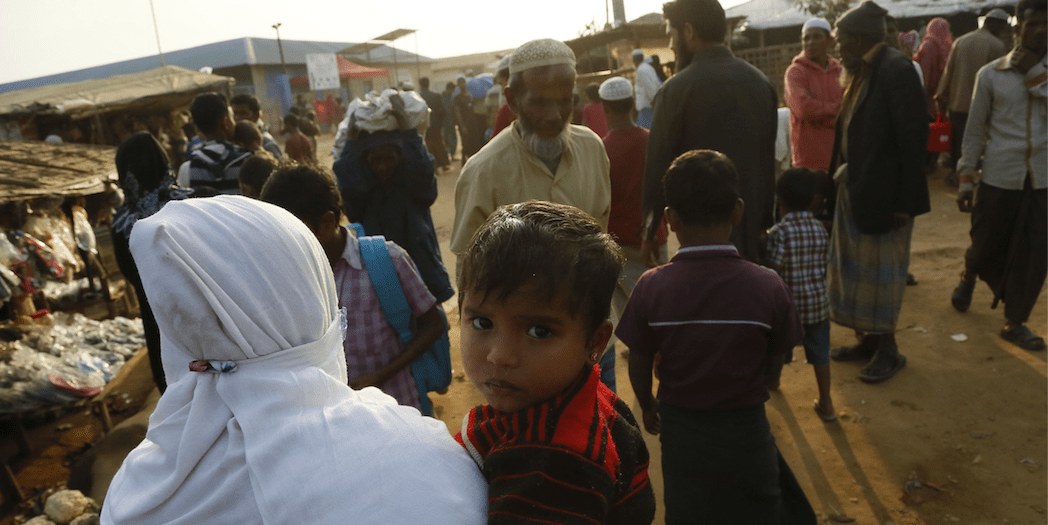
Billions wasted on nuclear weapons could save the world’s children
By Kehkashan Basu
Kutupalong – a beautiful, lyrical name. It could possibly describe a flower, a river, or an exotic bird. In fact, it is none of these three. Its claim to fame or rather infamy comes from the fact that it is the world’s largest refugee camp. Not only is it the largest refugee camp on our planet, with a population of 1 million and counting, it is also the most densely populated. It took just six months to double in size when Rohingya refugees fled Myanmar, according to reports from the World Food Program. Tens of thousands of makeshift tents packed together on a hilly terrain, it offers refuge to over a million refugees.
A two-hour drive from Cox Bazaar in Bangladesh, Kutupalong was a sleepy unknown hamlet until a few years ago, when the Rohingya crisis escalated in neighboring Myanmar. On the ground the camp is sprawling, chaotic, and unimaginably crowded. If you were looking for a definition of misery, this is it!
I spent last Christmas with my team at this camp engaging with hundreds of Rohingya children, soaking in the latent energy they possessed and trying to be the catalyst that would ignite their passion into a meaningful avenue of growth and development. For these children, every day is a struggle for survival. Sanitation and hygiene do not exist. It’s an unbelievably moving sight which no words or pictures can describe.
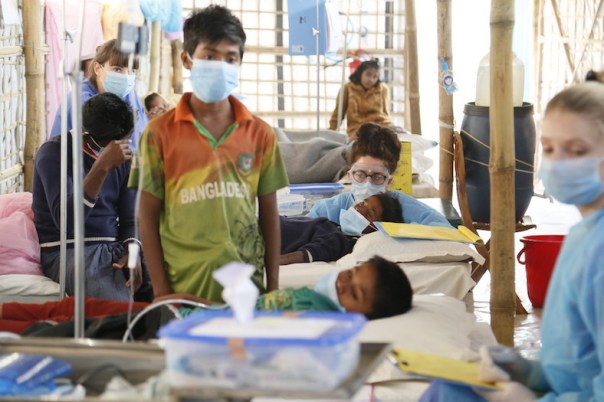
Dying children could be saved with food or medication costing less than 1/10th of the cost of one Trident submarine. (Photo DFID)
 Beyond Nuclear International