 Beyond Nuclear International
The USA-UK nuclear cabal

A “special relationship” in nuclear collusion
By Leonard Eiger
On March 16th the United Kingdom announced (in its Integrated Review of Security, Defence, Foreign Policy and Development titled Global Britain in a Competitive Age) that it will increase the limit on its nuclear arsenal for the first time in decades. Instead of maintaining a cap of 180 warheads (as it had previously stated), the UK will increase its stockpile cap to 260 warheads — a 40% increase. The review also broadens the role of nuclear weapons to include the possible use of nuclear weapons to address emerging technologies (cyber attacks). This is shocking and unacceptable! Indeed, it seems the British Empire is flexing its imperial muscles as it breaks away from the rest of Europe.
The announcement comes at a precarious time. A new nuclear arms race is brewing. The US and Russia, the two largest nuclear powers (with some 93 percent of global nuclear warheads) are failing to lead the world away from reliance on nuclear weapons, and other nations are following their lead. At a time when most nations are calling for an end to nuclear weapons (UN Treaty on the Prohibition of Nuclear Weapons), rather than setting a positive example and supporting the treaty, the UK is instead fanning the flames of proliferation. And, it is getting loads of help along the way.
Just prior to the announcement a spokesperson for the UK Ministry of Defence reiterated the longstanding claim that the “UK is committed to maintaining its independent nuclear deterrent, which exists to deter the most extreme threats to our national security and way of life.” The British have been claiming their nuclear weapons systems to be “independent” for so long that the world seems to have accepted this fraudulent claim. In fact, the UK’s nuclear forces are anything but independent, and there is ample evidence to disprove the governments claim. To more fully understand the situation, we need to study a bit of history.

Although the US declared its independence when the original 13 American colonies severed their political connections to Great Britain, the two countries have since found it mutually beneficial to develop a strong alliance; what has become known as the “Special Relationship,” an unofficial term used to describe certain aspects of their relationship including political, diplomatic, cultural, economic, and military.
And nowhere has their relationship been quite as special as is the case involving nuclear weapons. The two countries signed the Mutual Defence Agreement (MDA) in 1958, a secretly negotiated bilateral treaty on nuclear weapons cooperation under which both countries agreed to exchange classified information to develop their respective nuclear weapon systems.
Read MoreThyroid cancer in Fukushima children increased 20-fold

Latest results of the Fukushima thyroid screenings confirm worrying trend
By Dr. Alex Rosen
In 2011, people in Japan were exposed to radioactive fallout. Some still live in contaminated regions where they are exposed to elevated levels of radiation on a daily basis: radioactive hot-spots on the side of the road, in rice paddies or in sandboxes, contaminated mushrooms or algae, contaminated groundwater, and recontamination from forest fires or flooding.
One of the most dreaded effects of radioactive exposure is the development of cancer through mutation of the DNA. Thyroid cancer in children is certainly not the most dangerous form of radiation-induced cancer, but it is probably the easiest to detect. For one thing, the latency periods before a cancer develops are relatively short, while at the same time, thyroid cancer in children is an extremely rare disease, so that even a slight absolute increase can be statistically detected. Accordingly, in 2011, there was great pressure on Japanese authorities to investigate the development of thyroid cancer in children and adolescents in Fukushima by conducting long-term screening examinations.

For almost 10 years now, Fukushima Medical University has been regularly examining the thyroid glands of people who lived in Fukushima Prefecture at the time of the meltdowns and were under 18 years of age. Initially, this group consisted of about 368,000 individuals. Of these, 300,000 (about 82%) were successfully screened in the first few years. After the initial screening (2011-2014), follow-up examinations of these children took place every two years. The second examination has already been completed, the third examination is in its final stage, the fourth series of examinations has been running since 2018, and the fifth since 2020.
Read More“Advanced” isn’t the answer

Next in Talking Points series showcases USC takedown of non-light-water reactor delusions
By Linda Pentz Gunter
In the second in the Beyond Nuclear Talking Points series, we bring you Dr. Edwin Lyman’s definitive examination of so-called advanced reactors, or non-light-water reactors (NLWRs).
In a groundbreaking report, Lyman who is Director of Nuclear Power Safety at the Union of Concerned Scientists, debunks almost all of the industry claims for NLWRs, predominantly on the grounds of safety and security risks, but also touching on costs, time, regulations and waste.
The report — “Advanced” Isn’t Always Better. Assessing the Safety, Security, and Environmental Impacts of Non-Light-Water Nuclear Reactors — can be found in full here on the UCS website. We appreciated the opportunity to condense it into our second Talking Points, all of which are free to download, print and distribute widely.
As Lyman writes in the executive summary of the report, nuclear power in general is replete with flaws: “. . . the technology has fundamental safety and security disadvantages compared with other low-carbon sources. Nuclear reactors and their associated facilities for fuel production and waste handling are vulnerable to catastrophic accidents and sabotage, and they can be misused to produce materials for nuclear weapons.”
The study’s conclusion is that pursuing “advanced” nuclear reactors is too slow, too resource-intensive and too dangerous and won’t result in improvements over light-water reactors.
Time to draw down military spending

Progressives should unite to block new nuclear weapons
By Medea Benjamin and Marcy Winograd
Imagine this scenario:
A month before the vote on the federal budget, progressives in Congress declared, “We’ve studied President Biden’s proposed $753 billion military budget, an increase of $13 billion from Trump’s already inflated budget, and we can’t, in good conscience, support this.”
Now that would be a showstopper, particularly if they added, “So we have decided to stand united, arm in arm, as a block of NO votes on any federal budget resolution that fails to reduce military spending by 10-30 percent. We stand united against a federal budget resolution that includes upwards of $30 billion for new nuclear weapons slated to ultimately cost nearly $2 trillion. We stand united in demanding the $50 billion earmarked to maintain all 800 overseas bases, including the new one under construction in Henoko, Okinawa, be reduced by a third because it’s time we scaled back on plans for global domination.”

“Ditto,” they say, “for the billions the President wants for the arms-escalating US Space Force, one of Trump’s worst ideas, right up there with hydroxychloroquine to cure COVID-19, and, no, we don’t want to escalate our troop deployments for a military confrontation with China in the South China Sea. It’s time to ‘right-size’ the military budget and demilitarize our foreign policy.”
Progressives uniting as a block to resist out-of-control military spending would be a no-nonsense exercise of raw power reminiscent of how the right-wing Freedom Caucus challenged the traditional Republicans in the House in 2015. Without progressives on board, President Biden may not be able to secure enough votes to pass a federal budget that would then green light the reconciliation process needed for his broad domestic agenda.
Read MoreOvercoming resistance to a nuclear weapons-free world

Could giving the UN authority over international security do the job?
By Lawrence S. Wittner
Given the fact that nuclear war means the virtual annihilation of life on earth, it’s remarkable that many people continue to resist building a nuclear weapons-free world. Is the human race suicidal?
Before jumping to that conclusion, let’s remember that considerably more people favor abolishing nuclear weapons than oppose it. Public opinion surveys—ranging from polls in 21 nations worldwide during 2008 to recent polls in Europe, Japan, and Australia—have shown that large majorities of people in nearly all the nations surveyed favor the abolition of nuclear weapons by international agreement. In the United States, where the public was polled in September 2019 about the UN Treaty on the Prohibition of Nuclear Weapons, 49 percent of respondents expressed approval of the treaty, 32 percent expressed disapproval, and 19 percent said they didn’t know.
Nevertheless, surprisingly large numbers of people remain unready to take the step necessary to prevent the launching of a war that would turn the world into a charred, smoking, radioactive wasteland. Why?
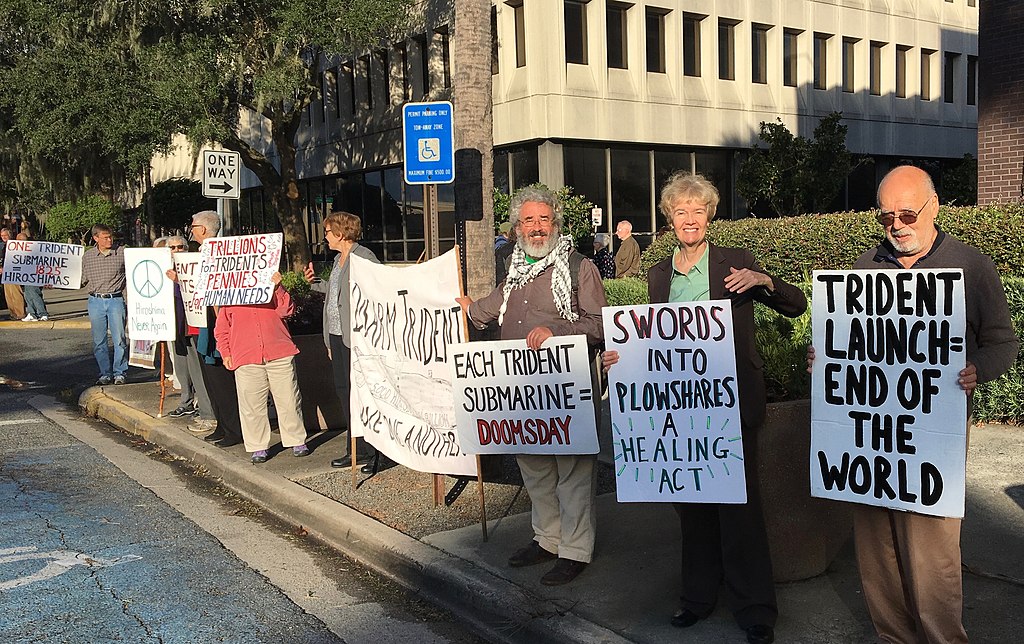
Their reasons vary. Die-hard militarists and nationalists usually view weapons as vital to securing their goals. Others are the employees of the large nuclear weapons industry and have a vested interest in retaining their jobs. In the United States, that enterprise has long been very substantial, and the Trump administration, through massive infusions of federal spending, succeeded in fostering its greatest expansion since the end of the Cold War. According to a December 2020 article in the Los Angeles Times: “Roughly 50,000 Americans are now involved in making nuclear warheads at eight principal sites stretching from California to South Carolina. And the three principal U.S. nuclear weapons laboratories . . . have said they are adding thousands of new workers at a time when the overall federal workforce is shrinking.” Members of these groups are unlikely to change their minds about the importance of retaining nuclear weapons.
Read MoreOne more whack at the SMR mole

Why Small Modular Nuclear Reactors Won’t Help Counter the Climate Crisis
By Arjun Makhijani, Ph.D. and M.V. Ramana, Ph.D.
Small modular nuclear reactors, or SMRs, are designed to generate less than 300 megawatts of electricity – several times less than typical reactors, which have a range of 1,000 to 1,600 MW. While the individual standardized modules would be small, plans typically call for several modules to be installed at a single power generation site.
The nuclear industry and the U. S. Department of Energy are promoting the development of SMRs, supposedly to head off the most severe impacts of climate change. But are SMRs a practical and realistic technology for this purpose?
To answer, two factors are paramount to consider – time and cost. These factors can be used to divide SMRs into two broad categories:
- Light water reactors based on the same general technical and design principles as present-day power reactors in the U.S., which in theory could be certified and licensed with less complexity and difficulty.
- Designs that use a range of different fuel designs, such as solid balls moving through the reactor core like sand, or molten materials flowing through the core; moderators such as graphite; and coolants such as helium, liquid sodium or molten salts.
On both counts, the prospects for SMRs are poor. Here’s why.
Economics and scale
Nuclear reactors are large because of economies of scale. A reactor that produces three times as much power as an SMR does not need three times as much steel or three times as many workers. This economic penalty for small size was one reason for the early shutdown of many small reactors built in the U.S. in the 1950s and 1960s.
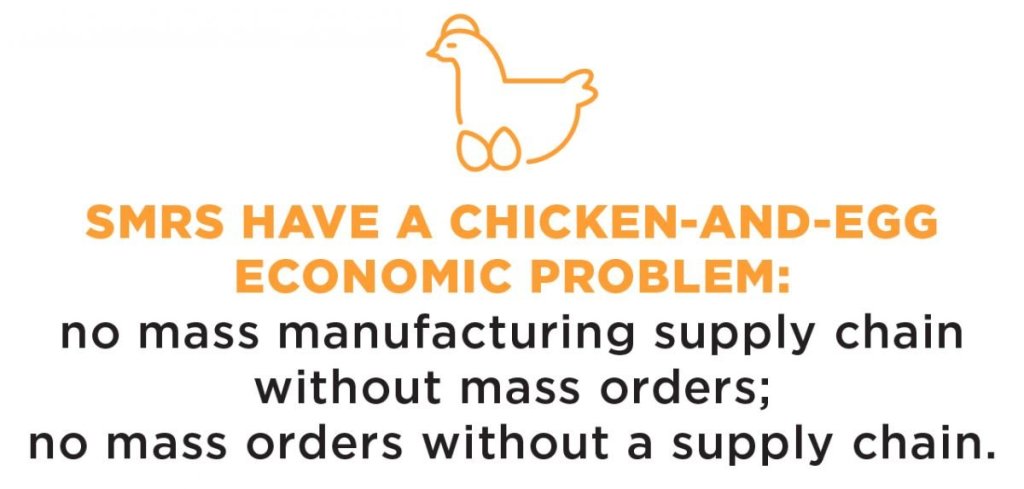
Proponents of SMRs claim that modularity and factory manufacture would compensate for the poorer economics of small reactors. Mass production of reactor components and their manufacture in assembly lines would cut costs. Further, a comparable cost per kilowatt, the argument goes, would mean far lower costs for each small reactor, reducing overall capital requirements for the purchaser.
Read More Beyond Nuclear International