 Beyond Nuclear International
Standing up to Rosatom

Anti-nuclear resistance in Russia: problems protests, reprisals
The following is a report from the Russian Social Ecological Union (RSEU)/ Friends of the Earth Russia, slightly edited for length. You can read the report in full here. It is a vitally important document exposing the discrimination and fear tactics used against anti-nuclear organizers in Russia and details their courageous acts of defiance in order to bring the truth of Russia’s nuclear sector to light.
Rosatom is a Russian state-owned corporation which builds and operates nuclear power plants in Russia and globally. The state-run nuclear industry in Russia has a long history of nuclear crises, including the Kyshtym disaster in 1957 and Chernobyl in 1986. Yet Rosatom plans to build dozens of nuclear reactors in Russia, to export its deadly nuclear technologies to other countries, and then to import their hazardous nuclear waste.
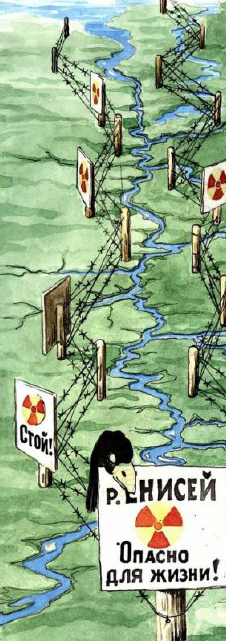
This report is a collection of events and details about the resistance to Russian state nuclear corporation, Rosatom, and other activities that have led to the pollution of the environment and violation of human rights. Social and environmental conflicts created by Rosatom have been left unresolved for years, while at the same time, environmental defenders who have raised these issues, have consistently experienced reprisals.
Nuclear energy: failures and Lies
- In the autumn of 2017, the International Atomic Energy Agency (IAEA) discovered a concentration of the technogenic radionuclide ruthenium–106 in the atmosphere of several European countries. A number of experts linked the ruthenium release to the Mayak plant in the Chelyabinsk Region2 3, but Rosatom continues to deny this.
- On the 8th of August 2019, an explosion occurred during a test of a liquid rocket launcher at a marine training ground in Nenoksa Village of Arkhangelsk Region. The administration of the city of Severodvinsk, 30 km from the scene, reported an increase in radiation levels, but later denied the claim. The Ministry of Emergency registered an increase of 20 times (to2 μSv/h) around Severodvinsk, while the Ministry of Defense reported the radiation level as normal. Only two days later, Rosatom reported that five employees were killed and three were injured at the test site. According to media reports, two employees of the Ministry of Defense were also killed and three were injured, and medical personnel who helped the victims were not informed about the risk of radiation exposure.
Invisible Fallout

New film helps us find it, measure it and understand it
By Linda Pentz Gunter
There are many ways to teach people about radiation. But if you want to make that lesson accessible, compelling and even moving, then this film is the way to do it.
Let’s go on a journey. A journey to learn about radiation exposure from fallout after a nuclear power plant accident. We have the perfect guide. It is the independent French radiation research laboratory known as CRIIRAD, and its director, Dr. Bruno Chareyron.
The organization’s full name in French is Commission de Recherche et d’Information Indépendantes sur la RADioactivité, hence the acronym. In English it is translated as Commission for Independent Research and Information about RADiation.
For those not familiar with CRIIRAD, our journey begins with a little history, and so does CRIIRAD’s brilliant new 45-minute film — Invisible Fallout (Invisibles retombées is the French title), which can be viewed in its entirety on YouTube and below. The film, written and produced by CRIIRAD staff and directed by Cris Ubermann, is in French and Japanese with English subtitles.
When the Chernobyl nuclear disaster hit in April 1986, the French government engaged in a notorious cover-up, claiming that France “has totally escaped any radioactive fallout.” The whole thing was a lie. Five days before the government denial, Chernobyl’s radioactive cloud had covered all of France.
As Invisible Fallout recounts, after Chernobyl, it took 15 years until the French government published accurate fallout maps of France. But the CRIIRAD laboratory, formed right after Chernobyl precisely to establish that France’s immunity was a myth, had already done the work that debunked the official line that the disaster was just a Soviet problem. French citizens not only got dosed by Chernobyl fallout, but would live in perpetual danger of a similar catastrophe at home, with a country almost 80% reliant on nuclear-generated electricity from its 58 reactors.
But Invisible Fallout does not linger long in the past. It segues quickly to the next nuclear catastrophe — the 2011 Fukushima-Daiichi meltdowns in Japan — and it is there that the CRIIRAD team, led by Chareyron, take us to learn about the effects of radiation exposure from nuclear power plants.
Read MoreNot so “super-duper”

Hypersonic nuclear-capable missiles would return us to the madness of the Cold War
By Karl Grossman
The United States is seeking to acquire “volumes of hundreds or even thousands” of nuclear-capable hypersonic missiles that are “stealthy” and can fly undetected at 3,600 miles per hour, five times faster than the speed of sound. In unveiling the plan, Trump called the new weapon a ‘super-duper’ missile. But with even less time to respond to a potential threat, will this lead to a deadly misjudgment?
Why so many? A Pentagon official is quoted in the current issue of Aviation Week & Space Technology as saying “we have to be careful we’re not building boutique weapons. If we build boutique weapons, we won’t—we’ll be very reluctant to—use them.”
The article in the aerospace industry trade journal is headlined: “Hypersonic Mass Production.” A subhead reads: “Pentagon Forms Hypersonic Industry ‘War Room.’”
On March 19, 2020, the U.S. conducted its first hypersonic missile test from its Pacific Missile Range Facility on Kauai, Hawaii.
“Fast and Furiously Accurate” is the title of an article about hypersonic missiles written by a U.S. Navy officer which appeared last year on a U.S. Naval Institute website.
The piece declares that by “specifically integrating hypersonic weapons with U.S. Navy submarines, the United States may gain an edge in developing the fastest, most precise weapons the world has ever seen.”
Read MoreBut not to the nuclear industry

“Black communities get more promises than jobs — and they get pollution and they get sick”
By Linda Pentz Gunter
Systemic racism in the nuclear industrial complex has endured for decades. Every community of color has been affected. As we confront the wider impact of centuries of racism in the US, we take a closer look specifically at discrimination against African Americans in the nuclear power sector.
The shackles of slavery may be gone, but there is now a knee on the neck of African American voices, whether literal or metaphorical, when it comes to challenging injustice. And it is there when confronting the bias of the nuclear power industry and other lethal polluters. It is quite deliberately there. It is there not only to oppress — and in the case of George Floyd to kill — but to silence and disenfranchise. To stunt movements for change.

Protest poster by Mateusz Sambor
That is perhaps how the NAACP’s A.C. Garner, felt after the US Nuclear Regulatory Commission (NRC) dismissed black concerns over a proposed new nuclear power plant in Mississippi in 2005. It was, he said, like “posting a ‘WHITES ONLY’ sign on the hearing room door.”
Garner’s statement was a reaction to a January 19, 2005 decision by the NRC to grant permission for a second nuclear reactor to be built at the Grand Gulf site in Mississippi. It was to be built in the poorest county in the state, itself the poorest state in the union.
It would join Grand Gulf Unit 1, opened in 1985 in the Claiborne County city of Port Gibson, and would be known as Grand Gulf Unit 3, as all there is of Unit 2 is an empty concrete pad— the plant owners, Entergy, having asked the NRC to revoke that planned reactor’s license in 1991.
Grand Gulf 1, the largest single unit in the country, with an output of around 1,500 MW, is located in a community that is 87% African American, with a poverty rate of 46% according to census data. The median household income in Claiborne County is $24,601 per year. At least 35% of the population depends on Medicaid. The Covid-19 infection rate there is still headed on an upward trajectory.
Back in 2005, the county was already ill prepared for a health crisis of any sort. It had just one crumbling hospital, struggling to meet the needs of a deprived community and with zero capacity to handle a nuclear emergency. Evacuation routes were washed out and impassible. The police force was completely under-equipped.
“The county doesn’t even have a hospital that’s open 24 hours, and there’s only one fire station in the entire county,” Rose Johnson, chairwoman of the Mississippi Chapter of the Sierra Club, told the Jackson Free Press at the time. “The situation should send chills down the spines of anyone who lives within a 100-mile radius of Port Gibson.”
Why such deprivation? Why weren’t Port Gibson and Claiborne County flush with the tax revenues the plant should have brought in? Because in 1986, fearing price hikes for the “too cheap to meter” electricity generated by Grand Gulf nuclear Unit 1, Entergy succeeded in getting the predominantly white Mississippi legislature to pass a bill to redistribute more than 70% of those tax revenues to 47 other counties in the state. It is the only reactor community in the country that does not reap the lion’s share of its nuclear plant tax dollars.
The law left an already poor black community even more desperately deprived. But it pre-empted any complaints about increased electricity costs from whiter communities elsewhere in the state.
From uranium mining to Covid-19

Assaulted by massacres, smallpox, uranium mining, and pipelines Native Tribes are standing up for their rights on COVID-19 protection
By Linda Pentz Gunter
Native Americans have largely been left out of the conversation about COVID-19 even though they have some of the highest infection rates in the country. They’ve been here before; with massacres, smallpox, pipelines, and the ravages of uranium mining whose radioactive releases compromise immune systems.
“We have an 80% unemployment rate,” said Milo Yellow Hair, who lives on the Pine Ridge reservation in South Dakota, one of nine which make up the Lakota Nation.
I made him repeat it. That was eight zero. Not one eight. Eighty. In America. Today.
It’s a symbol, to put it mildly, of several centuries of neglect, discrimination and persecution.
The Lakota Nation today contends with a chronic and widespread lack, not only of employment, but of other fundamental rights like running water, electricity, and adequate health care. Its communities are beset with high rates of poverty, alcoholism, drug use and domestic violence. These constitute the legacy of occupations, displacements, massacres, smallpox, fights for freedom crushed, and the imposition of ecosystem-destroying oil and gas pipelines.
Most significantly, perhaps, it is an inevitable result of the harmful legacy of exposures from uranium mining, unique to Native American communities, and which have had a devastating effect on health.
And now there’s COVID-19.
And yet, while some media attention has focused on the disproportionate COVID-19 infection and death rates among African American and Latinx populations, there was almost no mention at the outset of its effect on Native American communities.
Stop EDF’s silent spring!

Birds and other wildlife would be eliminated by EDF two-reactor project on English coast
By Linda Pentz Gunter
Two new nuclear reactors are threatened for the English east coast. The EDF project would destroy precious ecosystems and drive away already rare wildlife. Activists there are now raising funds for scientific expertise to help block any further progress on the reactors, and also, in a separate appeal, to continue the legal fight.
Did you ever hear a bittern boom?
It sounds like a question Dr. Suess might have asked. But that sound, and the bird that makes it, is one of the critically important losses about to befall coastal Suffolk in the UK if French nuclear firm, EDF, continues to press forward with its plans for a new reactor there. The project is called Sizewell C.
Or more accurately, plows ahead. Because what EDF is proposing, and so far not nearly enough people are opposing, is to literally plow under some of the most precious, fragile and unique flora and fauna anywhere in the world. In exchange, it will plant the technically flawed and financially failing fiasco that is its European Pressurized Reactor, directly on the beach there. Two of them in fact. As it is already doing at the Somerset UK site — Hinkley C. To disastrous effects on the surrounding countryside.
We touched on this threat earlier this year in another article. As I wrote there: “The first thing that is likely to happen is that EDF will raze Coronation Wood. It will do this, not because it needs to now. It is not even certain that Sizewell C will go ahead. It will do this for show. The show in question is to prove to the world that the French nuclear industry is alive and well.”
Fortunately, on June 3, Suffolk activists won a crucial round in court that will allow a judicial review of the decision by East Suffolk Council in September 2019 to grant EDF planning permission to cut down the 100 year-old Coronation Wood. The judge granted permission for the challenge to proceed on the basis it is arguable that there were deficiencies within the Environmental Impact Assessment relied upon by the Council in making their planning decision. (Update: As the allowed challenge forced the exclusion of the argument that the proposed development did not satisfy the standard of need required by law to justify a major development in an Area of Outstanding Natural Beauty, TASC has now also launched an appeal on those grounds.)

The otter, a remarkable comeback success story, could be driven away by EDF’s Sizewell C project. (Photo courtesy of Suffolk Coastal Friends of the Earth)
This is a crucial development because, if EDF is not stopped, and Coronation Wood goes, the company will then proceed to desecrate and destroy a remarkable landscape that abuts and traverses the beautiful Minsmere Nature Reserve, managed by the Royal Society for the Protection of Birds.
 Beyond Nuclear International