 Beyond Nuclear International
The woman who tore up the curtain of silence
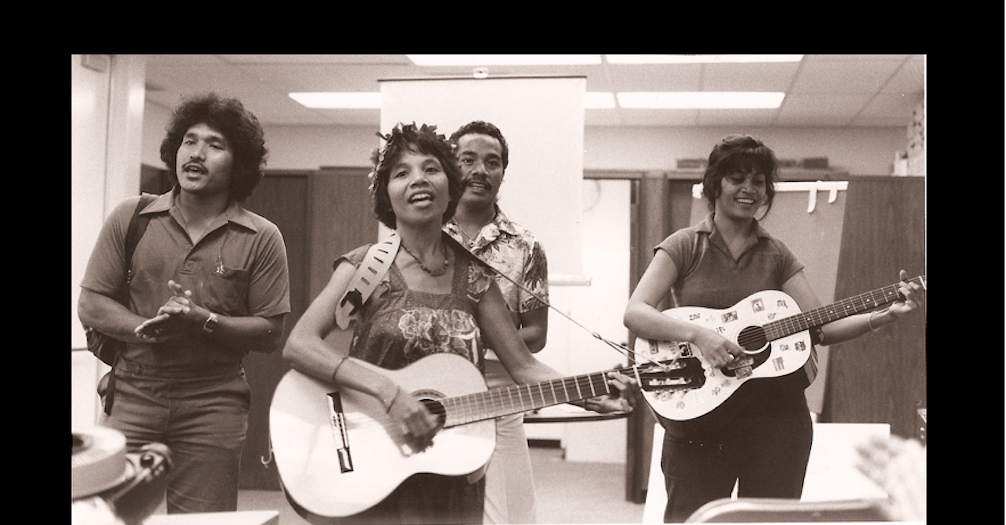
Through song and activism, Darlene Keju taught her fellow Marshall Islanders the truth about US atomic atrocities
By Linda Pentz Gunter
Early in her life, Marshall Islander, Darlene Keju, did not know the extent to which her fellow Marshallese had suffered as a result of the 67 atomic detonations inflicted on the region by the United States during the Cold War. But as she gained her education in Hawaii, the terrible truth began to reveal itself. And after that, Keju could not remain silent.
Once Keju began to research and understand more about the US atomic tests, she was stunned to discover how little information was available to most adults living in the islands and just how far the harm extended. Faced with the immense scale of damage and injustice, Keju went to work, touring, speaking, educating and using music, dance and song to reach her people, work that was cruelly cut short when Darlene’s life was taken by cancer on June 18, 1996, just two months after her 45th birthday. Many of the revelations about the true depth of depravity surrounding the US atomic tests only emerged well after Keju’s death.

Darlene Keju in 1989 in Hawaii on a brief respite from activism. (Photo: Giff Johnson)
All of this is beautifully chronicled in a book by Darlene’s American husband, Giff Johnson. In “Don’t Ever Whisper,” he describes how Darlene “expressed her outrage over repeated resettlements of Marshall Islanders, continual and unnecessary exposure of people to nuclear test fallout and the resulting health problems, and the US government’s refusal to admit that many more islands than Bikini, Enewetak, Rongelap, and Utrik were affected.” (You can hear an interview by Pacific Media Watch with Johnson about the book here.)
An A-Z against nuclear power

The Overview section of our new Handbook provides simple explanations of the entire nuclear fuel chain
By Beyond Nuclear staff
What is the difference between an open pit and an in-situ leach uranium mine? How does a nuclear power plant produce electricity? What happens to reactor fuel once it’s no longer usable? What is the difference between high-level and low-level radioactive waste and where is it stored? Why isn’t reprocessing really “recycling”?
We may know the answers to some or all of these questions. But can we deliver a succinct, clear, accessible answer to explain them to someone not already steeped in the issue?
As any activist engaged in anti-nuclear advocacy knows, nuclear power is a complex topic and describing each phase of the nuclear fuel chain can quickly bog us down in long, technical explanations. And once we go there, eyes glaze and we lose our audience.
Proponents of nuclear energy have taken full advantage of this, downplaying and minimizing the risks and using facile and superficially appealing sound bites, unsupported by facts, to convince people that nuclear power is benign and useful for climate change.
Facts are what we believe will change people’s minds. But the idea that bombarding someone with a deluge of irrefutable facts about the dangers of nuclear power will automatically win them to our cause has proven to be an illusion. It doesn’t necessarily work.
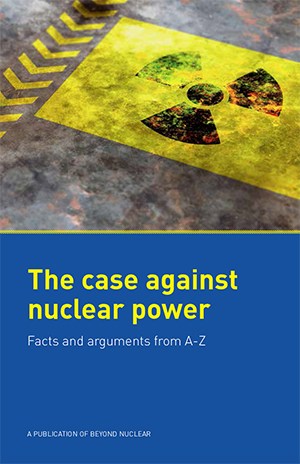 We do need facts, of course. And that is where our Handbook — The Case Against Nuclear Power: Facts and Arguments from A-Z — comes in. We must be able to accurately describe why nuclear power is dangerous, uneconomical and unjust. But we must do so in succinct, simple lay language. And then, once the basics are understood, we need to move people. And that is why the Beyond Nuclear International website came to be born, providing a natural home for the Handbook and expanding from facts to compelling narratives.
We have already compiled three Handbook chapters which you can find on the Beyond Nuclear International website under Handbook. So far, we have published: An Overview that offers simple explanations for every phase of the nuclear fuel chain; Radiation and harm to human health, which lays out the detriments to health of every phase of nuclear power operations; and Climate change and why nuclear power can’t fix it. More chapters are in the works.
French environment minister resigns
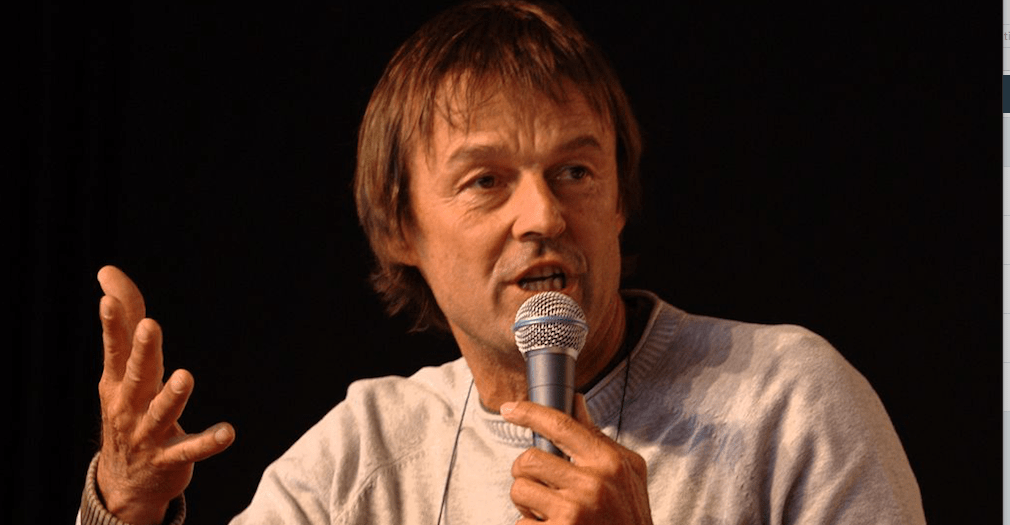
Update: A newly leaked report examines the possibility of France building six new EPR reactors starting in 2025, after a prolonged period of inactivity in the industry. The report was ironically commissioned by Hulot and economy minister, Bruno Lemaire, and concludes that France “cannot stop building” reactors in order to maintain industrial know how and provide jobs, according to the newspaper, Les Echos, which broke the story. The report’s finding may have contributed to Hulot’s decision to resign. However, the notion that France would build six more EPRs was met with derision by nuclear critics who pointed out that the French nuclear industry has been unable to complete even one EPR in either France of Finland, where both projects are years behind schedule and massively over-budget.
Is the departure of Nicolas Hulot significant?
By Linda Pentz Gunter
Opinion in France is decidedly mixed about the sudden resignation of French environment minister, Nicolas Hulot. He made his announcement on a radio show, taking the government of centrist, Emmanuel Macron, by surprise.
Certainly, the ecological crown had sat uneasily on Hulot’s head throughout his tenure in government. He arrived there ostensibly from the activist ranks — he was also a journalist — and was thought to be strongly anti-nuclear. But when French gendarmes raided and destroyed an opposition encampment at the proposed high-level radioactive waste repository site in Bure last February, Hulot failed to come to the defense of the anti-nuclear activists, some of whom were arrested. Even when challenged in the French parliament for his silence, he bobbed and weaved, relying on evasive rhetoric.
Yet when he resigned on Tuesday, he claimed it was to stop “having to lie to myself” and told the radio program on which he made the announcement that nuclear power is “a useless folly.”
Fighting for life in the “place of death”
Traditional owners won’t give up 40-year opposition to Yeelirrie uranium mine
By Linda Pentz Gunter
In the local Aboriginal language, the name Yeelirrie means to weep or mourn. It is referred to as a “place of death.” Yeelirrie is on Tjiwarl Native Title lands in Western Australia, where it has long been faithfully protected by Aboriginal traditional owners. The Seven Sisters Dreaming songline is there. It is home to many important cultural sites. And for 40 years, due to resolute indigenous opposition, and thousands of community submissions of protest, it had been spared plans by the Canadian mining company, Cameco, to plunder it for uranium.
The earth guardians know that such a desecration would cause the extinction of multiple species of subterranean fauna. It would release death. It would destroy Yeelirrie.
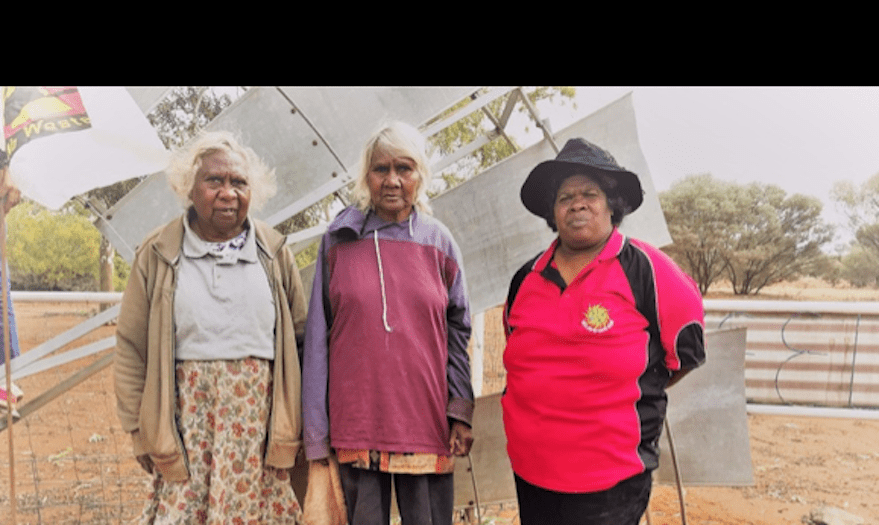
Now the fate of those tiny creatures hangs in the balance, their future in the hands of three brave women, backed by environmental organizations, after the outgoing Western Australian government decided to allow the Yeelirrie uranium mine project to go forward.
The wind that sings through the spinifex grass

A walk with Australian Traditional Owners to preserve the land from uranium mining
Over recent years many hundreds of people have visited the proposed Yeelirrie uranium mine site in Western Australia, walking with Traditional Owners to support the local opposition to the mine. The first Walkatjurra Walkabout was held in 2011 – a walk from Wiluna to Perth over three months. The walk was to demonstrate the opposition to uranium mining but had many other positive impacts in the local community. Smaller walks have been held every year since 2011 from Wiluna to Leonora via the proposed uranium mine at Yeelirrie. The walks are led by the Walkatjurra rangers from Leonora and include people from across Australia and around the world including participants from the US, Taiwan, Japan, France, Lapland, Greece and England. Marcus Atkinson of Footprints for Peace, describes the experience of the Walkabout currently in progress.
By Marcus Atkinson
The Walkatjurra Walkabout is a month-long 250 km walk through the Western Australia Goldfields, in support of Traditional Owners to protect country and stop uranium mining despite freezing overnight temperatures and long hot days.
During an early stop, a group of 55 people gathered at the gates of Yeelirrie to support Traditional Owners, Aunty Shirley and Lizzie Wonyabong and Vicky Abdhullah in the 40-year struggle to stop the proposed Yeelirrie uranium mine. The three women have shared stories of the area where they and their families grew up and the connection they have to this land. As we walk, they show us the bush tucker, the plants used for medicine, and the plants used for other purposes. We listen, we learn, and together we enjoy the beauty of this land.
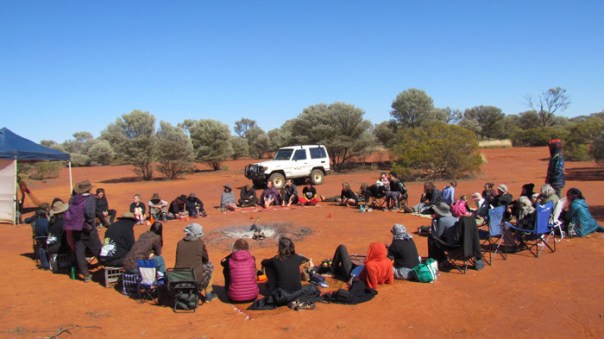
A group of walkers gathers to listen to Traditional Owners
Did a tweet about women’s rights just make the world safer?
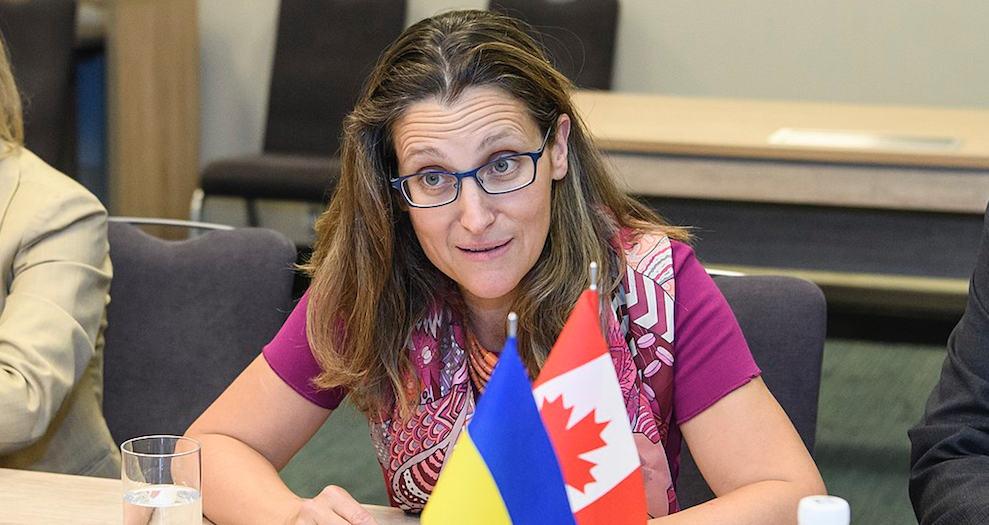
Canada may have unintentionally killed Westinghouse nuclear deal with Saudis
By Henry Sokolski and Victor Gilinsky
In the latest you-can’t-make-this-stuff-up event, Saudi Arabia’s furious campaign of economic retaliation against Canada — in response to Canadian foreign minister Chrystia Freeland’s criticism of the arrest of Saudi women’s rights activists — threatens to dash Westinghouse’s hopes for a lucrative nuclear deal with the Saudis. And, ironically, it may help to preserve tough rules on nuclear exports (“gold standard”) that the Saudi deal might otherwise scuttle.
On Aug. 7, the Saudis recalled their ambassador and expelled Canada’s ambassador, canceled flights to and from Canada, ordered Saudi students and even Saudis in Canadian hospitals to leave Canada, ordered the immediate sale of Saudi-owned Canadian assets “no matter the cost,” and — what is most important for our story — suspended all new business with Canada.
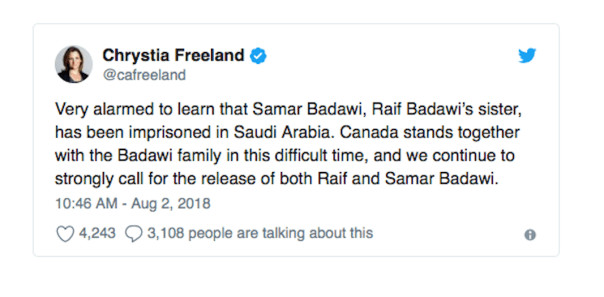
Canada’s Minister of Foreign Affairs, Chrystia Freeland, tweeted about women’s rights in Saudia Arabia. Now that country is tossing out everything — and everyone — Candian including, maybe, a nuclear power deal.
 Beyond Nuclear International