Résultats d’une nouvelle étude :
Le nombre de campagnols des bois et leur capacité reproductrice sont en déclin.
Il n’y a pas de seuil de radiation sous lequel il n’y aurait pas d’effet sur les populations d’animaux
Linda Pentz Gunter
Une équipe de scientifiques qui ont étudié les campagnols des bois se trouvant à moins de 50 km de la centrale nucléaire de Tchernobyl a conclu que les capacités reproductrices de ces mammifères et par conséquent leur population souffrent d’une exposition chronique aux rayons présents dans la région et que ces effets s’observent même quand les doses sont infimes.
L’étude, menée à grande échelle et à plusieurs reprises par Mappes et al. et publiée en avril 2019, « a testé l’hypothèse selon laquelle les mécanismes écologiques interagissent avec les rayonnements ionisants pour affecter de manière inattendue les populations naturelles ». L’équipe a constaté que les campagnols des bois ont montré « des diminutions linéaires du taux de fertilité en fonction de niveaux ambiants croissants de radiation, sans seuil en dessous duquel des effets ne seraient pas observés ».
Le campagnol des bois a été choisi parce que « c’est un vertébré terrestre commun et abondant qui habite les écosystèmes forestiers eurasiens, ce qui en fait une espèce indicatrice intéressante pour la santé des écosystèmes forestiers qui peuvent avoir été déteriorés par des activités anthropiques », écrivent les auteurs.

De jeunes campagnols des bois dans le nid. Plus l’exposition au rayonnement est élevée, plus le taux de fertilité diminue chez les campagnols dans un rayon de 50 km autour de Tchernobyl. Photo : Plantsurfer/WikiCommons.
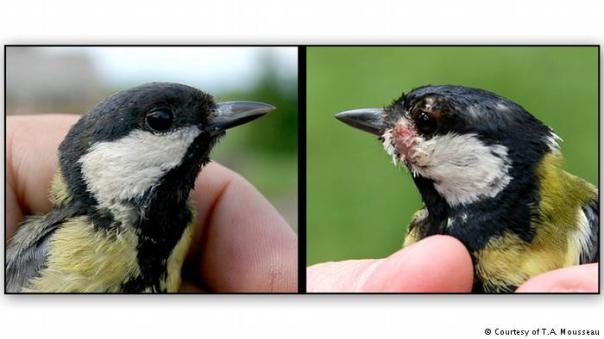
Lorsque le réacteur de Tchernobyl a explosé le 26 avril 1986, il a libéré des produits de fission en Ukraine, en Russie, en Biélorussie et ailleurs en Europe. Il s’agit notamment du strontium-90, du césium-137 et du plutonium-239, qui ont contaminé l’air, le sol et l’eau. Les retombées radioactives s’accumulent dans les plantes et les animaux, sources de subsistance de la faune. Au moins 90 études publiées par de nombreux membres de l’équipe Mappes ont mis en évidence de graves effets délétères de l’exposition aux rayonnements chez les animaux sauvages de Tchernobyl, en particulier les oiseaux, qui souffrent de cataractes, de tumeurs, d’un taux de spermatozoïdes réduit ou nul et d’une diminution de la taille du cerveau.
La nouvelle étude Mappes est importante parce qu’elle s’inscrit dans un corpus de travaux scientifiques qui réfutent l’idée selon laquelle, simplement parce qu’« il y a beaucoup d’animaux dans la zone de Tchernobyl », ils ne sont pas affectés par l’accident nucléaire. Ces études sur la « faune sauvage prospère » induisent le public en erreur en lui faisant croire que les animaux de la région profitent de l’absence d’humains et qu’ils ne souffrent pas des effets nocifs de leur exposition soutenue aux rayonnements provoqués par la catastrophe nucléaire.
Dans Mappes et al., les chercheurs ont donné des compléments nutritifs à certains groupes de campagnols afin d’écarter la pénurie alimentaire comme cause de la diminution du taux de fertilité et de la population. Mais ils n’ont observé que peu de différence entre les campagnols qui recevaient ces compléments et ceux qui trouvaient leur nourriture tout seuls.
« Les populations bénéficiant des compléments alimentaires n’ont augmenté que dans les zones de faible radiation » (1 μSv/h ou moins), mais ont diminué lorsque les niveaux de radiation étaient plus élevés. Les campagnols qui ne recevaient pas de compléments « ont eu tendance à diminuer linéairement avec l’augmentation des niveaux ambiants de radiation ». Des niveaux plus élevés de rayonnement réduisaient leur nombre, qu’ils aient reçu ou non des compléments alimentaires. « Ainsi, des compléments alimentaires ne peuvent atténuer les effets nocifs d’un environnement contaminé par des radionucléides que jusqu’à un certain point », ont conclu les chercheurs.
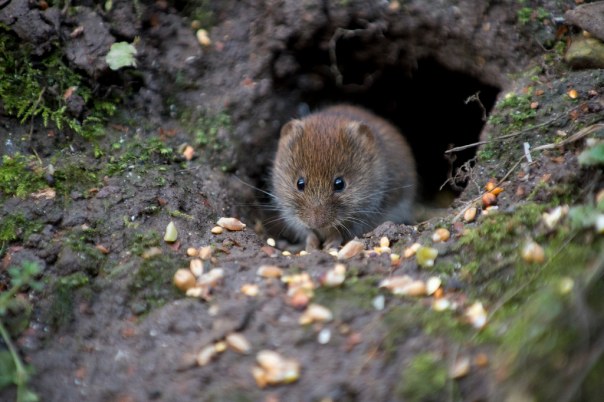
La probabilité qu’une femelle de campagnol des bois soit enceinte a diminué de manière significative avec l’augmentation du niveau de rayonnement ambiant. Photo : « Bank Vole » par clairespelling1, sous licence CC BY 2.0.
L’importance d’étudier la réponse des campagnols des bois à l’exposition de rayonnement dans la nature a été renforcée par des résultats récents montrant que, « les organismes vivants dans leur habitat naturel semblent être beaucoup plus sensibles aux effets délétères du rayonnement ionisant » que les animaux exposés et testés dans des conditions de laboratoire. Dans une méta-analyse de Garnier-Laplace et al. en 2013, qui s’est penchée sur « les effets des contaminants radioactifs dérivés de Tchernobyl sur 19 espèces de plantes et d’animaux vivants dans des conditions naturelles », le groupe de chercheurs a constaté que « les organismes sauvages étaient plus de huit fois plus sensibles aux effets négatifs du rayonnement que ces mêmes espèces placées dans des conditions de laboratoire ou de modélisation », écrivent Mappes et al.
L’équipe de recherche a trouvé des impacts significatifs sur la population de campagnols des bois de l’exposition de rayonnement provoquée par l’accident nucléaire de Tchernobyl. « La probabilité qu’une femelle de campagnol des bois soit enceinte a diminué de manière significative avec l’augmentation des niveaux ambiants de rayonnement, » dit l’étude. La taille des femelles n’a pas modifié ces phénomènes. Le nombre de campagnols des bois n’était pas non plus corrélé avec la probabilité de reproduction ou la taille de la portée.
Les saisons n’affectent pas non plus leur nombre. « Les populations estivales et hivernales de campagnols des bois ont diminué de manière significative avec l’augmentation du rayonnement ambiant », constate l’étude.
Les résultats de l’étude appuient fortement le modèle linéaire sans seuil, qui affirme qu’il n’y a pas de dose de rayonnement si faible qu’elle ne cause plus de dommages. Mappes a constaté que « des effets nocifs significatifs de rayonnement sur les populations de campagnol des bois peuvent être observés même à des niveaux très bas de radioactivité ambiante ».
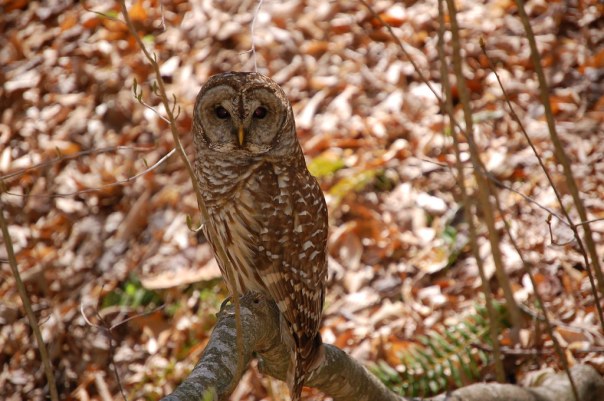
Le campagnol des bois est également une source importante de nourriture pour des hiboux et d’autres animaux sauvages de forêt. Photo : « 049 » de Mike Doss est sous licence CC BY 2.0.
Comment les campagnols sont-ils exposés ? Comme l’étude l’explique, les effets biologiques sur les campagnols « pourraient être causés par l’exposition directe au rayonnement gamma du milieu environnant ou par l’exposition aux particules alpha et bêta accumulées dans les animaux à partir des aliments. Par exemple, les champignons, un composant essentiel du régime alimentaire des campagnols des bois, peuvent être une source énorme de radionucléides émetteurs alpha et bêta. »
Le nombre de campagnols des bois et leur survie ne sont pas seulement importants pour l’espèce elle-même. Les campagnols servent également de proie indispensable à d’autres mammifères et oiseaux, y compris les rapaces comme les hiboux et les buses, les belettes, les renards et autres mammifères prédateurs — c’est donc une espèce-clé. Par conséquent, une réduction artificielle de la population de campagnols des bois due aux impacts négatifs de l’exposition au rayonnement peut commencer à affecter d’autres animaux dans la chaîne alimentaire. Ces animaux sont, bien sûr, probablement aussi affectés par l’exposition aux rayonnements, comme les nombreuses études antérieures l’ont indiqué.
Les conclusions de l’étude devraient être un avertissement fort à ceux qui sont prêts à minimiser ou à rejeter les dommages causés non seulement à la faune sauvage, mais aussi aux humains qui vivent dans des zones encore affectées par des niveaux inacceptables de contamination radioactive, ou qui sont obligés d’y retourner comme c’est le cas à Fukushima.
« Ces résultats suggèrent que les populations de rongeurs et, par conséquent, des écosystèmes entiers ont vraisemblablement été affectés sur environ 200 000 km2 en Europe orientale, septentrionale et même centrale, où les contaminants radioactifs provenant de la catastrophe de Tchernobyl sont encore mesurables dans une grande diversité d’espèces différentes et s’accumulent dans la chaîne alimentaire », selon l’étude Mappes. Ceci a déjà été observé dans des études sur les sangliers en Allemagne et les rennes en Finlande et en Suède, qui sont toujours trop radioactifs pour être consommés.
Comme l’ont conclu les chercheurs, « les études expérimentales présentées ici fournissent des preuves irréfutables que même de très faibles doses (0,1 μSv/h ou moins) peuvent entraîner des conséquences importantes pour les individus, les populations et même vraisemblablement des écosystèmes entiers ».
___
Read the full study: https://www.researchgate.net/publication/332369605_Ecological_mechanisms_can_modify_radiation_effects_in_a_key_forest_mammal_of_Chernobyl
And watch a new podcast about Dr. Timothy Mousseau’s more than 50 trips to study animals living around Chernobyl: https://podcasts.apple.com/us/podcast/biologist-timothy-mousseau-cant-stop-going-back-to/id1370092284
Traduction : Fin du nucléaire asbl (www.findunucleaire.be).
La traduction est disponible sur le site de Fin du nucléaire asbl en PDF, pour imprimer.
____
Autres articles similaires sur le site de Fin du nucléaire asbl :
Cliquer sur les liens ci-dessous ou aller sur le site www.findunucleaire.be, page Documents, section Articles. Ensuitecliquer sur « ce répertoire » et le dossier « –articles ».
 Beyond Nuclear International





 Beyond Nuclear International