 Beyond Nuclear International
Indian Point should be “autopsied”
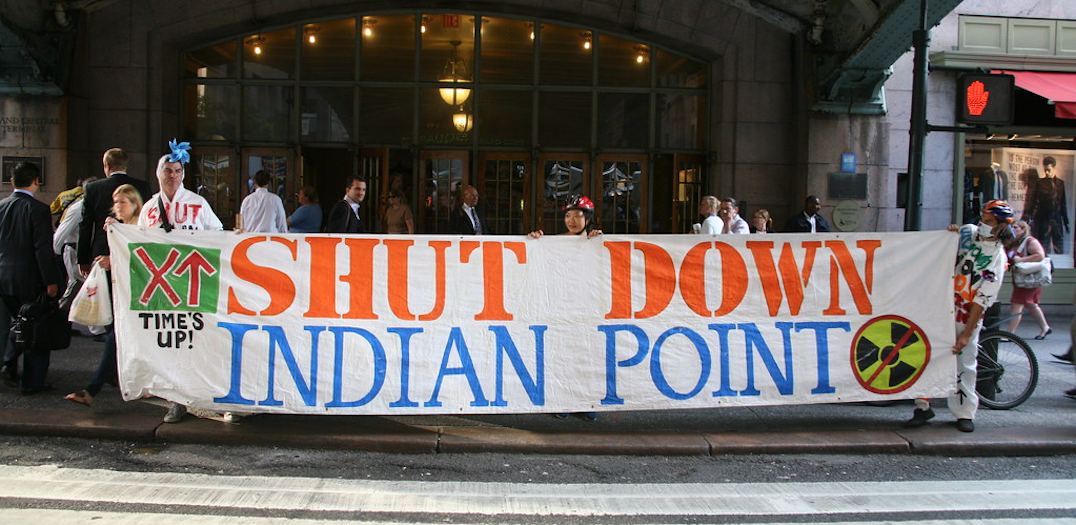
Analysis of closed reactors would reveal dangers of those still operating
By Linda Pentz Gunter
The Indian Point reactors have had numerous problems and near-misses. A close look at Unit 2 would inform the safety status of reactors still running — and ought to prompt their shutdown as well, rather than extending operating licenses to 80 years.
The Indian Point Unit 2 nuclear reactor in New York closes down permanently on April 30. It is a moment replete with good news and golden opportunities that should not be wasted.
As Richard Webster, Legal Director for Riverkeeper, wrote recently in Gotham Gazette, “there will be no problem keeping the lights on when Indian Point closes.” But the question is, with what? Riverkeeper and others have launched a Beyond Indian Point campaign (a good choice of name!) which says that the electricity delivered by Indian Point will be replaced by renewables.
But will, or could be? Despite a ban on fracking in the state, New York still imports fracked gas from Pennsylvania. It is processed at a recently opened giant fracked gas power plant at Wawayanda, just 53 miles from New York City. The plant faced strong local opposition and acts of non-violent civil disobedience, including by actor and Beyond Nuclear supporter, James Cromwell.
There has also been opposition to “A massive, 42-inch, high-pressure gas pipeline [that] was built under the property of Indian Point to carry fracked gas to Canada for export,” posing risks even after Indian Point closes, since its inventory of high-level radioactive waste will remain on site.
So while, even before closing the plant, New York had already made “considerable progress toward replacing Indian Point with demand reduction, additional transmission, and new renewables,” as Webster wrote, Beyond Indian Point has set out to ensure that the Indian Point electricity is indeed replaced by a mix of renewables, energy efficiency and conservation.
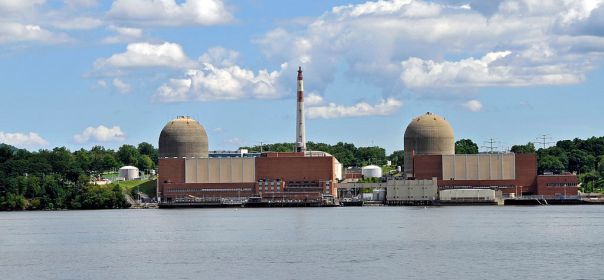
Indian Point has been dubbed “Chernobyl-on-the-Hudson.” (Photo: Tony Fischer/Wikimedia Commons)
The women who told Chernobyl’s story

And the charity that sees those consequences first hand
By Linda Walker
Three great women writers have done so much to tell the story of Chernobyl. Their focus was not on the accident itself, but its impact on the people of Belarus and Ukraine.
Alla Yaroshinskaya
When reactor No 4 at the Chernobyl Nuclear Power Plant blew up in the early hours of 26th April 1986, it threw millions of curies of radioactive materials into the air, forming a 2km high plume.
Amongst the most dangerous isotopes it released were iodine 131, caesium 137 and strontium 90.
But according to Alla Yaroshinskaya, a journalist whose tenacity was responsible for revealing much of the subsequent cover-up, the most dangerous substance to escape from the mouth of the reactor did not appear on the periodic table. It was Lie-86, a lie as global as the disaster itself.
She visited towns and villages in northern Ukraine 18 months after the accident. The head of the local department of child health told her that they had not found any problems linked to radiation, or any thyroid problems. She had just visited doctors who told her that 80% of the children in their district had thyroid problems.
On land contaminated to less than 15 curies sq/km, agriculture continued as normal. The land in the UK from which farmers could not sell their lambs was contaminated to less than 1 hundredth of this level.
People who continued to live on contaminated land were given extra money for food and free medical care and better pensions, sometimes called the ‘coffin allowance’. Villagers in Ukraine signed an undertaking not to drink milk from their cows, but they were not provided with any clean milk or meat.
(You can watch a three-part interview with 1992 Right Livelihood award winner, Alla Yaroshinskaya below)
Stalking Chernobyl
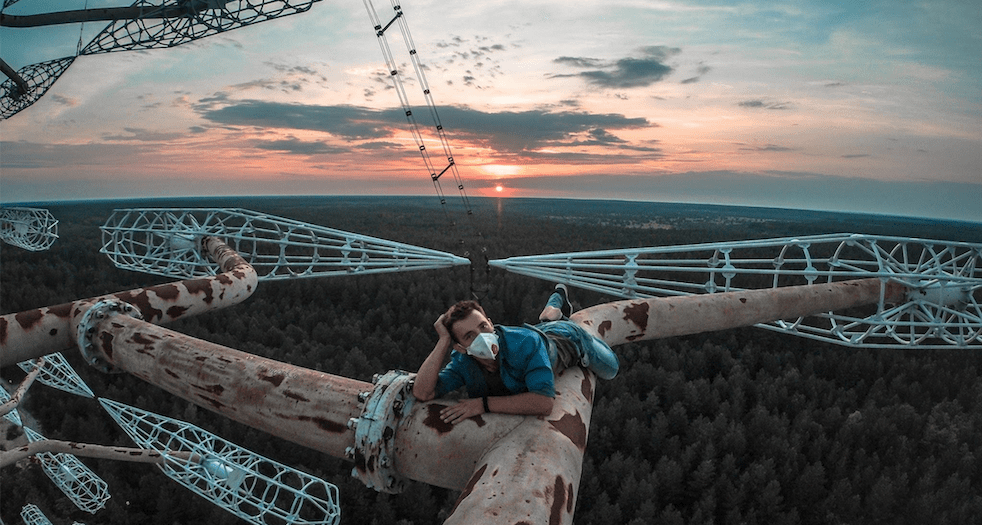
Where a dose of adrenaline matters more than a dose of radiation
By Linda Pentz Gunter
Chernobyl is a place of loss and abandonment. The Zone is radioactive. So why do people flock there today? Iara Lee’s fascinating documentary goes with them to find out, and reminds us about life there before the April 26, 1986 nuclear disaster.
For most of us, Pripyat — the Ukrainian city that has become an iconic symbol of forced abandonment — summons images of drab, Soviet decay. Pripyat is a place of ghastly tower blocks, rusting playgrounds, a deserted Ferris wheel and peeling paint, its workforce trudging like automata to toil at the doomed Chernobyl nuclear power plant just 2.5km away.
But in the opening sequence of Iara Lee’s new documentary — Stalking Chernobyl; exploration after the apocalypse — we see a very different Pripyat, before the April 26, 1986 nuclear disaster. It is a place of singing and roses, swimming pools and picnics, and dancing babushkas.
And then, as someone in the film says, “On April 26, what had once been our pride became our grief.”
As we now know, and as the film reminds us, the residents of Pripyat did not fully understand the scope of the accident. They were told over an official loudspeaker announcement, with classic Soviet obfuscation, that “an unfavorable radiation environment is forming.” They packed up a few possessions and some food and left, forced into an evacuation that would endure not only for their own lifetimes, but for those of their descendants as well.
At the heart of Lee’s vivid and compelling film is a firsthand look not at those who fled, but at those who feel compelled to journey into the Chernobyl Zone — whether officially as tourists, or illegally as “stalkers” or aficionados of extreme sports. They are an eccentric, often misinformed bunch, in particular the stalkers, most of whom are young men and some of whom appear to be embarked on a kind of vodka-fueled macho right of passage.
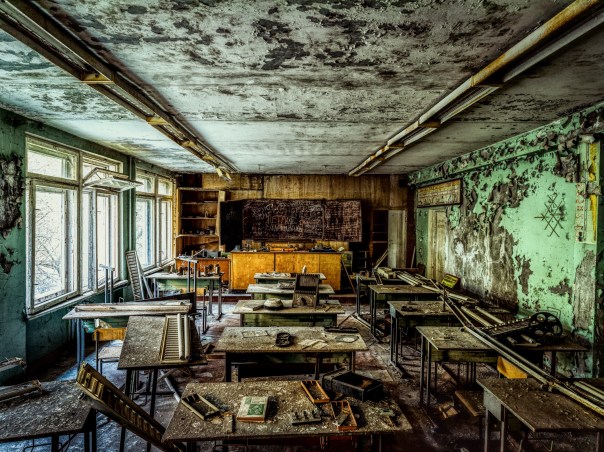
Schoolroom in the Zone. (Photo by Thierry Vanhuysse, courtesy Cultures of Resistance Films)
But there are others who are appalled at the desecration of what they see as a mausoleum. As one young man notes, visitors to Chernobyl are staging scenes, bringing in their own props, and posing for gleeful selfies in a place that represents profound loss to those forced to abandon their homes and to those whose family members died during their heroic sacrifice as liquidators.
“They are destroying something that should be untouched,” he says.
Farewell Fessenheim, finally
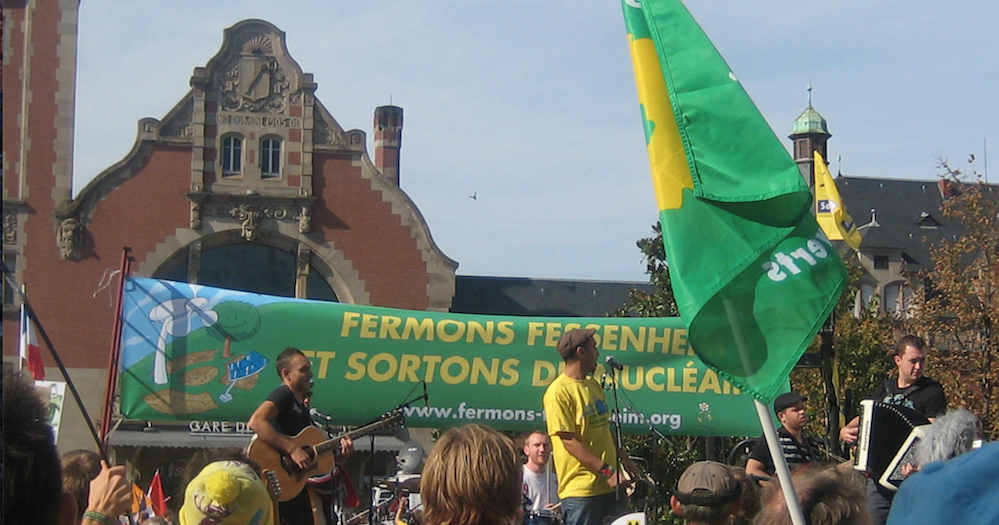
The long fight to close French nuclear plant ends in relief rather than victory
By Linda Pentz Gunter
France’s two oldest reactors are finally closing. But their waste inventories sit perilously in pools adjacent to a canal, in a seismic area and on top of Europe’s largest groundwater source. Consequently, the Stop Fessenheim movement isn’t closing its doors.
On a sunny October day in 2009, a French border town was put under siege. There was no virus, but there was an invasion of sorts.
Protesters against the continued operation of the Fessenheim nuclear power plant were streaming into town. French authorities weren’t worried about their own citizens, but what they really feared were “rioting” Germans.
We were in Colmar, a town in Alsace, a region that has historically been a source of conflict between France and Germany for more than a century, changing hands several times until finally becoming French again in the waning days of World War II.
Possibly unaware of this, but maybe guilty of watching too many news clips of German protesters at Gorleben, the French police locked Colmar down.
The original protest site in the central Place Rapp was moved to one on the fringes of town adjacent to the station.

The German protesters turned out not to be as fierce as French authorities feared. (Photo: Linda Pentz Gunter)
Helicopters circled overhead, police with dogs (yes, Alsatians) blocked intersections, and trucks with the word “horses” plastered on them idled in side streets.
On the morning of the protest, the only place to get a cup of coffee was in the local butcher shop. Everything else was closed. When the French close their cafes, you know something serious is going on.
If we can tackle corona, why not climate?

What the pandemic can teach us about changing our ways
By Alex Kirby, Climate News Network
Societies worldwide are changing overnight to meet the coronavirus threat. The climate crisis should match the rapid pandemic response.
If you want to know how fast a modern society can change, go to most British town centres and see the pandemic response. They will be unrecognisable from what they were 10 days ago.
You’ll see far fewer pedestrians, now sheltering from coronavirus infection at home, far fewer vehicles, hardly an aircraft in the skies above. The familiar levels of urban noise have faded to a murmur. The usual air pollution is dropping fast, with reports of significant falls from not just the UK but China and northern Italy as well.
So we can change when we decide to, and a pandemic demands change that’s both radical and rapid. But pandemics are not unique in that respect: there’s something else on the world’s agenda that’s crying out for action to match what’s happening today.
Dieter Helm is professor of economic policy at New College, University of Oxford. He writes in the latest entry on his site: “The coronavirus crisis will come to an end even if coronavirus does not … What will not be forgotten by future historians is climate change and the destruction of the natural environment.” What can we learn from this crisis that will help us when it’s over?

Dieter Helm says that while the coronavirus crisis will end, historians will not forget our inaction on climate change. (Photo: Policy Exchange/Wikimedia Commons)
The wrong crisis stopped the Olympics

Radiation risks couldn’t kill the Games, but Covid-19 has
The Japanese government allowed 50,000 people to cluster around the Olympic flame, then hesitated to postpone the Games, until the IOC (and a reluctant Abe) called them off until 2021. Now those concerned about the persistent radiological contamination, which could harm athletes and spectators, have one more year to organize to stop the Tokyo Olympics altogether.
By Linda Pentz Gunter
On Saturday, March 21, 50,000 people queued up at Sendai station to see the Olympic flame displayed in a cauldron there. Packed together, not all of them wearing masks, the eager spectators waited as long as three hours to glimpse a flame that should have been extinguished in Japan months ago.
Sendai is just 112 kilometers up the Japanese coast from the stricken Fukushima-Daiichi nuclear reactors that exploded and melted down on March 11, 2011.
Around the same time that those 50,000 people, and the authorities who govern them, failed to take the novel coronavirus pandemic seriously, Japan’s prime minister, Shinzo Abe, was making lukewarm noises about maybe possibly postponing the Olympic Games.
After some skillful negotiating designed to spare Japan embarrassment, that decision was finally made on March 24, when the International Olympic Committee, and the Abe government, each announced that the Games would be postponed until the summer of 2021.

The 50,000 who queued to see the Olympic torch in Fukushima will not see Japanese Olympians or any others this summer. (Photo: Kyriazis/Creative Commons)
Yes, it was beyond stupidity to have continued contemplating an event that would have brought tens of thousands of corona-carrying athletes and spectators to Tokyo and beyond. But it was worse that the persistent radiological contamination of Japan in the now 9-year long aftermath of the Fukushima nuclear disaster didn’t cancel the Games months ago. Or better still, disqualify Japan’s bid in the first place. Things in Japan won’t be significantly better in that regard one year from now. But radiation remains untouchable as a topic.
 Beyond Nuclear International